
Highlights
- We encourage our generation to be brave, take chances, and play the dating-game. Post This
- New relationship models like “situationships,” and “just talking” phases have normalized undefined commitment, harming dating culture. Post This
- Rather than jumping into life’s next milestone and figuring things out as they go, Gen Z turns inward, hoping to improve themselves in isolation before stepping out onto the stage. Post This
“Gen Z might just be the most risk-averse generation on record.” These are the sentiments expressed in a 2024 article titled “What Are We?" by Emma Camp. She paints a grim dating landscape for young adults, where one must risk a lot—rejection, embarrassment, heartbreak—in pursuit of a romantic interest. Indeed, Camp's hypothesis has been accurately reflected in recent dating shifts: 80% of Baby Boomers had their first romantic experience by their late teens, while 3-in-10 Gen Z adults report never even going out on a romantic date. Moreover, nearly 90% of 12th graders in the 1980s were going on dates at least occasionally, but by 2024, this number had tanked to a mere 46%, according to a recent IFS analysis of the Monitoring the Future study.
To those following the cultural conversation about Gen Z, these trends are not surprising. In light of decreasing socialization with friends and a troubling loneliness epidemic, the fact that dating is down may seem like a natural consequence for a generation immersed in the digital world since adolescence. However, a new Institute for Family Studies and Wheatley Institute report reveals a deeper and more complicated incongruency in young adults about desire and actualization.
The Dating Recession finds that only about 1-in-3 young adults (ages 22-35) who are interested in marrying someday are actively dating (defined as dating once a month or more). Overall, a staggering 74% of unmarried young women and 64% of unmarried young men report either never having gone on a date or dating only a few times in the last year.
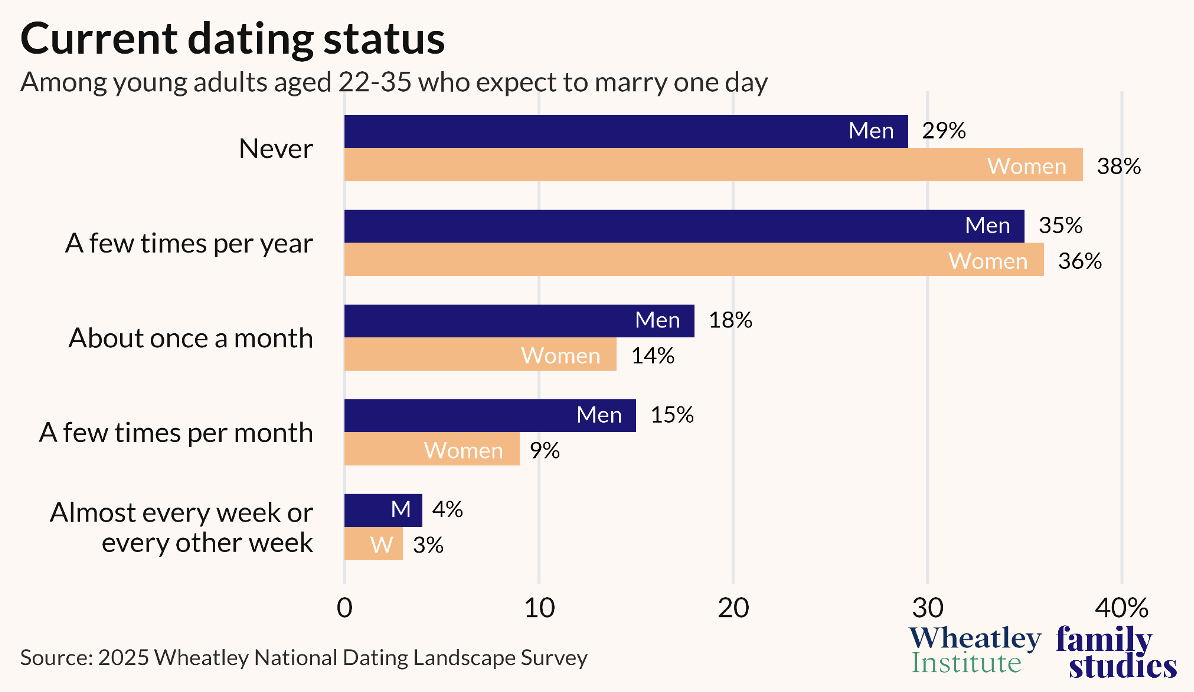
Despite this dating recession, the IFS/Wheatley report also reveals a generation hungry for deep and genuine connections. Young men and women alike strongly endorse a more formal dating culture centered on forming serious relationships (74% of young men and 83% of young women) and creating emotional connections (76% of young men and 83% of young women). In addition, over half of the survey respondents express interest in starting a relationship.
So, interest in romance is high, yet only 31% of young adults report dating either casually or exclusively. What accounts for this discrepancy?
A serious lack of confidence.
A Lack Confidence in Dating Skills
Overall, only about a third of young adults who expect to marry express much faith in their dating skills. When asked if they felt confident when approaching someone they are interested in, only a quarter agree (29% of young men and 21% of young women).
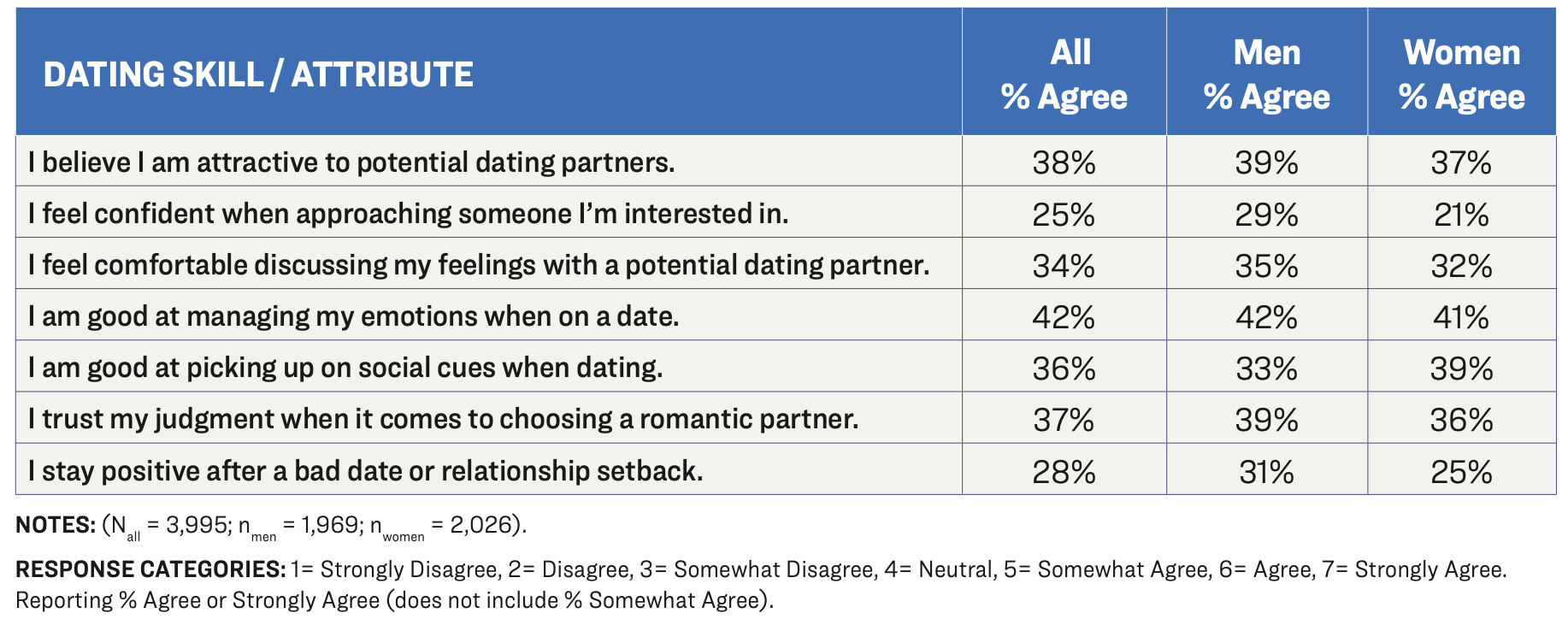
Emotional factors are compounding this lack of confidence. No more than about one-third of young adults say they feel comfortable discussing their feelings with a potential dating partner, and well under half (42%) say they are good at managing their emotions on a date.
Additionally, dating resilience is low. Almost half of respondents expressed that bad dating experiences in the past have gotten in the way of their current dating life. Only about a quarter (28%) report that they can stay positive after a bad date or relationship setback, while more than half (55%) agree that their breakups have made them more reluctant to begin new romantic relationships.
Confidence and risk-taking are critical building blocks to a healthy dating culture and a flourishing society.
It’s not “breaking news” that young adults are struggling with self-confidence. Generation to generation, growing up and finding one’s place in the world has never been an easy task. What is new, however, is that this common area for growth is acting as a barrier rather than a catalyst for maturation, especially in the dating culture. Rather than jumping into life’s next milestone and figuring things out as they go, gaining confidence and identity on the way, Gen Z turns inward, hoping to improve themselves in isolation before stepping out onto the stage. We have already observed this in modern marriage culture, where the average age to marry has increased to almost 29 for women and over 30 for men. Nowadays, most young men and women are unwilling to even entertain marriage until they feel they’ve reached an often unrealistic degree of readiness, whether that be emotional, social, or financial—sometimes delaying marriage and having children unnecessarily. And now we are observing this reluctance in dating culture.
4 Tips for Marriage-Minded Young Adults
What can young adults do to defy the downward dating trend? As Gen Zers ourselves, we have four simple recommendations for those who desire a lasting relationship.
1. Pursue Mature Friendships
One of the most formative decisions for many young adults is the choice of friends. For individuals who want serious commitment, the most prudent course of action is to intentionally surround himself/herself with others who share the same aims. Not only does this increase one's likelihood of finding a possible partner, merely by association, but more critically, it encourages the maturity and healthy habits necessary to eventually form long-term romantic relationships. Young adults—especially those who report low emotional and self-confidence levels—would greatly benefit from the self-reflection and vulnerability brought about by true and mature friendship.
2. Seek New Environments and Novel Activities
Start new hobbies. Young adults should expand their social sphere by engaging in new interests. Brett Cooper recently discussed how run clubs are the new “dating apps.” Exploring new social circles and clubs are great ways to meet people and work on social dexterity. While this recommendation may seem simple, it speaks to the deeper obstacle young adults have difficulty hurdling: risk. As Cooper put it, repeatedly engaging in these low-stakes environments acts as a school to learn the necessary social skills and modest risk-taking that facilitates romantic connections.
3. Don’t Be Afraid to Say “Yes” or to Be Told “No”
Dating requires decisiveness. Both of us have seen how many relationships stall and flounder due to lack of resolution. New relationship models like “situationships,” and “just talking” phases have normalized undefined commitment, harming dating culture. These trends may seek to ‘protect young adults from rejection,’ but they ultimately encourage prolonged timelines and uncertainty, leaving participants frustrated and unsatisfied. We encourage young adults to counter these harmful habits by prioritizing clarity and polite forwardness when approaching the dating scene. Regardless of the outcome, both parties are better off when the desire to date or not to date is clear.
4. Don’t Expect Perfection
Social media and popular entertainment have given this generation of young adults unrealistic dating expectations. Be forgiving of your own flaws and those of others. Don’t be too quick to designate “red flags” and shut down a possible connection. Be generous with second and even third chances. You may be surprised what—and who—you find when you don’t confine yourself to your conception of a “dream partner.”
Confidence and risk-taking are critical building blocks to a healthy dating culture and, more critically, to a flourishing society. All relationships require vulnerability—romantic relationships especially. If, as this new IFS/Wheatley report finds, young adults are no longer willing or even able to develop these crucial connections, long-term family formation is in danger. We encourage our generation to be brave, take chances, and play the dating game.
Autumn Zeoli is an intern at the Institute for Family Studies and a Master of Public Policy Candidate at the University of Virginia. Sophie Anderson is Research Coordinator and Assistant Editor for IFS Insights at the Institute for Family Studies.
*Photo credit: Shutterstock


