Highlights
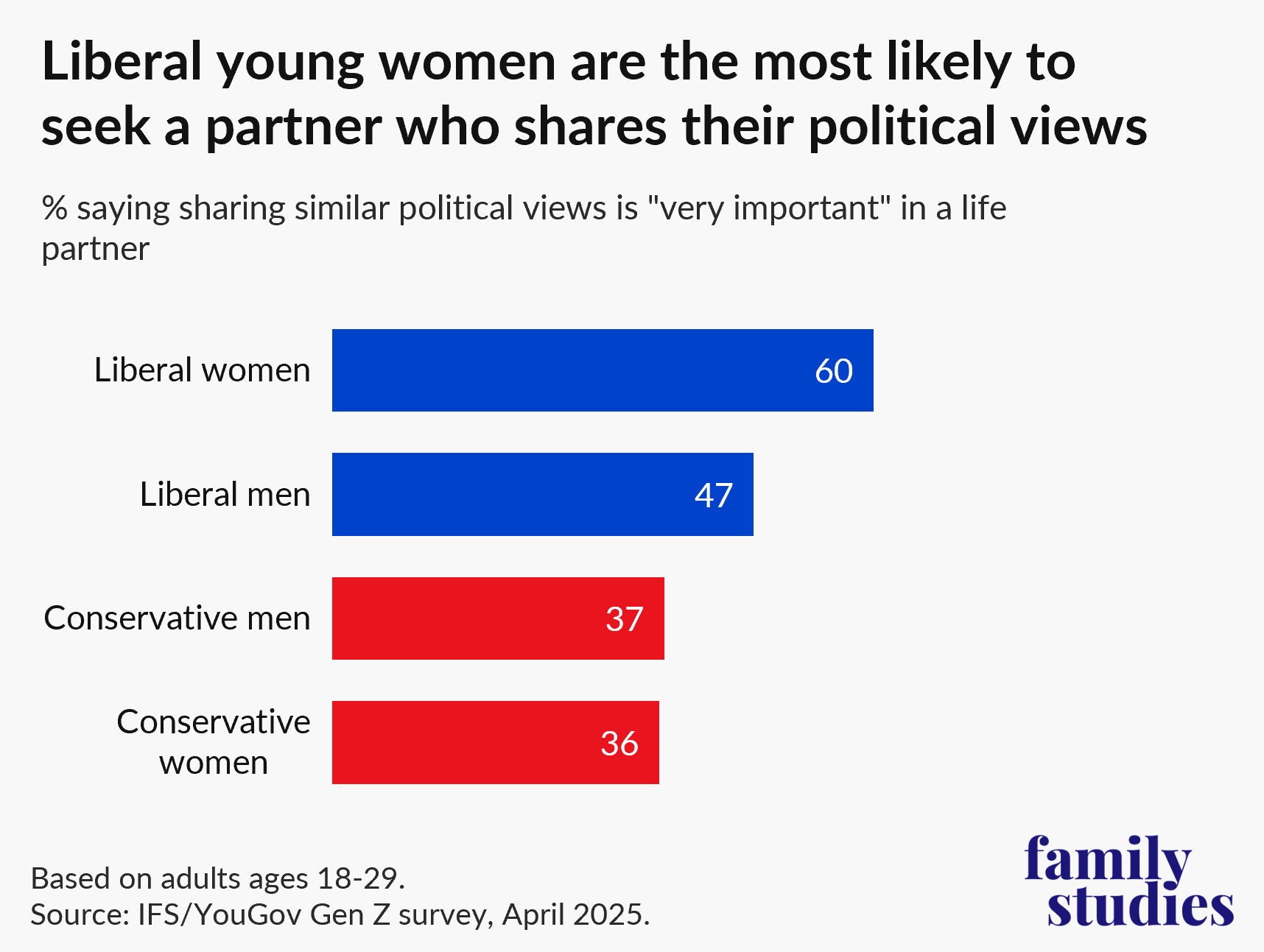
- Liberal young women value shared political views more than a partner’s stable job. Post This
- More than 70% of young men say that men should protect women, and a similar share of young women agree. Post This
- Out of 10 qualities in a life partner—ranging from being kind to sharing political views—young women place a higher value on 8 of these qualities than young men do. Post This
The dating scene for today’s twenty-somethings is messy. With young women increasingly turning left, and young men turning right, tensions between the opposites sexes are running high. “Love is an online battlefield,” as a recent WSJ article put it.
Adding to the uncertainty, a recent Pew analysis of data on 12th graders suggests that girls’ desire for marriage has declined significantly over the past 30 years, while boys’ interest has remained unchanged. For the first time since the 1970s, high-school girls are now less interested in marriage than boys.
To be fair, a sizable share of highschoolers in the same survey said that they had no idea about their marriage prospects in the long run, and their views will likely change as they move on to college, work, and adulthood. And marriage remains highly valued among young adults today: the vast majority would like to marry. But the reality is that dating and marriage prospects are increasingly fragile for today’s young adults, and men and women seem to be drifting further apart.
When it comes to romantic relationships, do young men and women agree on anything these days? How does ideology shape the dating landscape?
Where Gen Z Men and Women Agree
Surprisingly, Gen Z men and women are largely aligned when it comes to dating and gender norms, according to a new Institute for Family Studies/YouGov survey of young adults ages 18 to 29.1 While both men and women lean toward a more egalitarian approach to dating and marriage, they also agree on keeping one traditional expectation for men: protecting women.
First, a majority of young adults no longer expect men to lead in dating and to pay for dates. About 6 in 10 Gen Z men and women say that dating responsibilities, including paying for dates, should be shared equally, while about 40% say men should cover the bill. There are virtually no gender differences on this question.
About 6 in 10 Gen Z men and women say that dating responsibilities, including paying for dates, should be shared equally.
Second, the traditional “men as breadwinner and women as caretaker” model is not what most of Gen Z believes. Instead, more than 80% of Gen Z women and 68% of Gen Z men say couples should divide work and home responsibilities in whatever way works best for them. Though young men are more likely than young women to say that it is better if men focus on breadwinning (32% vs. 18%), this view is still a minority position even among young men.
But traditional gender roles are not completely forsaken by the younger generation. More than 70% of young men say that men should protect women, and a similar share of young women agree. Only 26% of women say that “women don’t need protection from men.”
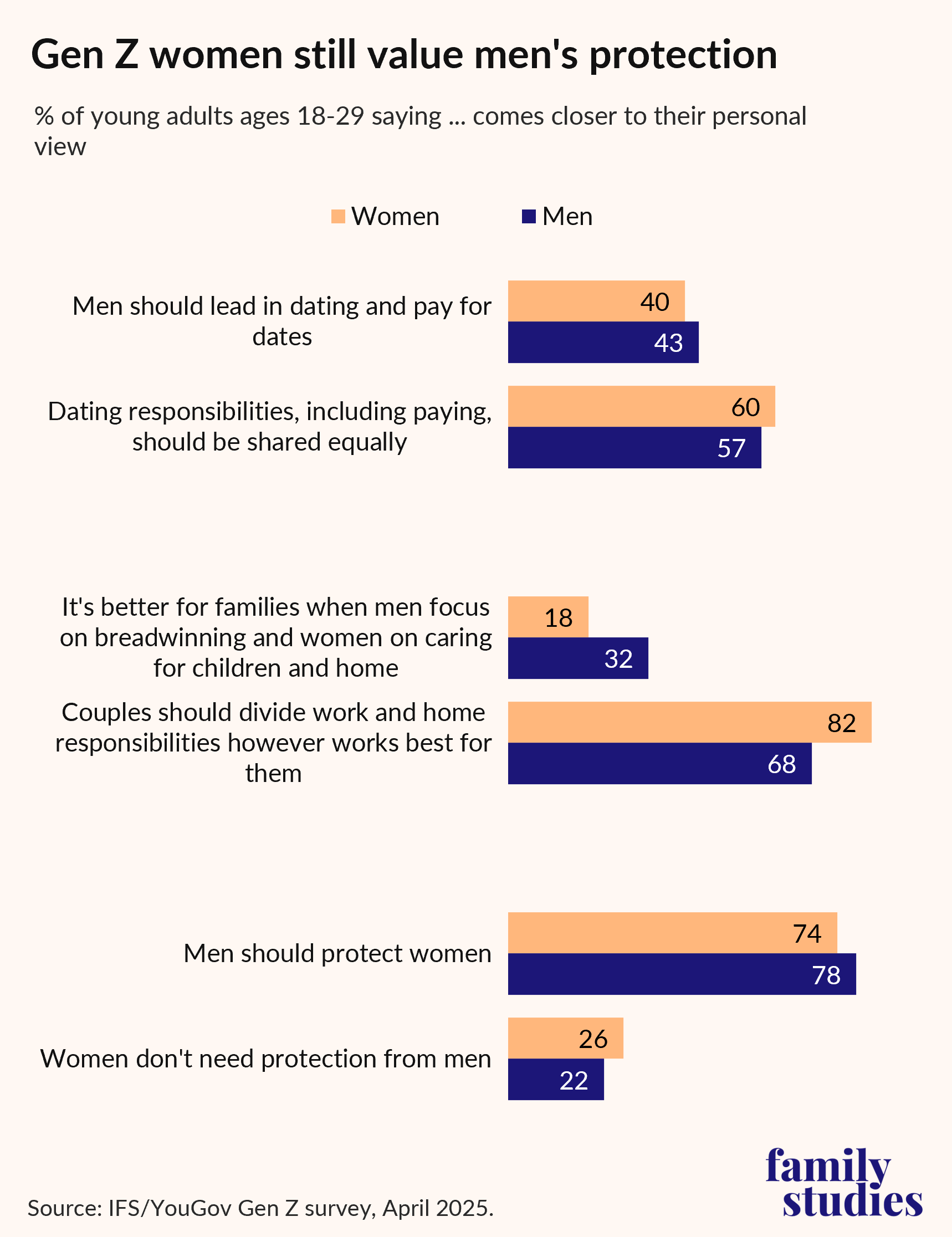
There are large ideological differences. Liberal young adults are less likely than their conservative peers to endorse traditional gender roles. For example, only one-third of liberal women say men should lead and pay for dates, compared with nearly 60% of conservative young women. The corresponding shares among young men are identical. However, even among liberal young women, a majority (64%) still believe that men should protect women. (Please see our interactive charts for more findings in the Appendix below).
Young Women Are “Pickier” Than Young Men
We often hear that one of the reasons it is hard to find the right partner is that women are pickier than men. Well, there is some truth to this.
The IFS/Gov survey shows that out of 10 qualities in a life partner—ranging from being kind and having a sense of humor to sharing political views—young women place a higher value on 8 of these qualities than young men do.2 The biggest gender difference occurs in two qualities. Gen Z women are much more likely than young men to place a high value on “sharing ideas about having and raising children” (73% vs. 54%). They are also more likely than men to say having a stable job is very important in a life partner (58% vs. 40%).
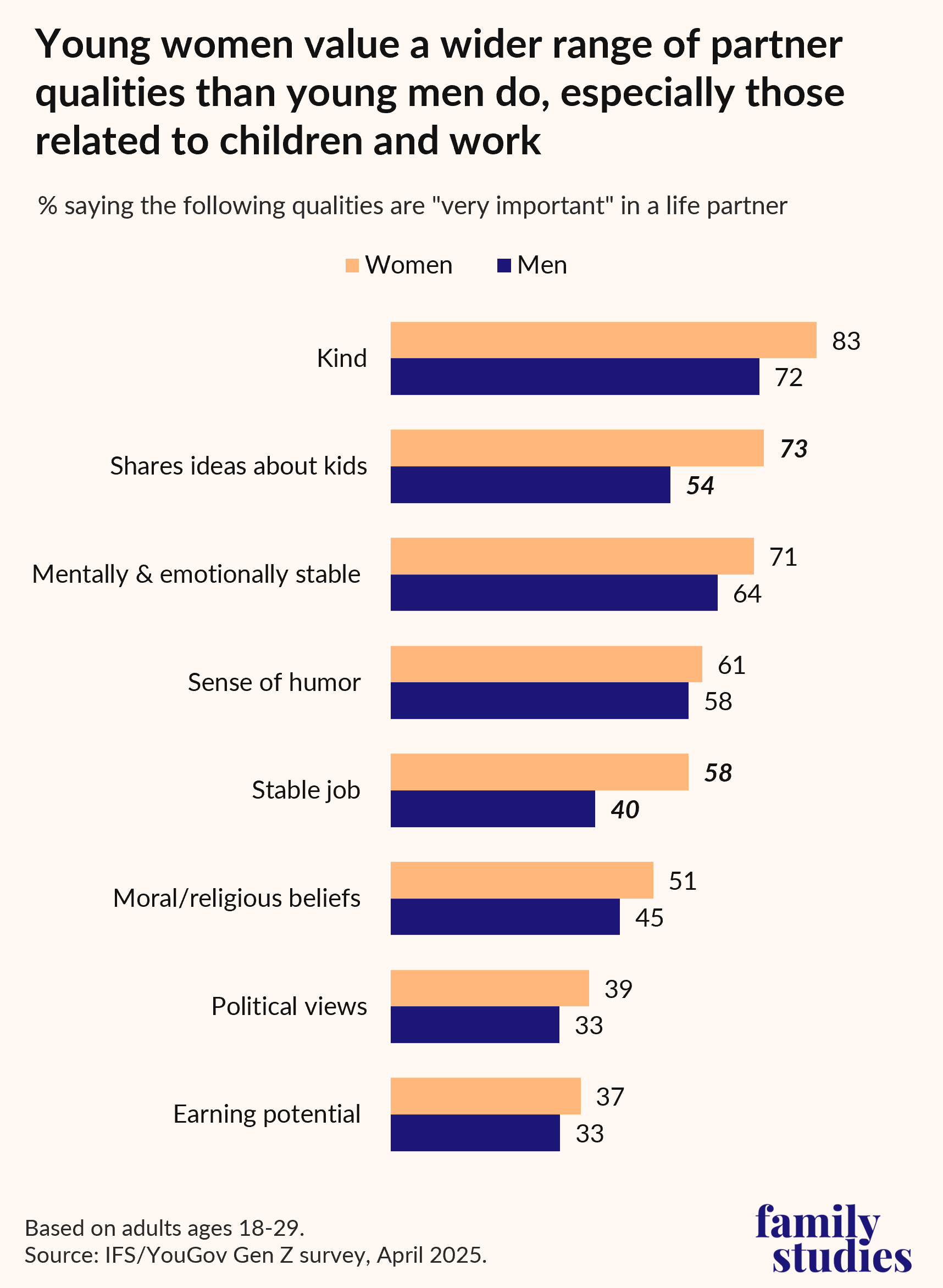
Young women’s top priorities in a partner include someone who is “kind,” “shares ideas about kids,” and “mentally and emotionally stable.” Surprisingly, political views are far less important to women. Only 39% of young women say this is a “very important” quality in a life partner.
Young Men Value Attractiveness More
Gen Z men also value qualities like kindness and emotionally stability in a partner, but they are less likely than Gen Z women to rate most of these qualities as “very important.” However, this doesn’t mean they care less across the board. In fact, Gen Z men are “pickier” than women in two areas. Men are more likely to say that confidence is a very important quality in a life partner (53% vs. 44%), and they also place a higher value in a partner’s physical attractiveness (39% vs. 30%).
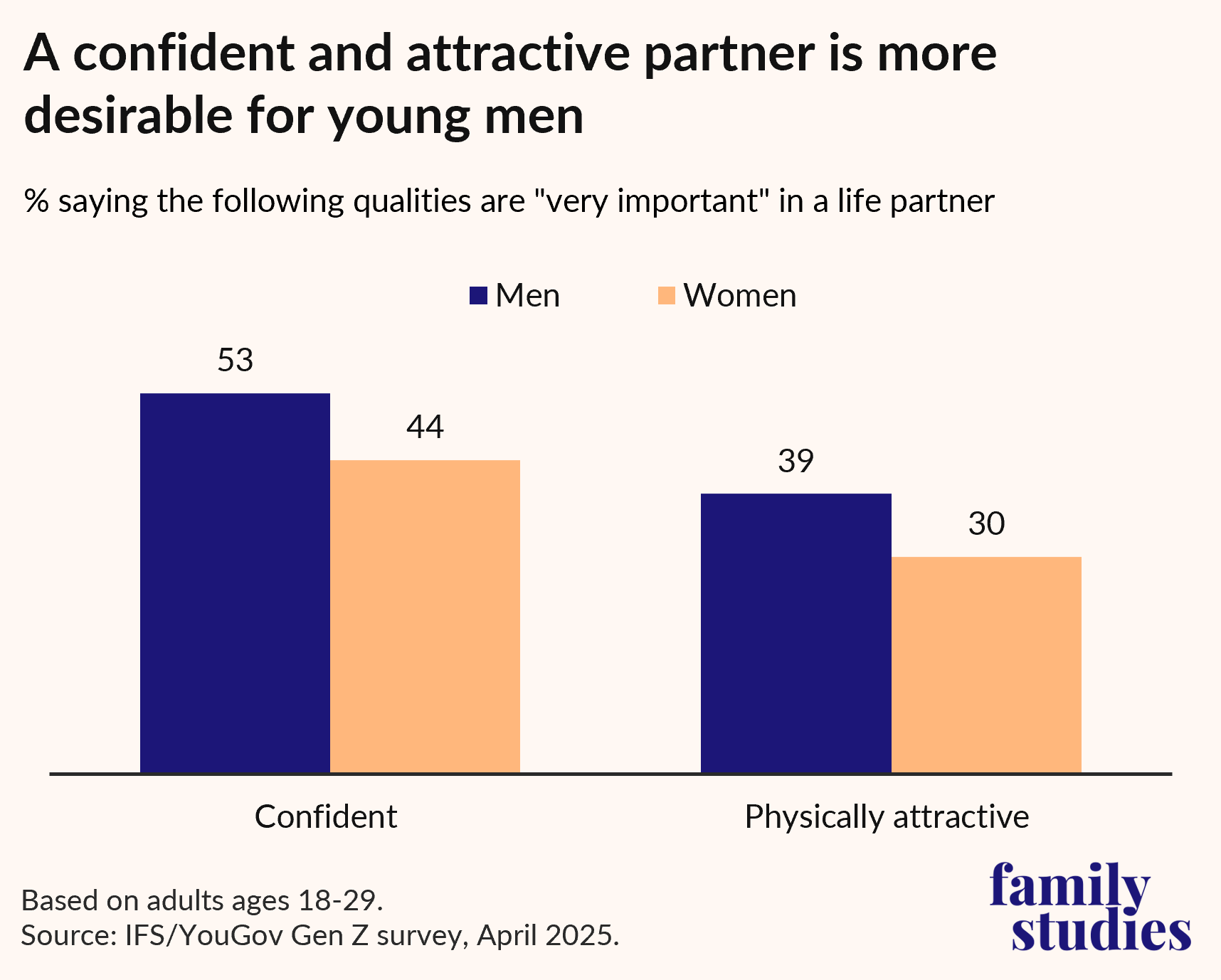
It is not surprising that men place a higher value on their partner’s appearance, but the emphasis on confidence is something new. Previous research by IFS Senior Fellow Lyman Stone finds that high-status men (measured by education and income) tend to marry similarly-aged, highly-educated (and high-earning) women. Basically, they are not “turned off” by ambitious women. So, it is possible that confidence is becoming a more attractive trait for young men these days.
To be clear, both confidence and physical attractiveness rank much lower than other key qualities young men are seeking, such as kindness and mental and emotional health, but these are the only two traits in the survey that matter more to young men than to young women.
Ideological Differences in What Gen Zers Want in a Partner
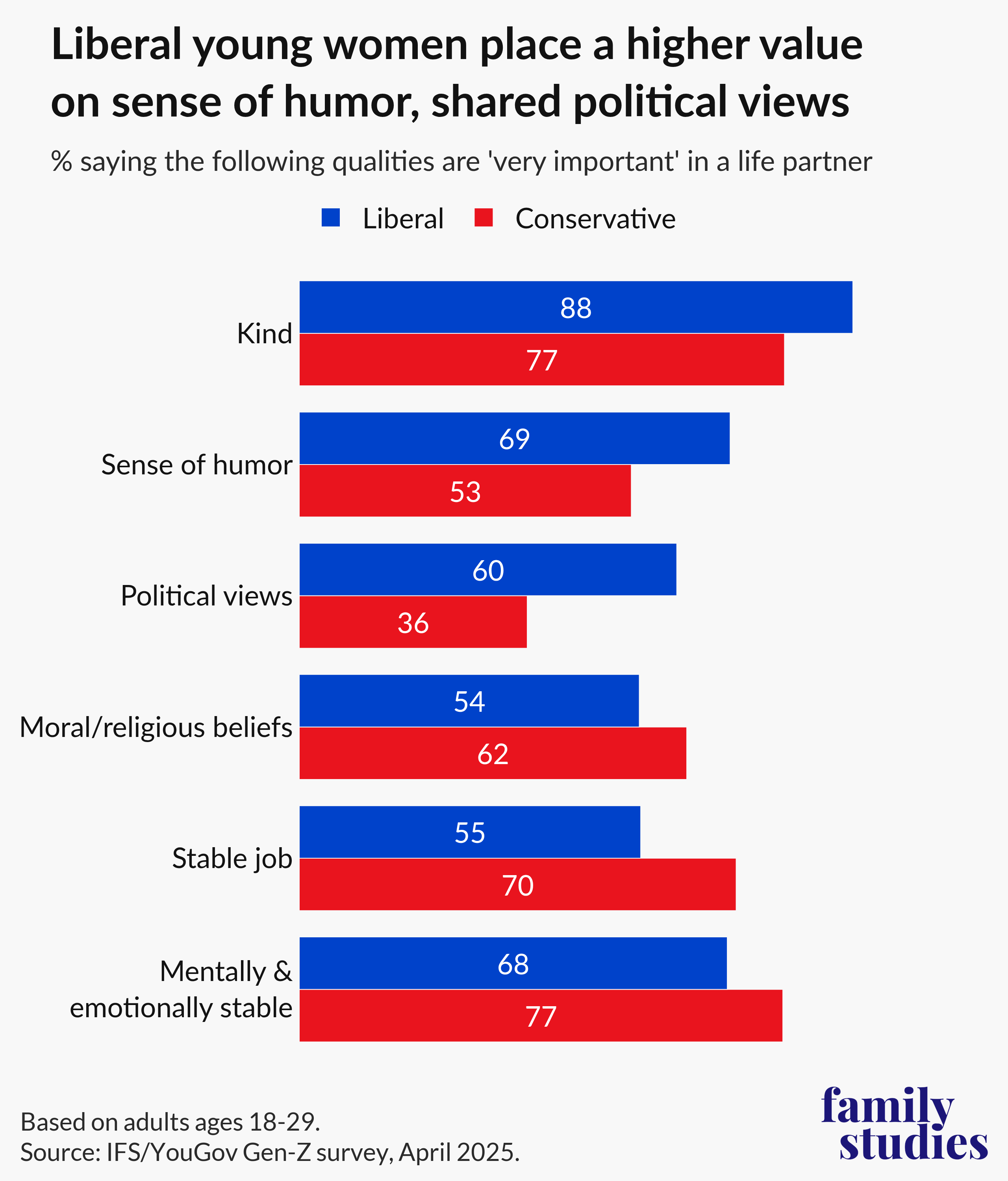
Political compatibility is often seen as a crucial aspect of modern dating, but a further look by gender and ideology reveals a striking patten. This is also the area where the ideological differences are the largest: liberal young women are most likely to value a partner who shares their political views.
Among young liberal women under age 30, a majority (60%) say that finding someone who shares similar political views is “very important,” compared with less than half of liberal men (47%), and a much lower share of conservative young men and women.
In fact, liberal young women value shared political views more than a partner’s stable job. Political alignment also ranks higher than shared moral or religious beliefs (54%), a partner’s confidence (41%), or earning potential (32%). In contrast, political compatibility is one of the least important qualities for conservative young women when evaluating a life partner; it is ranked near the bottom of their list.
In addition to political compatibility, liberal and conservative young adults differ in some other areas in terms of what they value in a life partner. Specifically, liberal young women are more likely than their conservative peers to place more importance on finding someone who is kind, funny, and shares similar political views, while conservative young women place more value on a partner’s mental/emotional stability, whether he has a stable job, and shares similar moral or religious beliefs.
Liberal young men are more likely than conservative young men to value kindness, sense of humor, and shared political views in a life partner. In contrast, conservative young men place a higher value on finding someone who is confident, shares similar moral and religious beliefs, and is physically attractive.
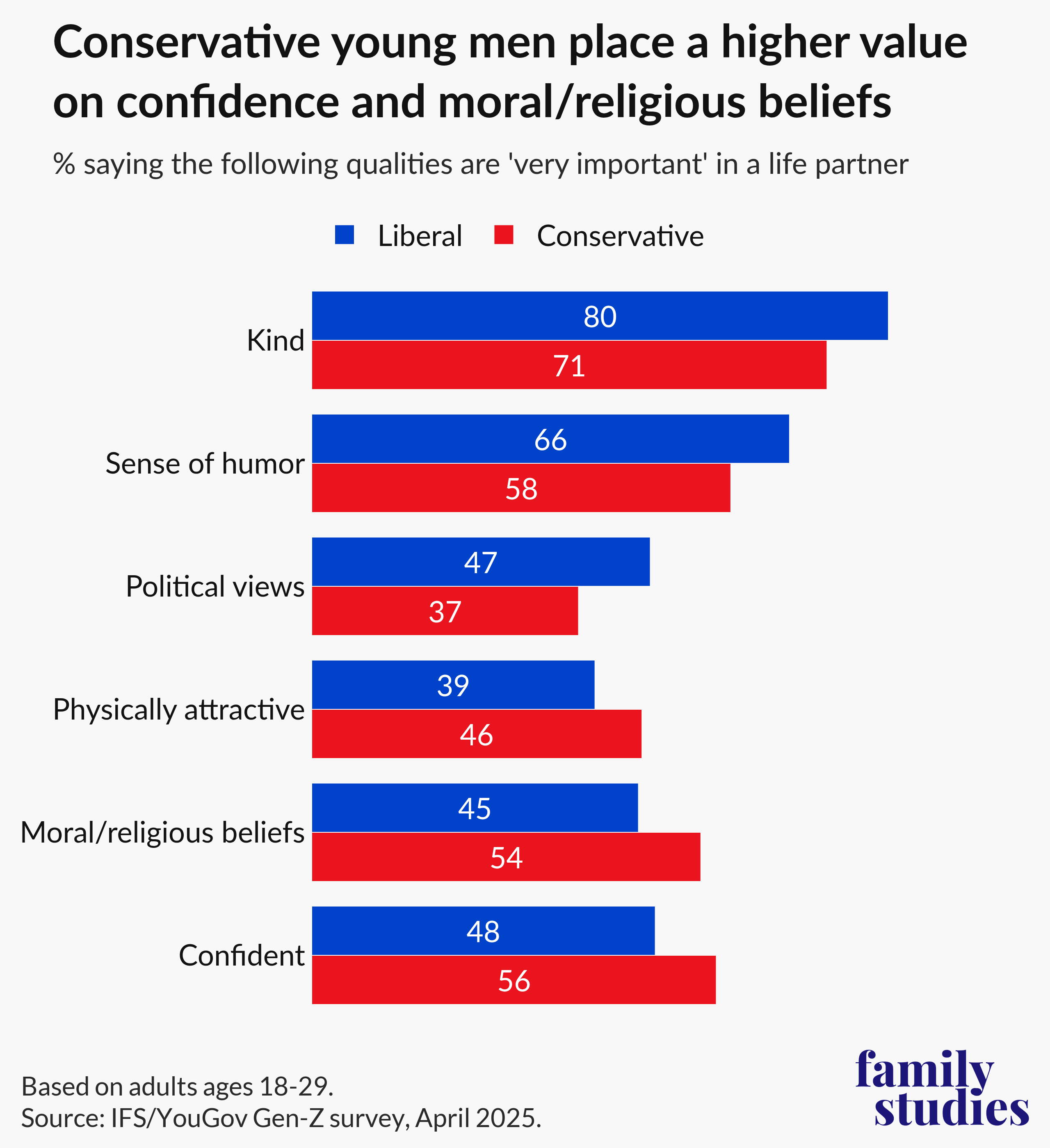
It is worth noting that qualities like kindness, mental, and emotional stability still rank higher overall than confidence or physical attractiveness for conservative young men. The comparisons here highlight only the specific traits where the differences between conservative and liberal young men are statistically significant.
Conclusion
Despite the widening ideological divide between young women and men today, Gen Z is not nearly as polarized in their relationship expectations as the headlines suggest. This IFS survey finds that a majority of young adults embrace egalitarian norms around dating, work, and family life. Yet most Gen Z women still want men to play the traditional role of protector—and young men agree.
As young women outpace young men in higher education, and more married women outearn their husbands, it makes sense that men’s breadwinning role is becoming less central to dating and marriage. Yet men’s role as a protector remains strong. Some could argue that this has deeper biological roots. As a survival instinct, men are biologically wired to protect women and their family. At the same time, men’s provider role appears to benefit both men and women. Previous research shows that men’s sense of being a protector is tied to healthier expressions of masculinity, better mental health, and greater family stability. And an earlier report from the Institute for Family Studies and the Wheatley Institute finds that having a protective spouse is a one of strongest predictors of a happy marriage, especially for women.
These findings suggest that Gen Zers aren’t turning away from relationships or marriage; they are just navigating them with a mix of new and old norms.
Meanwhile, young men and women do differ in what they prioritize in a long‑term partner. Overall, young women are “pickier” than young men across most qualities, from kindness to earning potential, with the largest gaps appearing around children and jobs. Women place much more weight on shared ideas about children and a partner’s job stability. In contrast, young men are more selective about just two traits: confidence and physical attractiveness.
Even though shared political views can feel like a deal breaker today, these findings suggest that most Gen Z men and women do not place a high value on political compatibility in a life partner. Only 39% of young women say this is a “very important” quality in a life partner, along with 33% of young men. The exception is liberal young women, who are the most selective about finding a partner who shares their political views (60%).
Ideology also shapes differences in other qualities young adults value in a partner. In addition to political compatibility, liberal young women are more selective about kindness and a sense of humor, while conservative young women place more emphasis on mental and emotional stability, a stable job, and shared moral or religious beliefs. Young men report ideological differences as well, though less sharply.
Taken together, these findings suggest that Gen Zers aren’t turning away from relationships or marriage; they are just navigating them with a mix of new and old norms. Ideological differences add another layer of complexity, and when young adults on the right and left value different qualities in a partner, forming lasting unions can only become more challenging.
Wendy R. Wang is the Director of Research at the Institute for Family Studies and an expert on demographic trends, marriage, family, and well-being.
Editor's Note: *Interactives charts below created by Ken Burchfiel.
Appendix:
Interactive Charts
About the survey
The Institute for Family Studies Gen-Z survey was conducted by YouGov between April 7 and 15, 2025, with a representative sample of 2,000 men and 1,000 women ages 18 to 29 living in the U.S. The respondents were matched to a sampling frame based on gender, age, race, and education. The sampling frame is an 18-29 year old subset of a politically representative "modeled frame" of US adults, based upon the American Community Survey (ACS) public use microdata file, public voter file records, the 2020 Current Population Survey (CPS) Voting and Registration supplements, the 2020 National Election Pool (NEP) exit poll, and the 2020 CES surveys, including demographics and 2020 presidential vote.
The matched cases were weighted using propensity scores derived from age, gender, race/ethnicity, education, and region, grouped into deciles and post-stratified. The characteristics of the final weighted sample mirror those of the general U.S. population of men and women ages 18 to 29. Lesbian, gay, bisexual and transgender (LGBT) adults are included but are not analyzed separately. All estimates have been weighed to reflect the actual population.
1.Gen-Z refers to the cohort born between 1997 and 2012, whose ages currently range from late teens to late twenties. In this article, “Gen-Z” and “young adults” are used interchangeably.
2. The analysis is based on all young adults, regardless of marital status.