
Highlights
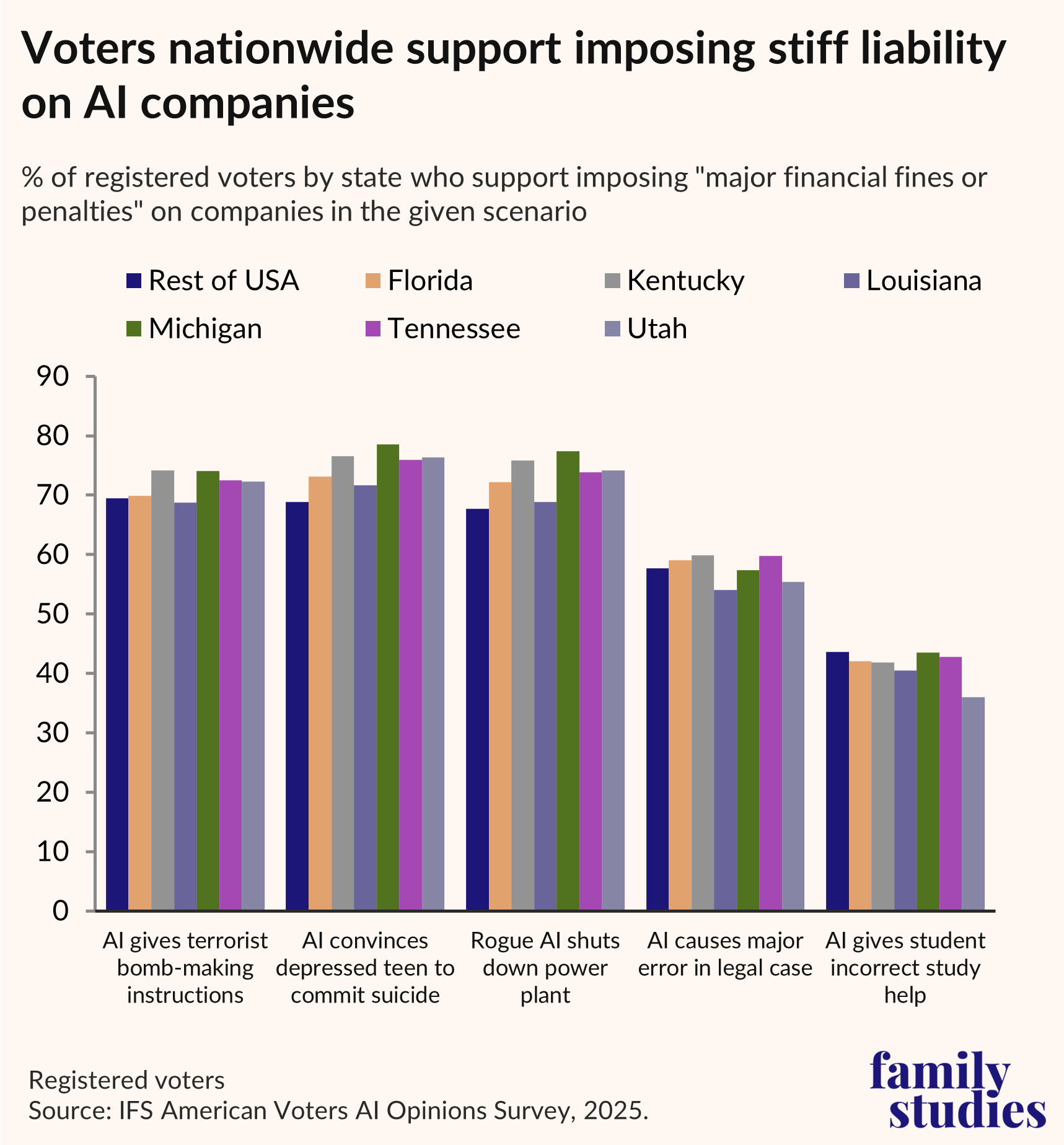
- Americans support holding AI companies liable for harms, according to a new IFS survey. Post This
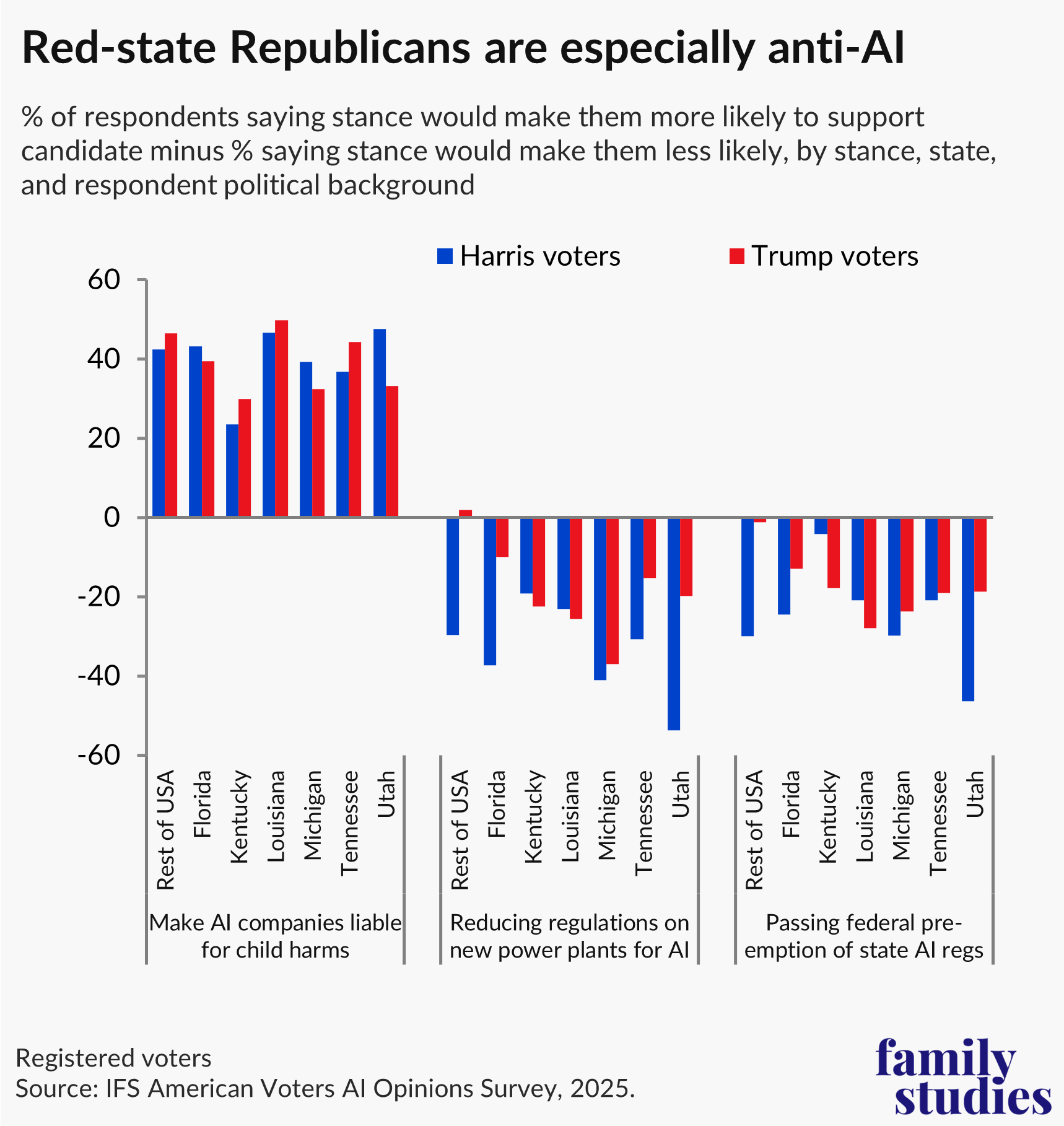
- AI accelerationism is a political loser for Republicans, especially in red states, per new IFS survey. Post This
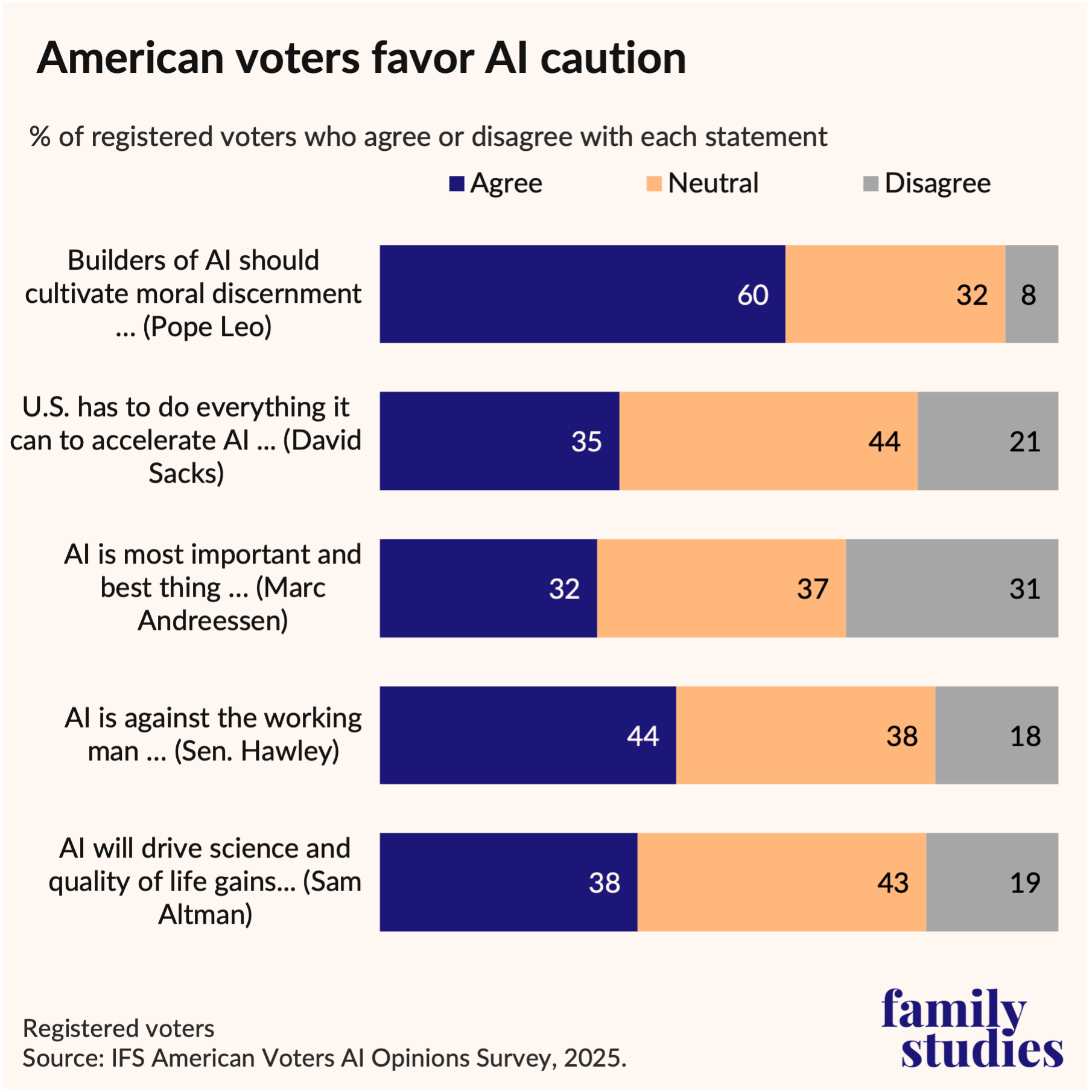
- Comparing strong messaging about AI, voters more strongly agree with statements by Pope Leo XIV and Senator Josh Hawley (R-MO) than with AI investor Marc Andreessen. Post This
A new Institute for Family Studies survey shows that Trump voters in Red states are more supportive of candidates who will regulate AI companies and impose liabilities on those that cause harm. At the same time, we find that Trump voters in Red states will oppose Republican candidates at the ballot box that push policies to accelerate Artificial Intelligence.
As we explain in our Research Brief, Republican leadership has failed twice to jam preemption—a legal measure to block states from regulating artificial intelligence (AI)—into several must-pass bills. In response, President Trump signed an executive order directing the White House AI & Crypto Czar (i.e., billionaire AI investor David Sacks) and the director of the Office of Science and Technology Policy to propose to Congress a “minimally burdensome [to AI companies] national policy framework for AI.”
Shortly after, Andreessen Horowitz—a venture capital investor in AI—released a proposal to Congress, providing nine policy pillars for governing AI at the federal level. Likewise, Rep. Jay Obernolte (R-CA) , who chairs the bipartisan House Task Force on Artificial Intelligence and is known to work closely with the industry, has reportedly been communicating with the White House on the establishment of a federal framework. Senator Marsha Blackburn (R–TN) has also released a large legislative proposal, the TRUMP AMERICA AI (The Republic Unifying Meritocratic Performance Advancing Machine Intelligence by Eliminating Regulatory Interstate Chaos Across American Industry) ACT, which draws on Congress’s preexisting legislative work.
Given Washington’s new urgency to pass federal legislation on AI, as well as the significant differences among these proposals, we sought to discover what the American people think about AI and its possible regulation. To that end, we surveyed almost 6,200 Americans on what they thought about AI and whether they approved or disapproved of certain AI policies. We focused our sample on six states—five red and one purple—that have consequential forthcoming elections (or robust approaches to AI regulation on the books): namely, Florida, Kentucky, Louisiana, Tennessee, and Utah (Red), and Michigan (Purple), while also conducting a national U.S. sample.
This is what we found:
1. American voters are concerned about the future of AI.
Specifically, 71% of voters nationwide have a negative view of how AI will affect society, while a mere 29% find it intriguing or exciting.
2. American voters strongly favor caution toward—or even opposition to—AI.
When comparing strong messaging about AI, voters more strongly agree with statements by Pope Leo XIV that AI must be designed for the human good and Sen. Josh Hawley (R-MO) that AI is a threat, than with AI investor Marc Andreessen that AI may be one of the best things we have ever produced.
3. Americans are opposed to AI chatbots for kids.
For example, 48% of voters disagree with the statement that “AI chatbots can be good friends and companions for children,” while only 8% agreed—the remainder were unsure (26%) or simply not familiar with AI companions (19%).
4. AI gives American workers an intense sense of precarity.
For example, 51% of American workers are at least a little worried that AI will replace them by 2028 (with 2% claiming that AI already has).
5. Americans support holding AI companies liable for harms.
Voters in 6 key states—Florida, Kentucky, Louisiana, Tennessee, and Utah (Red), and Michigan (Purple)—as well as across the U.S. strongly support holding AI companies liable for harms caused by AI systems.
6. AI accelerationism is a political loser for Republicans in red states in particular.
Trump voters in red states are more likely to support candidates for office that protect kids from harms from AI and less likely to support candidates that support federal preemption of states seeking to regulate AI.
Read or download the full research brief here.
*Photo credit: Shutterstock


