Highlights
- The link between religious practice and healthy marriage is a well-established empirical finding. People who go to church more divorce less. Post This
- Religious congregations embed couples in supportive communities to help them work through the relationship, financial, or other problems that strain marriages. Post This
- There is at least one step young couples can take to strengthen their marriages, and it's pretty simple: Go to church. Post This
In the white-picket-fence era of the 1950's, the median age at marriage in the United States reached its lowest point on record—20 for women, 22 for men. This can be hard even for marriage-minded modern Americans to get their heads around. At a point in life where younger generations are just trying to get on their feet, their (great?) grandparents were already tying the knot.
Today, we're in precisely the opposite situation, with marriage happening later in life than ever before. Men and women alike are waiting until around age 30 before getting hitched. This shift is due to a variety of factors. Most people say they want to be on a path to financial security before they get married, which increasingly requires a college degree. Then there’s the early years at the bottom of the professional ladder, possible moves that disrupt dating, and a general sense of young singlehood (what some call "emerging adulthood") as a valuable life phase in its own right. For younger generations, this adds up to nearly an extra decade in between moving out and settling down.
This culture of mature marriage creates some problems. Married couples who want to have children must do so on a delayed and abbreviated timeline, raising risk of infertility and health complications. A growing share of Americans will not marry at all, even among those who desire marriage. But later marriage also has its defenders, and a major factor they point to is lower divorce risk. The basic argument is that when people wait to marry until they are both financially established and emotionally mature, they enter into more stable unions that can stand the test of time. Conversely, when people marry too young, they lack the stability, maturity, and experience needed to navigate life's inevitable challenges together. When things get tough, they're more likely to break apart.
A Key to Happily Ever After
For those who would like to see a renewed culture of young family formation, then, it isn't enough to tell Gen Z to hurry up and put a ring on it. We need to set them up for success.
There is at least one step young couples can take to strengthen their marriages, and it's pretty simple: Go to church. Religious congregations embed couples in supportive communities to help them work through the relationship, financial, or other problems that strain marriages. Just being around other couples in a healthy community can provide good models for how to do marriage right. Churches also offer pro-family messages and ministries that help sustain couples through hard times. In short, houses of worship can give young married couples the tools they need to live something like happily ever after.
Going to church can help keep marriage on a steady path, and it helps the most for those who marry at young ages when that path might be the bumpiest.
This isn't just conventional wisdom—it's borne out in the research. The link between religious practice and healthy marriage is a well-established empirical finding, and religion makes the most difference for those who marry young.
Church, Age at Marriage, and Divorce Risk
We can see this using data from the National Longitudinal Study of Adolescent Health (Add Health), a nationally representative study of young Americans who were first surveyed as teens in 1994, and again at several other time points through 2018. For this analysis, I took everyone who had ever been married as of 2009 and looked at whether their first marriages had dissolved as of 2016–2018. I then split them up by age at first marriage and whether or not they attended worship weekly around the time they got married.1
I set out to answer two questions:
- First, what difference does age at marriage and weekly worship attendance make for risk of divorce?
- Second, does going to church matter more for those who marry older or younger?
Here is what I found, as shown in the figure below. The first takeaway is that, as expected, divorce is much more common for those who married at age 21 or younger compared to those who wait. For the youngest-marrying group, probability of divorce approaches 50%, while for those who marry at age 29 or later, it is less than 3%.
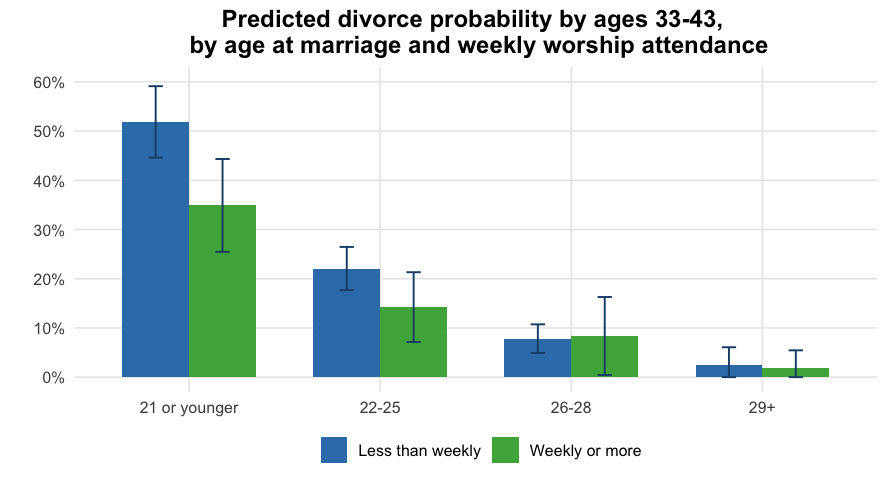
But there is a very important caveat: Because Add Health follows the same group of people over the same period of time, the people who marry earlier also have more time to get divorced. For instance, say one group of people gets married in 1998, and another in 2008. If we check back in with both groups in 2018, we shouldn’t be surprised to see more people in the first group have gotten divorced—after all, it’s easier to make it 10 years into a marriage than 20! If it were possible to adjust our results according to how long people had been married, we would see smaller gaps by age at marriage.2 Even so, the general conclusion is the same: Young marriage means higher risk of divorce.
What about the role of religion? Once again, my findings are consistent with what we already know from existing research: People who go to church more divorce less.
But there is a wrinkle. The effect of religion is by far the strongest for those who marry young. Specifically, for people who married at 21 or younger and did not go to church, over half were divorced by 2018. For weekly attenders, this proportion goes down to just over a third. For those marrying between 22 and 25, the difference is smaller but occurs in the same direction, with a 22% divorce probability for those who didn't attend weekly, but only 14% for those who did.3 In contrast, for those who married age 26 or later, we see no difference by weekly worship attendance.4
The takeaway is that going to church can help keep marriage on a steady path, and that it helps the most for those who marry at young ages when that path might be the bumpiest. If we want a culture of young families, a key ingredient is to foster a culture of faith.
Jesse Smith is a sociologist of religion, family, and culture, and an Assistant Professor with the Salmon P. Chase Center for Civics, Culture, and Society at The Ohio State University.
*Photo credit: Shutterstock
1. Specifically, I examined whether or not respondents attended worship weekly at whichever wave of data collection was closest to their time of marriage, whether before or after. Data collection occurred at the following points: 1994–1995, 1996, 2001–2002, 2008–2009, and 2016–2018.
2. Although Waves III and IV of Add Health have marital timelines, Wave V does not. This means that for people who were married at Wave IV but divorced by Wave V, though we know who got divorced, we don’t know when it happened.
3. This difference is marginally statistically significant at p=.08.
4. Somewhat surprisingly given the strength of the trend, there is no statistically significant interaction between age group and weekly attendance in predicting divorce. This may be due in part to measurement error resulting from the temporal gap between time of marriage and report of weekly attendance. Ideally, the results here should be replicated using other data sets to strengthen the conclusions.