Highlights
- Both married and unmarried mothers of young children are about equally likely to work full time today—a trend never seen before. Post This
- Mothers’ preferences are shifting. While part-time work used to be the top choice of American mothers, full-time employment is gaining ground. Post This
- When asked which policies would help them most, college-educated married moms overwhelmingly prioritize flexible work arrangements (85%), followed by paid family leave (83%), and child tax credits (78%). Post This
The 2025 headlines about women and work fixated on a brief dip in the share of mothers with young children in the labor force. “Mothers are leaving the workforce, erasing pandemic gains,” warned The Washington Post, while The New York Times asked, “American women are leaving the workplace. Why?” Analysts pointed to return-to-office mandates, federal layoffs, and shifting political priorities in Washington.
But short-term fluctuations often even out. Looking at the long-term trajectory of mothers’ work, something more intriguing emerges. Since 2000, during the so-called “stalled revolution” when women’s overall labor force participation in the U.S. plateaued, the share of mothers with young children in the workforce actually rose. And here’s the surprise: that entire increase was driven by married mothers.
Married moms account for 75% of women ages 25 to 55 with children under five. Labor force participation among this group of mothers rose from 63% in 2000 to 69% in 2025. Over this same period, labor force participation among unmarried mothers with young children declined from 75% to 70%, according to a new Institute for Family Studies report that I co-authored with Jenet Erickson.
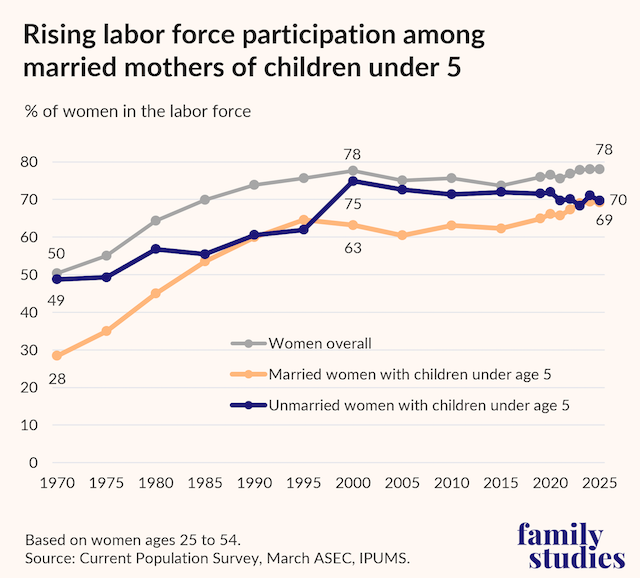
Full-time employment is the engine behind this trend. In 2024, for the first time since data have been collected, married mothers with young children were more likely than unmarried mothers to work full-time (56% vs. 54%). The share dipped slightly for married mothers in 2025, leaving both groups about equally likely to work full time today—a trend never seen before.
Why Are More Married Mothers Working Full Time?
What is driving married mothers of infants and toddlers, who were once the least likely to be in the workforce, into full-time employment?
Economic pressures are the most obvious factor. According to the latest American Family Survey, 7 in 10 Americans say that raising children is unaffordable, a 20-percentage-point increase over the last decade. Financial concerns have now surged to the top of the list of challenges families report, surpassing worries about crime and religion. As a result, dual-income households have become the norm: about half of married couples today have two earners, compared with just 23% who rely on a single income.
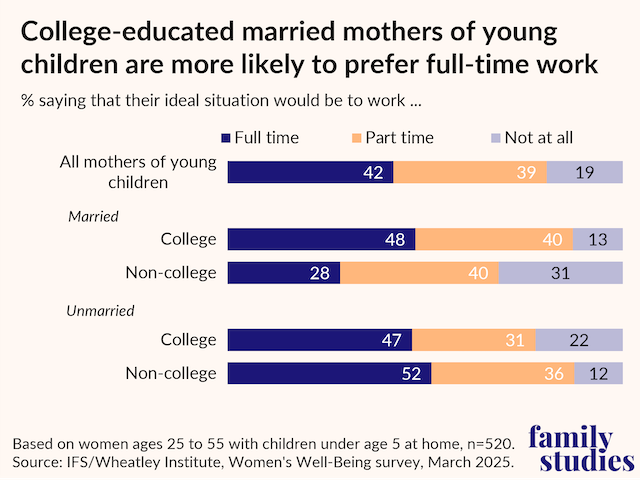
But this isn’t only about money. Mothers’ preferences are shifting, too. While part-time work used to be the top choice of American mothers, full-time employment is gaining ground. For example, among college-educated married mothers of young children under age 5, nearly half say full-time work is ideal, compared with just 28% of those without a college degree. In fact, college-educated married mothers are about as likely as their unmarried peers to say full-time work is their preferred arrangement.
Behind this shift in preferences is a deeper generational force among today’s mothers with young children. The median age of married mothers with children under five is now 34, well within the Millennial generation. Millennial women are the most educated generation of women in U.S. history, far more likely to hold college degrees than previous generations. (Gen Z women are on track to surpass them, but many are still coming of age and haven’t yet completed their degrees.)
Today, nearly 6 in 10 married mothers with pre-school children have at least a college degree. These mothers are more career-oriented, in part, because they’re more likely to work in higher-paying professional jobs. Leaving the workforce to care for children carries a much higher opportunity cost for them than for women without a college degree. Meanwhile, about 26% of Millennials carry student debt, more than any previous generation. These financial concerns may be motivating many married mothers to stay in the workforce.
At the same time, the education gap between married and unmarried mothers has widened. Unmarried mothers with young children are overwhelmingly women without a college education (80%), which limits their job opportunities. Combined with the expansion of welfare programs in recent decades, this helps explain why their labor force participation is falling.
What Moms Want: Flexible Work
To be clear, a rise in married mothers’ labor force participation does not mean these women want to miss out on caring for their babies and toddlers. When asked which policies would help them most, college-educated married moms overwhelmingly prioritize flexible work arrangements (85%), followed by paid family leave (83%), and child tax credits (78%). In contrast, government-subsidized child care ranks near the bottom of their list, based on a recent IFS/Wheatley survey of 3,000 women ages 25 to 55.
These policy priorities aren’t limited to college-educated married mothers. Across the board, regardless of marital status, education, or income, mothers agree on what matters most: paid family leave, flexible work, and child tax credits.
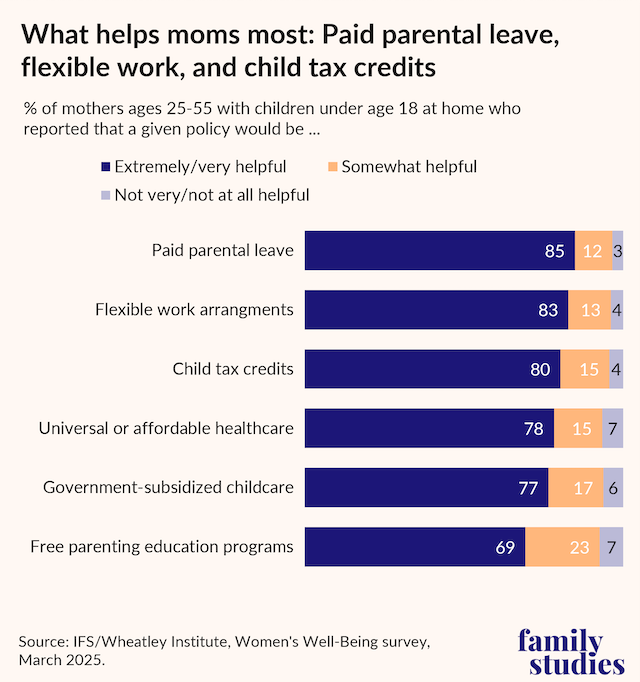
It’s no surprise that flexible work and paid leave top the list. These policies allow mothers to stay connected to the workforce without sacrificing family life. Child tax credits are also valuable, especially since not all mothers prefer paid employment. No mother prefers to miss her baby’s first steps or first words because they happened in daycare.
Unfortunately, the U.S. remains the only high-income country without a national paid leave mandate. Meanwhile, fertility has fallen to record lows, prompting the White House to warn that the declining U.S. fertility rate is a “national security threat.” If we want to reverse this trend, we need pro-family policies that give parents the time and support required to raise children.
I’m not suggesting that we copy Europe’s generous programs; those often come with steep tax burdens and can slow women’s career advancement. But families do need more time to care for newborns. Raising children requires both time and money, and the cost should not fall on the parents alone.
A better approach is emerging: state-based leave programs that reflect local demographics and avoid heavy-handed federal mandates. So far, 13 states and Washington, D.C. have passed laws that offer paid family and medical leave. And a growing number of Republican-led states, including Alabama, Iowa, Mississippi, and South Carolina, have expanded paid parental leave for public employees like teachers and state workers.
The quiet revolution in mothers’ work preferences and behavior is already here. It is time for U.S. policy to catch up.
Wendy R. Wang is the Director of Research at the Institute for Family Studies and an expert on demographic trends, marriage, family, and well-being.
*Photo credit: Shutterstock