Highlights
- The repeated salvos against marriage and motherhood from left-leaning women help explain why so many single women, especially young and liberal ones, believe marriage is a bad deal for them. Post This
- New IFS research using the GSS finds that the happiness premium for married moms compared to single, childless women is not only large but growing. Post This
- The progressive case against marriage and family for women is completely wrong. Today, married women live longer, earn more, and report more meaningful lives, compared to single women. Post This
“The worst thing a woman can do, statistically speaking, is to get married to a man,” Liz Gilbert said recently on the "Marie Forleo" podcast. "Married women do not live as long as single women, they do not earn as much money as single women, they are not as happy as single women..." she continued. "They report themselves in every single way that you can measure sociological data for wellness as being less contented than single women."
Her comments are just the latest in a long line of salvos against marriage from the bestselling author of Eat, Pray, Love. Gilbert and other progressive writers like Amy Shearn (“Married heterosexual motherhood in America… is a game no one wins” in The New York Times) and Wendy Patrick (“Why Are Many Single Women Without Children So Happy?” in Psychology Today) regularly inveigh against family for the fairer sex. Today, they contend, the path towards forging a meaningful and happy life for women runs away from marriage and family, not towards it. What’s more, their argument goes: even as marriage and family life hurt women, they help men.
The repeated salvos against marriage and motherhood from left-leaning women help explain why so many single women, especially young and liberal ones, believe that marriage is a bad deal for them and a good deal for men. New research shows a “massive gender divide” in public views about the benefits of marriage, according to Dan Cox, a pollster at the American Enterprise Institute. Cox found that:
Fifty-eight percent of men and 53 percent of women agree that men who get married and have children are better off than those who do not. However, … [only about] half of men (49 percent) and less than one-third (32 percent) of women believe that women who get married and have children live fuller, happier lives.
His surveys indicate that women’s skepticism about the merits of marriage are especially strong among young and liberal single women now.
Progressives Are Wrong
There’s only one problem with the progressive case against marriage and family for women: It’s completely wrong. Today, married women live longer, earn more, and report more meaning in their lives, compared to single women. They are also markedly happier than their single peers, according to recent research by psychologist Jean Twenge and colleagues.
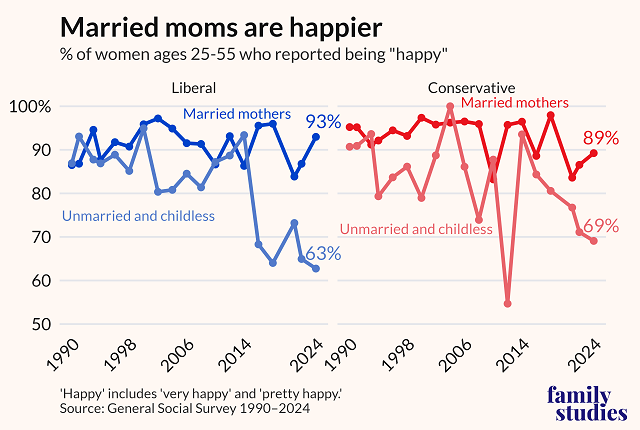
In fact, new IFS research using the General Social Survey (GSS), the gold standard social barometer, finds that the happiness premium for married moms compared to single, childless women is not only large, but growing among prime-aged (25-55 year-old) women. Among liberal women in the early 1990s, for instance, there was no premium in happiness favoring married moms over single, childless women.
Contra Liz Gilbert, it sure looks like the best thing a woman can do, statistically speaking, is to get married.
But now that premium has grown to a stunning 30-percentage point gap in 2024, such that liberal married moms are dramatically more likely to say they are happy with their lives, compared to their single and childless peers. This pattern over time is similar for conservative women, although the 2024 gap in happiness between these two groups is not quite as seismic: it’s only 20 percentage points, which is still large.
The Unhappiest Women? Single and Childless
When we look more broadly at the GSS data for four family groups of prime-aged women—married mothers, married childless women, unmarried mothers, and unmarried childless women—the larger story is that married women continue to do well on the happiness front from the 1990s to the present, but unmarried women appear to be losing ground.
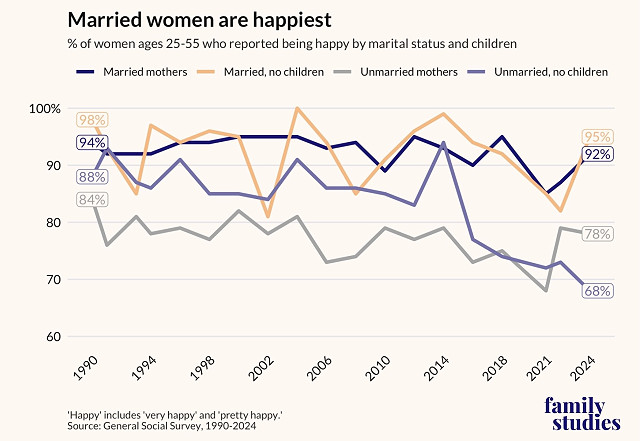
In fact, this decline in women’s happiness seems to be especially precipitous for single, childless women post COVID. Today, there is no group of women in America who are less happy than prime-aged women with no immediate family.
We suspect that the “digital revolution” of the last 15 years—which has eroded opportunities for in-person socializing even as it has broadcast anxiety-inducing messages about the world—has hit the emotional well-being of single, childless women especially hard. By contrast, in this digital age, married women have enjoyed more opportunities for in-person socializing, physical touch, and meaningful time spent with loved ones. All this helps explain why, contra Liz Gilbert, it sure looks like the best “thing a woman can do, statistically speaking, is to get married,” especially in an age when the alternative to spending time with family is getting lost in a digital world that leaves so many depressed and anxious.
Sophie Anderson is Research Coordinator and Assistant Editor of IFS Insights at the Institute for Family Studies. Brad Wilcox is Distinguished University Professor of Sociology at the University of Virginia, Senior Fellow at the Institute for Family Studies, and author of Get Married: Why Americans Must Defy the Elites, Forge Strong Families, and Save Civilization.
Photo credit: Shutterstock