
Highlights
- Compared to their 2019 population levels, the 20 states that voted for former vice-President Kamala Harris in 2024 saw a decline in people in their 20s and kids under 10. Post This
- States with cheaper housing tend to have better luck attracting or keeping parents of young kids. The majority of these states are politically red. Post This
- For states that want to remain attractive to families, it's vital to focus on the fundamentals of good governance—affordable housing, solid job growth, and the political center rather than either extreme. Post This
In March 2020, life shut down, and many couples found themselves with a little extra time on their hands. Some of them welcomed a new member of the family nine months later, and those COVID babies are now getting old enough for kindergarten—and the geography of American family life has been indelibly changed in the meantime.
As the Institute for Family Studies has highlighted, red states have higher birth rates than blue states. Red states also have seen higher rates of in-migration from other states than blue states in the years following the pandemic. There is clearly an increasing correlation between a state’s partisan valence and rates of family formation. We are seeing a kind of “big sort” of American families, which can help us predict where children will and won’t be seen and heard through the next decade.
Blue States Are Losing Kids
First, let’s look at the most important trend nationally. Both red and blue states are watching the share of residents who are age 60 or over grow as Boomers continue to age into retirement. But blue states are losing twenty-somethings, and, relatedly, kids. Compared to their 2019 population levels, the 20 states that voted for former vice-President Kamala Harris in 2024 saw a decline in people in their 20s and kids under 10, as well as a dip among 50- to 59-year-olds.
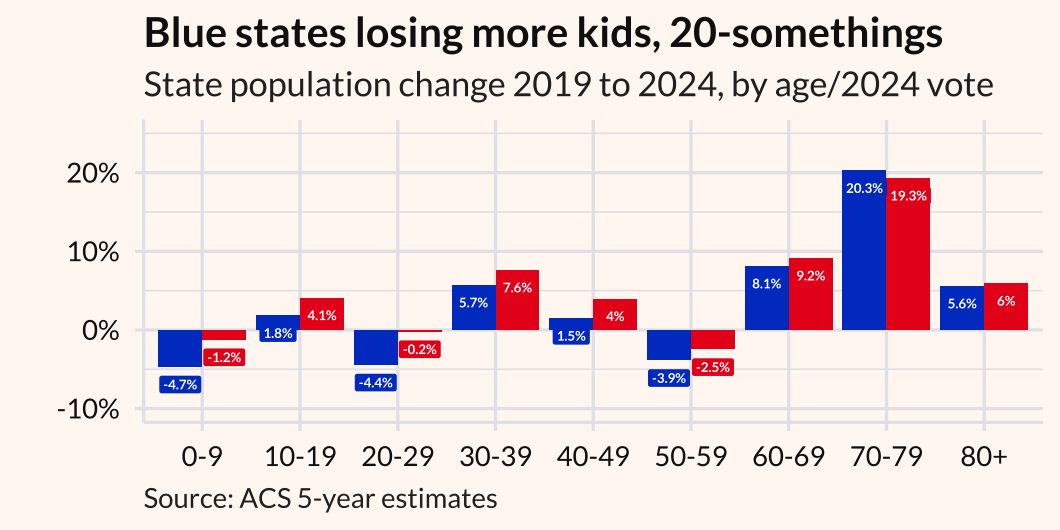
Even in a world of delayed marriage, people in their 20s are apt to have kids. So it’s not surprising that young parents are decamping for states with a lower cost of living. Red states saw growth among Millennials in their 30s as well. The upshot is that despite overall falling fertility, the total number of kids under 18 in the states that voted for President Trump in 2024 has grown slightly over the past five years, from 43.1 million in 2019 to 43.7 million in the most recent survey.
In blue states, however, the total number of kids has dropped over the past five years, heavily concentrated among parents of young children. The total number of children under age 5 in the 20 Harris-voting states fell from 8.2 million to 7.6 million from 2019 to 2024, while the overall number of school-age children remained fairly constant at just over 22 million.
That’s 600,000 fewer kids under five in blue states in 2024 compared to 2019. And nearly half of this number was due to one state alone–California, which saw its total number of kids in this age group fall from 2.45 million in 2019 to 2.16 million five years later. Some of that is due to declining fertility, even as Hispanic women have tended to have higher birth rates than non-Hispanic whites and blacks. But it is also due to high rates of out-migration from the state among households with kids, as IFS has previously indicated.
Housing Costs Play a Role
A big driver of these shifts, of course, is the cost of housing. Using the median mortgage cost relative to median income as a rough proxy for affordability, we can see that states with cheaper housing tend to have better luck attracting or keeping parents of young children. The majority of these states are, politically, red.
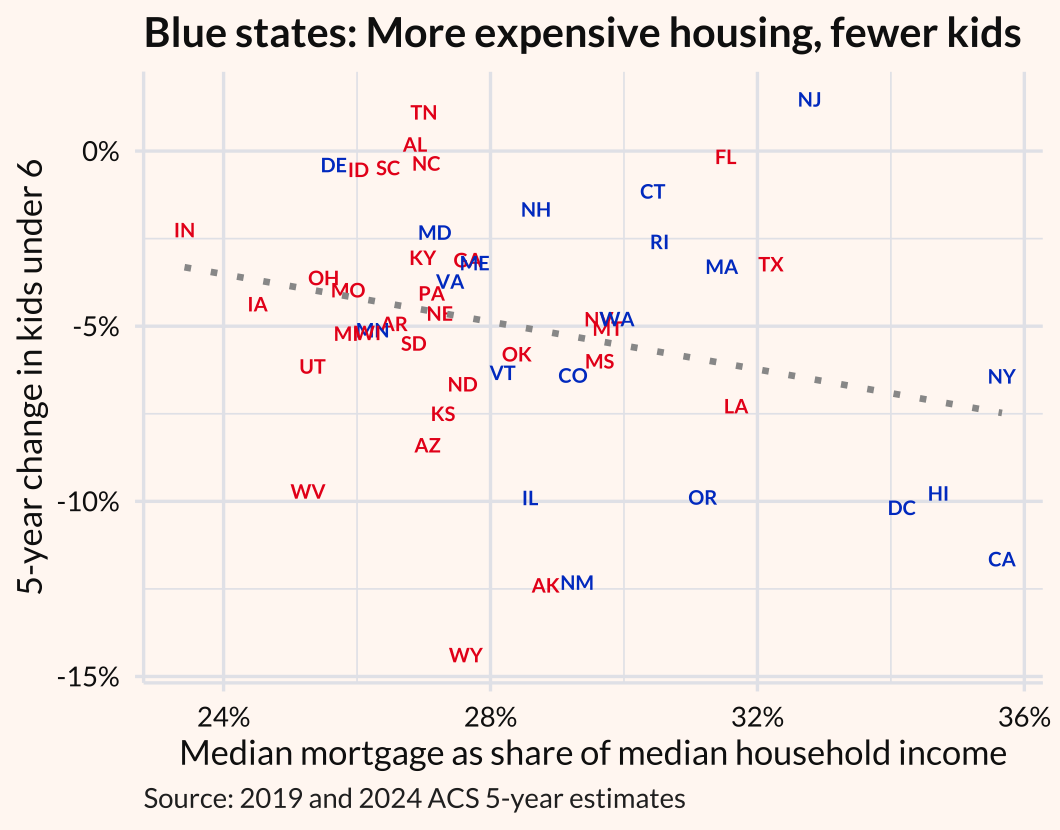
Party identification isn’t totally determinative; some more rural red states, like Kansas, the Dakotas, and Oklahoma saw a declining number of young kids even as their total population grew in the post-COVID reshuffle. Washington, New Jersey, and the DC metro area are blue overperformers, despite their higher cost of living. But most other blue states are expensive and losing families.
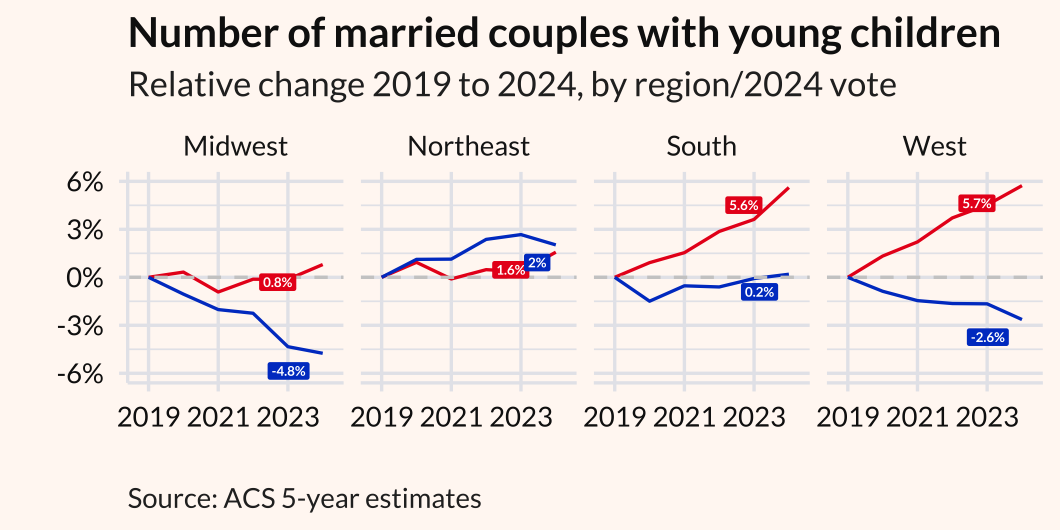
Let’s focus in a little more, solely on households that are made up of married couples that have had a baby since 2019. Idaho, South Carolina, Florida, Tennessee, and the District of Columbia ended the last half-decade with 10% more married families with children under five than they started with. Population-rich blue states—California, New York, Illinois—ended up with fewer married couples with young kids, while some of those who benefited from a COVID exodus (Connecticut, New Hampshire, Colorado, and New Jersey) held their own.
Of course, an entire state is a pretty big area to try to unpack something like housing affordability and family formation. We can also use the Census’ designed metropolitan statistical areas to see where married couples with young kids are congregating.
Many of the biggest relative gainers over the past five years are spots that had previously been home to large numbers of retirees, like Florida beach towns and Cape Cod. And other red-purple areas, like Wilmington, NC., Charlottesville, VA, and Chattanooga, TN, show that families are attracted to affordable places with dynamic job growth. Meanwhile, the number of married families with young kids is declining in metropolitan areas like New Orleans, as well as more rural areas that aren’t seeing an economic revival, like California’s San Joaquin Valley and Topeka, Kansas.
In general, regions with vibrant family life tend to be economically prosperous, with higher-than-average shares of Asian-Americans, or near military bases.
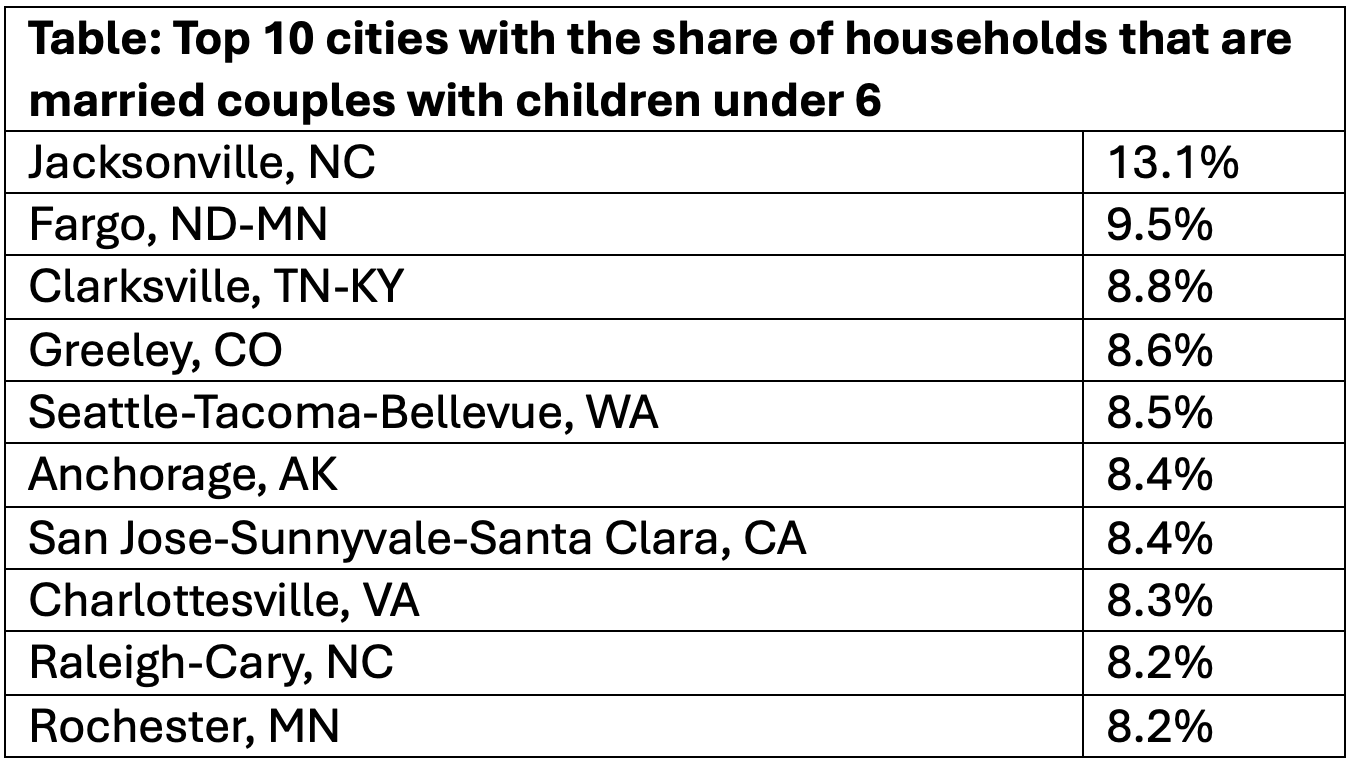 Note: Among metropolitan statistical areas with 2024 population of 200,000 or more.
The Geography of American Families Is Changing
Yesterday’s COVID babies are today’s kindergarteners—and they’re more likely than ever, statistically speaking, to live in a state that voted red in the last election. This has predictable political implications, as observers project how population shifts could impact the Electoral College map for the 2030 election cycle and beyond.
But it also points to a broader shift in the geography of American parenthood. Big blue cities, like New York and San Francisco, can try to invest in large-scale spending programs to make child care more affordable or safety-net programs more generous. In these places, it’s great to be rich, or poor—but if you’re in the middle, you’re stuck. And if these states can’t solve their cost-of-living crisis, they will continue to lose middle-class families to Sun Belt states and commuter towns.
It’s also a reminder to red states to not rest on their laurels. Ensuring that their housing markets stay affordable—such as by freeing up land and legalizing denser housing in cities and suburbs—will help them attract more parents. Practical assistance, like state-level child tax credits, expansions of school lunch programs, or tangible benefits like paid leave, can also help make their states stand out compared to the other red states that are attracting families.
Fertility and marriage rates are likely to continue to decline. For states that want to remain attractive to families, it will be vital to focus on keeping the fundamentals of good governance strong—making housing more affordable, attracting and creating solid job growth, and keeping an eye on the political center rather than veering to either extreme. The states that manage to do this the best will be the winners—especially once the COVID babies hit middle school.
Patrick T. Brown (@PTBwrites) is a fellow at the Ethics and Public Policy Center, where he writes the weekly “Family Matters” newsletter.
*Photo credit: Shutterstock


