Highlights
- Although the jury is still out, the odds are that AI will hurt rather than help birthrates. Post This
- The most reliable solutions to the birthrate crisis are not high-tech but old-school: things like marriage, religion and houses. Post This
- In an optimistic scenario, AI helps solve the birthrate crisis. But in a pessimistic scenario, our species could follow a path like it did with the industrial revolution, TV, contraception, and the smart phone. Post This
We could use a reprieve from the global birthrate crisis with fertility levels far below replacement across the developed world. Is Artificial Intelligence the answer? A number of people have argued that AI will lower birthrates further.
In an optimistic scenario, AI helps solve the birthrate crisis. Maybe smart robots will ease the burden of childcare. Maybe AI dating apps figure out matchmaking. But in a pessimistic scenario, our species could follow a path like it did with the industrial revolution, televisions, contraception, and the smart phone, where technological advances pulled us further from the world we are used to and leaving birthrates even lower.
Examples of New Tech Lowering Fertility
The jury is still out on whether AI will hurt birthrates. But recent history suggests that it could. With every iteration of tech advance, we get further from our historical cultures, and fertility often falls. Consider the impact of birth control, TV, and smartphones.
Modern birth control
It's obvious that modern birth control stops a lot of unplanned pregnancy and lowers fertility directly. But the indirect cultural effects on birthrates were even greater.
Modern birth control since the 1960s drove a social transformation to much lower marriage rates and much later marriage when people could enjoy sex without the risk of pregnancy. That has contributed to most advanced countries having an equilibrium of fertility far below replacement.
Television
Quite a lot of academic literature has shown that the adoption of the television and other media led to lower birthrates around the world.

Source: "Why are birthrates falling around the world? Blame television." Washington Post, May 13th, 2013
There were a couple of mechanisms at work. First, people could see different lifestyles to emulate. Famously in Brazil, telenovas showed much smaller family norms and this caused birthrates to fall. Second, people just had something else to do with their time, a new way to stimulate the limbic system besides sex.
Phones
Plenty of thinkers have linked the big drops in fertility since 2007 to the rise of the smartphone. The iPhone was first introduced in June 2007.
Social skills are lagging. There are a lot of different reasons smartphones might reduce fertility. Young people can be immersed in a virtual world instead of human relationships. Dating apps have produced a dating marketplace that is not helpful for making matches.
The highest fertility groups in the United States are Amish, and they are famous for avoiding many kinds of technology. Notably, the highest fertility Amish groups are the ones that avoid phones completely.
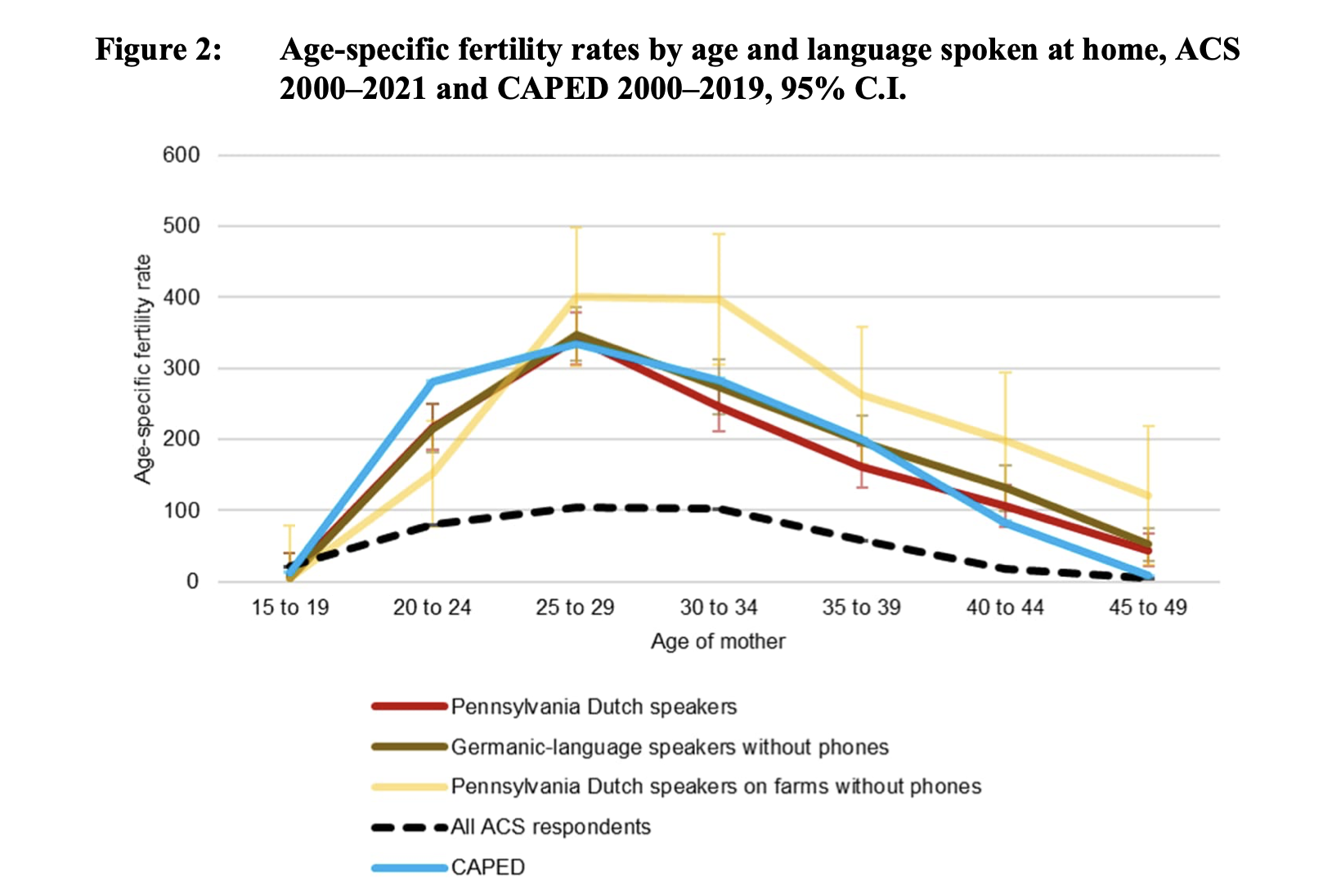
Source: "Amish fertility in the United States: Comparative evidence from the American Community Survey and Amish population registries," Stone et al., 2025 in Demographic Research.
The Stunning Rise of Artificial Intelligence
To say that AI will be transformational is an understatement. In just the last five years, AI has gone from beating the human baseline on narrow tasks like image classification to beating us at almost everything, from competition-level math to PhD-level science questions.
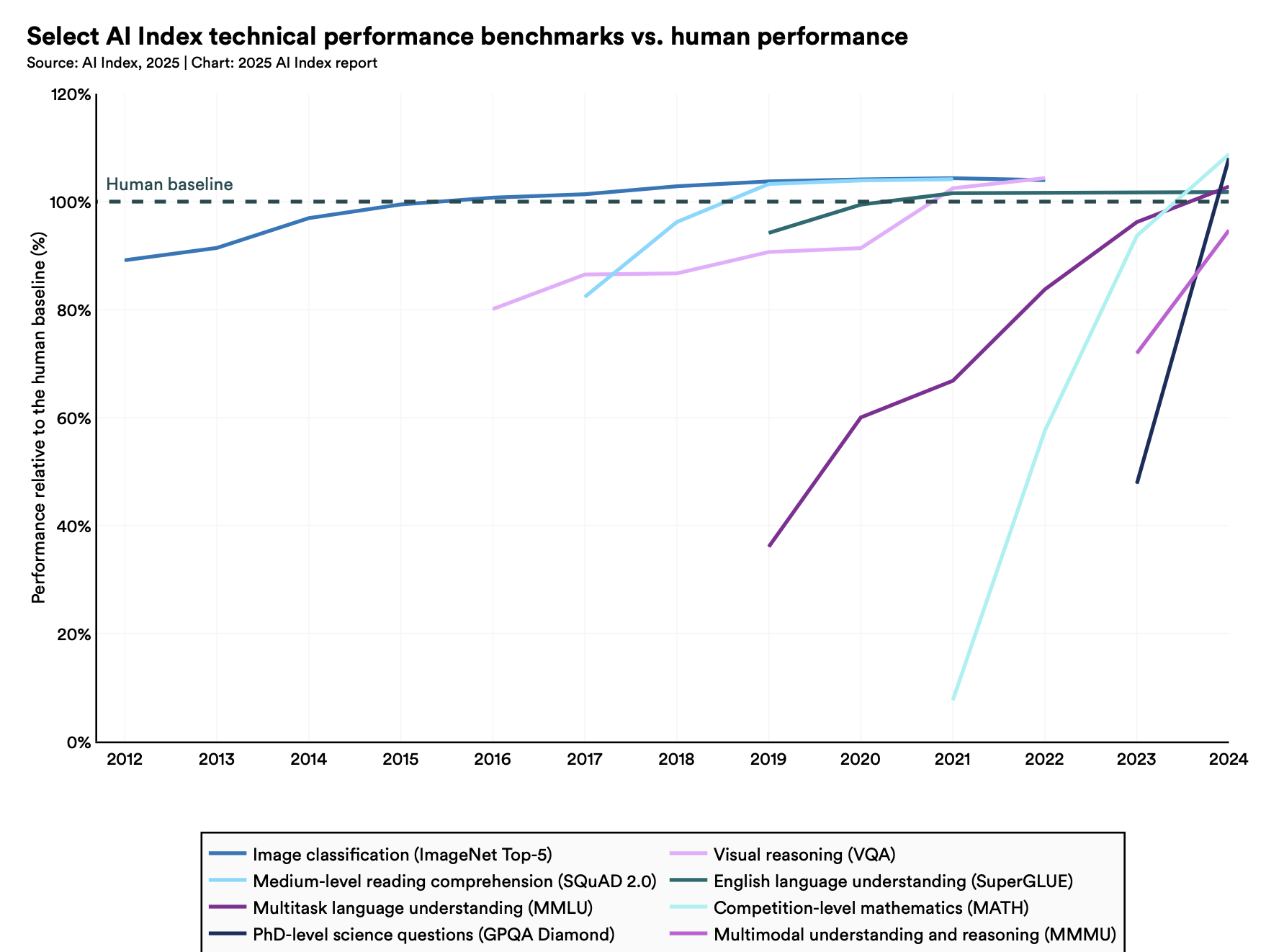
Source: The 2025 AI Index Report, Stanford University.
We don't know what this will do to society, but it isn't hard to imagine that many of our jobs will be at risk, especially in white-collar, knowledge-based work.
How AI Could Hurt Fertility
What impact will this have on fertility? We can't know for sure, but we can make some intelligent speculations.
Lowering the status of young people
Sociologist Alice Evans offers a great prediction how AI could impact relationships in a recent essay on her website, writing:
As AI companions offer affection on demand, real-world romance may face a double squeeze: economic disruption and digital distraction. Here’s one possible future: AI rips through entry-level law, finance, and marketing, slashing wages for graduates.
She adds: "In short, the labor demand shock could amplify the online entertainment shock—potentially hurting graduates’ earnings, status and romance.”
In the words of IFS Senior Fellow Brad Wilcox: "AI could gut work among young adults even as it produces an online entertainment shock that drives in-person dating down even more. This would push marriage and fertility to new lows."
Disrupting the work of young men, especially
Many studies have demonstrated that higher male income leads to higher fertility while higher female income tends to produce the opposite effect.
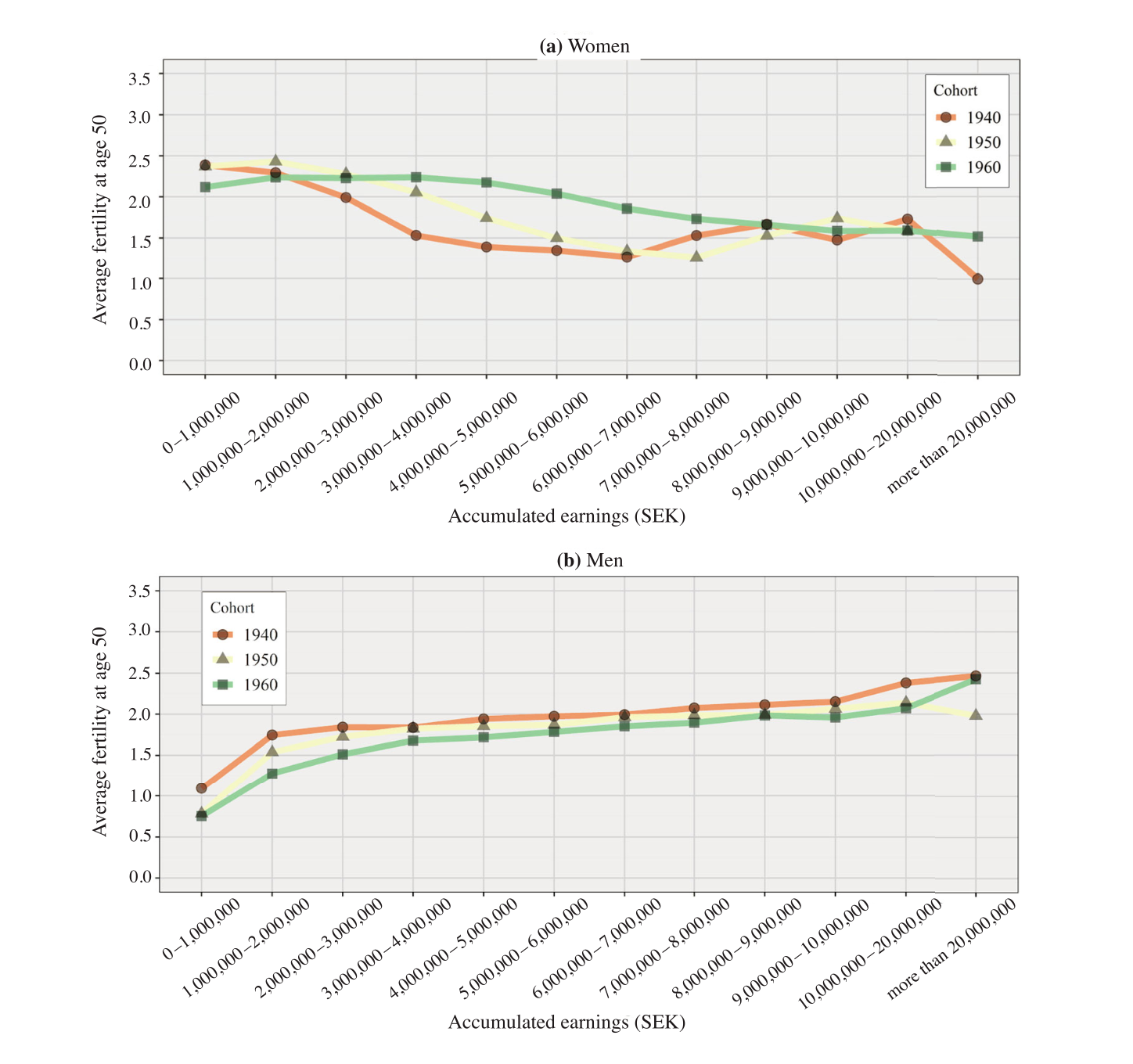
Source: "Income and fertility – a positive relationship?" Kolk, 2023.
Meanwhile, recent technological changes have led to a reduction in manufacturing employment (predominantly among men) and a rise in healthcare employment (predominantly among women).
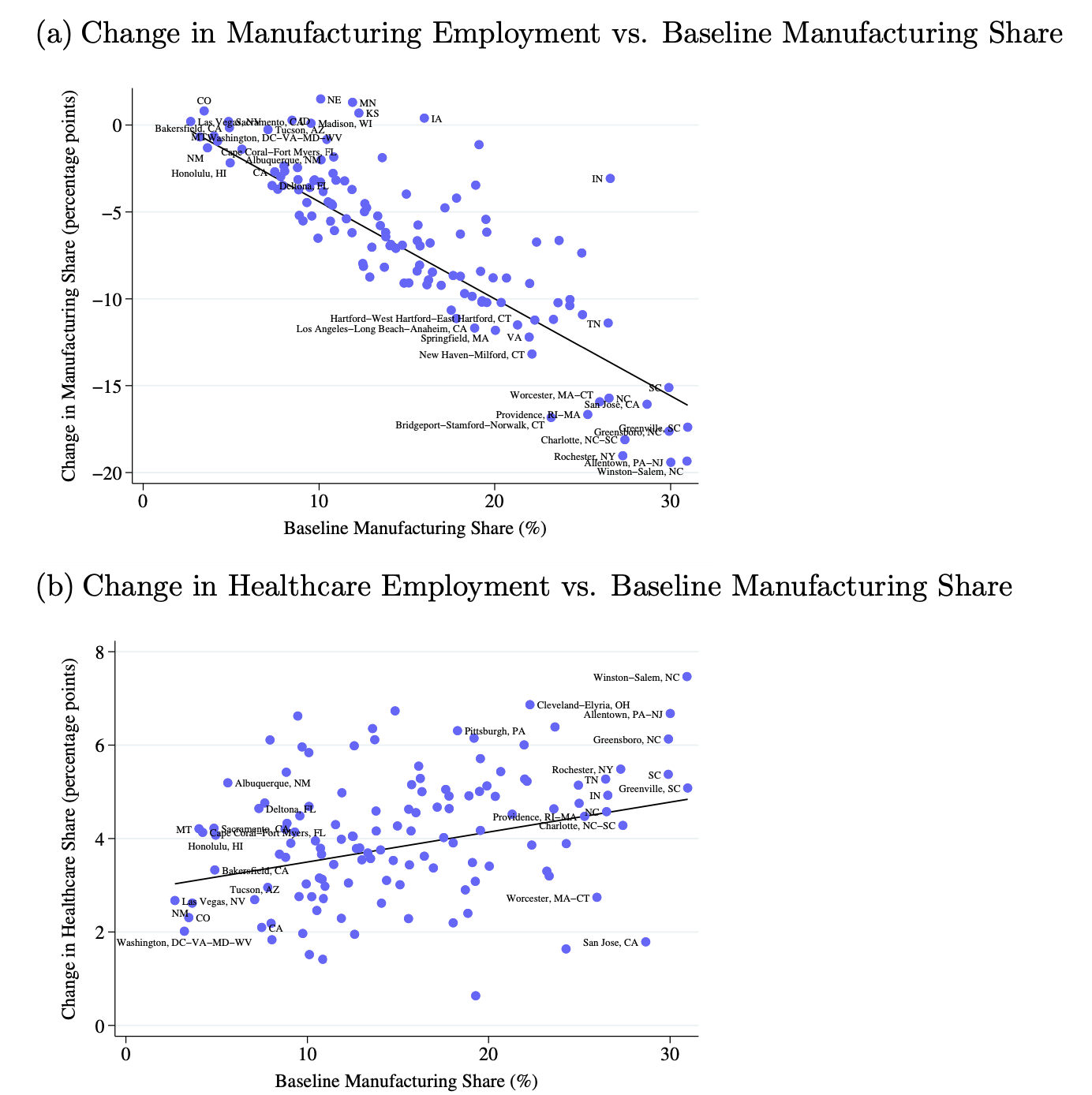
Source: "The Rise of Healthcare Jobs" (Gottlieb et al., 2025)
If the job impacts of AI are similar, hurting men more than women, then this too could reduce fertility.
AI Companions
We might as well rip the band aid clean off and talk about what is happening in the world of AI companionship. In just the last year, there has been a huge proliferation in AI companion apps. Chatbots are infinitely patient and understanding. They have all the time in the world for you while expecting nothing in return.
Will this peel off a significant percentage of young people from the dating and marriage market? Who knows? But even if people don't consider these apps to be a partner, just a new form of entertainment, it is hard to imagine the effect on fertility will be anything but negative.
Ways that AI Could Help Fertility
Of course, some argue that AI could help boost fertility, such as:
Giving couples ideas
Justine Moore writes on X, "AI is fixing the birth rate. The girls are getting oneshotted on pro-natalism by ChatGPT." If this works, it would be amazing.
Robots Helping at Home
The idea of AI-driven humanoid robots helping with housework has been around for a very long time. The Jetsons (1962-1987) starred Rosie the Robot.
Unfortunately, we are continually confronting what is called Moravec's Paradox. All the way back in 1988, Hans Moravec wrote, "it is comparatively easy to make computers exhibit adult level performance on intelligence tests or playing checkers, and difficult or impossible to give them the skills of a one-year-old when it comes to perception and mobility."
There has been huge progress since then, but the paradox remains. AI can solve math problems that nobody has ever solved, but no robot can substitute for a human babysitter.
Did the Fertility Problem Just Get Tougher?
Although it is still early, the odds are that AI will hurt rather than help birthrates. That's what several other technology disruptions have done, by taking us ever further from the world we're used to.
Generative AI is already disrupting work, and it may disrupt romance as well. Both of those things will be negative for birthrates. But if you were hoping that AI would help you with diaper changes and nighttime feedings, you are out of luck for the near future.
Meanwhile, the most reliable solutions to the birthrate crisis are not high-tech but old-school: things like marriage, religion, and houses.
Daniel Hess is pronatalist researcher and father of 6. He maintains the popular pronatalist account @MoreBirths on X, MoreBirths.com, and is a speaker on the topic of pronatalism.
Editor's Note: This article was first published by the author on X. It has been lightly edited and reprinted here with permission.
*Photo credit: Shutterstock