
Highlights
- Policies and practices of public school systems toward gifted students vary widely across states and have changed over time. Post This
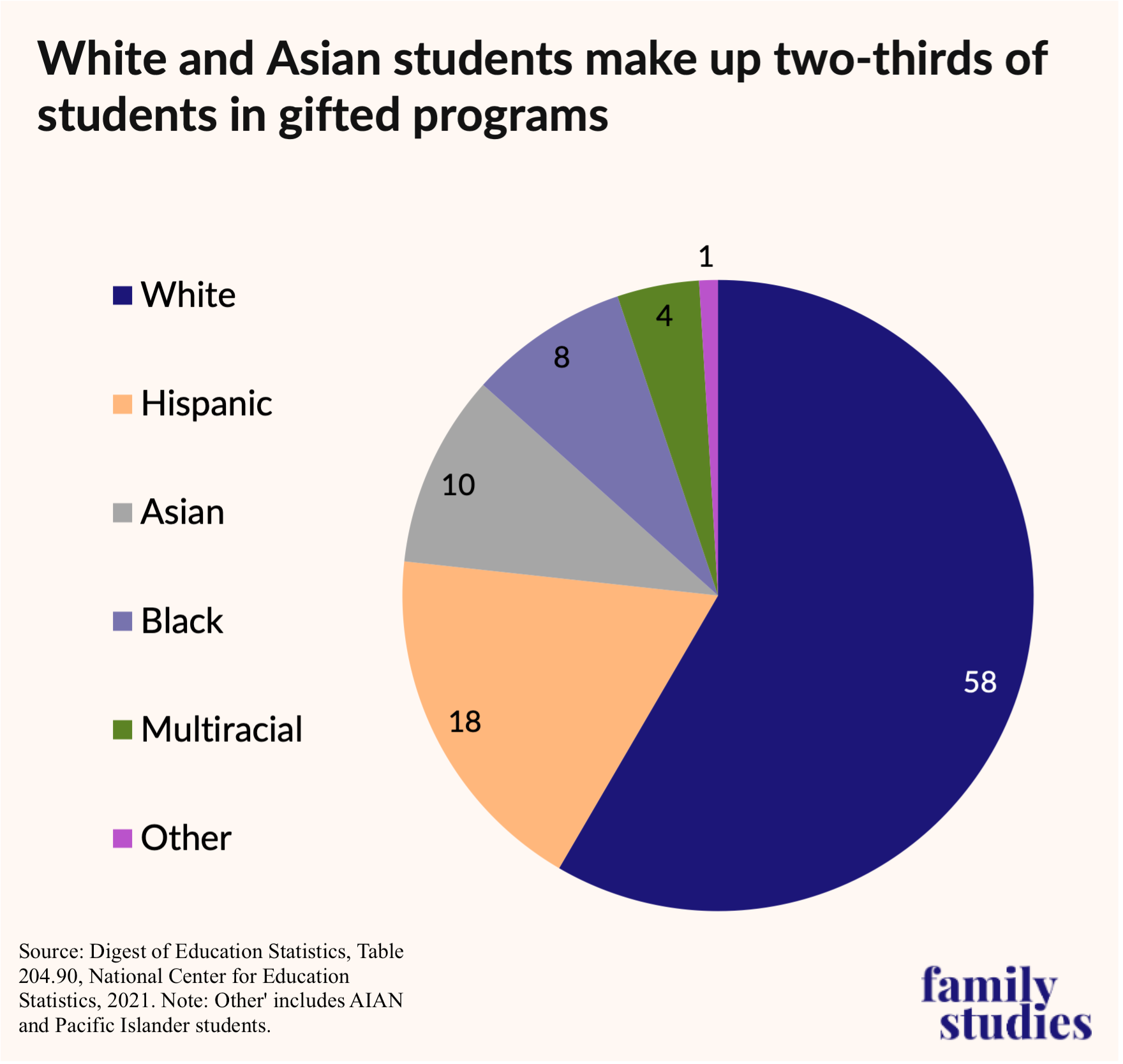
- Fully one-third of the students in gifted programs are Hispanic (18%), Black (10%), or multiracial (4%). Post This
- There are some 3.3 million students enrolled in gifted and talented programs across the country (as of 2021). Post This
Mothers and fathers whose children show early or unusual ability in subjects like reading, math, science, art, music, drama, or dance look to schools to provide gifted education programs that encourage and nurture those interests and talents. They do not want their daughters and sons to be bored and restless in class because they have already mastered the knowledge and skills their teachers are teaching. They seek a type and level of instruction that will engage and challenge their children. However, parents looking for such tutelage in today’s public schools may well become frustrated.
Public School Policies Toward Gifted Students
Policies and practices of public school systems toward gifted students—those who are well ahead of their age peers in knowledge or skill—vary widely across states and have changed over time. Attitudes in many school districts range from mildly encouraging to indifferent or even faintly hostile. Schools tend to be more concerned about and supportive of students who are substantially behind their age peers, especially if those pupils come from low-income families, minority ethnic groups, or have a diagnosed disability. “No Child Left Behind” and “Diversity, Equity, and Inclusion (DEI)” are still guiding principles in many systems, despite recent pushback. At the same time, more districts than ever have programs for gifted students in publicly-funded charter schools and private schools offering scholarship support to families with financial need.
All Students Are Gifted in Menlo Park, CA
In Menlo Park City, California, for example, in the heart of Silicon Valley, the school district “believes that all of our students are gifted in their own ways, and by focusing on Learner Variability we can appropriately meet the needs of individual giftedness. Intelligence is not a fixed trait. With this as our belief, we do not offer a Gifted and Talented program.”
Another example is Massachusetts, often deemed to have some of the best public schools in the nation. It does not have a statewide mandate to identify or serve gifted students. Resources, funding, and specific program requirements are not uniform across the state. And only one half of 1% of students in the state are enrolled in such programs.
Students in Gifted Education Programs in the U.S.
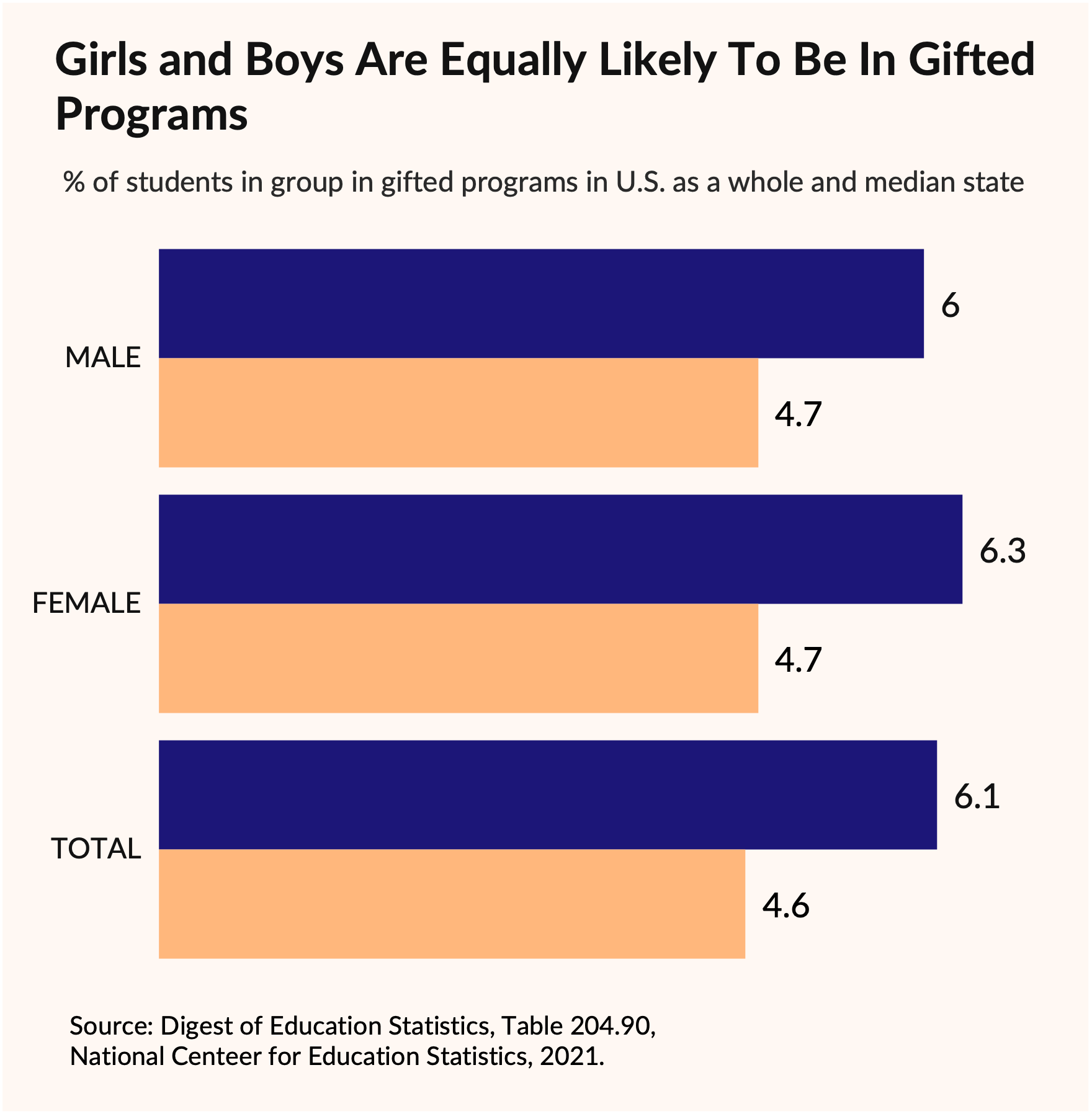
Many states do have programs for gifted and talented students. Based on the most recent national data, which are from 2021, there are some 3.3 million students enrolled in gifted and talented programs across the country. These students represent 6.1% of the total student population, or about 1 in 16 students. The percentage of students enrolled in gifted programs in the average (i.e., median) state is lower: 4.6%, or 1 in 22 students.
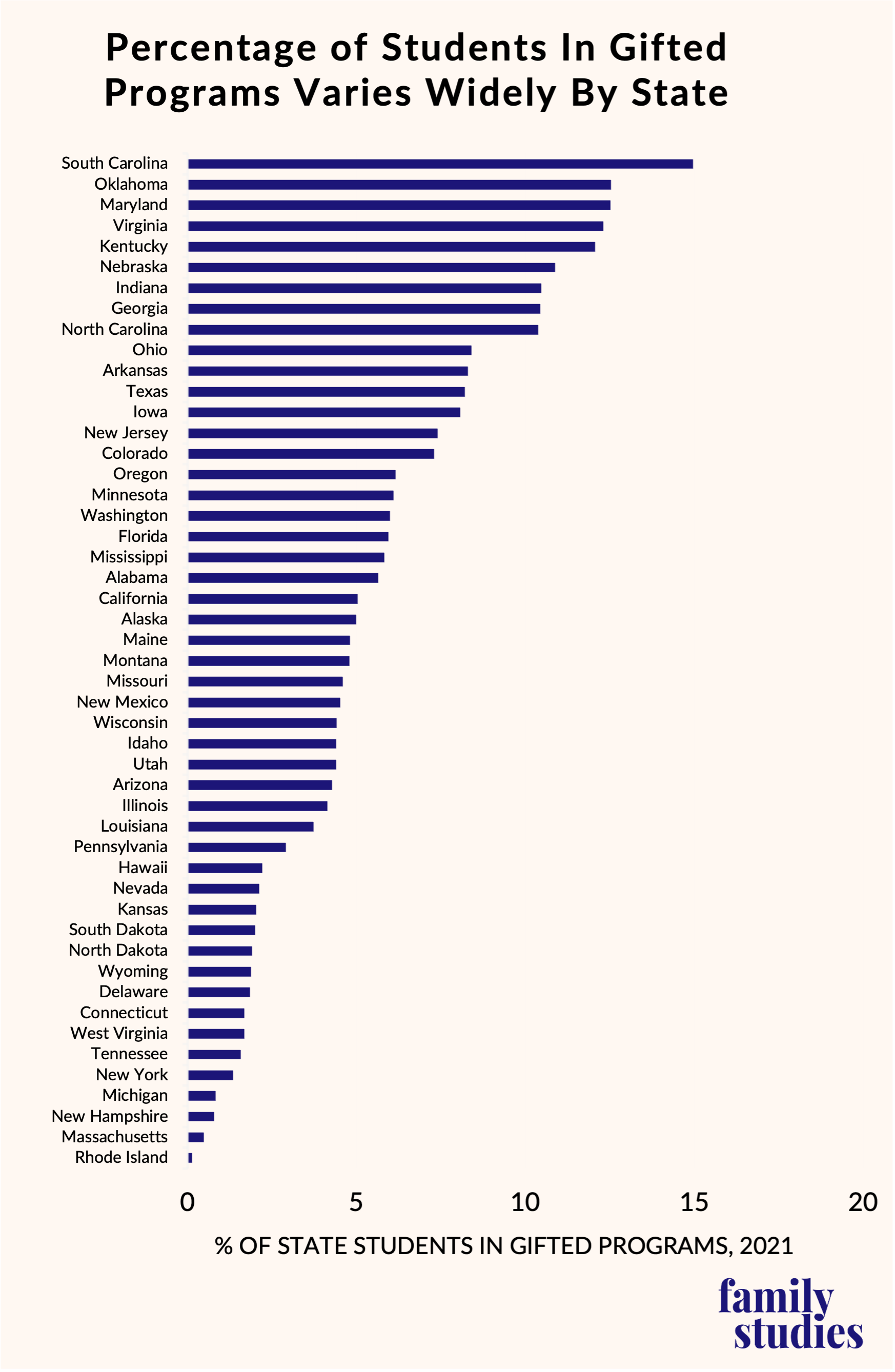
The percentage of students in gifted and talented programs ranges from 15% in South Carolina to less than 1% in Rhode Island and Vermont. States that rank high, with 10% or more in gifted programs, are Southern states (North and South Carolina, Maryland, Virginia, and Georgia) and “Red” states (Nebraska, Indiana). States that rank at the bottom of the distribution, with one percent or less in such programs) are most New England states, New York and Michigan.
A mixed bag of states rank in the middle of the distribution, with three or four percent of students in their gifted programs. The assortment includes Western states (Montana, New Mexico, Idaho, Utah, Arizona), populous states in the middle of the country (Pennsylvania, Illinois, Wisconsin, Missouri), one New England state (Maine), and a Southern state (Louisiana).
The overall percentage of students participating in gifted and talented programs changed little between 2004 and 2021.1 It was 6.7% in 2004, and 6.1% in 2021, or 92% of the 2004 figure. But there were considerable drops in individual states, including most New England states, and populous and influential states like New York, California, and Pennsylvania.2 On the other hand, the numbers rose in one New England state, Maine, and in an assortment of mostly Red states including Indiana, Alaska, Missouri, Alabama, South Carolina, Idaho, and Washington.3
Racial Disparities in Gifted Education Programs
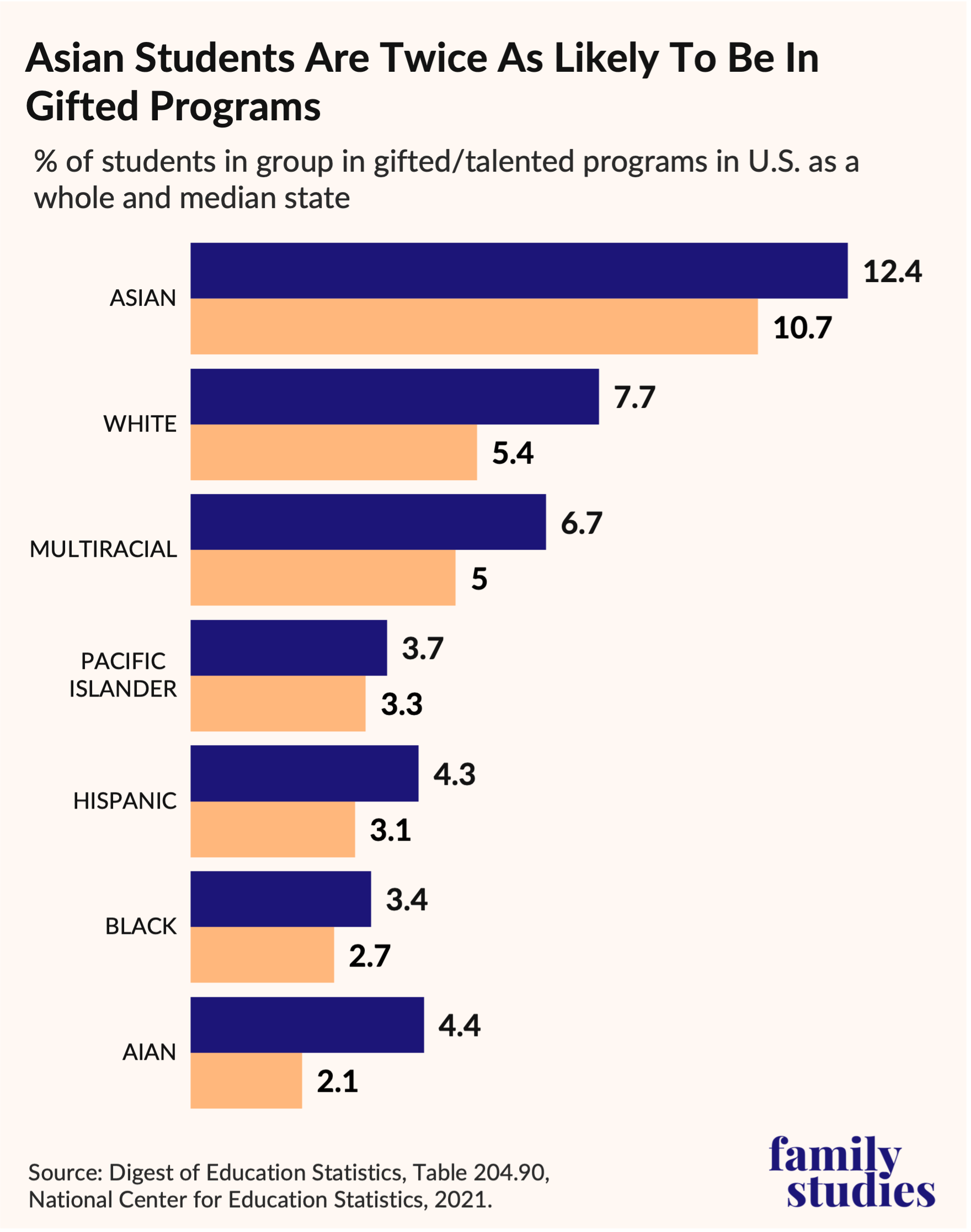
As we saw above, girls and boys are equally likely to be enrolled in gifted and talented programs. The percentage of students in gifted programs varies widely by race and ethnicity, however.
More Than A Million Black and Hispanic Students In Gifted Programs
Given the respective sizes of different ethnic groups in the U.S. student population, the makeup of the group of students receiving gifted and talented instruction presents a different and more encouraging picture, as shown below. Fully one-third of the students in gifted programs are Hispanic (18%), Black (10%), or multiracial (4%), meaning that more than a million students from these groups are enrolled in such programs.
Shutting Down Gifted Programs Won't Eliminate Achievement Disparities
Racial and ethnic differences among students in gifted and talented programs have much to do with the reluctance on the part of some state and local school systems to continue or expand gifted education programs. But shutting down gifted programs will not eliminate disparities in the proportions of students who are well ahead of their peers in subjects learned and skills mastered. Qualification differences for gifted programs are mirrored in “advanced” performance on standardized testing programs, such as the “Nation’s Report Card” also known as the National Assessment of Educational Progress (NAEP). They are also evident in results of college admission tests like the SAT and ACT, and state-level achievement tests.
Families in areas like Oakland, California, and Silicon Valley have protested against the termination of advanced classes and gifted programs. They lobby schools to continue, resume, or expand programs and classes, such as high school classes in Advanced Algebra and Calculus. Rather than shutting down such programs, school systems would do well to work with parents to find ways of helping more students to qualify. Furthermore, schools should work to expand their gifted education offerings for students with talents in visual arts, music, dance, and drama, as well as other fields in which skills are less closely correlated with academic intelligence. Doing so would help systems stem the flow of families out of regular public schools and into charter schools, religious schools, and secular private schools.
Nicholas Zill is a research psychologist and senior fellow of the Institute for Family Studies. He directed the National Survey of Children, previously served as the first project director of the Head Start Family and Child Experiences Survey, and he is the founder of Child Trends.
*Photo credit: Shutterstock
1. Digest of Education Statistics. U.S. Department of Education. Table 204.90. Percentage of public school students enrolled in gifted and talented programs, by sex, race/ethnicity, and state or jurisdiction: Selected school years, 2004 through 2020-21.
2. As a proportion of the 2004 percentage enrolled in gifted programs in each state, 2021 enrollment was: RI (.07), VT (.17), NH (.34), NM (.34), HI (.39), TN (.47), CT (.55), MA (.58), CA (.60), PA (.60), NY (.63).
3. As a multiple of the 2004 gifted and talented participation in each state, 2021participation was: ME (1.60), WA (1.59), IN (1.48), AK (1.22), MO (1.20), AL (1.18), SC (1.17).


