
Highlights
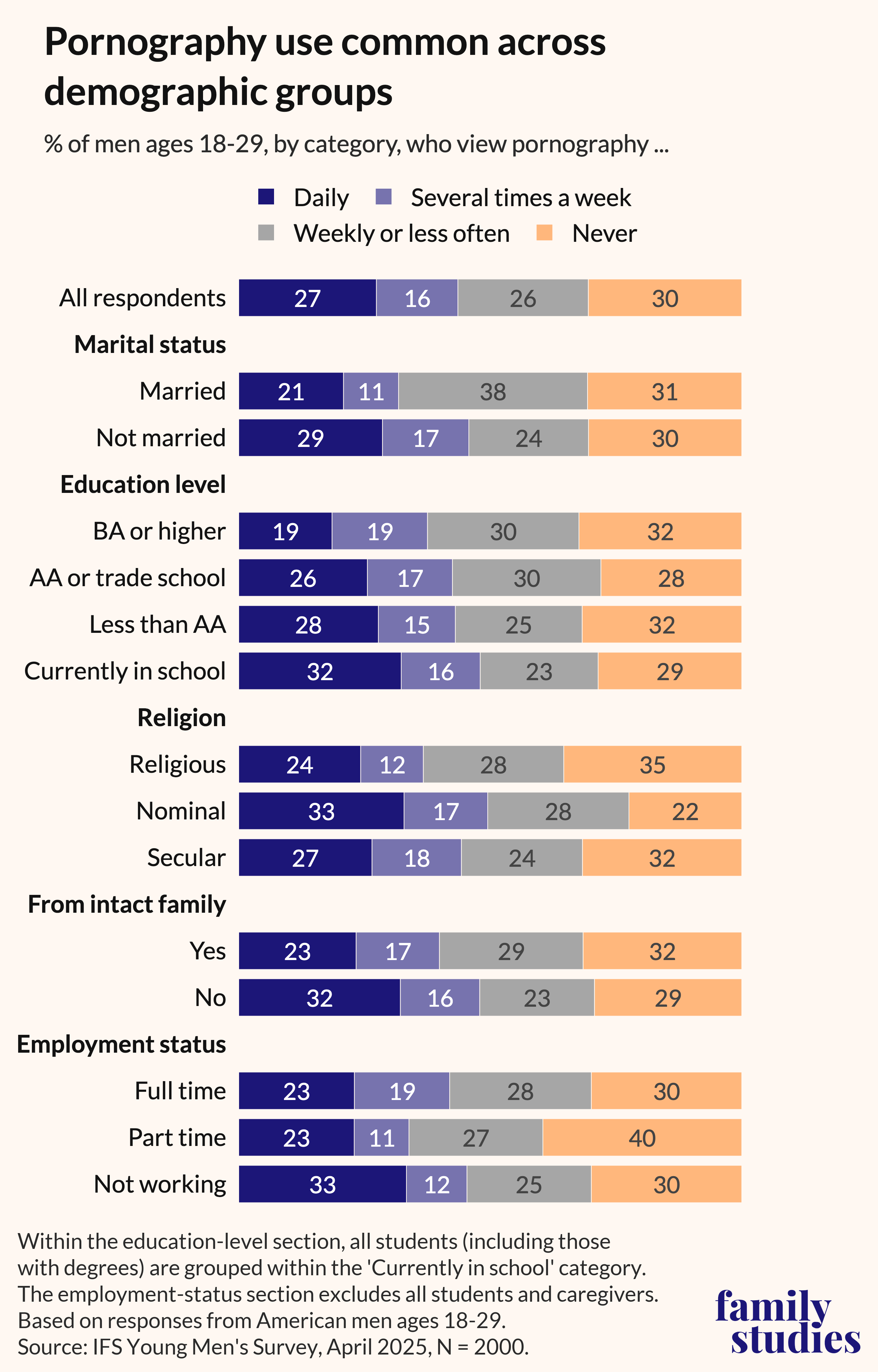
- Pornography use among young men is extremely widespread: 42% watch porn daily or several times a week, with another 26% viewing it weekly or less. Post This
- The American dream feels out of reach for many young men; even so, a remarkable 84% say that having ambitious plans for the future describes them at least somewhat well. Post This
In March 2026, the Institute for Family Studies released America’s Demoralized Men, Part I: Worthy Aspirations, Trying Circumstances, the first installment of a two-part report, based on a YouGov survey of a nationally representative sample of 2,000 young men, ages 18-29. Our aim, within the limits of the survey, was to allow young men to express themselves on a range of personal issues, for which there has been considerable and often harsh public commentary.
In Part I, we began our exploration by considering what young men say about becoming an adult—both in terms of what it means to them and whether they feel they have reached that life stage. We found that while they see adulthood as a matter of personal responsibility, self-direction, and financial independence, accessing their own adult status is connected to the older metrics, like marriage, parenthood, and finishing school. By these criteria, many do not feel they have reached full adulthood. However, when we asked about work, manhood, marriage, and parenthood, the great majority express a strong desire to be responsible men, to make a living sufficient to support themselves and others, to date, to marry, and to become fathers.
Reaching these worthy goals, however, is another matter. Young men identified a number of specific obstacles, from inadequate incomes to limits on educational opportunity, to personal struggles to finding a suitable romantic partner. They are not where they want to be in life, and the mismatch between their aspirations and where they stand is a source of frustration and stress.
In this second installment, America's Demoralized Men, Part II: Lost Pathways, Greater Struggles, we continue our analysis by first taking a close look at the social lives of young men, including questions about social integration and support, friendship and participation in organized groups, and family relations, especially with parents. Next, we consider feelings of alienation and frustration, perspectives on the American Dream and how their future will take shape, and reports of mental health problems and potentially traumatic experiences. Lastly, we survey online activities, such as pornography, gaming, and gambling, and some of the trouble correlated with these.
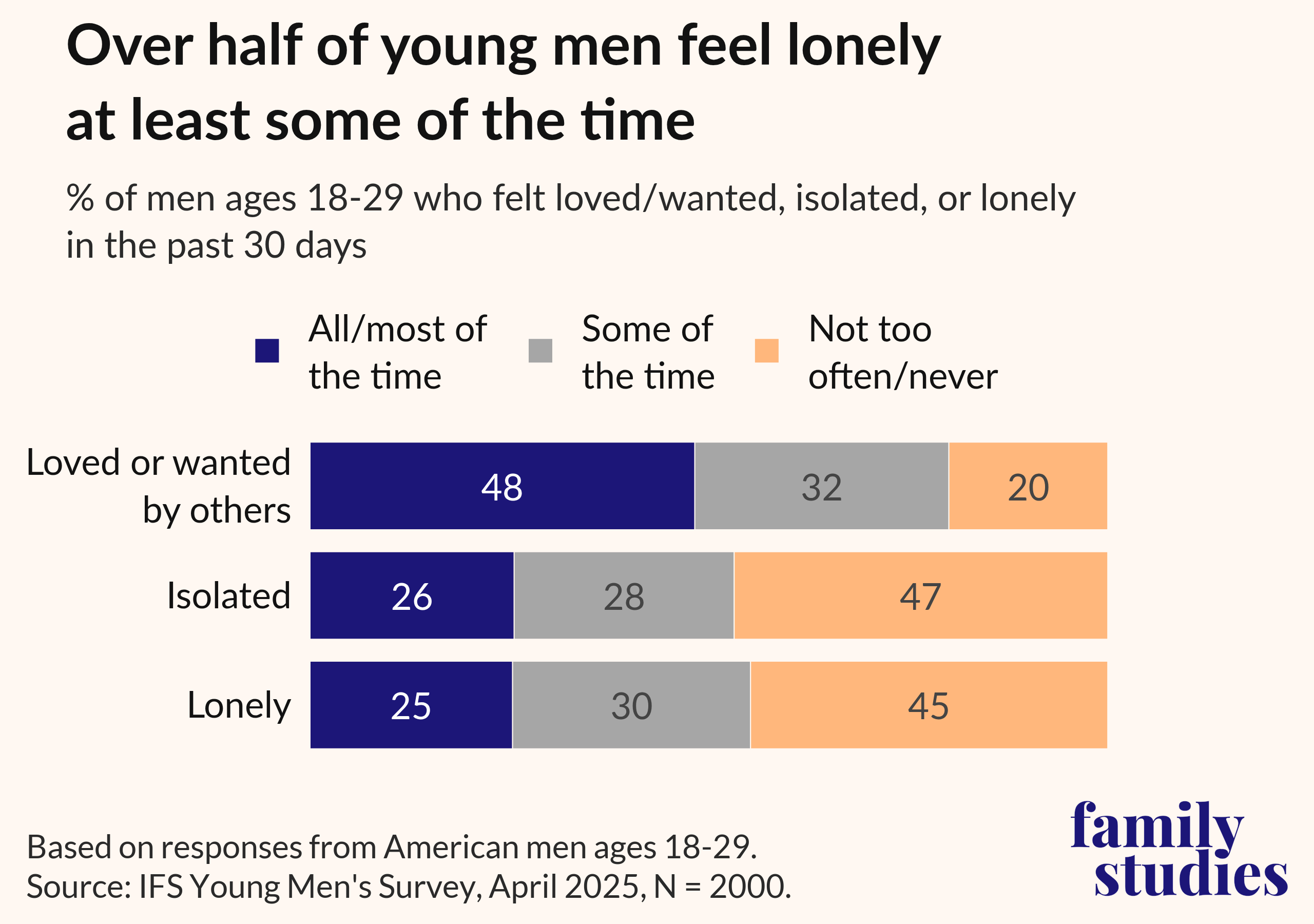
“Demoralized” is the term we use to characterize a state of mind reflected in agreement with such self-appraisals as “I am inclined to think that I am a failure” (43%), and such expressions of powerlessness as “I often feel that I have little control over the things that happen to me” (61%), and of being found insufficient, such as “I never seem to do enough to please people” (54%). We also report here on the dispiriting experience of feeling lonely (25%), isolated (26%) or lacking community (48%) much of the time. As we noted in Part I, some young men “are not in crisis but thriving.” But some are struggling mightily, as we can see in the major findings reported below.
Major Findings
Here are 7 important findings from Part II of our report:
1. Slightly less than half of young men feel a steady emotional connection to others. Close to half of the young men say they never or not too often feel lonely (45%), isolated (47%), or unloved or unwanted (48%). The other half, however, report feeling lonely (55%) or isolated (54%) at least some of the time; and when the young men were asked if they feel loved or wanted by others, 1 in 3 (32%) say only some of the time, and 1 in 5 (20%) say seldom or never.
2. For many young men friendships are in short supply. In fact, 4 out of 10 young men have two or fewer close friends, which includes 1 in 3 (34%) with one to two close friends and almost 1 in 10 (9%) who report zero close friends. The best predictor of having three or more friends is connection to institutions like marriage, church, and school. Young men who participated in all-male groups, such as sports teams or the Boy Scouts, during the school years are also more likely to report three or more friends (64%) than those who did not (48%).
3. Social, civic, and religious participation is low. While 57% participate in at least one community activity, a mere 31% report working as a volunteer, and even fewer are members of a faith-based group (29%), social club (27%), adult sports league (24%), or other type of civic organization. In terms of overall participation, being involved with at least one activity is most strongly associated with being religious (81%), being a student (73%), being married with kids (72%), and having finished trade school (74%). Overall, 25% attend religious services at least monthly; 28% say they have become more religious in recent years.
4. The American dream feels out of reach for many young men. About half of young men agree with the statement, “No matter how hard I work, people like me will never achieve the American Dream.” Similarly, 72% agree that “Who you know is more important than ability or hard work in getting ahead.” For a significant share of young men, the meritocratic story is a myth. Still, they are not giving up on themselves: a remarkable 84% say that having ambitious plans for the future describes them at least somewhat well.
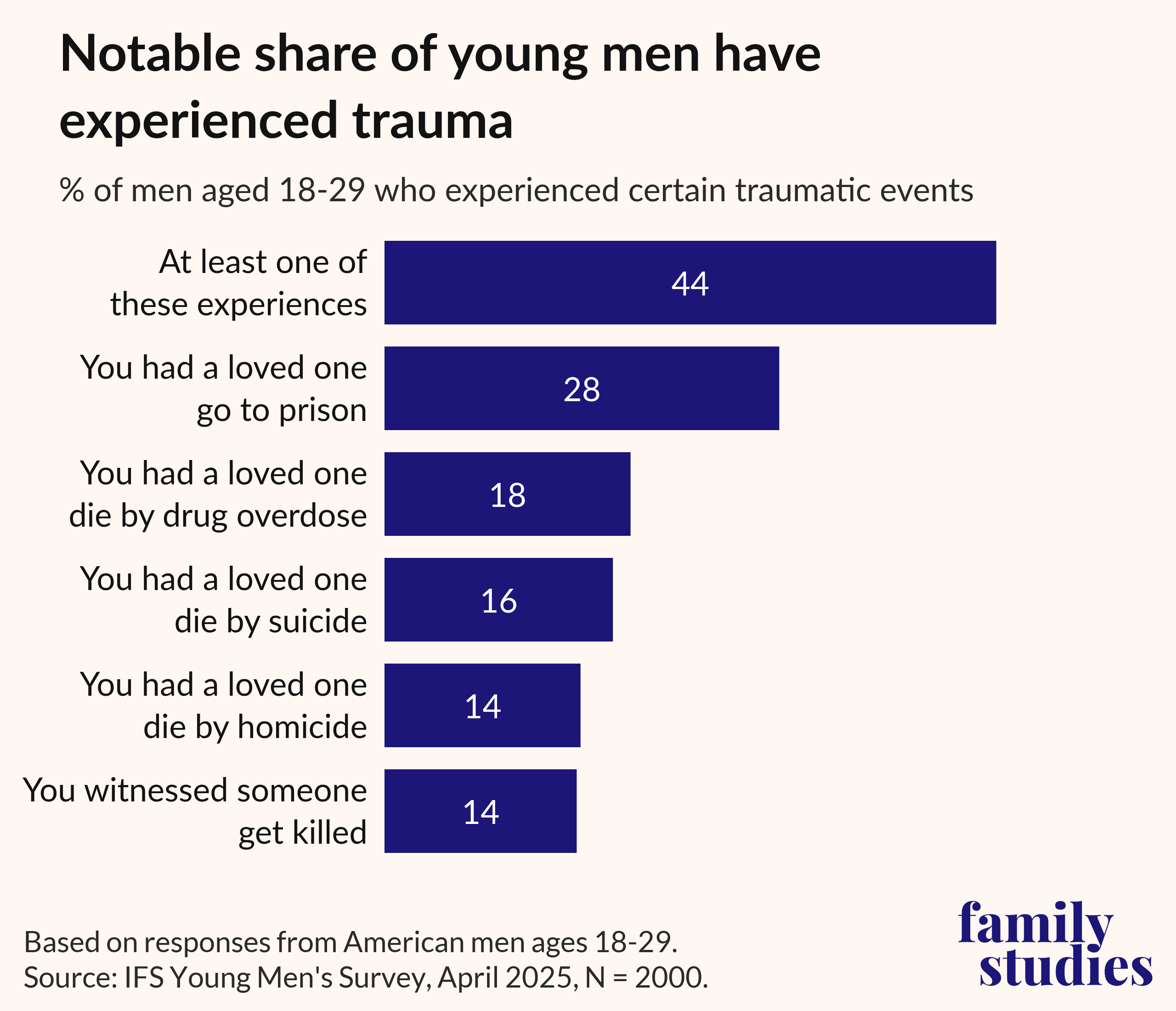
5. A notable share of young men report having faced traumatic events in their lives. For example, 12% have ever been incarcerated, while 44% have a loved one who has gone to prison (28%), died of a drug overdose (18%), died by suicide (16%), or died by homicide (14%). The men with such experiences have higher rates of mental health struggles than those who do not, including with depression (49% vs. 27%), an anxiety disorder (44% vs. 25%), ADHD (36% vs. 19%), bipolar disorder (26% vs. 8%), and a learning disability (21% vs. 11%).
6. Electronic media use is very high. Gambling is rampant: 23% of young men gamble daily, an additional 12% do so several times a week, and another 21% gamble weekly or less. Gaming is also very common, with 44% playing video games many times a day or more, and another 42% doing so at least a few times a week. Pornography use is also extremely widespread: 42% watch porn daily (27%) or several times a week (16%), with another 26% viewing it weekly or less. Those who watch porn daily include married men (21%) and regular religious service attenders (24%).
7. Online gambling and pornography have significant emotional repercussions. Around 2 in 3 regular online gamblers say it has caused them at least some distress. Of those who watch pornography many times a day or more, 43% experience loneliness, 36% feel depressed, and 29% are anxious. Feeling like a failure is also closely tied to these activities. For example, 66% of daily gamblers and 63% of daily pornography watchers, compared to 42% of men as a whole, report feeling like a failure.
Continue reading the full report, here.
*Photo credit: Shutterstock


