

Highlights
- In our survey of about 10,000 people across 12 countries, we failed to find a significant negative association between feeling overburdened by chores and any fertility indicator. Post This
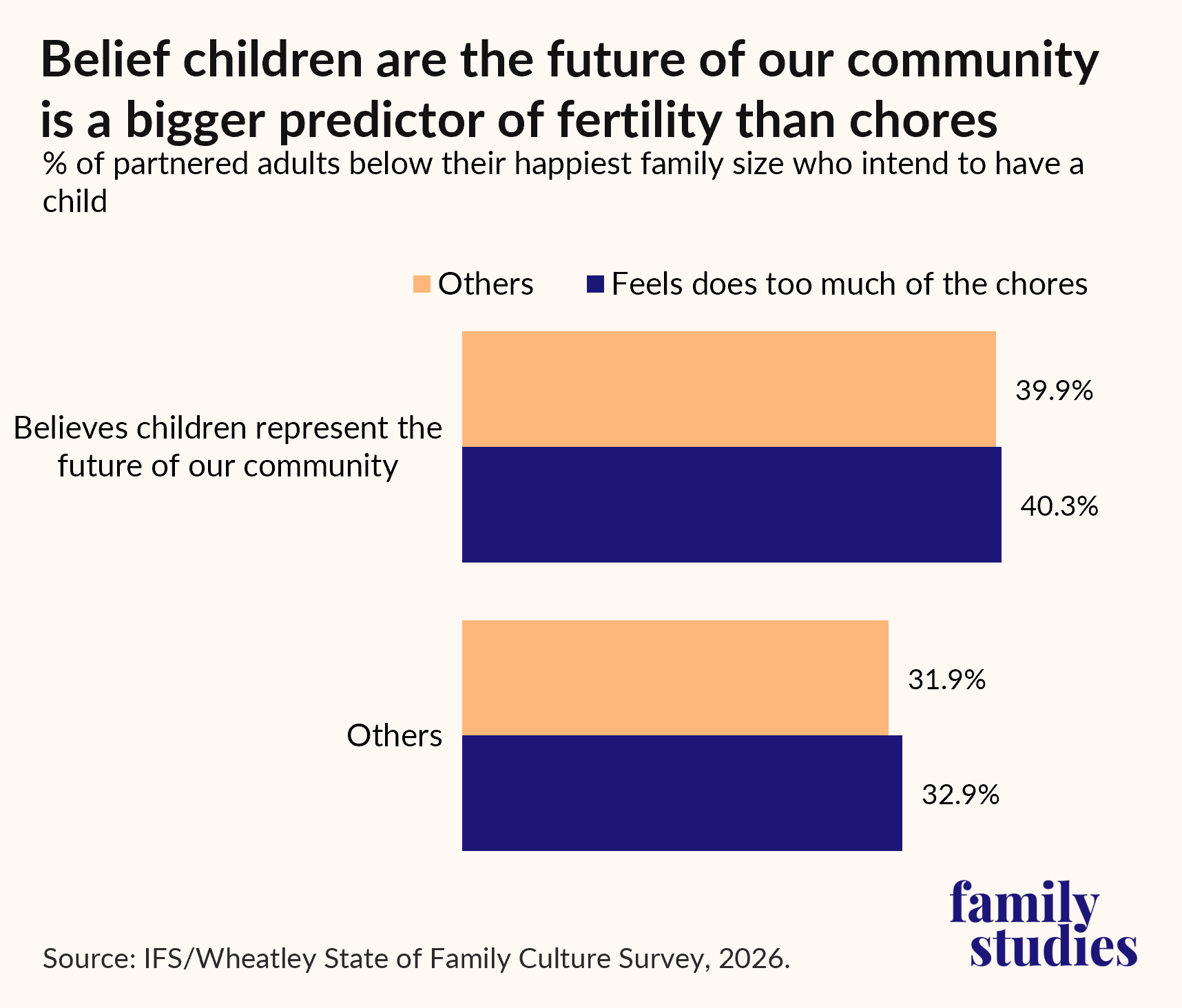
- The belief that “children are the future” explains far more of the variation in intentions to have another child than feeling that one does too many chores. Post This
Theories about recent declines in fertility have exploded in the past few years, but few have been circulated as widely as that recently popularized by the Nobel Prize-winning economic historian Claudia Goldin: the Incomplete Gender Revolution Hypothesis. Under this theory, the variation in birth rates around the educated world can be explained by the distribution of household and child care labor between men and women.
Goldin frames her argument in terms of economic growth outpacing social attitudes, and women being left with a bad deal in which they are expected to both engage in paid work and take on the brunt of the housework and child care. According to Goldin, women are simply rationally opting out of a bad deal. In response, some have suggested that men taking on more housework or child care might help more women to have the children they desire, and others have called for increased government provision or subsidizing of child care.
But there are at least three problems with this account: the evidence for the hypothesis is speculative, it has the appearance of being cherry-picked, and there are good reasons to doubt that it’s true, as Lyman Stone, Jason Carroll, and I found in our latest report, Baby Nudges.
If the Incomplete Gender Revolution hypothesis is true, then we would expect women who feel more burdened by their domestic responsibilities to have lower intentions to have children, since the whole theory is that women’s disproportionate burdens are leading them to forego births. But that’s not what we found. When we surveyed around 10,000 people across a dozen countries, we failed to find a significant negative association between feeling overburdened by household chores and any fertility indicator.
In fact, we did not find the hypothesized effect for men or women, for childless respondents, or for parents, for young people under 35, or even for couples. There was one exception: partnered men who felt they did more chores than they should were 21.5% less likely to intend to have another child. In contrast, partnered women who felt the same way had a (non-significant) 1.1% higher chance of intending to have another child. It appears that, contrary to the hypothesis that women’s burdens reduce fertility, it is within the realm of possibility that men’s fertility intentions may be more sensitive to perceived domestic unfairness. As the chart below shows, all association was driven by male respondents.
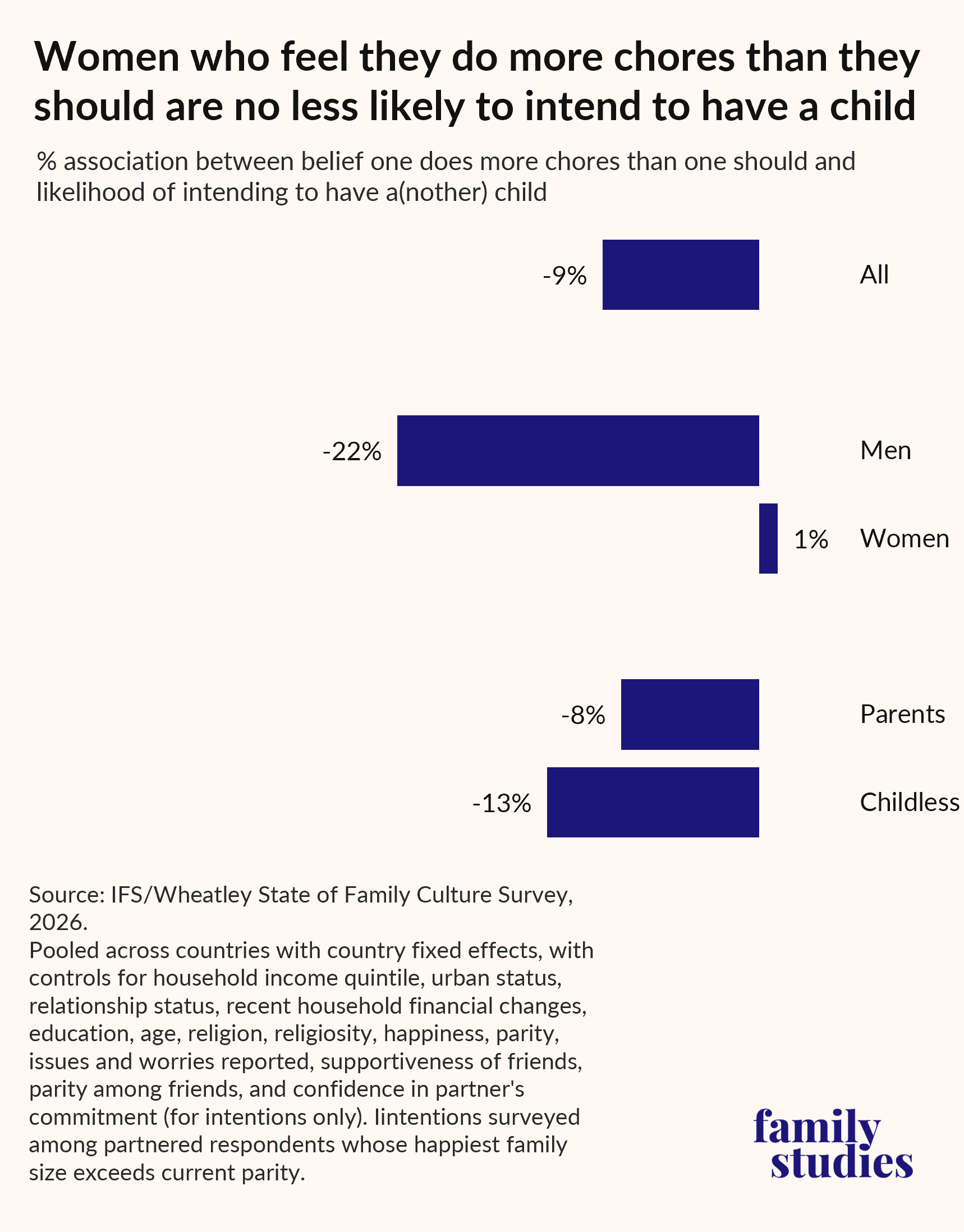
But maybe our null finding is just a product of our question being about perceptions; maybe a more objective measure of domestic labor would find something different. Not so. In questions we asked about specific household tasks, we essentially found no relationship with any fertility indicator for the groups we measured. In other words, the idea that low fertility is caused by an unfair chore chart just does not seem to hold up.
What we observed in the individual data also showed up in comparisons between countries. There was a weak—and, if anything, positive—cross-country correlation between the share of adults who feel they do more chores than they should and the share who intend to have a(nother) child. Those who value family find themselves intending kids even while doing a lot of work around the house.
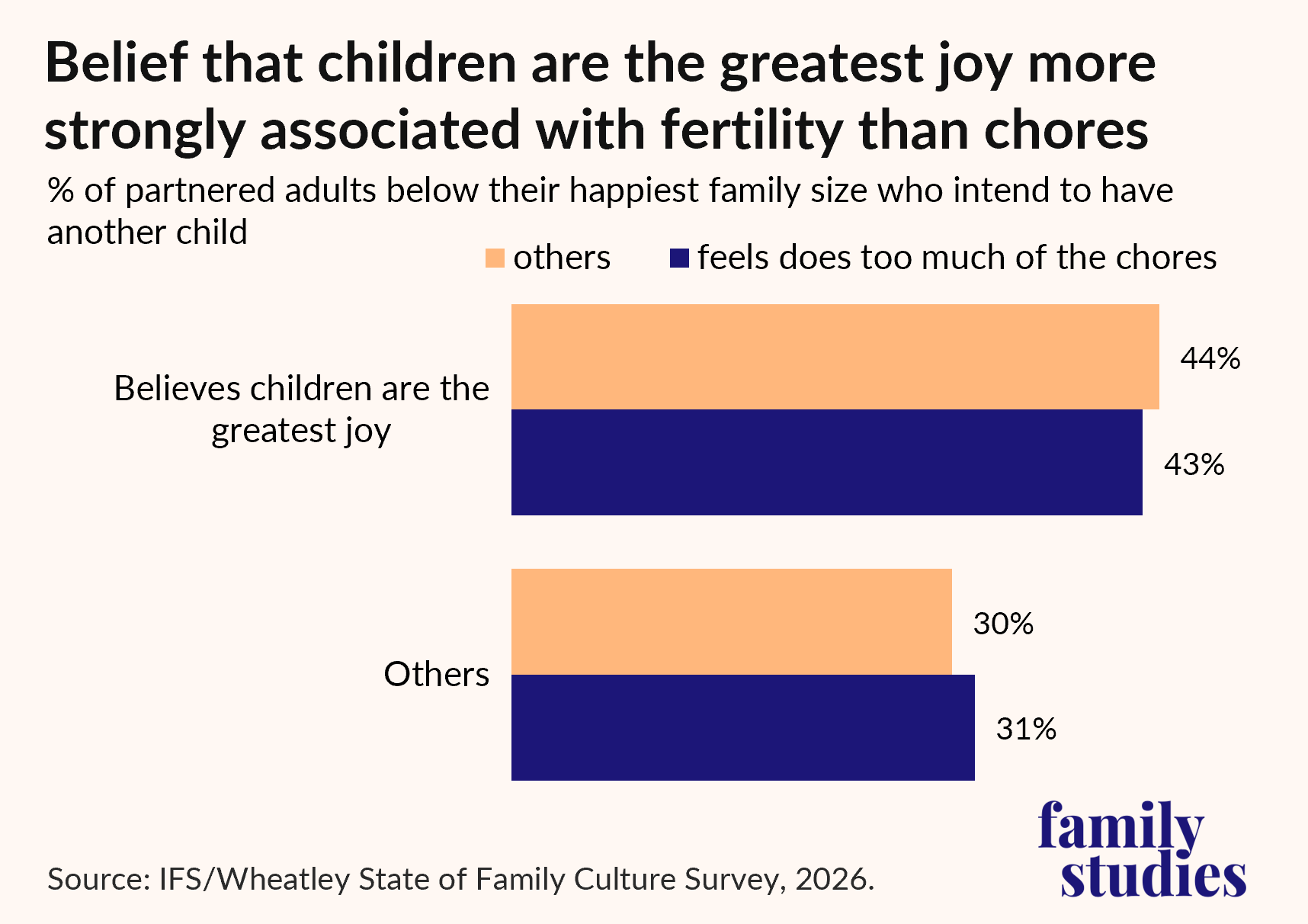
As it turns out, there are some pretty strong associations. Belief that children are the future of the community or that children are the greatest joy both positively predict intending to have another child and the desired number of children. More to the point, the belief that “children are the future” explains far more of the variation in intentions to have another child than feeling that one does too many chores.
In addition, other positive attitudes or beliefs towards family life predict fertility intentions. This applies to the belief that children are the greatest joy.
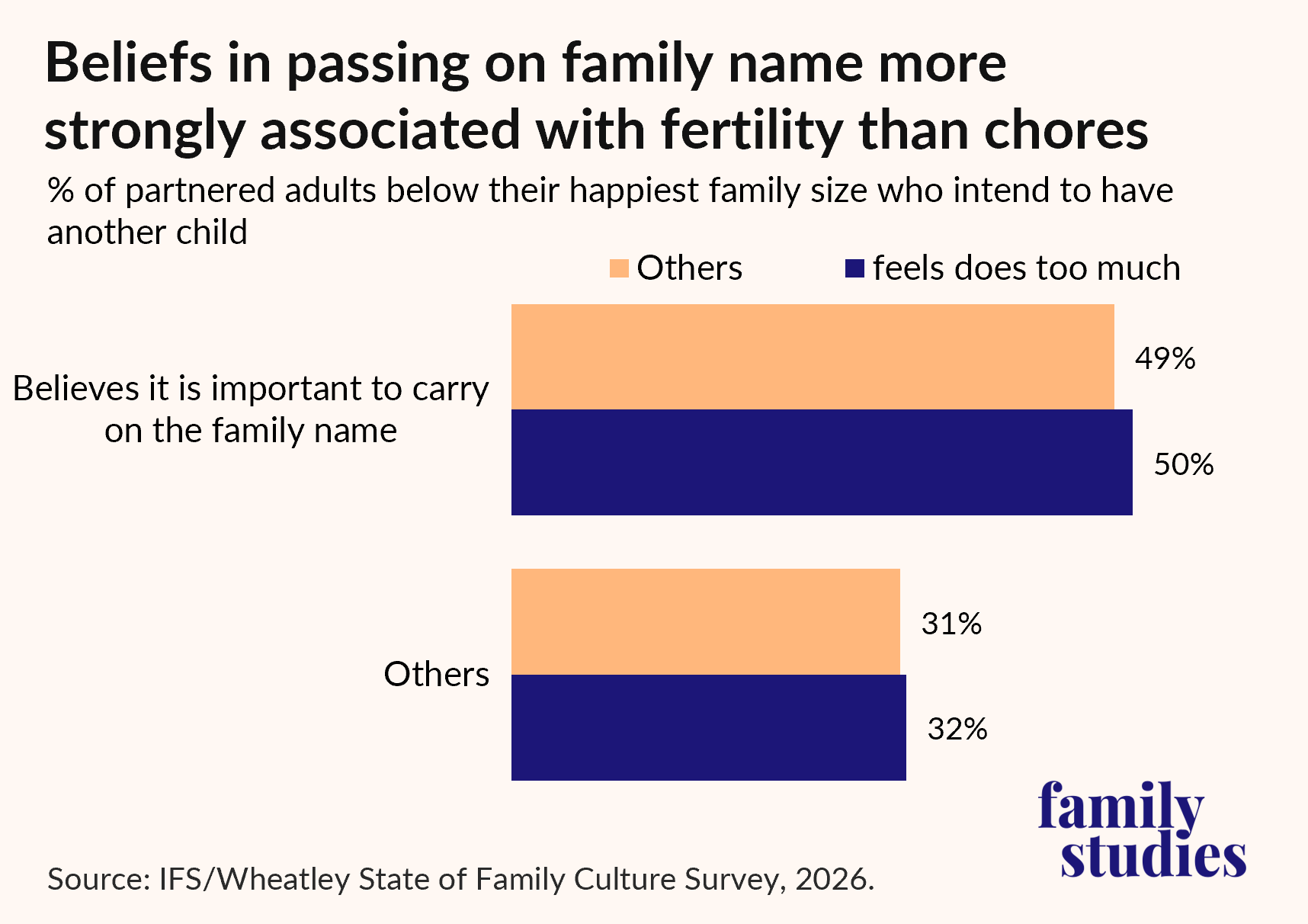
Additionally, the belief that is important to have children to carry on the family name predicts fertility intentions—indicating, again, that how much one values kin predicts fertility more than household chore burden.
We found that the beliefs and attitudes positively associated with fertility intentions and desires were largely at their lowest prevalence in East Asian countries. For example, Korean, Japanese, and Chinese speakers living outside of the mainland were the least likely to believe it is important to carry on the family name.
There is also another striking difference between much of the West and East Asian countries: religious belief. The four East Asian demographics we surveyed (mainland China, Japan, Korea and Chinese speakers overseas in East Asia) all had the lowest religiosity in our international survey, and, accordingly, the lowest rates of the belief that people should have as many children as God gives them. In our survey, religiosity and belief that people should have as many children as God gives them both predict higher desired number of children.
Our survey does not provide strong evidence of the causal links between these different variables, but it does tell us that there is no observable link between the chore burden women feel and their likelihood of intending to have children. When trying to explain gaps in fertility between East Asian and Western countries, our survey also suggests other values differences: Western respondents were, on average, more religious and more likely to hold pro-family attitudes which predict fertility desires or intentions.When discussing birth rates, we arguably have rushed too soon to explain trends exclusively in terms of work-family struggles and paid scant attention to the role of values and attitudes.
Peter Foreshaw Brookes is a Research Associate of the Pronatalism Initiative at the Institute for Family Studies.
*Photo credit: Shutterstock


