
Highlights
- Religious participation in a faith community opens up the mechanisms for social capital that makes flourishing possible—support, belonging, shared values, trust, and meaning. Post This
- Our analysis of the Global Flourishing survey's U.S. sample indicates that religious affiliation remains a key predictor of human flourishing for men and women. Post This
Over the last three decades, religious affiliation in the United States has undergone a precipitous decline. Whereas 90% of U.S. adults identified as Christian with 5% unaffiliated in 1972, only 63% identified as Christian, with 28% unaffiliated in 2024. The crucial turning point appears to be the 1990s, when disaffiliation began escalating. In a relatively short period of time, being religious shifted from an assumed public norm to almost a contested identity. By 2024, nearly half of religious Americans said they felt culturally “out of step.”
Mainstream media reflects this dramatic shift. Dean Baquet, executive editor of The New York Times, admitted openly in 2016, “We don’t get religion. We don’t get the role of religion in people’s lives.” Religion is often addressed when it intersects with politics, terrorism, international conflict, sexuality, or scandal. But understanding the ordinary ways that faith shapes daily life and serves as a framework for understanding everything else is almost entirely absent.
Given the shift, we might assume that religion plays a less important role in people’s lives today than it once did. And given than younger generations have seen the strongest decline in religiousness, the decreased impact of religion may be particularly visible for this group. However, the evidence reveals something very different: faith still has a powerful link to human flourishing, including for young people.
Tracking Human Flourishing
Scholars are just beginning to unpack findings from the most comprehensive study of human well-being ever undertaken, the Global Flourishing Study, conducted by Harvard University’s Human Flourishing Program and Baylor University’s Institute for Studies of Religion. The global longitudinal study of over 200,000 participants in 22 countries uses a rich set of questions to explore what makes it possible for human beings to really thrive. It includes measures in six different life domains: happiness and life satisfaction, physical and mental health; meaning and purpose; character and virtue; close social relationships; and financial and material stability.
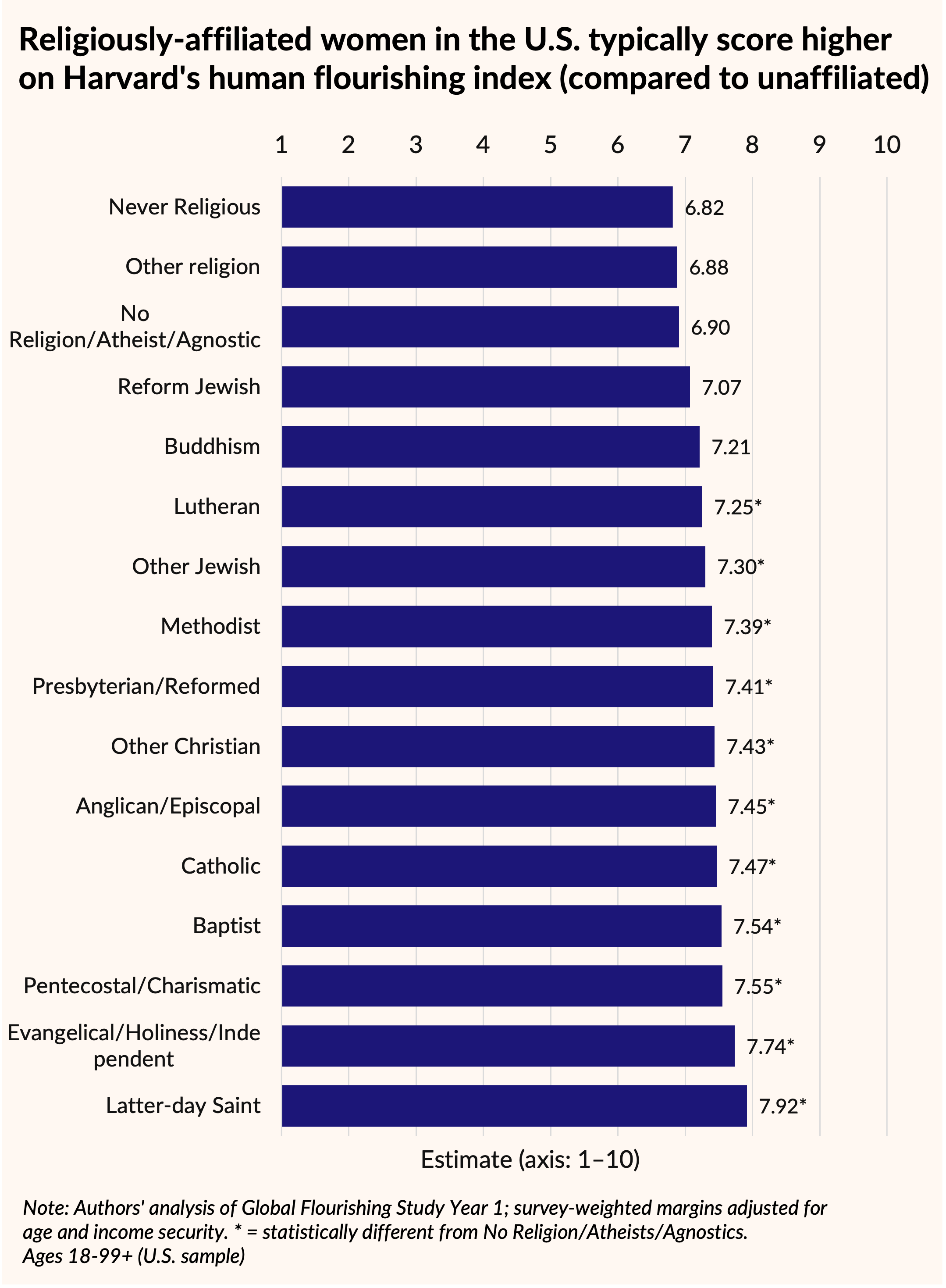
Our analysis of the survey’s U.S. sample indicates that religious affiliation remains a key predictor of human flourishing. As illustrated in the charts below, religious individuals from almost every religious group reported significantly higher flourishing overall (on a 10-point scale). They also reported significantly higher flourishing on every single life domain except financial and material stability.
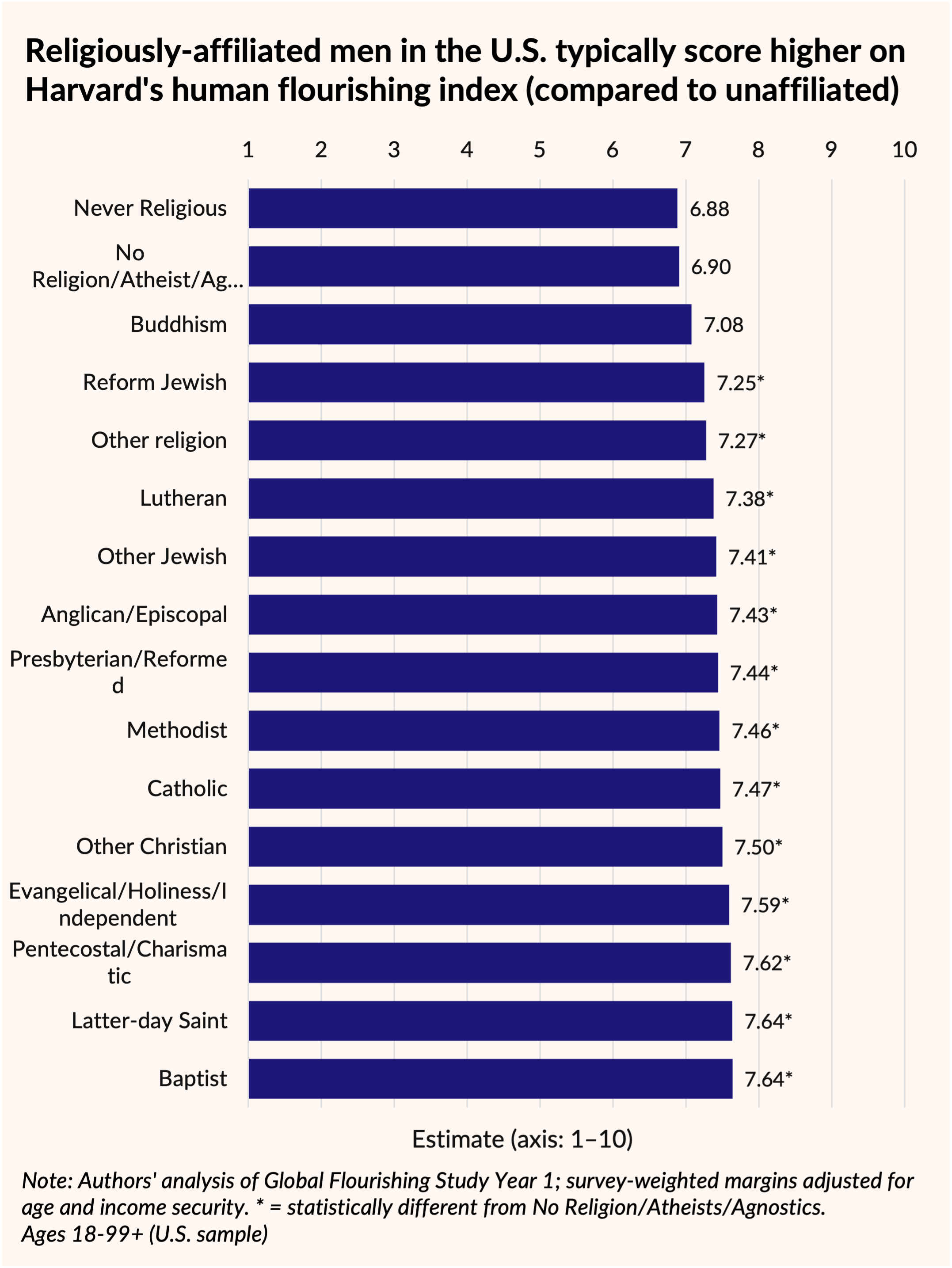
These findings hold up for women as well as men, in spite of a more rapid decline in religious participation among women in the most recent decade. Both religious women and men show significantly higher measures of well-being than those who are non-religious.
The largest gaps between the religious and non-religious in the different domains of flourishing for women and men were in reports of meaning and purpose (nearly 3 points), followed by happiness and close social relationships.
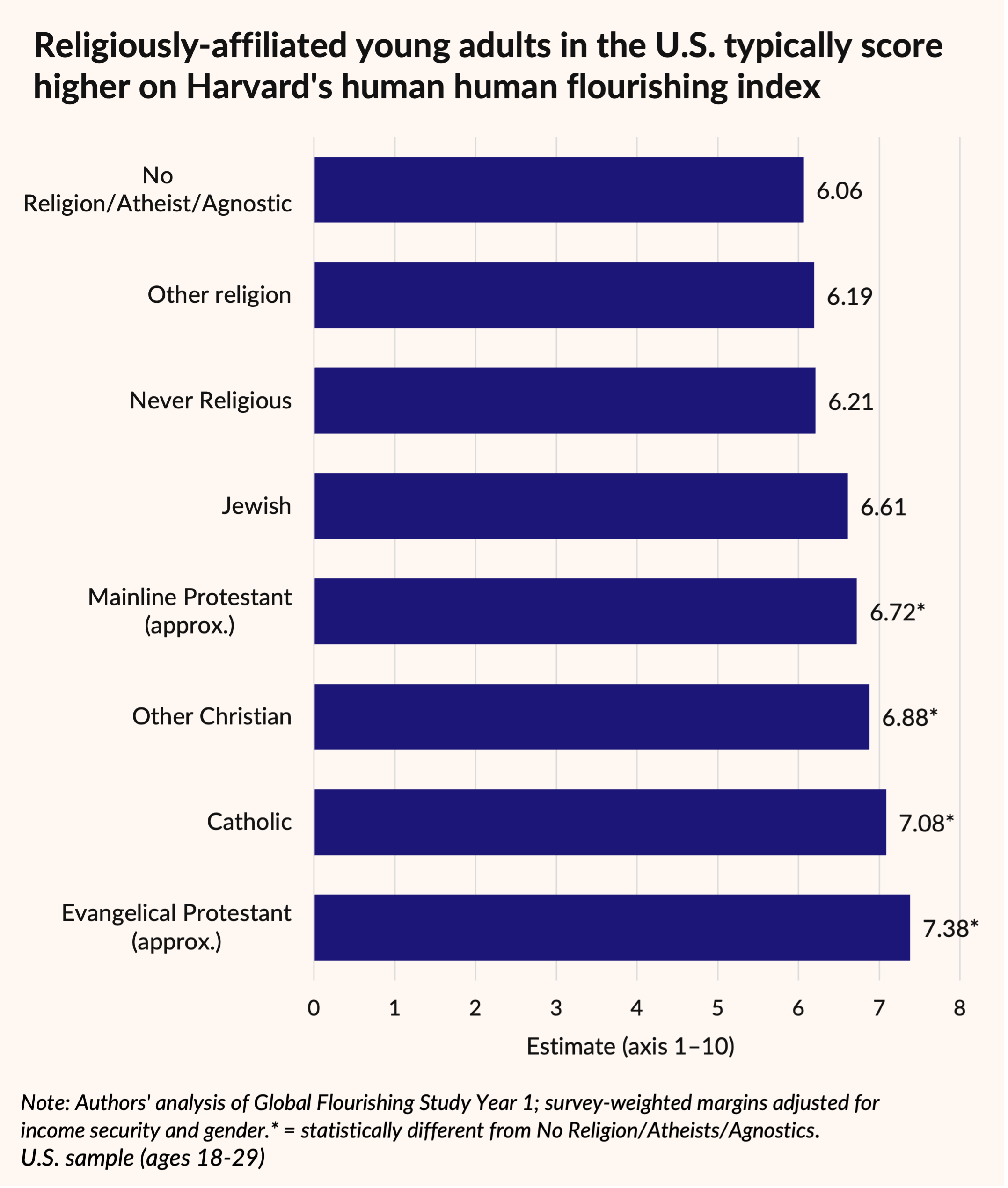
But what about the most recent generation? This is a critical question given a wide range of research indicating that young people are not doing as well as previous generations on a range of well-being measures, including happiness, health, meaning, relationships, and financial stability. However, as the figure below shows, religious affiliation continues to be a significant predictor of flourishing for young adult Americans as well.
Johann Kurtz argues that “on the surface,” things may seem fine for Millennials and Zoomers. Real median incomes are higher than they were for their parents at the same age, unemployment has remained remarkably low, and things like clothing, food, and electronics are cheaper than ever. But these cohorts are also failing to move through “the five pillars of a stable middle-class existence: education, stable employment, marriage, homeownership, children,” the very pillars that are so fundamental to flourishing.
And why? Previous generations received, according to Kurtz,
an enormous stock of social capital: trusted neighbors, functional public schools, a productive courtship culture, predictable career arcs, and a public square in which children could roam, and adults could be relied upon. That stock, once given for free, has not been substantially liquidated.
This social capital has become expensive—perhaps even unattainable—for younger generations, and it is showing up in dramatic differences between their well-being and that of older generations.
Yet it is precisely that gift of social fabric that religious communities are so effective at building and passing on. Religious participation in a faith community opens up the mechanisms for social capital that makes flourishing possible—support, belonging, shared values, trust, and meaning. For young adults today, these mechanisms play a critical role in guiding them along the fundamental institutional pathways of family, education, and work at a time when that support has become particularly challenging to access. As the recent Institute for Family Studies report, The Devout Difference, concluded, religious Americans are significantly more likely to marry, stay married, and start a family than their nonreligious peers, creating a gap that continues to widen. In our “technologically distracted, atomistic, and economically unequal,” the IFS report notes, religious institutions may be particularly valuable “in fostering the bonds that afford communion with others,” creating “reliable sources of social, emotional, and normative support.”
At a time when religious faith has become almost unfamiliar to our culture, its relationship to human flourishing in America appears to be stronger than ever. The very things that religious communities have long cultivated are among the dimensions of life that are most challenging for young adults, especially, to grasp. But as these findings confirm, faith is not a relic of an earlier cultural era. For many, it remains the fundamental source of the relationships, practices, and shared commitments that make a flourishing life possible. In the midst of pervasive social fragmentation, that reality deserves more careful attention and promotion from all of us.
Jenet Erickson is Nonresident Senior Fellow in Maternal and Child Well-being at the Institute for Family Studies, and an associate professor in the Department of Church History and Doctrine in BYU Religious Education. W. Justin Dyer is a Professor of Religious Education at Brigham Young University and an affiliate scholar at the Wheatley Institute.


