
Highlights
One of the most powerful expressions of human intimacy is sex. Human beings are social animals, after all, and sex is an unparalleled way to express and receive love, to touch and be touched, and to bring new life into the world. No wonder that regular sex is tied to our physical and emotional health and is one of the most powerful predictors of human happiness.
Unfortunately, America is on the downslope of a “sex recession,” with the share of adults reporting weekly sex falling from 55% in 1990 to 37% today. A big reason is the retreat from marriage.
Pop culture says monogamous marriage kills passion. As one 46-year-old woman recently told The Telegraph: “I thought motherhood had killed my sex drive, but I just needed a divorce.”
The data says otherwise. The Dartmouth economist David Blanchflower and his colleague Andrew Oswald found that “married people have more sex than those who are single, divorced, widowed or separated.” The surest path to a good sex life still runs through the altar, not away from it.
But today’s married couples aren’t fully immune to the sex recession, either. In 2008, 59% of married couples between the ages of 18 and 64 reported having sex at least once a week. That number today is about 49%. But there’s another stereotype-busting twist: That decline has largely missed married religious couples.
The surest path to a good sex life still runs through the altar.
According to recent research, churchgoing couples in America (and the religiously observant of other faiths) are still having sex about as often as they were in the 1990s, with almost two-thirds of religious husbands and wives getting intimate on a regular basis. It is secular couples who’ve experienced a big drop-off in sex, with less than half of them enjoying this kind of intimacy at least once a week.
Over the past few decades, religious faith has become bound more tightly to conservative political viewpoints and partisan affiliation. That left us wondering: Does the sex divide follow ideological lines as well as religious ones?
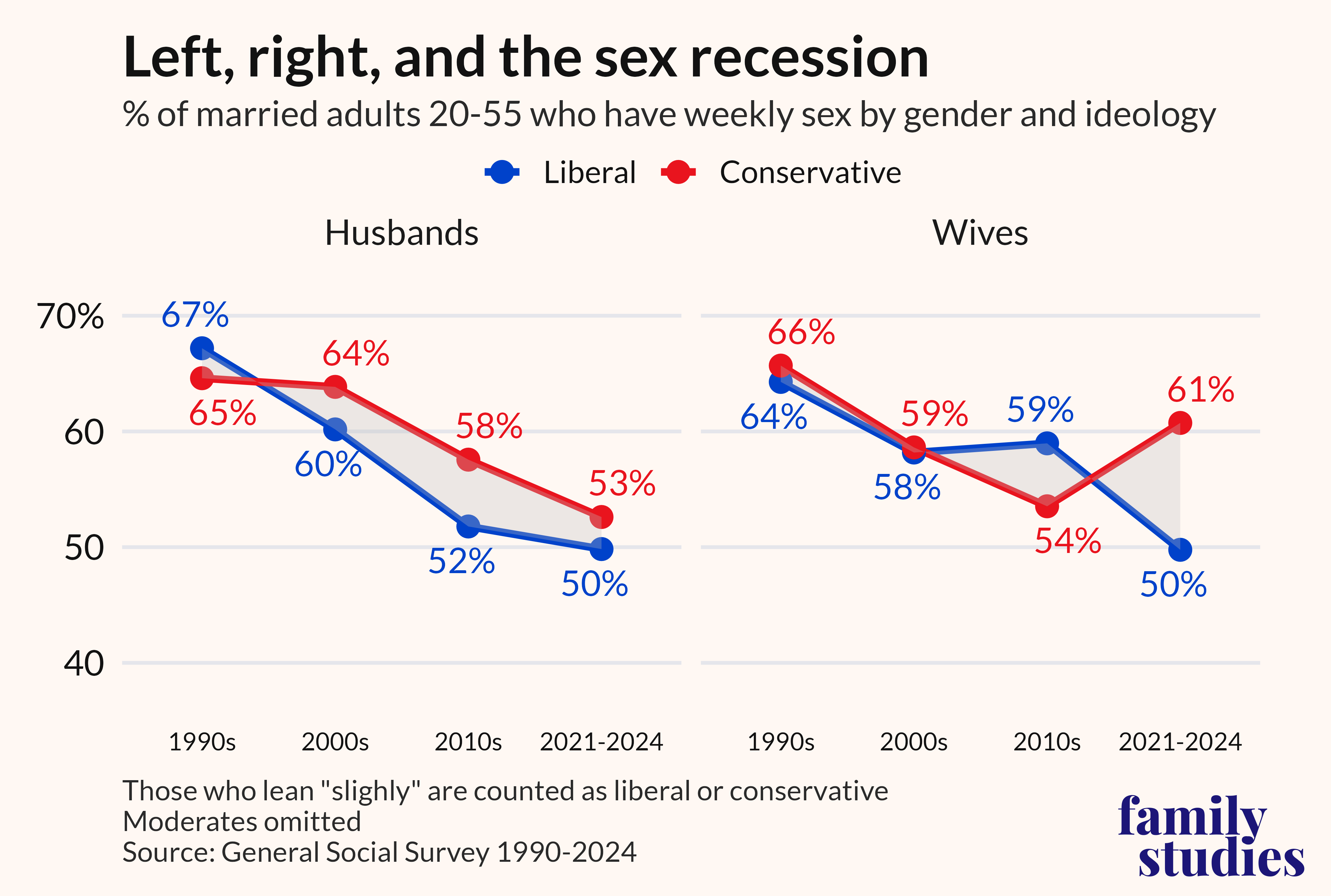
Data from the General Social Survey suggest a tentative “yes.” Among married women ages 20 to 55, marital sex has fallen sharply for liberals since the 1990s, but not for conservatives. Among husbands, the pattern runs in the same direction: Conservative men saw only modest declines. But the gap between conservative and liberal husbands isn’t statistically significant.
This pattern also shows up in the 2022 “State of Our Unions Survey”—a sample of about 2,000 married men and women by YouGov. Again, conservative husbands have a slight edge here in marital sex, but it’s not statistically significant. By contrast, when it comes to wives, we see that a majority (55%) of conservative wives have sex weekly or more, compared to only a minority (45%) of liberal wives.
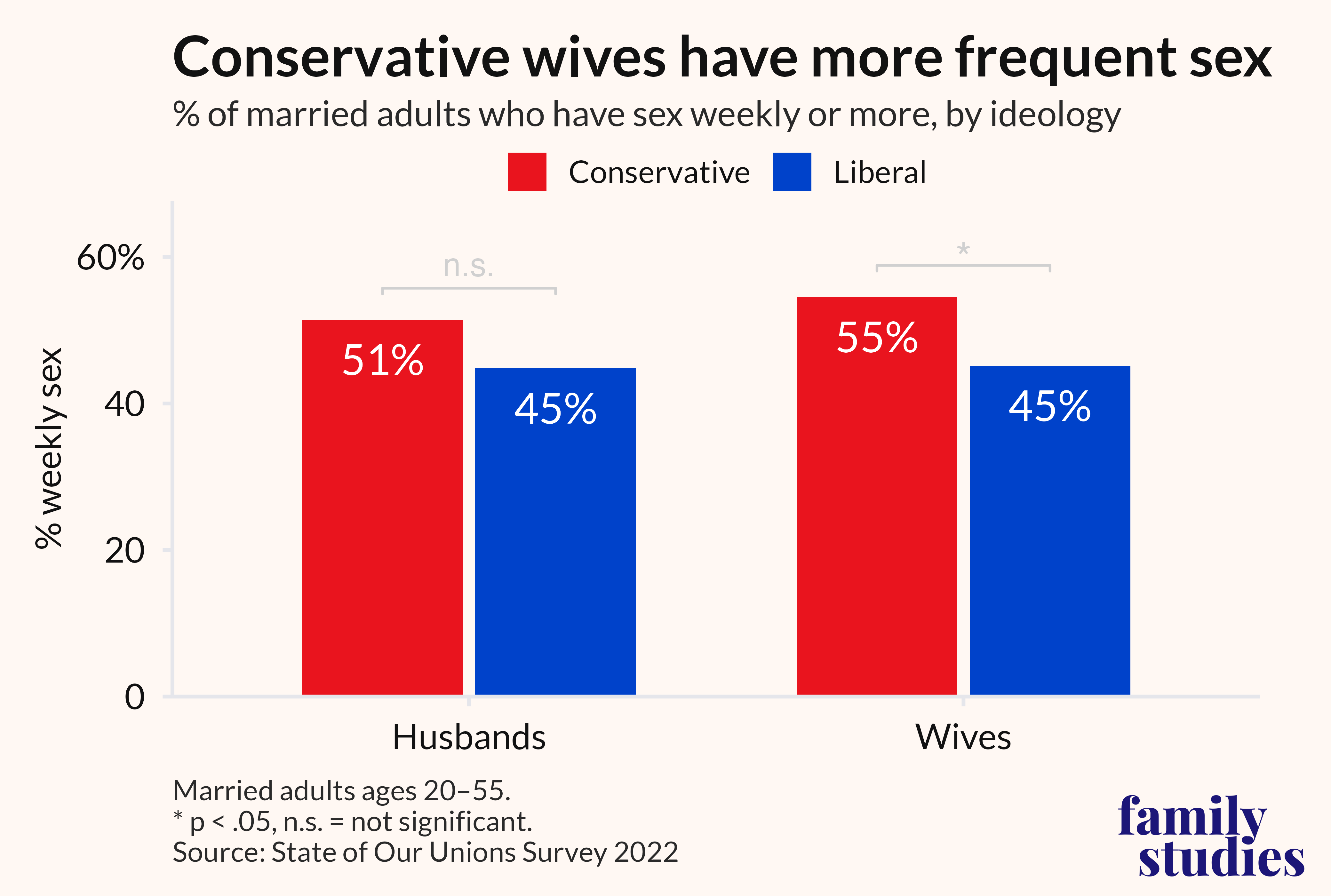
The data suggests that the gap between conservative and liberal wives is largely explained by conservatives being more religious—recall, again, that churchgoing couples have more sex. But perhaps ideology, social lives, and the algorithm are also parts of the equation.
Liberals are more exposed to messaging that catastrophizes about men and marriage, and they spend more of their lives online. Data from the Survey Center on American Life shows that Democratic women are about twice as likely to blame men for the “challenges that women face in American society” today—and the tide of anti-male attitudes has surged among women on the left since the rise of social media.
Other surveys indicate that Democrats are less likely to believe that marriage is a vehicle for happiness, important for children and needed to create strong families. Left-leaning Americans may be less likely to invest in their marriages—and, indeed, they are less likely to be happily married.
But the correlation between ideology and marital sex habits may also arrive from an unexpected statistic: the amount of time men and women spend online. Liberals spend more time on social media than conservatives, so progressive men and women are more likely to encounter the polarizing, controversy stirring content that keeps the platforms churning. The “gender wars,” hot-take battles between far-right misogynists and far-left radical feminists, may keep people scrolling. But they can be poison for real relationships.
Consider a recent episode of “Call Her Daddy,” one of the most popular podcasts among young women. Host Alex Cooper told the actress Sophia Bush that if a woman is wondering whether she could do better than her husband, “the answer is always ‘yes’.” Bush agreed: “This idea that it’s too late or you’re too old, or who are you to want more, that’s patriarchy. That is crazy.”
Is it, though? Research says the opposite. Not only did Blanchflower and Oswald find that “sexual activity enters strongly positively in happiness equations” but also that the happiness-maximizing number of sexual partners in a given year was one. Indeed, the happiest Americans are married men and women having sex at least once a week.
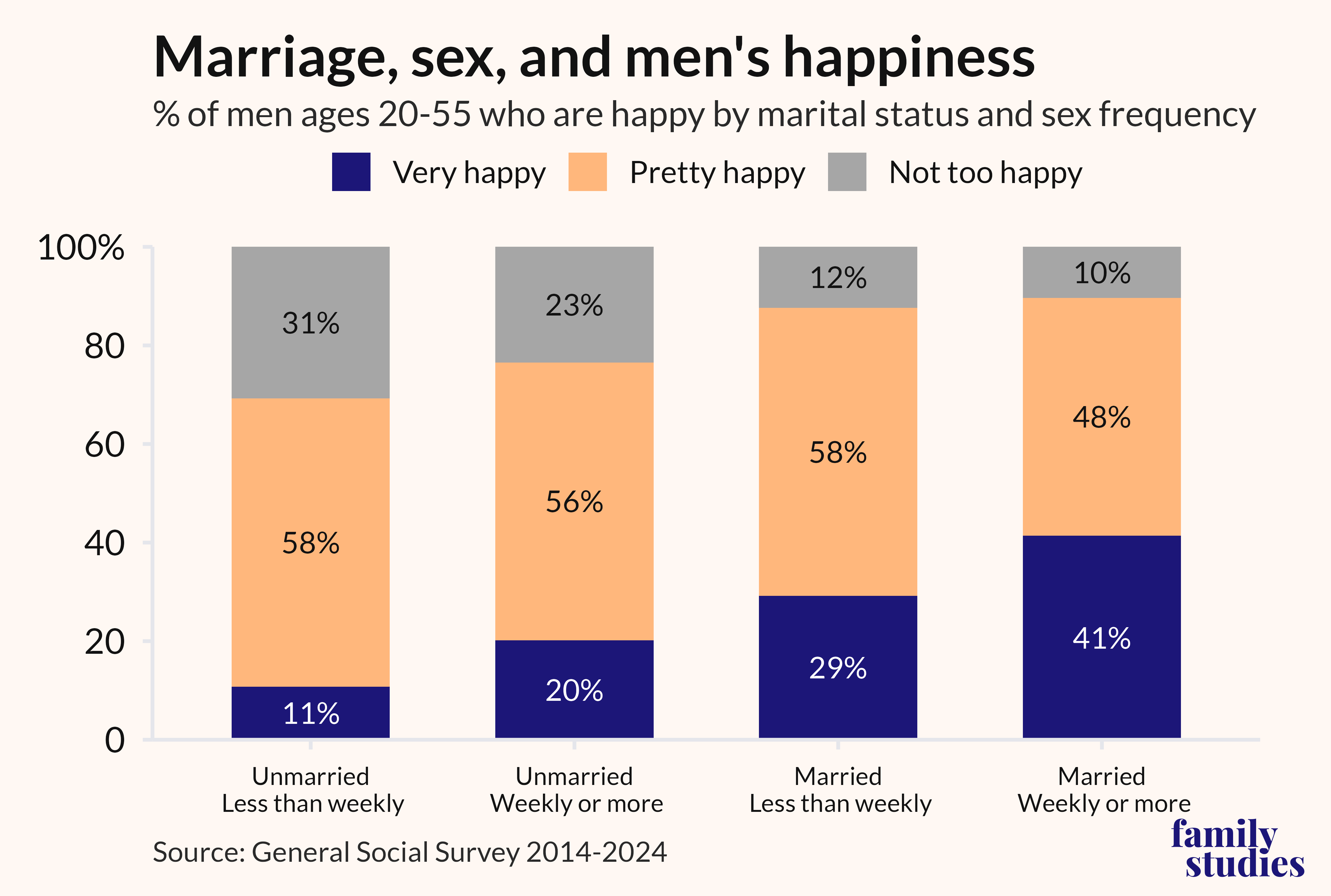
Men who have regular sex and are married (aged 20-55) are almost four times more likely to be “very happy” than their peers who are unmarried with little or no access to sex, according to data from the General Social Survey.
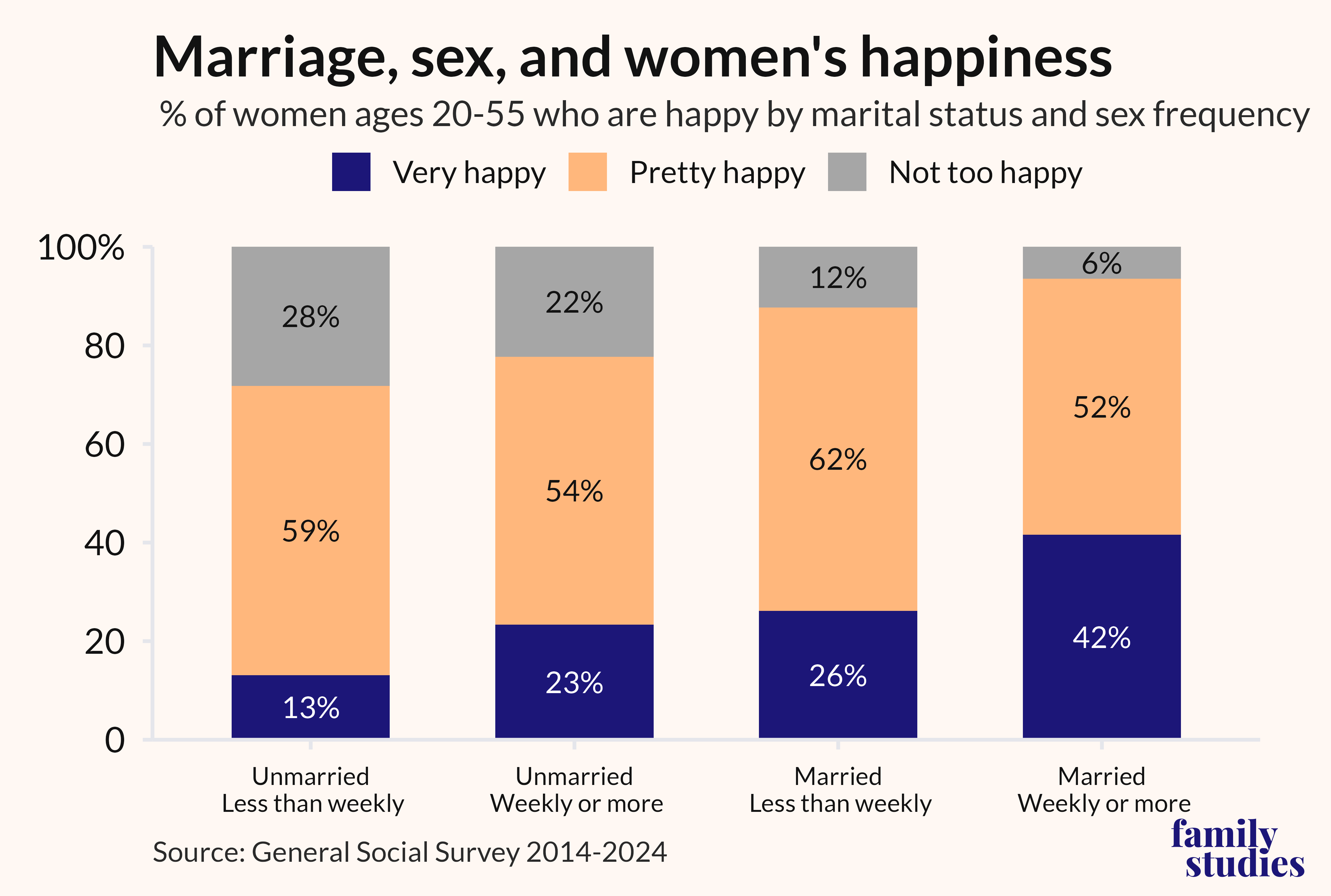
Married women aged 20-55 who have regular sex are three times as likely to be “very happy” with their lives compared to unmarried women who do not have regular sex.
But false tropes about marriage being a threat to sexual satisfaction aren’t the only things that fester online. Pornography has a demonstrably corrosive effect on sexual intimacy, including within marriages. Couples in which one or both partners regularly view porn report lower marital satisfaction and a higher likelihood of infidelity and divorce. Nevertheless, according to one YouGov survey, Democrats are much more likely than Republicans to say they view porn regularly, and almost two times as likely to say viewing porn is morally acceptable.
The online gender wars and widespread availability of pornography are content issues. The medium itself—time spent online—is another problem that may skew ideological.
Researchers recently found evidence of what they called “lifestyle polarization” among college students along ideological lines. Conservative students were more likely to spend their leisure time with other people—at parties, bars, fraternity activities, or church. Liberals were more likely to be at home or using social media during their free time.
This is not to say conservative and religious couples are uniformly happy, or that liberals are all glued to their screens. No marriage is perfect, and plenty of conservative couples struggle. Pornography is a problem for a sizable chunk of husbands, both conservative and liberal. On the flip side, plenty of liberals get married, have children, and live happy lives.
But in general, conservatism and religiosity are linked to more real-life socializing—more “touching grass,” as the kids say. So, here’s the hypothesis about the sex divide between liberals and conservatives: Conservative married couples may place a higher premium on intimate time together, and they may be more embedded in social networks, especially religious ones, that sustain their marriages.
After all, religious Americans are more likely to gather with friends and extended family, provide for the poor, and volunteer. Extensive amounts of research have shown religious practice to be linked to better physical, mental, and social health.
If there is one clear line in the sand to draw here, it’s that couples who want to enjoy the greatest intimacy in their marriages—regardless of their ideological commitments—ought to beware of spending too much time online and losing touch with what makes us human. Those who prioritize real relationships with real people in the real world will likely spend more time with the people they love. They’ll probably love them a little better, and they’ll probably love them a little more often—if you catch our drift.
Editor's Note: This article appeared first at Deseret News. It is reprinted here with permission.


