Highlights
- Those who die by their own hands are generally less likely to be living with family, have fewer friends, and be involved in organized community life. Post This
- “At any given point in time, married people are approximately 3 times less likely to think about, plan, and/or attempt a suicide," per a 2025 study by Stephen Cranney and Samuel Wilkinson. Post This
Editor’s Note: This article contains a discussion of suicide. If you need help, the national suicide and crisis lifeline is available by calling or texting 988.
Suicide rates in the United States are up 28% since 2001, the result of a broad increase among both men and women, rural and urban. While trends in attempted suicide are less clear, survey data from the Substance Abuse and Mental Health Services Administration indicate that 2.2 million American adults attempted suicide in 2024 alone.
There are many useful approaches to understanding suicide and related forms of behavior. We might study it as the outcome of ruminating thought patterns and cognitive distortions, or of chemical imbalances and genetic predispositions. But we also might understand it as something shaped by social circumstances.
Social Integration and Suicide
Consider one important generalization from the sociology of suicide: Suicide decreases with social integration. The notion is rooted in the classical work of early French sociologist Emile Durkheim, whose ideas have been developed and revised by generations of researchers since. What it means is that, all else equal, someone’s risk of committing suicide declines to the extent they are enmeshed in social ties to individuals and institutions. Bonds of family, friendship, and community exert a protective effect against self-destruction.
Several lines of research support this generalization. Studies of urban ecology in American cities of the early twentieth century found the highest suicide rates in areas that catered to the socially detached—districts full of boarding houses, furnished rooms, and a steady flux of transients with few close ties. In-depth analyses of coroner’s records reveal how startlingly common it is for suicide victims to lack spouses, jobs, or, in many cases, any relative or friend who can testify at a coroner’s inquest. Comparisons to control groups of people who died of other causes, or to still-living community members with similar demographic backgrounds, demonstrate that those who die by their own hands are less likely to be living with family, tend to have fewer friends, are less likely to be involved in organized community life, and are otherwise more socially detached and isolated. And one study tracking 34,000 U.S. men for 24 years showed that scoring high on a 7-item index of social integration was associated with a two-fold reduction in suicide risk.
Bonds of family, friendship, and community exert a protective effect against self-destruction.
The Protective Power of Marriage
Likewise, nearly 130 years of research shows that the bonds of marriage and parenthood are especially consequential when it comes to suicide. A few years ago, I wrote a piece on these pages highlighting some of this evidence. For example, an analysis of over one million U.S. adults found that never-married persons were 48% more likely to commit suicide than those who were either married or living with a partner. And a national-register study of all Norwegians ages 35-54 found that the married had lower suicide risk than the unmarried, and that parents had a lower risk than the childless.
Both of these are relationships reported by Durkheim in France in the 19th century. And similar findings continue to accumulate. While cross-cultural research shows that marriage patterns are not equally protective everywhere, we also have good evidence that the protective bonds of marriage are not limited to the U.S. and Western Europe. Thus, a 2022 study that compared South Korean suicide victims to a matched control group found that the suicide victims were significantly more likely to be either divorced, widowed, or never married. And an analysis of data from Hong Kong between 2002 and 2020 finds a marked protective effect of marriage for both men and women.
Newer research also confirms that family integration is relevant for non-fatal suicide attempts, which greatly outnumber deaths from suicide. For example, not only did a 2020 study of 1.5 million Swedes find that parents with two children had a 70% lower suicide risk than their childless peers, but a 2026 study of two million Swedes found that having a child generally reduced the risk of suicide attempts for both men and women in the year after childbirth. Yet another 2026 Swedish sample finds the effect begins before childbirth, with pregnancy reducing the risk of suicide attempt.
In the U.S., a 2025 study by Stephen Cranney and Samuel Wilkinson found that being married predicted a lower risk of nonfatal suicide behavior for both men and women. Analyzing a sample of over 400,000 people who participated in the National Survey on Drug Use and Health from 2008 to 2019, they concluded, “At any given point in time, married people are approximately 3 times less likely to think about, plan, and/or attempt a suicide.”
There is even some evidence that the association has grown more robust over time. For instance, while an earlier generation of research often found that the protective effect of marriage was much greater for men, a 2024 analysis of data from the CDC Multiple Cause of Death File and the American Community Survey found only a small gender gap, with unmarried men and women being 2 to 3 times more likely to die by suicide. Moreover, the 2025 study by Cranney and Wilkinson found significant growth in the suicide-attempt gap between married and unmarried people, as shown in the figure below.
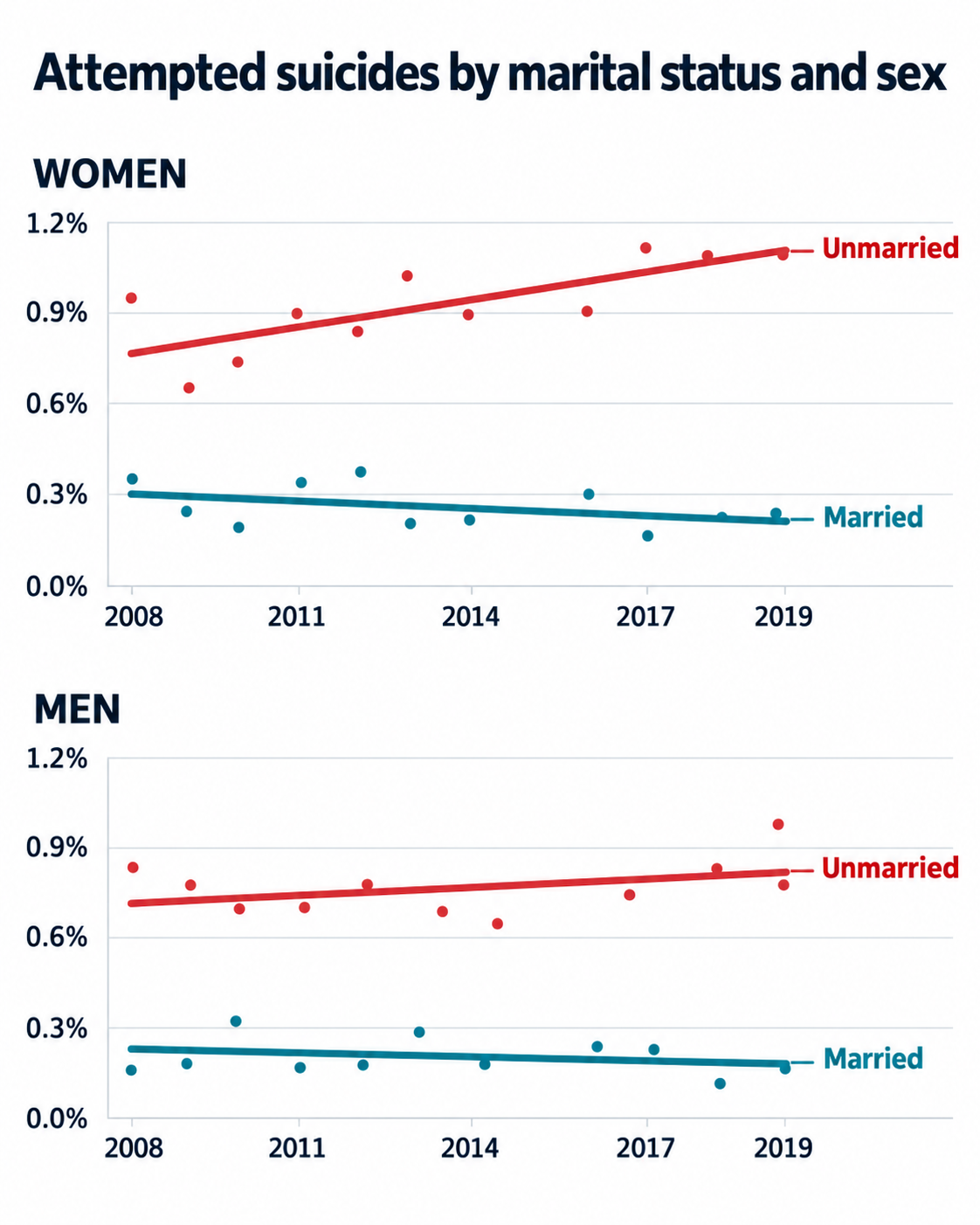
Source: Cranney, S., and S. T. Wilkinson (2025). “The relationship between marital status and risk for suicidal thoughts, plans, and attempts: Evidence for a growing association.” Journal of Affective Disorders. Redrawn from Fig. 1c. Data from the National Survey on Drug Use and Health, 2008–2019. “Unmarried” includes never-married, divorced, and widowed adults. The analysis excluded data from 2015.
Causal Mechanisms
So, is the relationship between family integration and suicidal behavior causal? That is, does being married or being a parent actually make people less likely to take their own lives? After all, people don’t marry and start families at random, and it’s likely that some of the personal factors that make them more likely to do so also make them less likely to be suicidal.
But there are also several plausible mechanisms by which family bonds can make suicide less likely.
First, we know that family provides meaning and purpose. Durkheim recognized this long ago, arguing that people need something greater than themselves to justify the trials of life. Along these lines, there is evidence that married people and parents report greater meaning in life, and that reporting greater meaning is associated with lower risk of attempting suicide.
A second factor is closely related, but perhaps distinct: Family provides a sense of belongingness. Psychologist Thomas Joiner proposes that belonging is a fundamental psychological need, and when it is thwarted, the lack of belonging can produce suicidal motivations. Humans are a social species, evolved to seek membership in a group and prone to feel pain at isolation and exclusion.
Nearly 130 years of research shows that the bonds of marriage and parenthood are especially consequential when it comes to suicide.
A third factor is that family bonds, like other forms of integration, can provide a strong source of social support. Having people to lean on can provide alternate ways of dealing with problems, including encouragement to seek additional help outside the family.
A fourth possible mechanism is that the responsibilities of family life, while they might be a source of stress, also encourage broader life patterns that have a protective effect. Routines of work and child care give structure to daily life, and a reason to keep going. Responsibilities mitigate against excessive drinking, gambling, and other risky behaviors that can themselves be risk factors for suicide. It’s therefore notable that a 2024 study by Hangqing Ruan and colleagues found that not only were married people substantially less likely to die from suicide, they were also less likely to die from alcohol and drug overdose.
If family bonds protect broadly against deaths of despair, it might also be due to a fifth mechanism: Social monitoring and social control. This does not necessarily mean by authoritarian coercion or severe discipline, which might bring its own risks. It can simply be a matter of close bonds being a channel to communicate norms and expectations, clarifying the moral unacceptability of suicide and providing a check on spirals of self-destructive behavior.
Close social bonds transform suicide, drug abuse, and various other risky behaviors from matters of personal preference to matters of right and wrong, and from a prerogative of the individual to something with clear consequences for others.
Jason Manning is Professor of Sociology at West Virginia University, and author of Suicide: The Social Causes of Self-Destruction. He blogs about sociology at his Substack, Bullfish Hole.