
Highlights
Over the past decade, as new research exposed the deleterious effects of digital technologies on children’s health and development, a growing movement of parents has objected to the ways in which social media and screens are transforming childhood. This has inspired a wave of states and school districts to establish stricter restrictions on student cellphone use in schools, with many opting for “bell-to-bell” phone bans. But it’s not just smartphones and social media that parents are rethinking. Naturally, the move to limit digital technology in childhood has also led parents to scrutinize educational technology, or “ed tech,” and, ultimately, rethink screen-based education altogether.
It is during this season, in which parents, teachers, administrators, and education leaders are seeking to restrain ed tech and recover tried-and-true, person-to-person modes of learning and classroom instruction, that artificial intelligence (AI) has arrived in America’s schools. Despite pushback from parents on phones and screens in the classroom, there has been steady pressure by some policymakers to rapidly and completely integrate AI into the curriculum.
What parents want for their kids is a critical matter for education, and parents clearly want fewer screens. But what do they want when it comes to AI in the classroom? Do they see AI as providing better learning outcomes or greater risks to their children’s learning and mental health? Do they want AI in the classroom at all? If so, when do they want it, how involved do they want to be in its implementation, and in what manner should it be used?
So far, despite the urgent political imperative to re-center the education of America’s children around AI, parents have not been consulted, and these questions have not been asked.
Our new report, released today, corrects these critical omissions.
Major Findings
1. Official actions by administrators and teachers to incorporate AI into schools are already widespread.
Nearly 4 in 10 American students in primary or secondary education attend schools where AI use is either explicitly allowed or even required. By contrast, 15% of American students attend schools where the use of AI in the classroom is officially blocked. The largest portion of American students, 45%, attend schools where no official action has been taken.
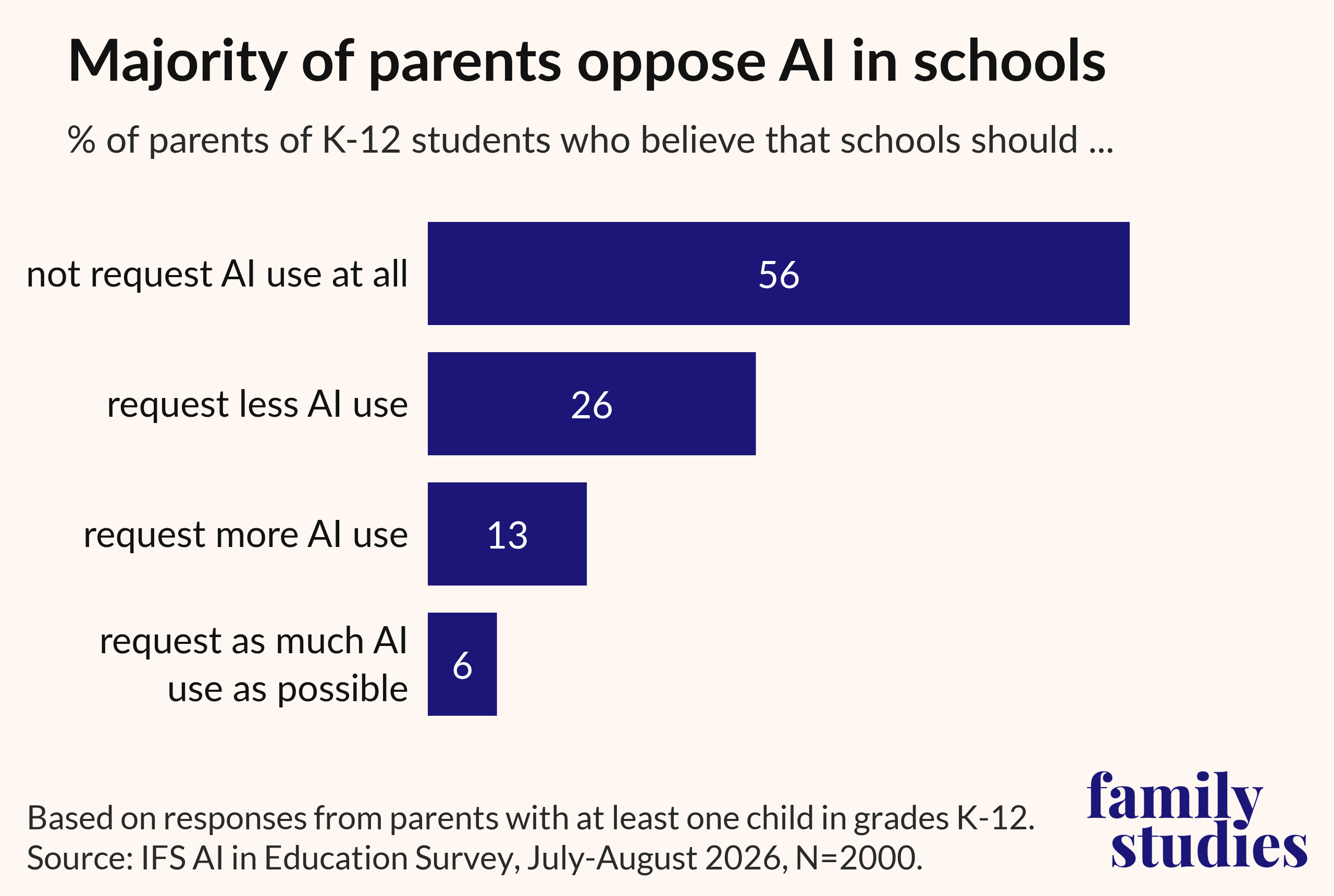
2. Most parents of K-12 students either do not want AI in schools, or they want less of it.
A majority (56%) of parents want AI fully blocked in schools, and another 26% want less AI in schools than is currently required or allowed. Only 13% of parents want more AI use in school, and a mere 6% want as much AI use as possible.
3. Many parents want deep changes to the way digital technology is used in the classroom, including AI.
A new “computer lab,” where AI and ed tech are used in discrete classrooms, is the most popular classroom form among parents: 38% of parents want AI to be used in computer labs only, with the remainder of schooling focused on physical books and handwriting; and an additional 25% of parents want books and handwriting only. The current trajectory—AI grouped with tablets as the basis of education—is very unpopular with most parents. Only 11% of parents want this form of education for their kids.
4. Parents want AI later, not sooner, in K-12 education.
Parents also feel strongly about when AI should be introduced. More than 2 in 3 parents want AI introduced in high school or later, or not at all. Only 3% of parents believe that students should be using AI in kindergarten and only 9% want it introduced in elementary school. The numbers rise in middle school and high school (21% and 25%, respectively), but nearly as many want it introduced in 12th grade or later (20%) or not at all (22%). In sum, parents as a group are generally not eager to have AI introduced in schools at any specific stage, though later years score modestly better.
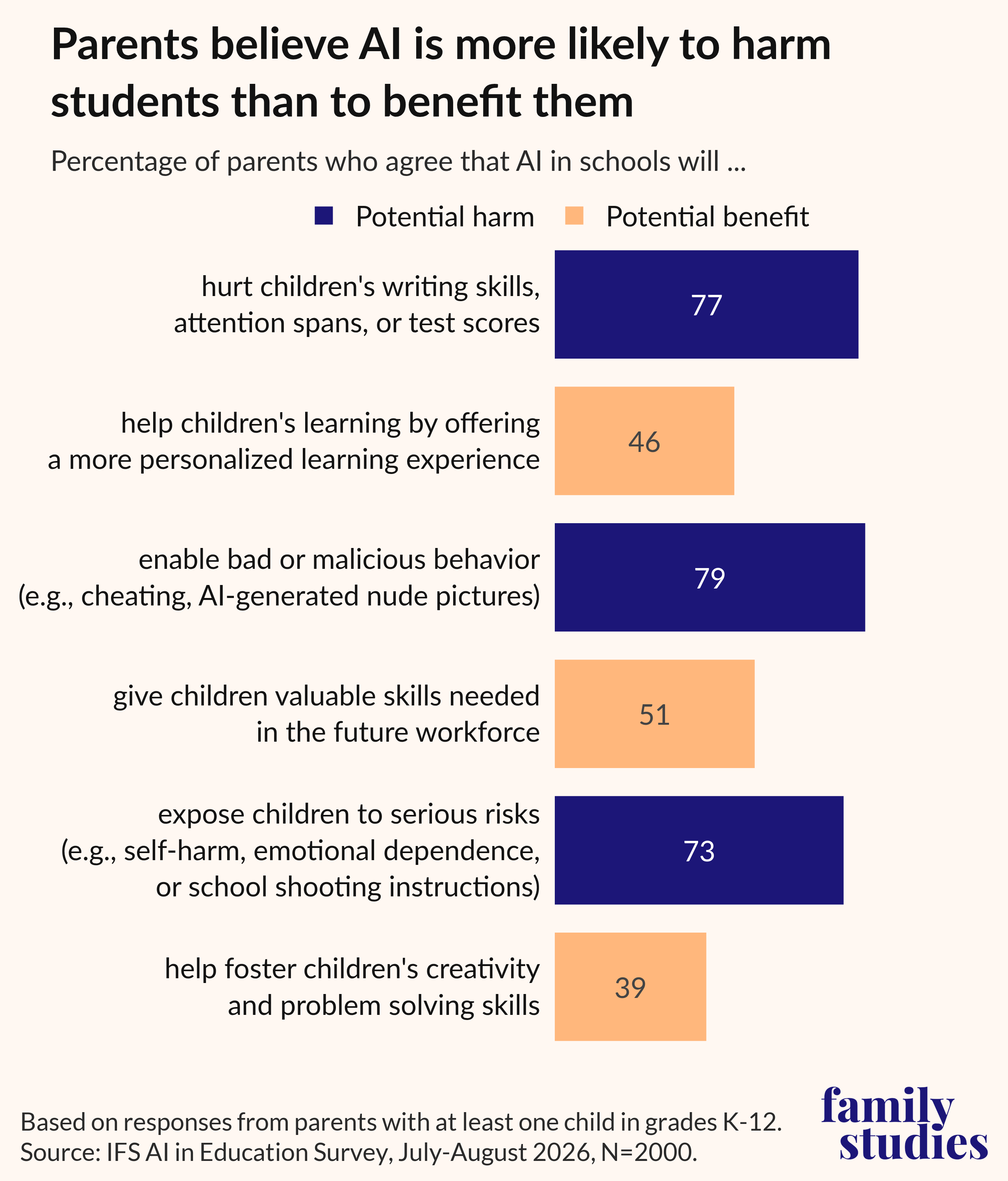
5. Parents think that AI is more likely to harm students than help them.
When offered a set of scenarios, a significant majority of parents tell us that AI will introduce more harms into the primary and secondary classroom than benefits. In fact, 77% say that AI will undermine learning, 79% say that AI will enable malicious behavior by students, and 73% say it will expose children to serious risks. As for benefits, only 46% agree that AI will help children learn by personalizing their learning experience, and a mere 39% say it will boost childhood creativity. The most popular positive case for AI in schools is that it will prepare children for the workforce of the future (51%).
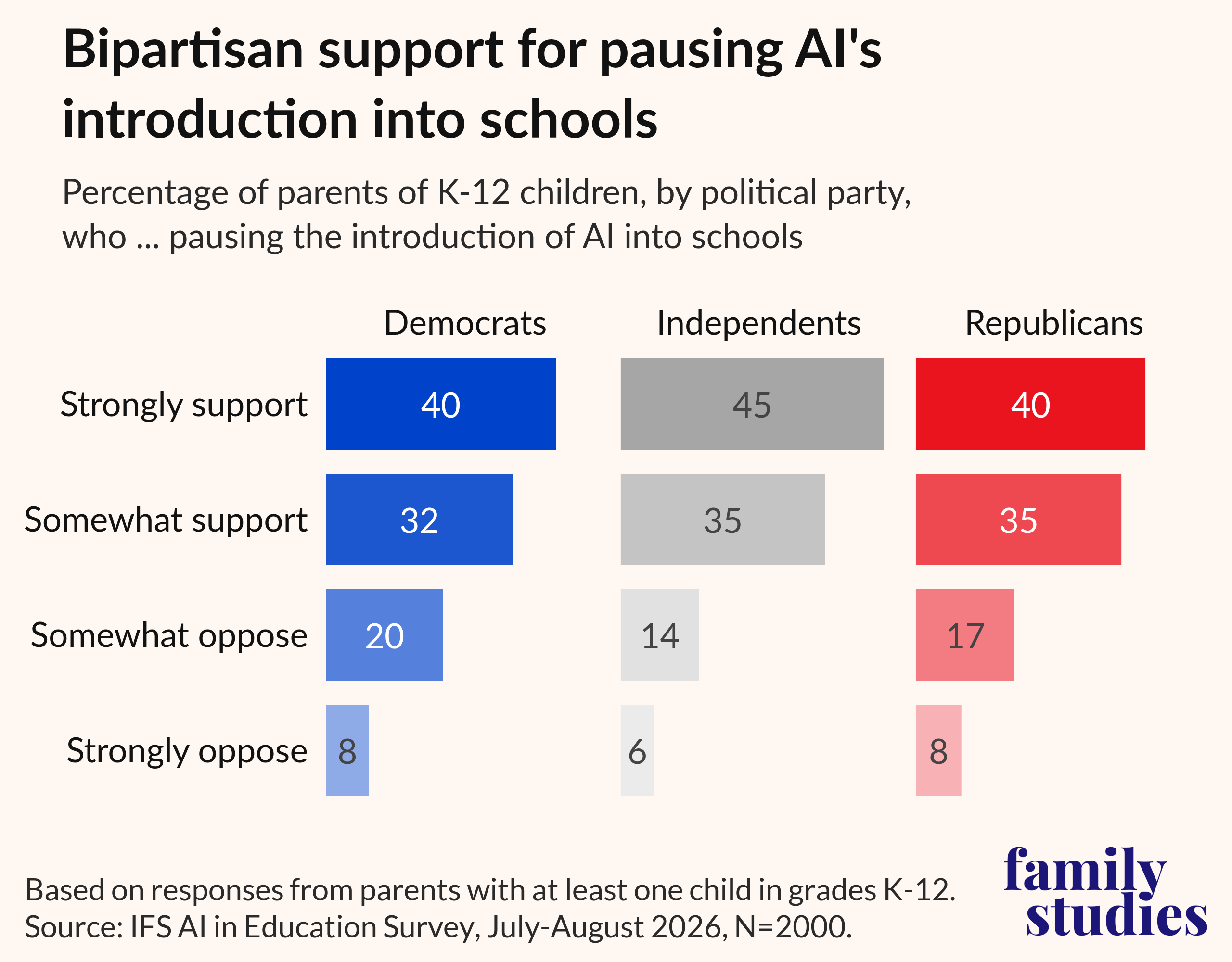
6. A large majority of parents support the policy to pause AI in schools.
Recently, two of the nation’s largest school districts, New York City and Los Angeles, paused the use of AI in most K-12 classrooms. Given the “deep blue” character of these localities, it could be that pausing AI in schools is a partisan policy. But that’s not what we found. In fact, 75% of Republican parents support the policy to pause AI in schools, as do 72% of Democratic parents.
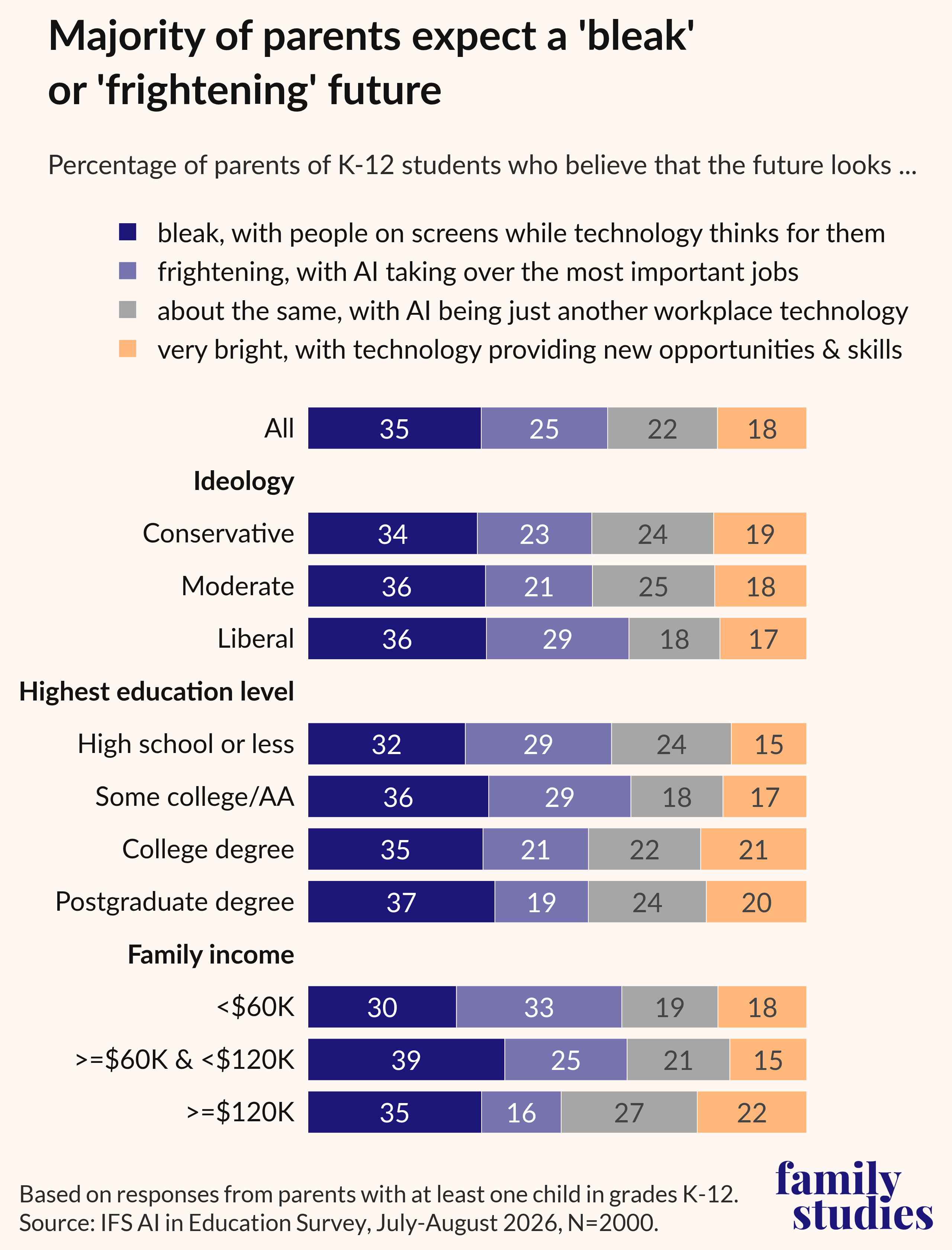
7. AI in education gives most parents a sense of foreboding about their children’s future.
When asked about their outlook on the future, considering the incorporation of AI in the K-12 classroom, a majority of parents are concerned for their kids. Most parents either think the future for their children looks “bleak” (35%), “with technology doing most of the thinking and people being stuck on screens all day,” or that it looks “frightening” (25%), “with AI taking over the most important jobs and making the future less human.” In sum, for 6 in 10 parents with school-age children, AI fosters a negative view of their child’s future.
Read the full IFS report here.


