
Highlights
- Asymmetric blame, hectoring lectures, and selectively revived norms are driving young men to the influencers the mainstream condemns. Post This
- It’s possible to successfully challenge young men to do more and be better. But that requires a different approach than the mainstream is taking right now. Post This
About a decade ago, Jordan Peterson discovered a huge untapped market: young men looking for direction in life. Churches had long struggled to attract young men, but Peterson swept up millions of them. He ate the church’s lunch, but it didn’t seem to show much interest in how he did that or why he resonated so much.
This is the general pattern I see when it comes to men’s influencers, especially of the manosphere variety. We see a lot of mainstream people raising the alarm about the odious Andrew Tate or struggling to understand the bizarre and also dubious Clavicular. But they’ve seldom tried to understand why young men are attracted to those figures. They prefer to condemn rather than figure out how to compete.
More than that, mainstream behavior can outright drive men to the manosphere. For example, I’ve been noting for a few years now the way that the media now affirms or celebrates women who divorce husbands whom those women themselves affirm were good ones. Just this week The Times (UK) published a piece titled, “At 39, I was married to a good man. So why did I end things?” Any young man seeing this online will immediately recognize that something’s not right.
Mainstream behavior can outright drive men to the manosphere.
Not everything about the manosphere can be competed away. Locker room humor, sexual obsessions, etc. are a perennial part of young men’s culture and aren’t going away. But old school lads magazines and the like didn’t form young men’s entire worldview in the way the manosphere does. Their readers understood this stuff for what it was. If we can just get back to that, it would represent progress.
Doing that will require that mainstream voices change the way they talk about young men. I want to illustrate this by looking at three examples I encountered recently, a survey finding, a viral post, and an op-ed. After discussing each, I’ll provide four concrete suggestions for how to communicate in ways that will actually be accepted by young men.
Women Blaming Men
Daniel Cox at AEI’s Survey Center on American Life has an interesting research finding that two-thirds of young Democratic women believe that the problems facing women today are largely caused by men:
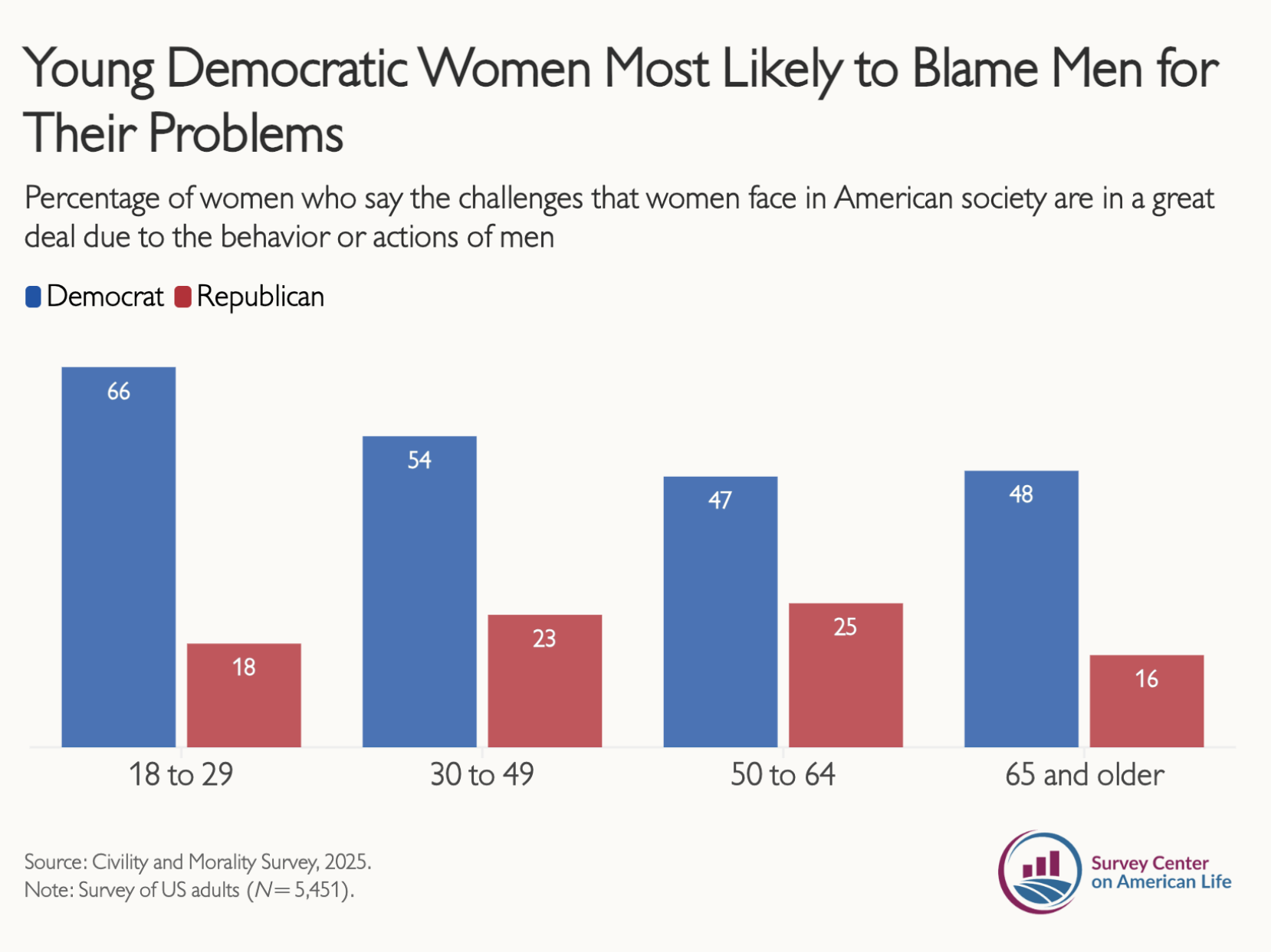
This chart looks at party split specifically, and unfortunately doesn’t provide a combined number for all women. He does note that 16% of men overall blame women for their problems. The combined rate for all women must be well above that based on the data in his graph, especially given that women are more heavily Democratic (52%) than Republican (38%). (The full survey results appear to be login protected, unfortunately).
The manosphere is widely critiqued for blaming men’s problems on women. Scott Galloway says men are “unsaveable” if they blame women for their romantic problems, for example. Undoubtedly there are things to critique here. But there’s very little pushback against the likewise broad or even broader phenomenon of women blaming their problems on men. Indeed, the very statistical reality highlighted by Cox’s research is rarely foregrounded in mainstream discussions.
One of the signature appeals of the manosphere is providing true statistics like this rarely mentioned in mainstream discussion. The canonical case here is the fact that women initiate the vast majority of divorces. But this is another good example. Harvard’s Steven Pinker has noted that encountering true facts that aren’t said in mainstream society is a prime vector of online radicalization.
The Hectoring Lecturer
Chris Hatch, a Utah real estate developer and franchisee for a rapidly expanding coffee chain, posted a viral X thread in which he, unhappy that the young women around him aren’t getting dates, proceeds to give young men an eleven-step action plan to attract them. It prompted an outpouring of blowback on the internet and managed to rack up 24 million views.

Among his steps are to stop playing video games, take a shower, get a haircut, etc. Interestingly, the manosphere might give the same advice on these points, but it would come in completely different packaging.
A few things made this one explode. One is that he led with the assumed dating travails of the 20-year-old women around him. While at the end he notes that a happy marriage is good for him and so also for other men, by leading with the single women he displays an instrumental approach to men. He’s motivated by wanting to help the women, not the men to whom he’s giving instructions.
Also, he simply assumes that the women aren’t going on dates because of some deficiency in men. Do the women actually want to go on dates? If so, do they have areas they need to improve on themselves? What is the actual root cause of these 20 year olds not dating? He displays no curiosity about that. And he simply assumes they are already doing everything they should be doing and are everything they should be.
All of the onus is put on men to change. And there’s a presumption in his rhetoric that the norm among young men is that they are failing in the basics like taking a shower.
Some commenters noted that Hatch is from an affluent LDS family, and in his community this sort of advice may still work. But it’s likely to be a recipe for frustration for almost everyone else, who no longer live in the kind of socio-cultural ecosystem that would make this advice functional.
Any young man can hear a “Man up!” lecture like this and realize something is not completely right. Today, it’s not necessary for him to accidentally stumble across some dark corner of the Internet to find people who will debunk it. The manosphere is everywhere today, which is why X so quickly took Hatch to task.
The Trad Con Critique
Leonard Sax is a psychologist who has written a lot about gender. I don’t know his politics but he gets coded as a conservative because of stands like arguing in favor of innate sex differences and calling for single sex eduction.
Sax had an interesting op-ed in the Institute for Family Studies that opines on the case of alleged rape at Cornell University. He says he is outraged that the original DA did not indict the men, but his main point is that too many men don’t know how to be gentlemen:
But I think the anger misses a more fundamental question, which is: how is it possible that these men, all students at an Ivy League college, saw nothing wrong in taking sexual advantage of an intoxicated woman?….
I explain to the students that Evan [from the movie Superbad] is trying to obey a rule from an earlier era, namely: A gentleman does not take advantage of a woman when she is drunk. Then I say, “Raise your hand if you have ever heard that rule.” In an auditorium of 400 students, typically only about three or four students will raise their hand.
The most important question raised by the Cornell case is: why did none of the young men involved that night know and follow that rule? I would argue that these men didn’t know because we, as adults, have failed to teach them. And because they are immersed in a toxic culture that sends a very different message.
These students may never be indicted. If they are, they deserve the presumption of innocence. But even apart from criminal law, I can condemn their behavior totally.
But rather than a moral critique, Sax’s point is that they aren’t behaving like gentlemen. Why that? And why focus specifically on a gentlemen not taking advantage of a woman who is drunk? Would it have been ok for them to do this if she were sober? The historic American idea of the gentleman would not have condoned this kind of behavior, drunk or sober.
I don’t know why precisely Sax did this, but one thing it allows him to do is to condemn the men’s behavior without having to challenge sexual liberationist norms in any way or to criticize drunkenness per se.
His rhetoric draws on the idea of the “gentlemen” from the past that still has some moral resonance, but disembodies it from the broader socio-cultural ecosystem of which it was a part. That ecosystem put a broad array of expectations on both gentlemen and ladies, much of which he presumably does not agree with and does not believe we should live by today.
This form of argumentation is unfortunately all too common in conservative circles. It’s what I call the “trad con” approach. It issues strident condemnations of male behavior, demands that men follow select elements of some former social code, but implicitly (sometimes explicitly) rejects much if not most of that code—and usually exempts women from any of the reciprocal expectations under it.
Another good example is the Jim Geraghty video that tells young men to act like the old TV dad Ward Cleaver, but without the status he enjoyed and without a woman like June Cleaver as his wife.
These types of arguments fall apart under even cursory scrutiny, and dismantling things like this is a manosphere specialty. Young men can sense that people like this are against them, and the manosphere helps explain to them exactly why that is.
A Better Approach
What would be some better ways mainstream authorities should be talking? I will suggest four concrete ones, informed by these examples.
First, rhetoric needs to be grounded in statistical reality. It’s not necessary to quote stats in every proclamation. But if a pundit or pastor complains about men blaming women for their problems, when the reality is that the reverse is also common or even more common, this is self-discrediting.
Second, women as well as men have faults. People who want to wade into commentary on gender issues have to be willing to acknowledge that everything isn’t 100% men’s fault all the time. They have to be willing to also call out bad female behavior or call on women to change some things too.
Obviously, there’s much more personal and professional risk in doing this. Everybody has a limited amount of personal capital they can invest, and they have to choose which issues they want to engage on. I don’t expect everyone to address this one. But those who choose to avoid it should also avoid making gratuitous criticisms of men that they know to be unbalanced.
Third, avoid appeals to retro concepts and norms. Doing things like calling on men to be “gentlemen” - or a carefully edited version of one - in the absence of the broader ecosystem in which the idea of the gentleman was embedded is unfair and won’t work. It is possible to call on people to embody values or behaviors that aren’t part of the social structure as part of building a subculture or some type of reconstructionist project. But you have to acknowledge that’s what you are doing. It’s frankly very difficult to pull off.
Fourth, delivering tough messages to men requires empathy and skin in their game. Empathy means that you understand a person’s reality. There’s an old saying that unless you meet someone where they are, you have no moral authority to lead them anywhere else. Skin in their game means that you actually care about the well-being and success of the people you are giving feedback to, not just treating them as instruments to benefit others.
Jordan Peterson succeeded in both of these. He convinced young men that he genuinely cared about them. That’s what allowed him to tell them things like, “Clean your room, bucko.” In the examples I highlighted, both Hatch and Sax failed this test.
I actually believe it’s possible to successfully challenge young men to do more and be better. But that requires a different approach than the mainstream is taking right now. Adopting these four principles would go a long way to start creating a mainstream message that can compete with manosphere influencers. A decade ago, Jordan Peterson showed that this was possible. I appreciate that Daniel Cox is putting out data like this. Richard Reeves at the American Institute for Boys and Men is doing some good work. But we need to see much broader adoption of these principles to help men find healthy and genuine flourishing for themselves.
Aaron M. Renn is a Senior Fellow at American Reformer, a former Senior Fellow in urban policy at the Manhattan Institute for Policy Research, and a former Managing Director at Accenture. His latest book is Life in the Negative World: Confronting Challenges in an Anti-Christian Culture. *This essay appeared first on the author's Substack. It has been reprinted here with permission.
Editor's Note: The opinions expressed in this article are those of the author and do not necessarily reflect the official policy or views of the Institute for Family Studies.


