
Highlights
- Putting marriage “on ice” in your 20s and even early 30s means showing up to a significantly smaller dating pool. Post This
- A recent IFS analysis found that women who wait past 30 have only about a 1-in-2 chance of having a child by mid-life. Post This
- The culture tells us the 20s are for working and playing hard. "Settling down" is meant for later, after we've established a career, own a home, and have a carefully crafted personal identity. Post This
Drake Maye is an anomaly: At 23, he is among the youngest quarterbacks to ever play in the Super Bowl. But he’s different for another reason, too. Last summer, Maye got married. Maye spoke to ESPN’s “Sportscenter" before the Super Bowl about his wife, Ann Michael Maye, with a charming and infectious joy. “There’s no better feeling than coming home to a wife that knows you, loves you, and worries about your best interests,” he said, advising his teammates to go and do likewise.
After that interview, we decided to write about the couple’s example, hoping it would encourage others to consider marrying young. Truth be told, we were hoping that on Super Bowl Monday, the story would be even more Cinderella-like—that Maye would be a Super Bowl champion to boot.
It didn’t work out that way. The New England Patriots lost to the Seattle Seahawks 29-13 in a particularly tough game for Maye, who threw two interceptions and fumbled in the third quarter. There’s no doubt his youth added to the pressure he felt on the field. But although he surely would have preferred to share a Super Bowl ring with his wife, a tough loss offers another kind of positive example: Defeat, too, is a little easier to bear when you have someone to bear it with you.
Conventional wisdom says Maye is too young to be married. That’s because contemporary culture has fully embraced what we like to call the “Midas Mindset”—the idea that our highest priority in our 20s should be to build a lucrative career and pursue high-status leisure activities, like shopping and travel. The culture tells us the 20s are for working hard and playing hard. “Settling down” to marriage and family life are meant for later, after we’re “established” in a career, a home that we own and a carefully crafted personal identity.
It turns out, however, that this conventional wisdom isn’t wisdom at all. It’s a high-stakes hypothesis. And with the Mayes as our latest data point, that hypothesis has been disproven.
1. First, the likelihood of finding a partner and getting married declines with age.
American marriage rates have fallen precipitously in recent decades, and the median age of Americans’ first marriage has risen to about 30. Nevertheless, statistics still show that the chances of marrying for the first time past age 40 are much lower than marriage rates for people who are in their twenties.
Most young people still say they hope to marry one day. But these statistics suggest putting marriage “on ice” in their 20s and even early 30s means showing up to a significantly smaller dating pool whenever they finally decide they’re ready, and this lessens the likelihood that they’ll ever marry at all.
2. Second, waiting to get married risks missing the chance to have children.
In some ways, childbearing in one’s 20s now garners the same skepticism as young marriage. Assisted reproductive technologies, like in-vitro fertilization and egg freezing, have given young adults the impression they can delay starting a family without consequence. But that, too, is a harmful myth.
“Despite amazing innovations in fertility medicine, women who reach a certain age are forced to face an inconvenient truth: there is a biological window of fertility, and for safely bearing healthy children. (And men have one too),” Dr. Sarah Poggi wrote recently in The Free Press.
Poggi noted the average age of having a first child is rising for American men and women, but that “women who decide to have children younger are more likely to be able to get pregnant, are more likely to be able to carry pregnancies to term, and are more likely to have healthy babies.”
In fact, women’s odds of having children fall precipitously after 30. A recent Institute for Family Studies analysis found that women who wait past 30 have only about a 1-in-2 chance of having a child by mid-life. Some of that is because some women who don’t have kids by 30 wish to remain childless. But women’s declining odds of having children after 30 are also related to two key social and biological realities.
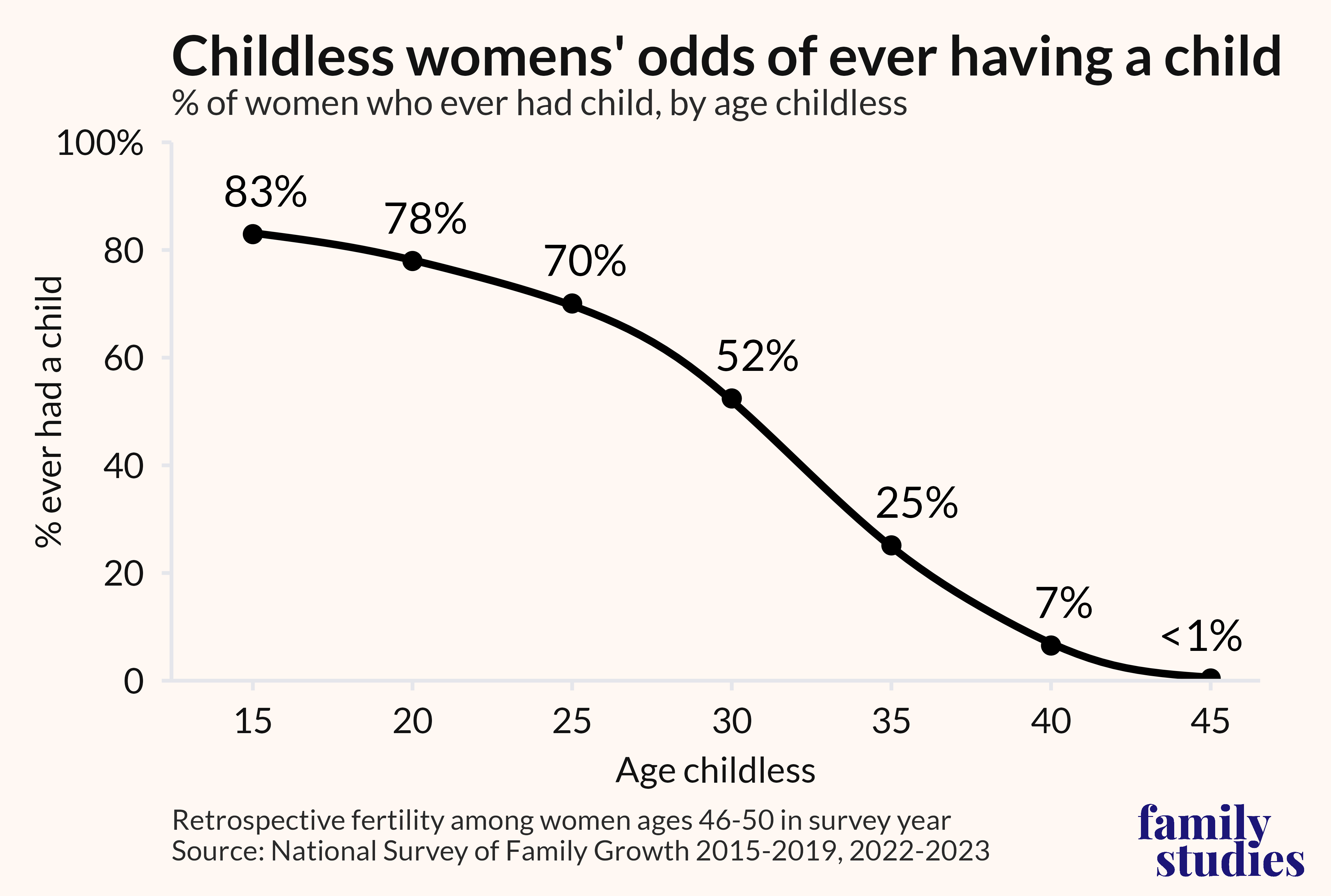
One is that dating has become exceedingly difficult for young adults today, with only 1 in 3 of eligible young adults now dating, according to a new Wheatley Institute report. This suggests that the longer you wait to date with an eye toward marriage, the greater difficulty you are likely to have finding the one.
Another is that women’s fertility declines in their 30s. As Poggi notes, “The American College of Obstetricians and Gynecologists states that fertility in women decreases gradually, but significantly, beginning around age 32, and decreases more rapidly after age 37.”
3. Third, these trends matter for happiness, too: Married couples with children report the highest levels of satisfaction.
This is true even for couples getting married on the younger side, like the Mayes. Young married men (22-35) who are married with children are significantly more likely to be “very happy” with their lives, with 37% of married fathers reporting they are very happy compared to only 14% of young men who are single and childless. Likewise, just 14% of young women who are single and childless are very happy, compared to 41% of young married moms (22-35). Our culture insists that marriage and family hold women back from meaningful, happy lives. The data tells exactly the opposite story.
This is not to say marrying young is risk free. Couples who marry younger face a higher divorce risk, especially if they marry as teens. But 20-something couples who attend church together minimize this risk, as do couples who do not live together before marriage. So young men and women who are considering marriage in their 20s, who are mature and consider themselves good friends, would do well to get married and plug into a local church.
Much of this is intuitive, if we can turn off the cultural noise about the drudgery and the “shackles” of marriage and family life. We never stop growing and changing, and marrying young offers the chance to grow and change with someone committed to loving you. Young couples may even find it easier to adapt to the rhythm of married life together than older couples who’ve spent a decade or more alone, making decisions and only bearing responsibility for themselves, before trying to adjust to a new intimacy with someone else. And young couples are far more likely and better situated to have more children.
Marrying young isn’t a burden; it’s a life hack.
As Charlie Kirk often said before his assassination at the age of 31, women—and particularly men—long for the personal meaning that comes with assuming responsibility for others. Everyone wants to feel needed and loved. Marriage and parenthood invite us to rise to that occasion. This reveals a profound paradox: Though getting married and having children may cause higher day-to-day stress and deeper vulnerabilities to loss and hurt, they also offer the potential for our deepest joy and satisfaction. In this view, marrying young isn’t a burden; it’s a life hack.
By pop-culture standards, Drake Maye’s young marriage was strange. “I got married young, and I don’t regret it one bit,” the quarterback wrote on Instagram—suggesting his decision needed defending. But Maye’s choice to marry his sweetheart since middle school means he gets to build a life with someone who knew him “before.” If the divorce rates of celebrity marriages tell us anything, fame and excessive wealth put couples at far higher risks of divorce than marrying young. The Mayes will likely benefit greatly by tying the knot before stardom.
Most couples won’t face Super Bowls or red carpets, but everyone will face pressure and hardships. And no matter how carefree and unburdened our young adult life, we’ll all grow old if we’re lucky. A recent episode of the NBC sitcom “St. Denis Medical,” about the daily foibles inside a hospital emergency room, brought this reality into sharp relief. The episode begins when a doctor saves the life of an elderly woman with a “do not resuscitate” order. She’s angry when she wakes up—what is she supposed to do now, she asks. The doctor suggests she spend more time with her husband, to which she replies that she never married. “Maybe spend time with your kids?” the doctor says. But she never had kids either. “Could you at least pass me the remote?” the patient asks, grumpily.
In his goofy, obtuse way, the sitcom doctor finds the situation forces him to look at his own life. He admits he pursued his career and sculpting his muscles over finding love. For purposes of the show, it’s a charming “aha” moment. But then the camera pans away to another sub-plot, this one involving a team of young nurses who are seemingly doing exactly what the doctor now regrets: partying hard, avoiding commitment, and pursuing their careers. It’s not clear the show’s writers saw the irony—making the whole scene, in the end, rather bleak.
It’s unfortunate that marrying young is considered unusual these days. But if young people could take a hint from the St. Denis doctor—or, more plausibly, couples like Drake and Ann Michael Maye—they’ll choose to take the plunge anyway. They, and the culture at large, will be all the better for it.
Editor's Note: This article appeared first at Deseret News. It is reprinted here with permission.


