
Highlights
- Despite what the American people have consistently said, this administration continues to push for deregulated AI at the expense of child safety. The question is why? Post This
- A strong majority of both Republican and Democratic voters in Utah support the right of states to regulate AI. Post This
- It's clear that the American people are concerned about the repercussions of AI and demand that AI be safe. Post This
After two failed attempts to preempt state AI regulation in Congress, the White House took matters into its own hands late last year. In December 2025, President Trump signed an executive order to prevent states from passing “onerous” regulations on the AI industry. David Sacks, the administration’s AI and Crypto Czar, insisted that the executive order was necessary to block “woke” AI regulations from Democrat-run states. But the White House made it clear that states that passed child safety regulations would be left untouched.
Unfortunately, only a few months after the White House made this promise, it appears to have broken it. Last week, the White House sent a one-sentence memo to Republican lawmakers in Utah, a reliably red state, categorically opposing a state AI safety bill, HB 286. This legislation, which would require frontier AI companies to publish their plans to mitigate harms to children and the public, was “unfixable,” according to the White House, and “goes against the Administration’s AI Agenda.”
As it happens, the Institute for Family Studies conducted a national poll of 6,200 voters, including more than 500 voters in Utah, asking their thoughts on AI and regulation of AI companies.1
Will the voters of Utah agree with the White House that HB 286 is “unfixable”? Not according to our survey results.
Poll Results
Utahns, like Americans more broadly, are generally cautious about AI. When we asked voters in Utah how AI will affect society, 70% took a negative view about AI, with 39% finding AI concerning and 31% saying AI was a big threat. A mere 30% found AI to be intriguing or exciting.
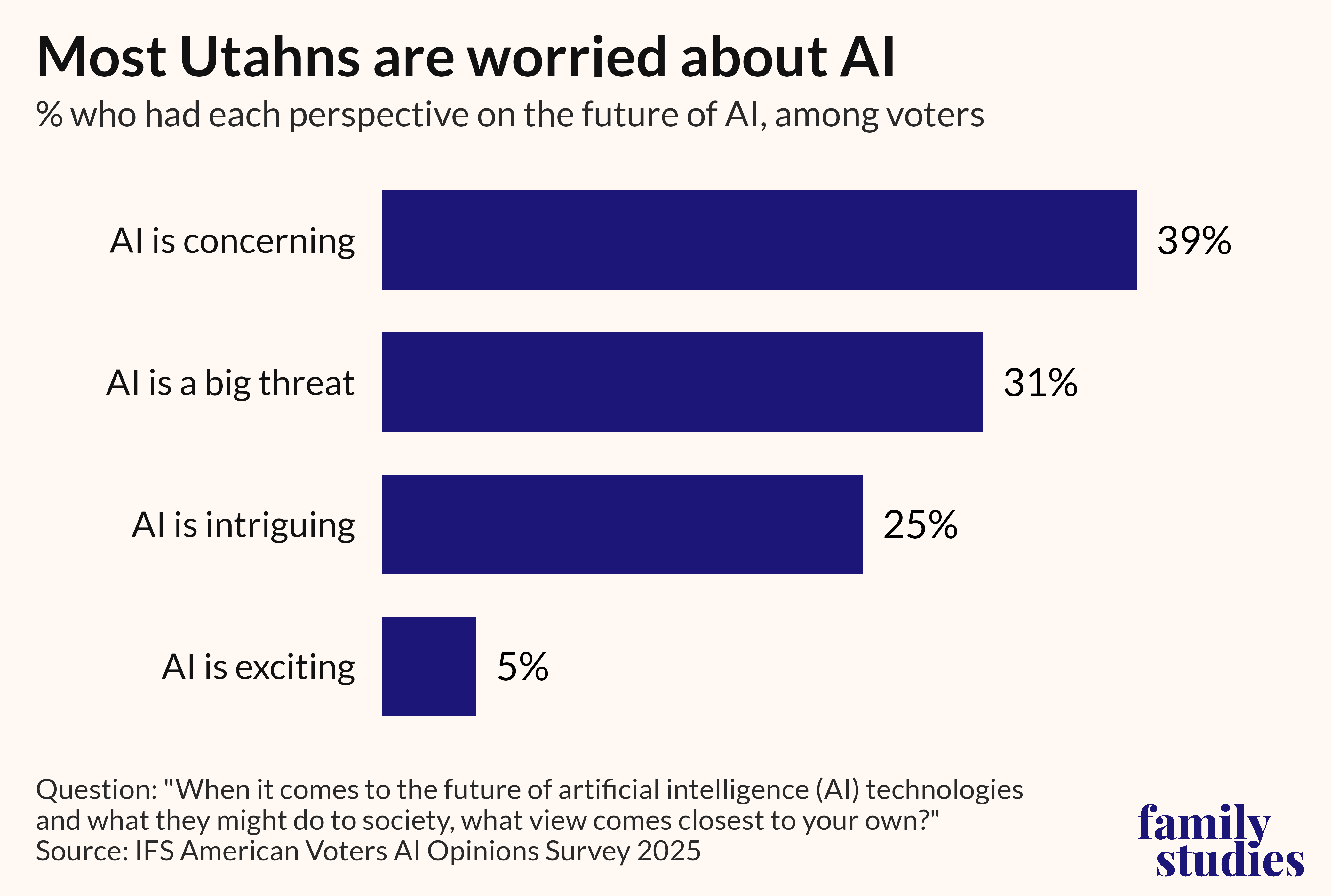
Views among Utah voters align with our findings that 71% of voters nationwide hold negative views about AI’s potential effects.
What about AI messaging? Which statements about AI do Utah voters find more compelling, positive or negative? To find out, we tested five statements about AI from various public figures: Pope Leo XIV, Senator Josh Hawley (R-MO), Sam Altman, David Sacks, and Marc Andreessen.2
Quotes from Pope Leo XIV and Sen. Hawley represent restrained or skeptical views about AI. For example, Pope Leo XIV calls for AI systems to be developed and designed with the good of human beings in mind. Likewise, Sen. Hawley states that the AI revolution is working against the working man.
On the other side of the issue, OpenAI founder Sam Altman states that AI will contribute to quality-of-life gains. David Sacks argues that AI industry should be expanded in America at all costs. Marc Andreessen, famed Silicon Valley venture capitalist, asserts that AI may be the greatest thing ever made by man. (For a full text of the statement that we provided respondents, see the Appendix.)
Which of these statements did Utah voters agree with most?
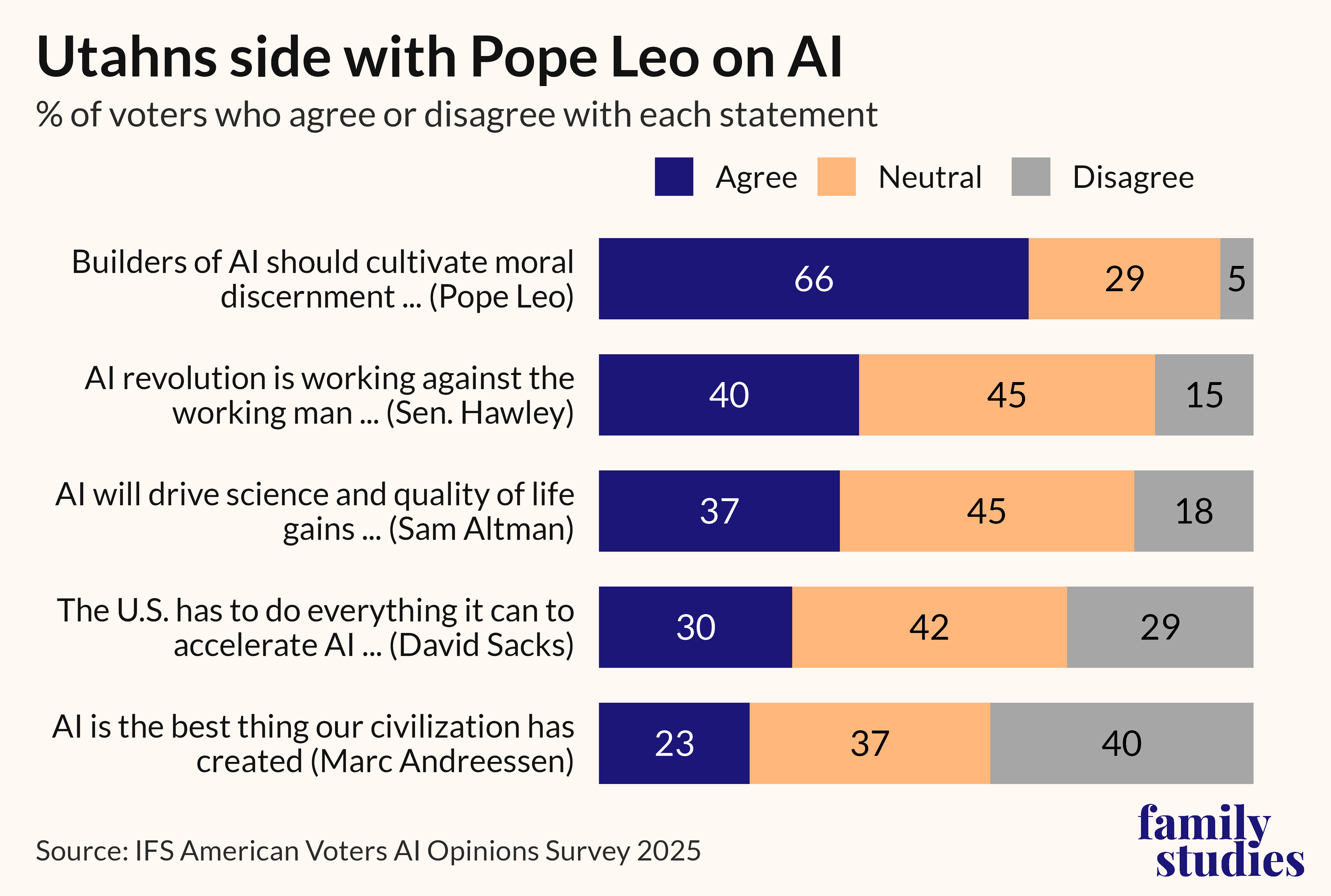
Pope Leo XIV was by far the most popular spokesman among Utah voters, saying that AI companies need to “develop systems that reflect justice, solidarity, and a genuine reverence for life.”
Andreessen’s quote, that “AI is quite possibly the most important—and best—thing our civilization has ever created,” receives the lowest agreement overall (23%), with a solidly-negative net agreement (-17%). In fact, Utah voters agree with Pope Leo over Andreessen by a margin of nearly 3-to-1.
The quote by Sacks, architect of the White House’s AI policy, that the U.S. must “do everything we can to help our companies win, to help them be innovative, and that means getting a lot of red tape out of the way,” polled low, with only 30% of Utah voters agreeing and 29% disagreeing.
We can see that AI and accelerationist politics leave voters in Utah feeling cold, but what about public policy? Do Utahns support the right of states to regulate AI? Yes, they do.
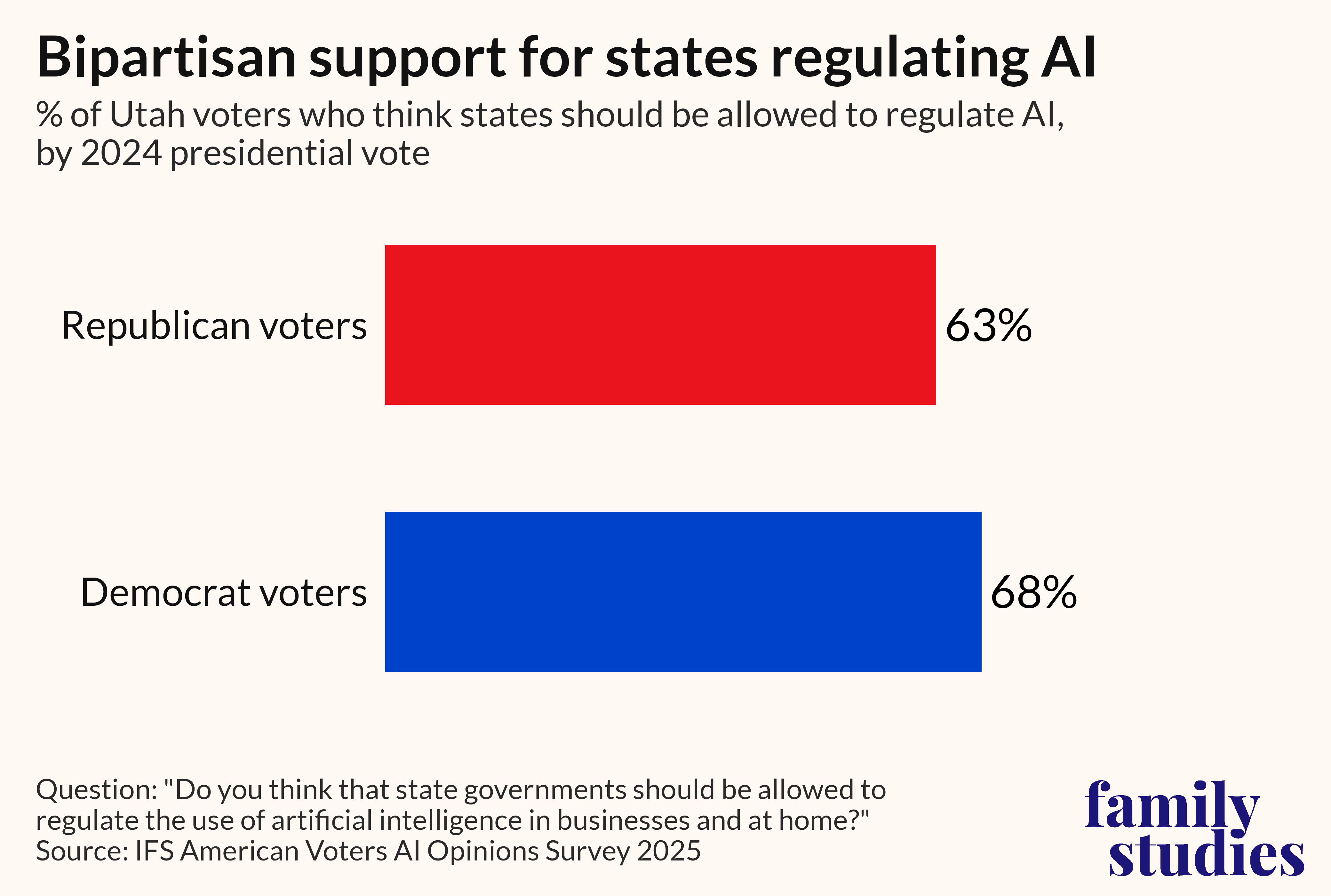
A strong majority of both Republican and Democratic voters in Utah support the right of states to regulate AI, at 63% and 68% respectively. Clearly, state regulation of AI has strong bipartisan support in the state of Utah.
But a larger question is whether these Utah voters support holding AI companies financially liable for harms to children and for what are sometimes called “catastrophic harms,” i.e., significant damage to people or public infrastructure caused by AI systems. We found that Utah voters broadly support holding AI firms accountable.
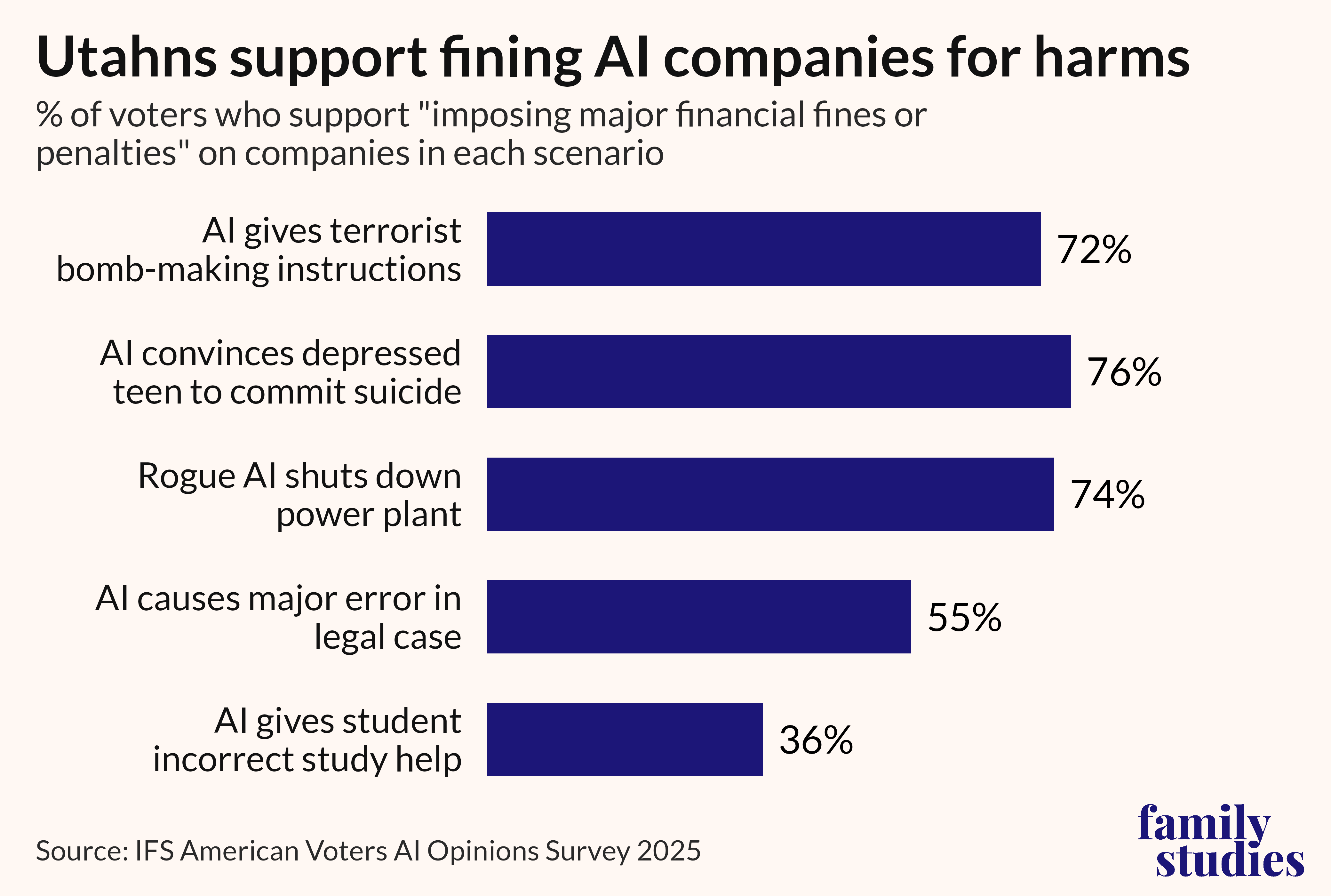
This polling aligns with the kinds of harms that are addressed in HB 286—grouping harms to children and catastrophic harms to the public under one question—alongside other more quotidian harms that might require legal redress. There is majority support for four out of the five measures, especially for the catastrophic harms and harms to children. According to this analysis, HB 286 will be popular with voters.3
Utah Voters Support AI Regulation
President Trump set the tone of his first term in office in his 2017 inaugural address, when he said, “we are transferring power from Washington, D.C. and giving it back to you, the American People.” But the administration’s second term seems to be taking a different course, at least when it comes to AI.
Both in Utah and across America, it is clear that the American people are concerned about the repercussions of AI and demand that AI be safe. Indeed, Americans support the protection of children over AI industry growth by a margin of 9-to-1. Despite what the American people have consistently said, this administration continues to push for deregulated AI at the expense of child safety. The question is why? If Utah lawmakers pass stiff legislation to regulate AI, they should rest assured that Utahns are with them.
Michael Toscano is Senior Fellow, Director of the Family First Technology Initiative for the Institute for Family Studies. Grant Bailey is a Research Fellow with the Institute for Family Studies and editor of IFS Insights.
1. Prior to the current analysis, IFS conducted four other surveys on AI policy, the first three being surveys of how American voters view preemption on three separate occasions—June 2025 (N=1,000), September 2025 (N=2,000), and November 2025 (N=1,000), respectively—and found overwhelming bipartisan opposition to the measure. Lastly, we conducted a survey of voters in December 2025 (N=6,200) with oversamples of six key states, including Florida, Kentucky, Louisiana, Tennessee, Utah, and Michigan, which covered a larger array of issues related to AI, including policy. See: “The Artificial Politics of Artificial Acceleration: How U.S. Voters Feel About AI Accelerationism”
2. We anonymized the quotations to decrease bias towards the speaker, focusing rather on the content of the statements.
3. A poll by Public Opinion Strategies cited in Deseret News has polled HB 286 directly and found that 90% of its sample supported the measure.
Appendix
Pope Leo XIV: “Builders of AI should cultivate moral discernment as a fundamental part of their work. They should develop systems that reflect justice, solidarity, and a genuine reverence for life.”
Sen. Josh Hawley: “Thus far, the AI revolution is working against the working man, his liberty and his worth. It is operating to install a rich and powerful elite. It is undermining our most cherished ideals. And insofar as that keeps on, AI works to undermine America.”
Sam Altman: “AI will contribute to the world in many ways, but the gains to quality of life from AI driving faster scientific progress and increased productivity will be enormous; the future can be vastly better than the present. Scientific progress is the biggest driver of overall progress; it’s hugely exciting to think about how much more we could have.”
David Sacks: “So we have to do everything we can to help our companies win, to help them be innovative, and that means getting a lot of red tape out of the way…. We have to have the most AI infrastructure in the US. It has to be the easiest place to build it.”
Marc Andreessen: “AI is quite possibly the most important—and best—thing our civilization has ever created, certainly on par with electricity and microchips, and probably beyond those. The development and proliferation of AI—far from a risk that we should fear—is a moral obligation that we have to ourselves, to our children, and to our future.”


