

Highlights
- When Iceland increased the “opportunity cost” of fertility by increasing returns to work, fertility rose. Post This
- Fertility increased during the tax holiday year, suggesting that even though Icelanders had a strong incentive to make more money that year, they instead chose to have more babies. Post This
It is often claimed that income and wealth act negatively on fertility, not least by former British cabinet ministers. A comparison of countries and regions around the world yields a strong negative association between income and fertility. However, there are many socioeconomic and cultural factors that affect this relationship. To isolate the effect of one factor, social scientists find natural experiments in which a shock to just one variable occurred. Such natural experiments are rare, which is why Iceland’s “personal tax-free year” is so interesting: it shows a case where, for no particular fertility-related reason, Icelanders’ incomes shot upwards. The result was surprising: contrary to the assumption that income and wealth reduce fertility, Iceland’s fertility rates actually increased.
How Income Relates to Fertility
Iceland’s tax-free year was unexpectedly announced in December 1986, shortly before the tax holiday began in January 1987, and it was introduced as part of a restructuring of the tax system. The tax holiday is therefore a great natural experiment on the effects of taxes, and has already been used to investigate labor supply responsiveness to taxation. But did this sudden change in taxes influence fertility? And what does that tell us about how income is related to fertility in general?
At least two prior working papers have shown that winning the lottery (a sudden gain in wealth) raises fertility. However, establishing that wealth acts positively on fertility is not sufficient to show that income increases fertility. That’s because of opportunity cost, i.e., when someone’s wealth increases, they have more money to spend on things they like—including children. But an increase in the amount of consumption someone can purchase from a given time spent on labor has two different effects:
- It gives the earner more money to spend on children and therefore acts positively on the number of children they have (the income effect).
- But it also increases the amount of earnings one might have to partially or wholly give up by focusing more on family life or other leisure, and therefore encourages one to give up more out-of-work activities for work (the substitution effect).
Emphasis on the substitution effect has led many fertility economists to argue that declining fertility is due to the increasing opportunity cost with [particularly women’s] increasing earning potential. As wages go up, the “cost of staying home” goes up too, and fertility falls. However, this cannot be reasonably taken for granted! As discussed above, there is also a very simple way that increases in income increase fertility: it provides more money to spend on having children for those who want kids.
In a previous article for IFS, Lyman Stone found that, in recent years, a 2% increase in GDP per capita is associated with a 0.15 increase in TFR (although the association varies over time). Since individuals do not choose the economic times in which they live, this is suggestive evidence that income could have a net positive effect on fertility. But it is not completely conclusive, because changes in economic growth might affect the timing of births (and thus appear to raise fertility rates where couples have delayed fertility to more opportune times) and economic downturns often have their own particular surrounding events (e.g., the Covid-downturn period also saw large changes in how people lived their lives). Conclusive evidence that real disposable wages positively act on fertility would use a natural experiment of an unexpected shock on incomes. Iceland provides just such a natural experiment.
What Happened in Iceland
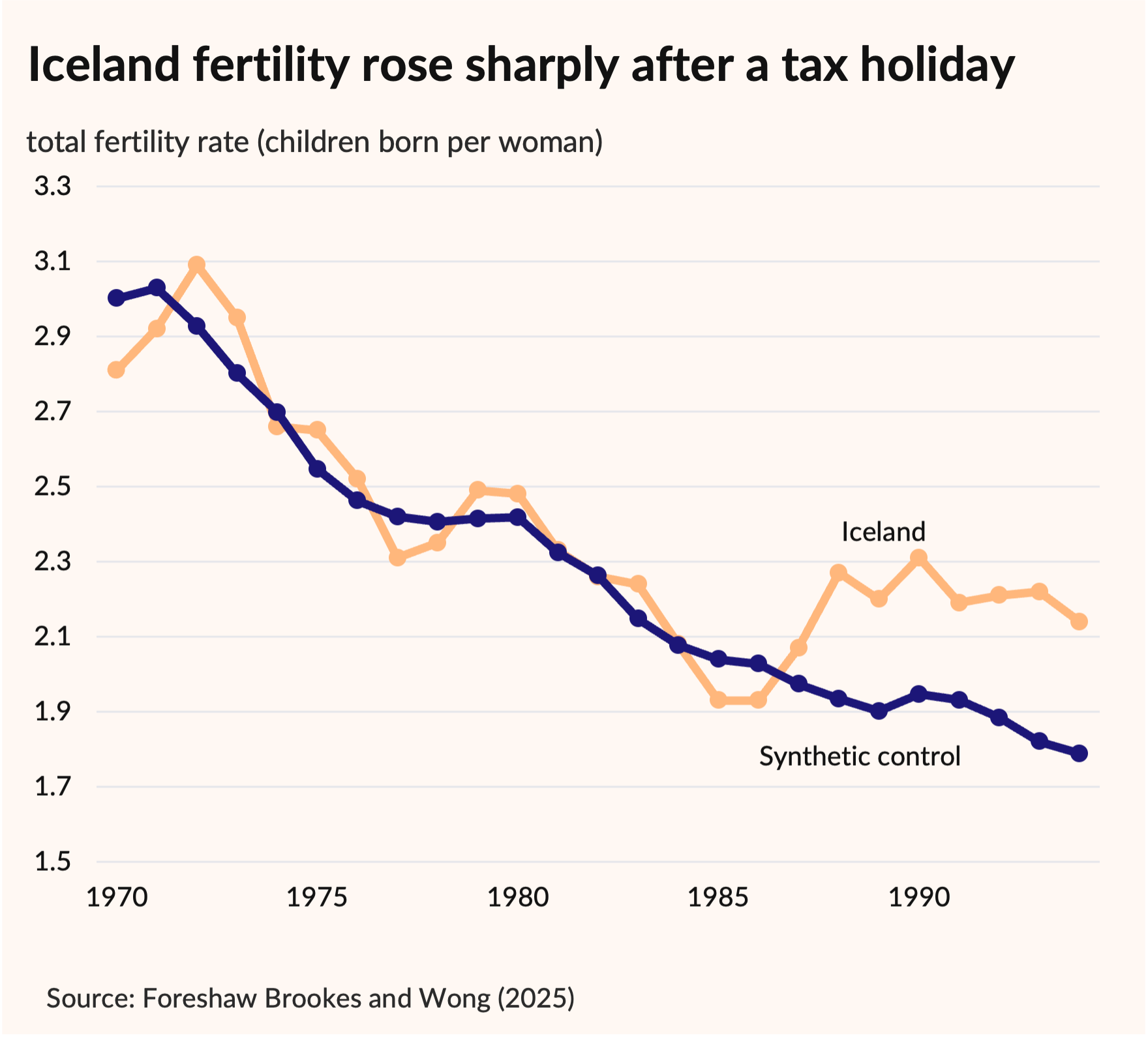
In a recent report for the Centre for Family and Education (CFE) co-authored with Ella Wong, we found that when Iceland gave its taxpayers a break for a year, fertility rose. Using a synthetic control model (an approach which simulates a counterfactual trend of Iceland’s TFR based on the trend for other countries that had a similar pattern as Iceland before the tax holiday), we found that TFR was 0.33 children per woman higher than it would otherwise have been—a very large effect in developed countries. The effect in 1987 was not statistically significant, since Icelanders only had about 3 or 4 months to conceive births in response to the tax holiday and have them in 1987, but Iceland’s fertility continued rising in 1988 before continuing its prior trend.
But to further demonstrate the effectiveness of this policy in a new working paper, I isolated the effect of the tax holiday on fertility rates by analyzing month-by-month fertility data. As mentioned, the tax-free year was announced in December 1986 and came into effect in January 1987. Therefore, if the lack of taxes—and resulting increase in real disposable income—raised conceptions, one would expect it to affect fertility specifically in the later months of 1987. Using a method called interrupted time series analysis that identifies structural breaks in data series, I found that Iceland births broke from their prior trend in November and December 1987. Since most couples don’t successfully conceive on their first attempt, it’s to be expected that major fertility effects wouldn’t be observed exactly 9 months after the policy announcement.
The graph below shows monthly births in Iceland, divided by the average births in that month 1983-1986, and helps visualize the major trend break in late 1987.
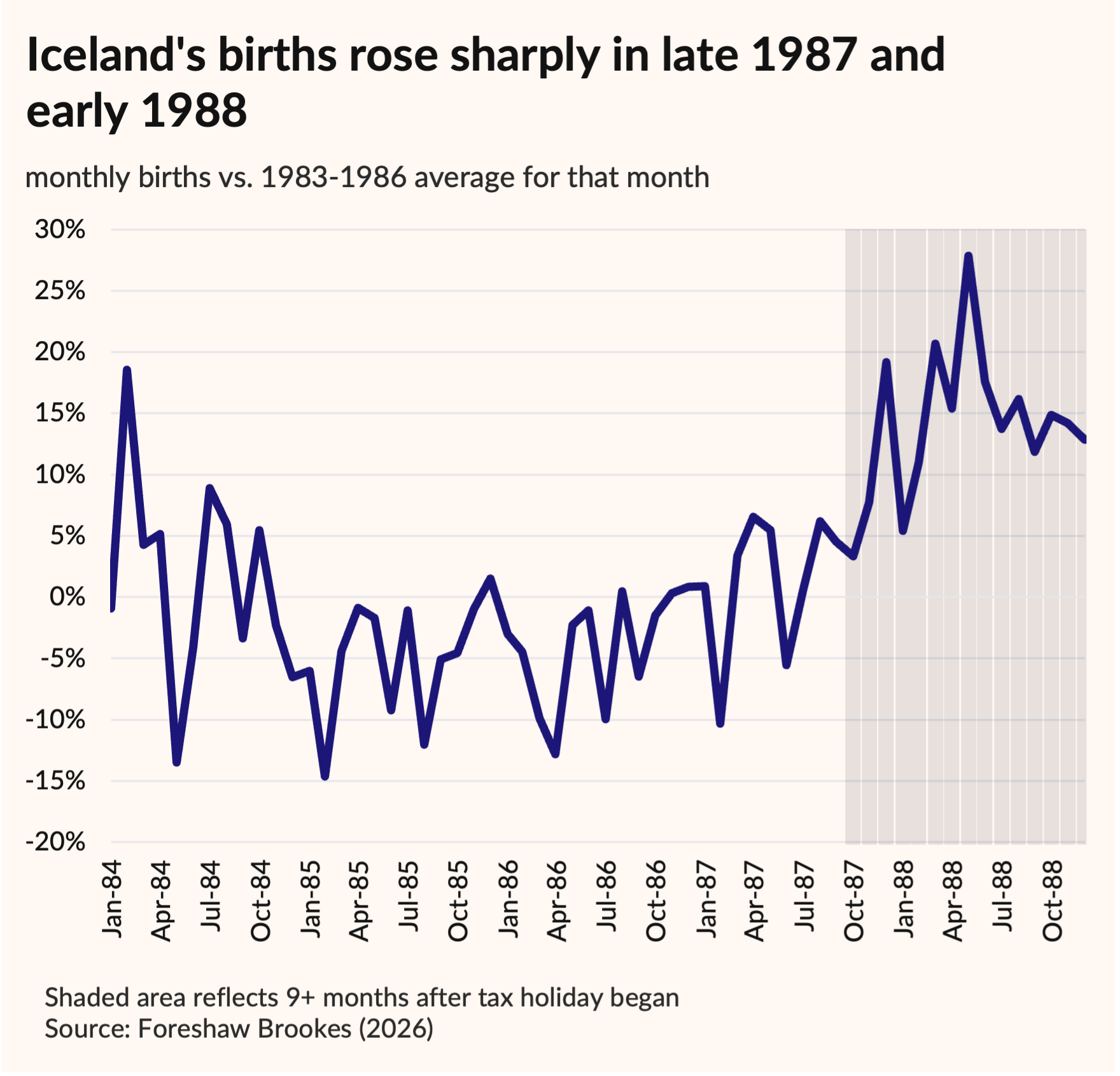
In the working paper, I show that this result is not spurious: fertility increased during the tax holiday year, suggesting that even though Icelanders had a strong incentive to earn more income in that year (because income in that year faced lower taxes), they nonetheless instead chose to have more babies in the year of the tax holiday. This increase in fertility in the year of the tax holiday is only observed in the fourth quarter of the year, not earlier, consistent with the idea that the tax holiday in December 1986 motivated more conceptions.
Further, couples could have chosen to delay childbearing to the beginning of 1988, when the tax-free year (and increased earning opportunity) was over, and when a more generous parental leave policy was introduced for some women, rendering the increase in fertility within the tax holiday all the more striking. If parents had delayed their conceptions by just another month, they’d have gotten more time off work!
Harmony, Not Tension
This finding has several major implications. First, there may be harmony, not tension, between economic growth and fertility. Those who accept low fertility as an inevitable consequence of material comfort per se are mistaken, as are those who advocate degrowth as a means to raise the fertility rate. When Iceland increased the “opportunity cost” of fertility by increasing returns to work, fertility rose.
Moreover, the status quo of the developed world, in which working families shoulder a large part of the cost of supporting a growing number of dependents, likely reduces fertility by reducing the real disposable income of families and those yet to have children—that is to say, prime working-age people.
Finally, finding ways to increase economic growth, and other means of raising the real disposable income of people of fertile age, may actually have a positive effect on fertility.
Peter Foreshaw Brookes is the founder and director of the Centre for Family and Education. Before founding the CFE, Peter worked as an educator and researcher.
*Photo credit: Shutterstock


