
Highlights
- In a new analysis of young adults, we find three relatively distinct dater profiles: active, unprepared, and selective daters. Post This
- The three types of young adult daters are equally dissatisfied with their dating options, and their attitudes about achieving financial milestones before marriage are not widely different. Post This
In our previous research using the Wheatley Institute’s 2025 National Dating Landscape Survey, we identified a “dating recession” among American young adults. Specifically, we found that less than a third of young adults in the prime serious dating years (ages 22-35)—who expect to marry in the future—are dating at least once a month. Furthermore, 29% of men and 38% of women in this age group report not dating at all in the last year.
While these percentages of dating frequency provide a broad description of the modern dating landscape, they are relatively flat descriptors of what is likely a much more diverse social topography. Simply put, it is not very helpful to see all young adults through a single statistic of central tendency. We suspect that dating experiences and opportunities vary widely across different sub-groups and life situations.
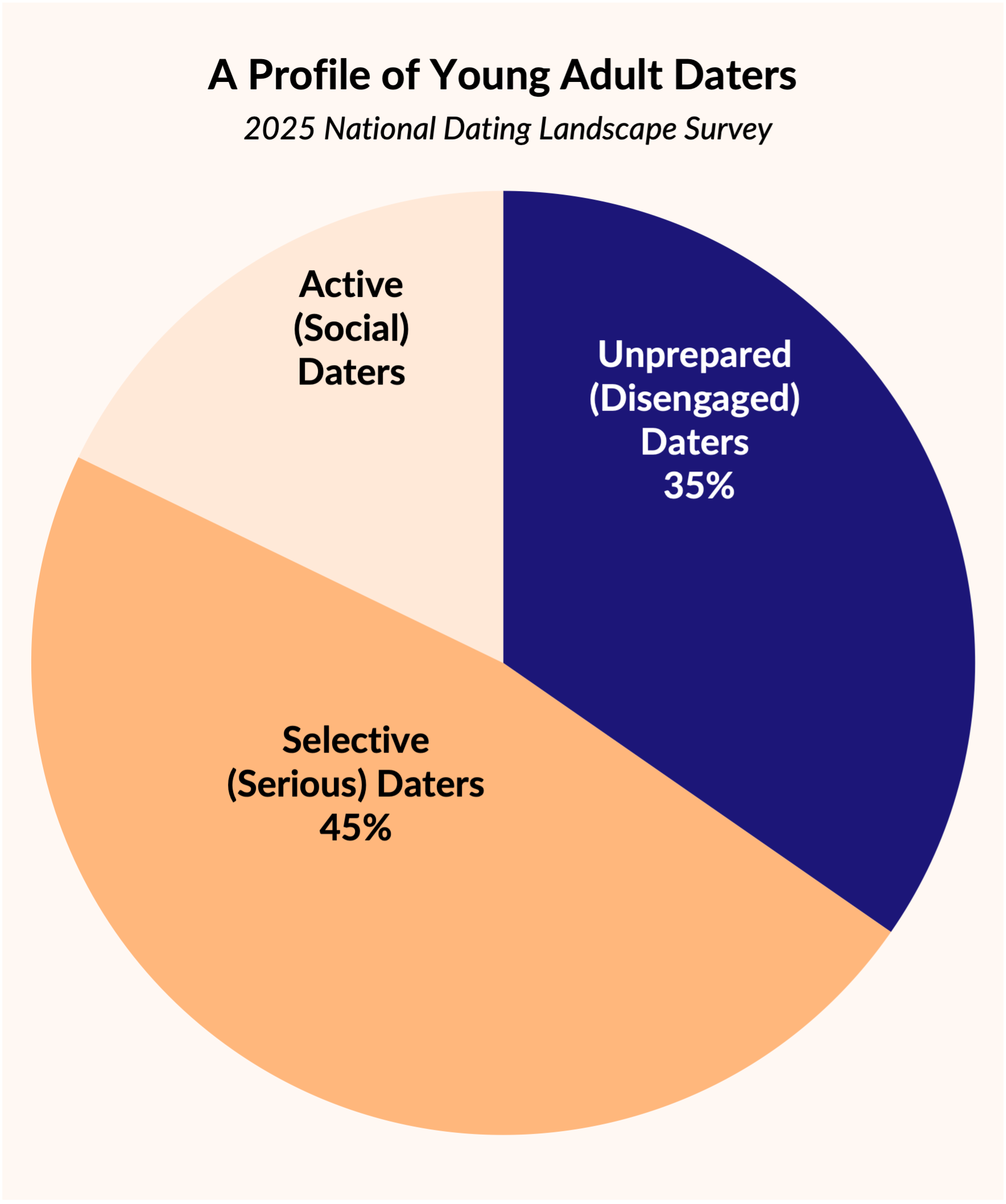
To that end, in a deeper analysis, we explored different dating profiles of young adults. That is, we used a range of dating behaviors, attitudes, and experience variables, along with marital attitudes and expectations—as well as demographic variables and individual characteristics—to see whether there are identifiable, distinct profiles or groups of daters. Our tentative answer is yes,1 and we identified three relatively distinct dater profiles: unprepared, selective, and active daters.2
The Unprepared (or Disengaged) Dater
In our analysis, 37% of young adults are classified as “Unprepared Daters” (or “Disengaged Daters”). On average, these young adults only dated once or twice a year. Not surprisingly, they have the furthest marital horizon (almost 7 years out) and the oldest expected age at marriage. They also have the lowest marital salience scores. Their sense of dating confidence is the lowest by far among the three groups. They perceive themselves as having weak dating skills and a low level of dating efficacy. They also have lower scores on the serious dating orientation scale, although they are the middle of the scale for wanting to avoid commitment and serious relationships. And to top it off, their parents are not especially supportive of them dating seriously.
The Unprepared Dater profile is equally divided between women and men. Comparatively, they are less well-off financially and less likely to have advanced education. And they are much less likely to be working (23%) or to be working full time (37%). They are a little more liberal politically and much more likely to be absent from religious services (47%). They have poorer physical and mental health, and are in the middle in terms of pornography use and interaction with AI romantic partners.
The Selective (or Serious) Dater
About 45% of young adults in our survey are “Serious Daters.” On average, this group of young adults only date a few times a year (a little more than Unprepared Daters). However, their pattern of infrequent dating looks very different than their Unprepared Dater peers. Simply put, their profile reflects seriousness and selectivity.
Serious daters have the closest marital horizon length (but still 4-5 years out) and the lowest expected age of marriage. They have relatively high marital salience scores and are the group with the most confidence in their dating skills. By far, they have the highest scores on a serious orientation to dating and the lowest scores on avoiding commitment. They also have the highest parental support for dating. At the same time, they score lowest on having negative feelings about dating from bad past breakups and score the highest on feeling that past breakups have helped them learn and grow.
Low-frequency dating is composed of low-resourced daters with low confidence, and daters looking for—but struggling to find—serious relationships.
Selective or Serious daters are split: 60% women and 40% men. They are the most educated group, much more so than Unprepared Daters. They are also the middle group in terms of political orientation and religious attendance. They have the lowest levels of depression and the highest body image scores. Importantly, they have the lowest levels of online pornography use and interaction with AI romantic companions.
The Active (or Social) Dater
Finally, 18% of young adults with expectations to marry are “Active Daters.” This group of young adults is dating the most—on average, about once a month. Their marital horizon is in between the two other groups (5-6 years out), as is their expected age of marriage. Interestingly, they have the highest scores on marital salience, even a little higher than Selective Daters. Their dating skills and dating efficacy scores are almost as high as for the Selective Daters, but they have by far the highest scores on a social orientation to dating and an orientation toward exploring relationships. And they have the highest scores on avoiding commitment and serious relationships. They are the middle group in terms of parental support for serious dating. Interestingly, they have the highest scores on negative feelings about dating due to bad breakups in the past.
Active daters are nearly 70% men. They are also twice as likely to be African American (17%) as the other groups. They are the best resourced group. They have the highest levels of full-time employment and personal income, facilitating their social dating activity. They are generally well educated. They are by far the most politically conservative group with the highest level of regular religious attendance (43%). And they have the greatest satisfaction with their physical health (70%), but they were in between the two other groups on depression scores. Finally, they have the highest level of regular pornography viewing (42%) and regular interaction with an AI romantic partner (30%).
Profiles Comparison
Interestingly, the three groups are equally dissatisfied with their dating options (although their “meh” feelings might come from different experiences). Also, their attitudes about achieving financial milestones before marriage are not widely different. And we found no age difference among these three groups.
Two of these groups are what we call low-frequency daters, but they have very different profiles. Unprepared Daters—nearly 4-out-of-10 young adults— rarely go out on dates, probably because they lack confidence in their dating skills and they have the longest marital horizon. Moreover, they have the fewest resources to devote to dating and to attract dating partners. (Note that money was the most endorsed barrier to dating in this survey.) And they tend to be more liberal and less religious.
Young adults who are dating the most do so for social reasons and have fears of serious relationships and commitment, even though marriage is important and salient to them.
In contrast, Selective Daters—the other low-frequency-dating group, and the largest group overall—have much higher confidence in their dating skills. They bring a serious orientation to dating and low concerns about commitment. They have the shortest marital horizon and relatively high marital salience scores. They are more likely to be women with more education. These young adults appear to be dating infrequently, perhaps because they are only looking for serious relationships that can lead to marriage and not because they lack confidence in their dating skills.
Active Daters represent about 2 in 10 young adults (18%). They have the most resources to date. And they were predominantly male and the most conservative and religious. They have the highest scores on negative feelings about past breakups and avoiding commitment. They appear to use dating for social involvement but are holding off on forming serious relationships. This is a bit odd because this group also scores higher on marital salience than the other two groups. Marriage matters to them, but they are not ready for serious relationships.
Implications for Supporting Young Adults
These findings suggest important considerations for parents, young adult mentors, church groups, and dating practitioners. In a recent IFS post, Dr. Andrea Gurney argued that we have a cultural blind spot: “We left the critical stage of dating initiation and marriage formation almost entirely to commercial algorithms and hookup culture," she wrote. "As a result, today’s young adults suffer from an acute skills and confidence deficit.”
To help improve young adults’ dating experiences and help them move forward with their aspirations for marriage will require adapting and tailoring our efforts to account for these dating-group differences.
- First, infrequent daters are two very different groups with different needs. “Unprepared Daters” (or “Disengaged Daters”) lack dating confidence and resources (and are the least religious). Parents and other educators can help these young people improve their dating skills and surface lower cost dating options.
- “Selective Daters” (mostly women and educated) report higher dating confidence, a much more serious orientation to dating, and low concerns about commitment. This group, it seems, needs more help finding dating partners who match their serious orientation to dating. They need dating pathways more than dating education. (Although it is possible that their dating-skills confidence could be misplaced.)
- And finally, “Active Daters” might be dating more frequently but appear to be doing so more for social integration, and they have concerns about commitment and serious relationships, partially because they have had more negative breakup experiences in the past that make them hesitant about serious dating. Dating practitioners can serve this group by helping them build more dating resilience and greater perspective about the inevitable “thrills and chills” of dating. They could also explore with these young adults what is driving their fears of commitment and serious relationships and help them process those fears.
Young adults are experiencing a dating recession, but low-frequency dating is composed of low-resourced daters with low confidence, and daters looking for—but struggling to find—serious relationships. And those who are dating the most do so for social reasons and have fears of serious relationships and commitment, even though marriage is important and salient to them. Helping contemporary young adults improve their dating lives and achieve their marital aspirations will require careful tailoring to meet their different needs.
Alan J. Hawkins, PhD, is an affiliated scholar with the Wheatley Institute at Brigham Young University, a non-resident fellow with the Institute for Family Studies, and Chair of the Utah Marriage Commission. He is also the co-chair of the newly established Dating Education Action Network. For more information about this network, please feel free to contact him at [email protected]. Jason S. Carroll is the Director of the Marriage and Family Initiative at the Wheatley Institute and a Senior Fellow at the Institute for Family Studies. Brian J. Willoughby, PhD, is a professor and associate director of family life at Brigham Young University, a Fellow with the Wheatley Institute, and a Senior Fellow at the Institute for Family Studies. Anna Elmer is a data analyst with the Wheatley Institute at Brigham Young University.
Editor's Note: Readers interested in greater statistical details may contact Dr. Hawkins directly at [email protected].
*Photo credit: Shutterstock
1. Here we present preliminary results of Latent Class Analyses (using Stata). Further, ongoing analyses in preparation for a peer-reviewed publication may differ somewhat from what is presented here.
2. Entropy = .784; AIC = 182,041; BIC = 182,439; N = 4,539.


