Highlights
- Family researchers have spent decades asking whether marriage simply reflects pre-existing commitment. They've devoted much less attention to the possibility that marriage itself strengthens commitment. Post This
- When all eligible families are included and parents who eventually marry are compared with those who never do, marriage appears to matter considerably more than many studies have suggested. Post This
For more than 15 years, one interpretation has come to dominate discussion of marriage among family researchers and policymakers. Yes, married parents are much more likely to stay together. But, as this argument goes, that's not because marriage makes any difference; it's because the kinds of people who marry were already more likely to stay together.
This idea, known as selection, has shaped policy, influenced journalists, and discouraged politicians from saying much positive about marriage. Why champion marriage if the evidence supposedly shows that it is little more than a marker for couples who were already destined to succeed?
My recently completed PhD thesis suggests this consensus may rest on shakier foundations than many realize. Rather than challenging previous research outright, I decided to reproduce it. But when I made two methodological improvements, the results changed substantially. Instead of selection explaining almost all the difference in family stability, it explained only about half.
Selection clearly matters. But marriage itself appears to have been substantially underestimated.
Replication Before Revision
Over four years, I reanalysed the same UK Millennium Cohort Study used in some of the most influential British studies on family stability. Before questioning their conclusions, I first attempted to replicate them. Using essentially the same sample, comparison group and methods, I obtained almost the same headline findings.
That replication was important. It showed that any differences in my conclusions resulted from changes in the analysis, not from analysing different data or using different statistical models. Only after introducing two methodological improvements did the picture begin to change.
The first change concerns missing data. Missing data is where parents do not answer all of the questions in the survey. There are loads of useful information about these parents. But some of their answers are missing.
My PhD study began by replicating the most influential UK studies, published by researchers at the UK Institute for Fiscal Studies (UK IFS) between 2010 and 2013, which followed thousands of parents for up to seven years after the birth of a child.
These studies concluded that once differences in education, income, age, relationship quality, and other background characteristics were taken into account, marriage explained little, if any, of the remaining difference in family stability. Selection appeared to explain almost everything.
Family researchers have become exceptionally good at explaining why marriage might not matter. They have devoted much less attention to understanding why it does.
Yet, in replicating these analyses, I found that around one quarter of otherwise eligible families were excluded because information was missing on one or more variables. Missing data are rarely random. Families with incomplete information are often those experiencing greater instability, financial hardship, or relationship stress. Excluding them risks producing biased estimates.
By 2010, multiple imputation had become a well-established method for retaining such cases rather than simply discarding them. The UK IFS researchers explicitly stated that their analyses were restricted to respondents with non-missing data. But they didn’t say how many parents they had excluded or who these parents were.
My replication suggests that this mattered a great deal. The excluded quarter contained disproportionately more couples who never married or later separated. Remove these more vulnerable families, and the remaining couples inevitably look more alike.
The second methodological decision has received even less attention. These previous studies compared parents who were married when their child was born with those who were not. At first glance, that seems perfectly reasonable. But I found that around one quarter of the "not married" group got married within the next three years, while more than one third married during the first 14 years after becoming parents.
If the research question is whether marriage contributes to family stability over childhood, comparing "married" with "not yet married" is likely to understate the long-term association between marriage and stability.
Same Data, Different Story
My PhD thesis then extended the analysis from seven years to 14 years of parenthood, increased the number of socioeconomic controls to 27, and incorporated both methodological improvements. The results were striking. Using the same approach as UK IFS, I found little evidence of any substantial independent association between marriage and family stability. But adding back in that one-quarter of parents with missing data changed the picture. Selection no longer explained almost all of the difference. It explained roughly two-thirds.
That is a meaningful change. But when I compared parents who eventually married with those who never married during the 14 years of observation, selection explained only around half or less of the difference in union dissolution.
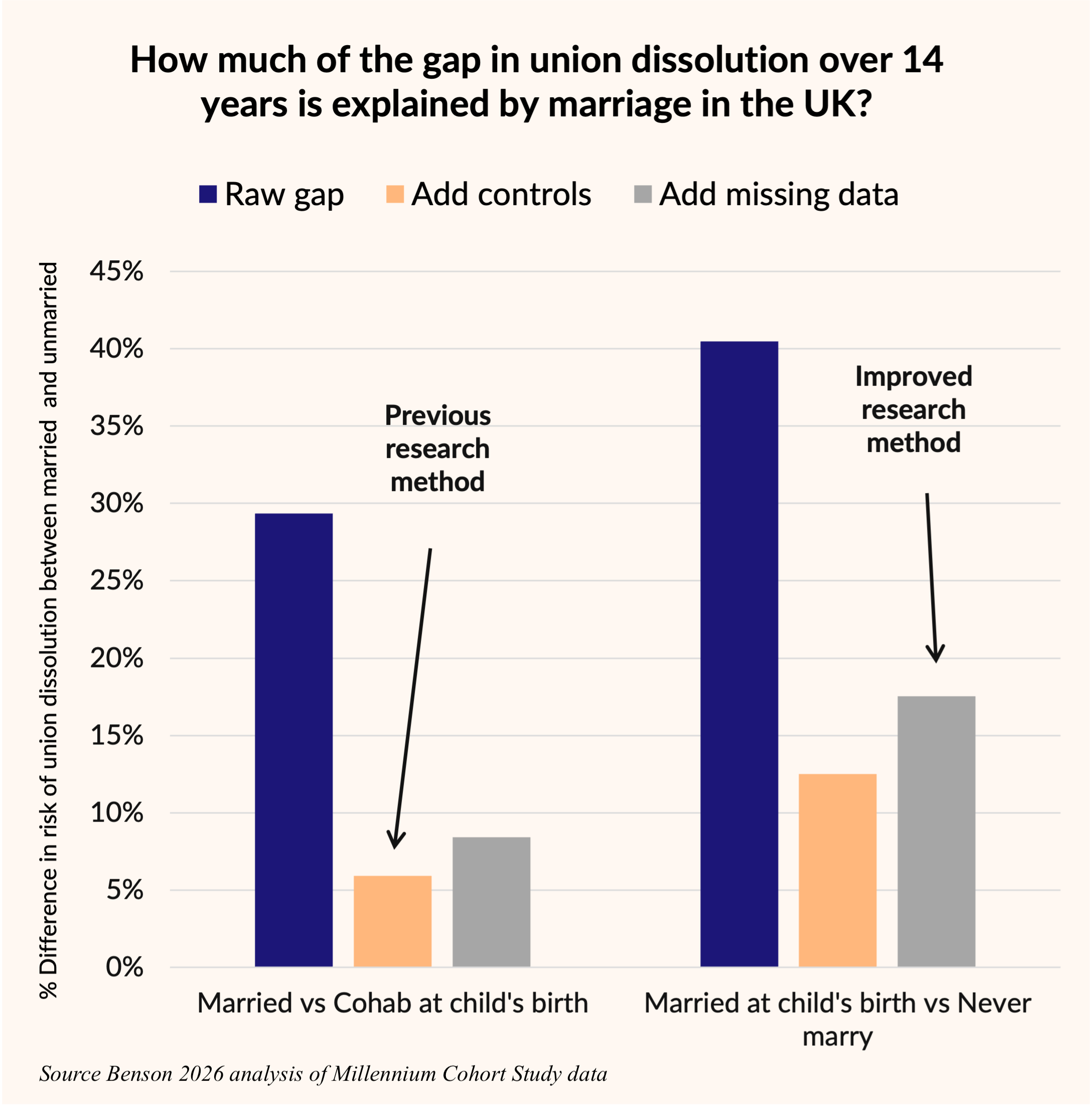
After adjusting for 27 socioeconomic, demographic, and relationship characteristics, marriage retained a substantial independent association with family stability.
A Broader Pattern
One wonders why such influential and capable researchers failed to ask how analysis of the full sample of parents might have influenced their results and conclusions. Yet even in analyses that do find an association with marriage above and beyond selection, despite also not addressing the problem of missing data, they omit to mention this in their abstract or executive summary (see, for example, two recent studies: 1) Kelly Musick and Katherine Michelmore—Cross-National Comparisons of Union Stability in Cohabiting and Married Families With Children; and 2) Sam Crossman, et al.—Families and Inequalities).
This omission matters because relatively few readers study regression tables. Policymakers and journalists generally absorb the headline conclusions, and over time, those conclusions become conventional wisdom.
Selection clearly matters. But marriage itself appears to have been substantially underestimated.
One notable exception deserves recognition. Laurie DeRose, Brad Wilcox and colleagues (see the World Family Map) explicitly compared parents who married with those who did not over the first 12 years after childbirth. They concluded that marriage itself may contribute meaningfully to family stability. Their conclusions sit comfortably alongside my own.
The Missing Psychology
The methodological findings point to a broader omission. Family researchers have spent decades asking whether marriage simply reflects pre-existing commitment. They have devoted much less attention to the possibility that marriage itself might strengthen commitment. Yet psychology offers several plausible mechanisms:
- Scott Stanley's commitment theory distinguishes between "deciding" and "sliding," suggesting that relationships built on explicit decisions generate stronger dedication than relationships that simply drift forward.
- Signal theory proposes that marriage functions as a uniquely costly and public signal of commitment, shaping expectations among partners, families, and communities.
- Cognitive consistency theory suggests that once people publicly commit themselves to a lifelong relationship, they become motivated to behave consistently with that commitment.
At the minimum, these theories suggest that the act of marriage has the psychological potential to transform some relationships for the better. In other words, marriage may not simply reflect commitment. It may also help create it.
It's Time to Ask a Better Question
Every academic discipline develops dominant narratives. Over the past 15 years, family researchers have become exceptionally good at explaining why marriage might not matter. They have devoted much less attention to understanding why it does.
My PhD dissertation does not claim that marriage explains everything. Family and relationship background influences the risk of union dissolution. Whether an individual’s parents stayed together or split up matters, too. Previous partnership history also matters. Current relationship happiness counts as well. Interestingly, education and economic situation matter a lot less than some might think (but that’s a whole other topic: for example, see my recent paper “The Stability Advantage”).
My findings suggest that the evidence has been interpreted too narrowly. When all eligible families are included and parents who eventually marry are compared with those who never do, marriage appears to matter considerably more than many influential studies have suggested.
For years, researchers have asked whether married couples were already different before they married. That remains an important question. But I have now shown that prior selection provides an insufficient explanation. It is time to change the narrative and ask what happens to people when they marry.
Dr. Harry Benson is research director of UK Marriage Foundation. His PhD thesis “The timing of marriage and union dissolution among first time parents in the UK” is available from the University of Bristol. His new book Reliable Love: The Psychology of Marriage and Commitment is out now.
Editor's Note: The opinions expressed in this article are those of the author and do not necessarily reflect the official policy or views of the Institute for Family Studies.
*Photo credit: Shutterstock