

Highlights
- Childless adults are slightly more likely than parents to report having no sex or sex only once or twice in the past year (17% vs. 15%), Post This
- Nearly 1 in 5 married adults who never or rarely attend religious services (18%) are in a sexless marriage, compared with 13% of the married adults who attend services regularly. Post This
“I thought motherhood had killed my sex drive, but I just needed a divorce.” This headline from a recent essay in The Telegraph sparked a wave of online reactions, with some criticizing the mother for putting her sex life ahead of her family. While individual experiences vary, divorce is painful, and marriages end for many reasons beyond sex. But there are some broader questions worth exploring: Does parenthood really kill a couple’s sex life? Which married couples are more likely to be in a sexless marriage?
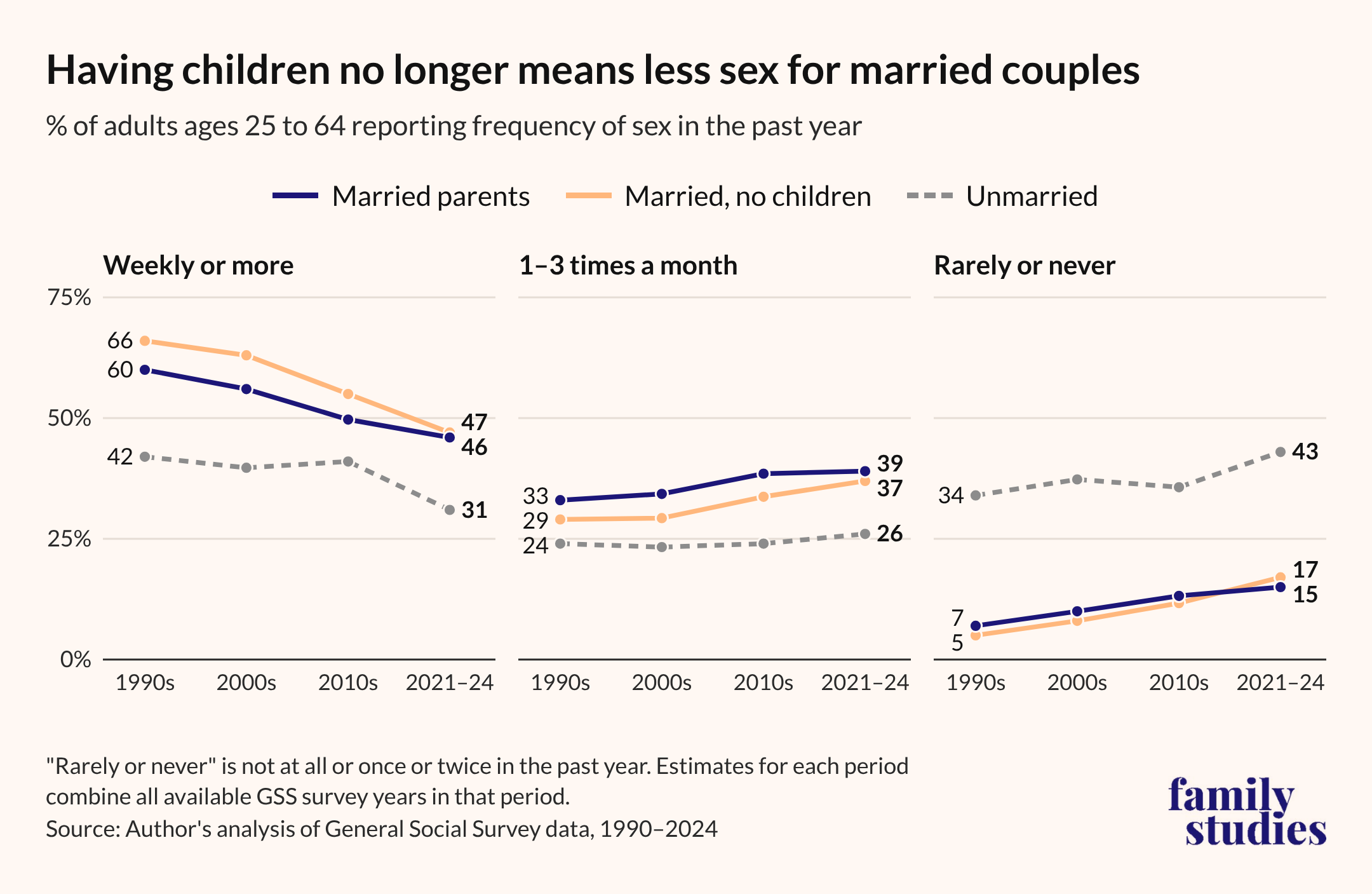
For quite some time, married childless couples had a slight edge in the sex department over their peers with children, but this is no longer the case. Among prime-age married adults (ages 25 to 64), similar shares in each group now report having regular weekly sex. Childless adults are slightly more likely than parents to report having no sex or sex only once or twice in the past year (17% vs. 15%), according to data from the General Social Survey (GSS) collected between 2021 and 2024.
Married parents also tend to have more sex than their childless counterparts in midlife and beyond. Even though young married parents (ages 25 to 34) have sex less often than young married adults without children (62% vs. 65% weekly), the pattern reverses during middle age, and the gap is much bigger after 50. Among married adults ages 50 to 64, 1 in 3 with children have sex at least weekly, compared with 25% of those without children.1
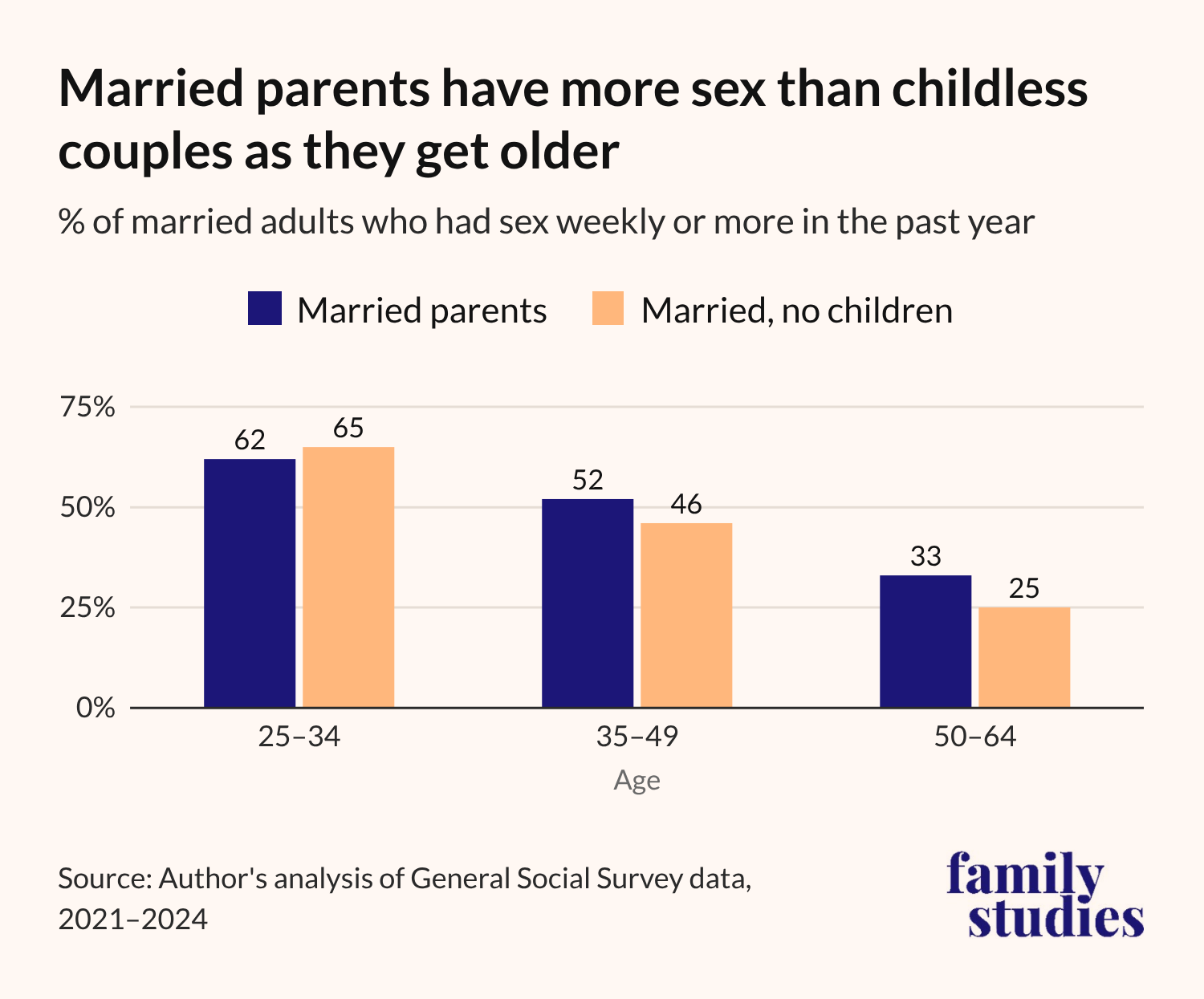
Parenting is the most exhausting, yet most rewarding job. This is especially true when children are young and need round-the-clock care, which could explain why young married parents have less frequent sex than their peers who don’t have kids. However, as kids grow and couples have a little bit more time for each other, the situation changes.
But what is driving the sharper decline of sex among married childless adults over the past decade? A further look shows that this decline is much more pronounced among those younger than 50. Between 2010s and 2020s, weekly sex among young childless couples (ages 25 to 34) fell 5 percentage points from 70% to 65%, and 10 percentage points among those ages 35 to 49 (from 56% to 46%). In comparison, the decline among married parents was milder: there was little change in weekly sex among young married parents during the same period, and a drop of 5 percentage points among those ages 35 to 49.
It is important to note that America is in a “sex recession,” as previous IFS research showed that the share of American adults who have regular, weekly sex is at a record low. Even though married adults still have a lot more sex than unmarried adults, they are not immune to the overall downward trend of declining sex.
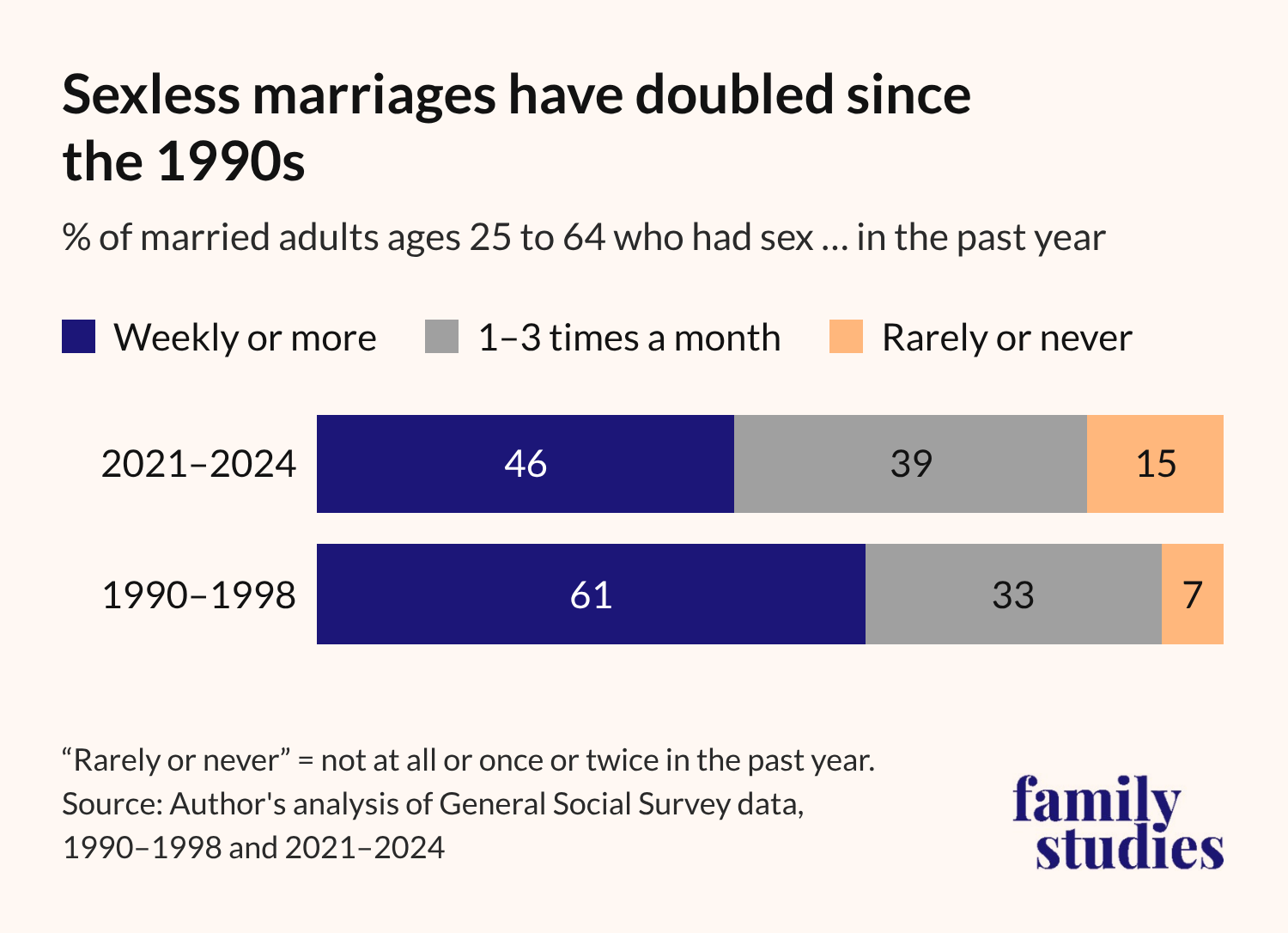
About 1 in 7 married Americans ages 25 to 64 (15%) reported having no sex or sex only once or twice in the past year between 2021 to 2024, more than double the share in the 1990s (7%). Meanwhile, the share having weekly or more often sex is down from 61% to 46%, which means fewer than half of prime-age married adults are having regular sex these days.
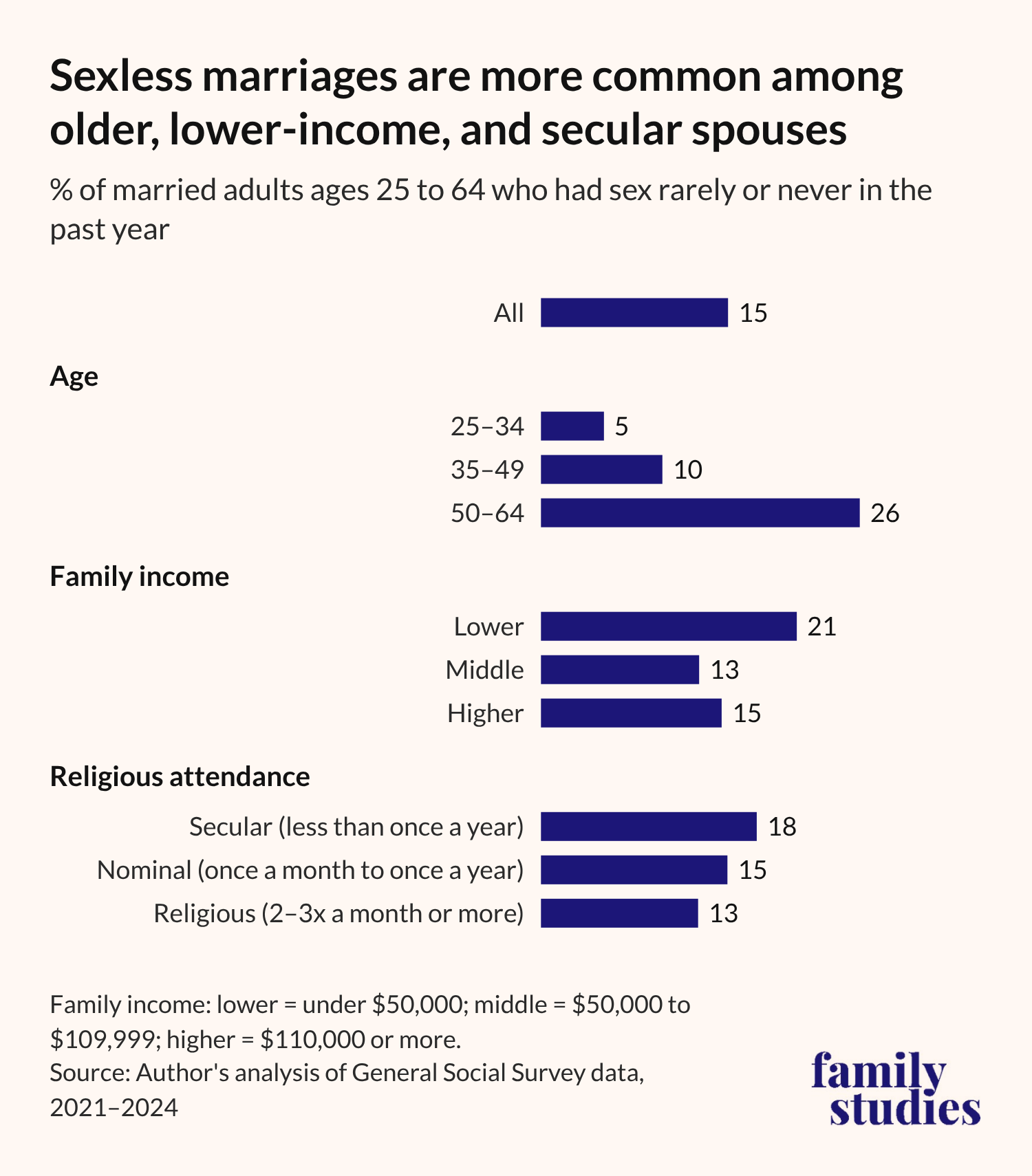
As to which couples are more likely to be in a sexless marriage, the data points to three significant factors: age, income, and religious attendance. Sex generally declines with age, so it is no surprise that married adults in their 50s and 60s are much more likely to be in a sexless marriage than those who are younger. Interestingly, money also plays a role. Married adults with a family income under $50,000 are more likely to have no sex or to rarely have sex than couples with middle or higher incomes.
In addition, a couple’s religious attendance matters for their sex frequency. Nearly 1 in 5 married adults ages 25 to 64 who never or rarely attend religious services (18%) are in a sexless marriage, compared with 13% of the married adults who attend services regularly. The link between religion and sex has been documented in a recent IFS report, which found that churchgoing married adults not only tend to have more sex than their non-churchgoing peers, but also report higher sexual satisfaction.
To test the independent effect of each factor, I ran a regression model that accounts for several other characteristics of married adults. It turns out that age, family income, and religiosity remain significant predictors of being in a sexless marriage. A number of factors are not significantly associated with the odds of being in sexless marriage, including whether married adults have children or not, education (college vs. non-college educated), and political ideology.
The standard of how much sex is best in a relationship can be subjective, but the data show a strong link between the frequency of sex and marital happiness. Among married adults ages 25 to 64 in 2021-2024, those who had regular, weekly sex were much more likely than their sexless peers to say that they were in a very happy marriage (70% vs. 42%), and those who had sex once or a few times a month fell in the middle (60%).
Meanwhile, a sexless marriage is not necessarily a devastating one. Only 11% of married adults ages 25 to 64 who had no sex or sex only once or twice in the past year said they were “not too happy” with their marriage. Perhaps some unhappy, sexless marriages have already ended in divorce. A lack of sex can be just the tip of the iceberg in an already troubled relationship, as in the marriage depicted in The Telegraph story. But one thing seems clear from these findings: parenthood is not likely the culprit for a sexless marriage.
Wendy R. Wang is the Director of Research and Senior Fellow at the Institute for Family Studies.
1. Married men and women report similar sex frequency in the age groups younger than 50, but married men are less likely than women to report being in a sexless marriage among those ages 50 to 64, possibly because husbands tend to be older than their wives. A similar pattern is found among married parents.


