
Highlights
- New parents need ways to balance the economic imperative to keep household earnings as stable as possible with the benefits of dedicating time to newborn bonding. Post This
- Like unemployment insurance, paid family and medical leave programs are designed with the goal of protecting workers from sudden earnings losses by smoothing household income. Post This
Nearly one-third of American children will experience parental divorce before they reach adulthood. This life altering episode is associated with falling household income despite parents working longer hours. Children experience more residential instability, moving more, and often to poorer neighborhoods that offer few opportunities for upward mobility. When these children grow up, they are less likely to attend college, earn less, and are more likely to end up in jail or worse. Children cannot necessarily count on their age or class background to protect them from these negative outcomes. Research suggests that the consequences of family instability are particularly negative for young children and children from middle- and upper-income families.
Cultural factors play an important role in increasing the chances that children are raised in stable, thriving families. IFS Research Director Wendy Wang and Senior Fellow Brad Wilcox have discussed the importance of setting expectations that the path to a successful family life starts with finishing school, finding work, and getting married before having children. Old fashioned practices like having a joint bank account can help set married couples up to better align financial expectations, which make financial conflicts less likely to cause marital strife.
But we know that economic factors matter, too. The classic family stress model suggests that economic stability helps undergird family stability—and that negative economic shocks can undermine it. Even parents who have built up great financial communication skills will find their relationship strained by a sudden loss in their household earnings power.
Fortunately, research shows that policies that help protect workers against negative earnings shock by stabilizing household incomes also help stabilize families during these episodes. Getting laid off from a job is a good example. The sudden loss of earnings can put a strain on families, leading to a greater likelihood of divorce among married workers. Studies find that unemployment insurance, which serves to smooth household income in these circumstances, mitigates the negative impact of layoffs on divorce rates.
Earnings shocks extend beyond unexpected layoffs, though. Ironically, the birth of a child is the other major earnings shock families are likely to experience. New parents are hit with a double whammy: household earnings temporarily decline as one or both parents take time off to recover (or support mom’s recovery) and bond with their newborn, while family expenses simultaneously rise to cover the cost of newborn needs.
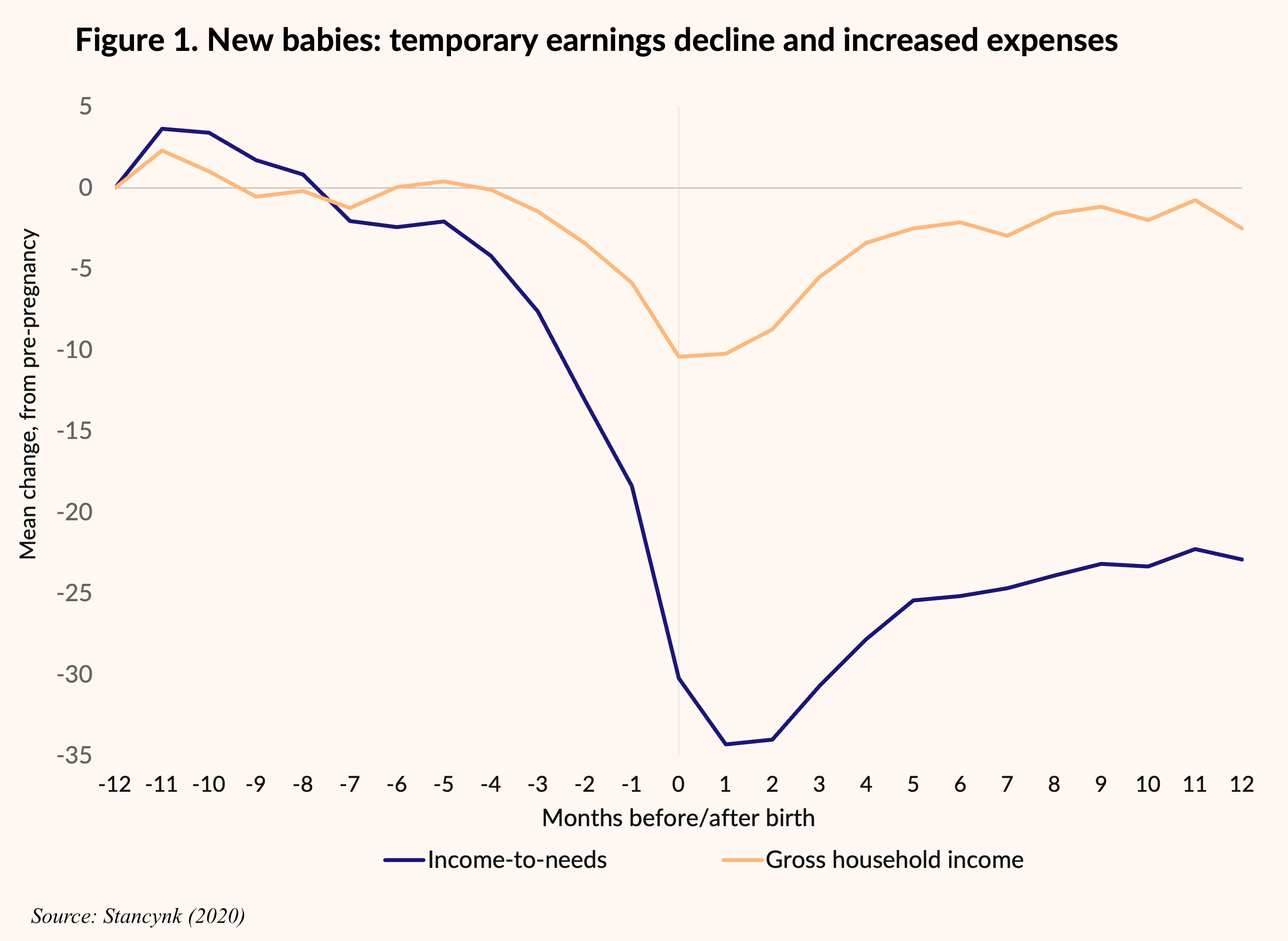
New parents need ways to balance the economic imperative to keep household earnings as stable as possible with the benefits of dedicating time to newborn bonding. This is particularly important—but tough—for new dads who find themselves facing pressures to be a breadwinner and a good dad and husband. Parental engagement following birth sets the stage for parental engagement over the course of a young child’s life. In the absence of programs to support them, new parents may be forced to choose between reducing earnings—jeopardizing marriage stability—or keeping earnings stable, potentially weakening their ability to build the foundations of their relationship with children.
Like unemployment insurance, paid family and medical leave programs are designed with the goal of protecting workers from sudden earnings losses by smoothing household income in these circumstances. The public discussion around paid leave tends to focus on issues like poverty reduction and women’s labor force participation, but the potential impact on marital stability and family well-being warrants more attention in these debates. It turns out there is good evidence that access to paid leave, like unemployment insurance, can bolster family stability, in part, by protecting against economic instability. A growing literature from Europe finds that paid paternity leave is associated with lower divorce rates, increased paternal involvement, and higher relationship quality within the family.
Expanding access to paid parental leave is an important tool for strengthening American families at a time when families are under increasing pressures.
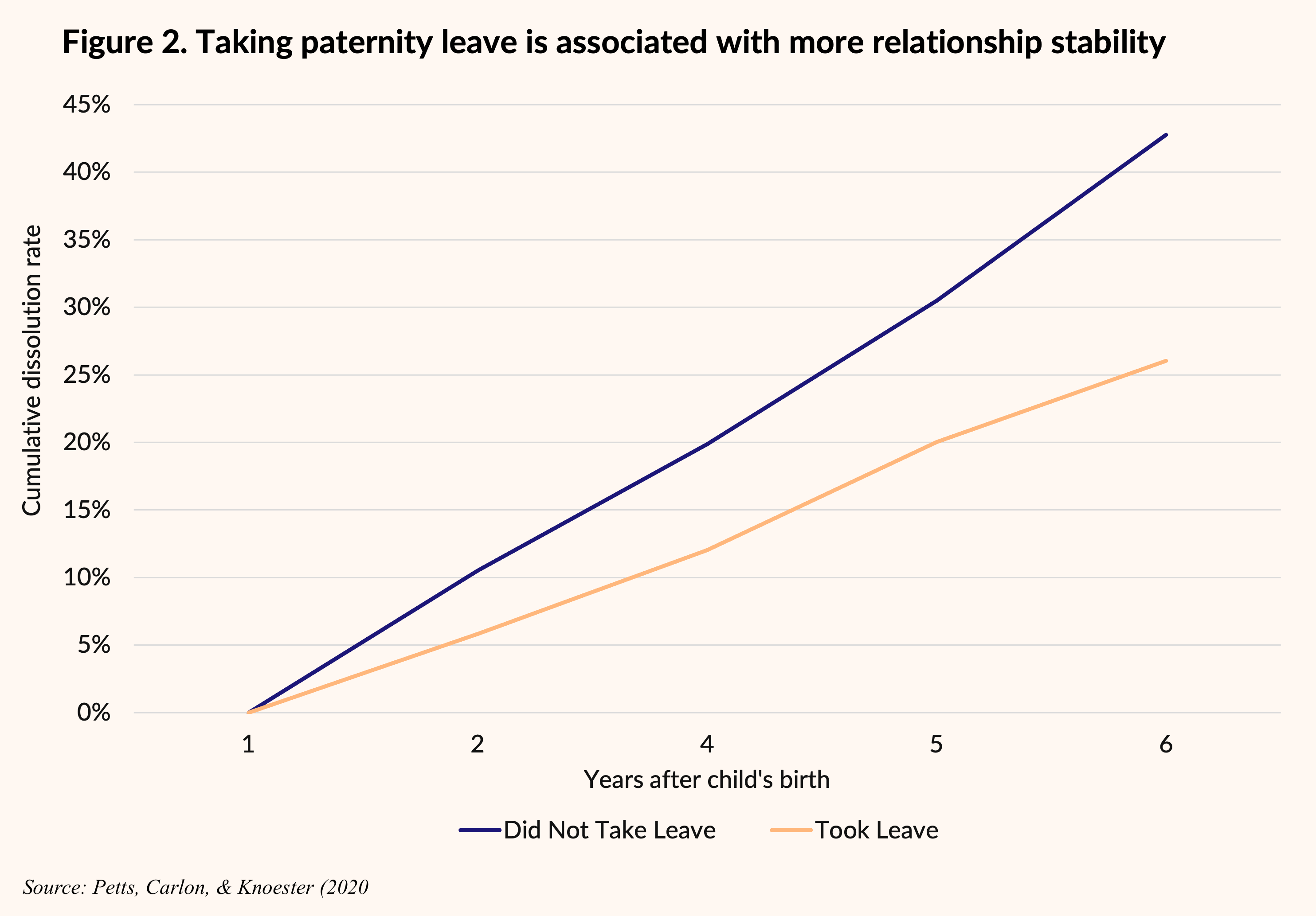
American families have more limited access to paid leave, but we see similar evidence from the growing number of state programs here. In a U.S. study, taking paid leave—in this case about two weeks—was associated with greater relationship stability. Dads often use this time as an opportunity to support moms with recovery from childbirth and bond with their new baby. In fact, dads with access to paid leave are five times more likely to take time off and are much more likely to be intimately involved in caring for their newborn. Overall, paid leave may help men be better husbands and dads at one of the most crucial times in family life.
There are some concerns about paid leave’s impact on other aspects of family life, but the evidence in these cases is limited to European contexts and more mixed at this point. For example, “daddy quotas” have been gaining popularity among some advocates as a way to incentivize what some progressives see as more egalitarian gender roles within families. On one hand, the 1995 introduction of a dedicated “daddy month” in Sweden increased the likelihood of separation and divorce. On the other hand, a similar Icelandic reform in 2001 was found to reduce divorce rates there.
Similarly, paid leave’s impact on fertility is still unclear. In 2007, Spain introduced a small expansion of paid paternity leave, which subsequently led to delays in parents having additional children. That same year, Germany introduced “daddy quota” and increased the program generosity, which subsequently led to an increase in fertility rates in West Germany.
Until we have more research to provide clear answers, the scattered evidence suggests policymakers might want to play it safe and avoid gender-specific leave policies, lest they inadvertently undermine family stability that we know comes with more generalized paid leave policies. But the bulk of the evidence is clear that expanding access to paid parental leave for both parents is an important tool for strengthening American families at a time when families are under increasing pressures.
Joshua McCabe is the Director of Social Policy at the Niskanen Center.
Editor's Note: The opinions expressed in this article are those of the author and do not necessarily reflect the official policy or views of the Institute for Family Studies.
*Photo credit: Shutterstock


