

Highlights
- Welfare contributed to the destruction of the traditional family structure that was the norm in black America by creating powerful incentives for a woman not to marry the father of her children. Post This
- The most important thing any pastor can do to support is preach with Biblical clarity and conviction about God’s design for sex, sexuality, and marriage. Post This
A consistent pattern in marriage and family formation over the past 50 years is the decline across most demographic groups. Since the 1960s, marriage and fertility rates have dropped across America, while divorce and family instability have risen. Nowhere has this trend been more stark than in the black family. Almost 70% of black children are born outside of wedlock. Nearly half are raised by single mothers. This is one of the most important issues facing the black community, yet it gets little attention.
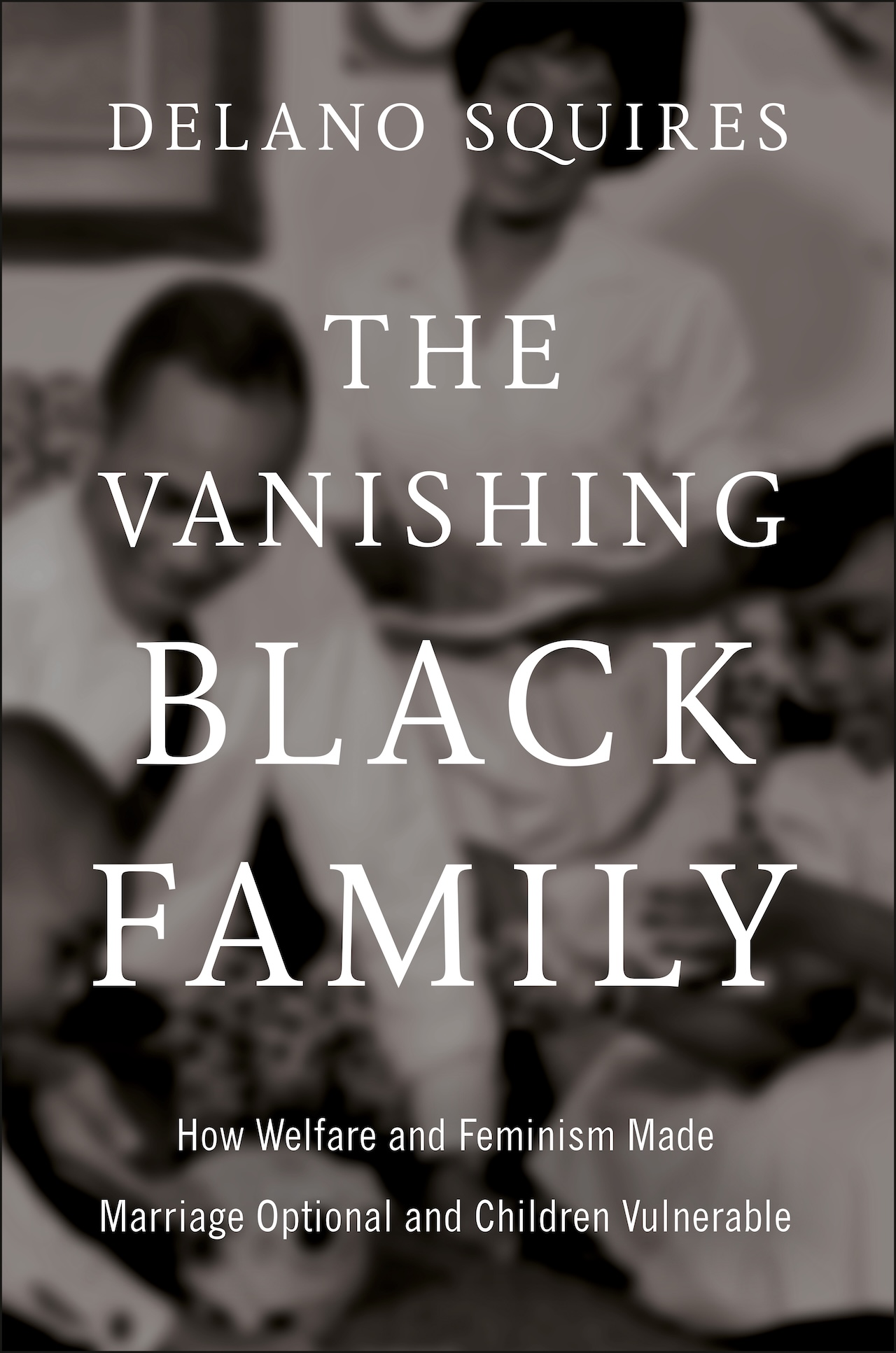
In his new book, The Vanishing Black Family: How Welfare and Feminism Made Marriage Optional and Children Vulnerable (Sentinel, 2026), Delano Squires, Director of the Richard and Helen DeVos Center for Human Flourishing at the Heritage Foundation, lays out a blueprint to reverse these trends. Squires attributes the decline in black marriage and family formation to a combination of welfare incentives and feminist cultural changes. His book is a call to action for black leaders and public officials to tackle the problem directly through political and cultural changes.
In the following interview, Brad Wilcox, Senior Fellow and Director of the IFS Get Married Initiative, talks with Squires about what’s happened to the black family since the 1960s and what policy steps could help strengthen marriage and family life for black children.
Brad Wilcox: A century after the end of slavery, most black men, women, and children lived in intact families. But in the last 60 years the intact black family lost ground with, for instance, 69% of black children now being born outside of marriage.
How would you describe the scope of today's crisis, and why do you think the black family was more intact a century after slavery than it is three generations after the Civil Rights Movement?
Delano Squires: American families of every background look drastically different today than they did decades ago, but as the saying goes, “when America catches a cold, black America gets pneumonia.”
The unfortunate reality is that the black family is far more fractured today than it was in 1965, despite gains in civil rights, education, economic power, and political representation. In 1959, the poverty rate for blacks was about 55 percent. Despite those challenging economic circumstances, more than 75% of black children were born to married parents. By 2023, the poverty rate decreased to 18%, but the nonmarital birth rate increased to 69 percent.
The numbers in some cities are even more stark: 75% of African American babies in New York City are born to unmarried parents, as are 77% in Washington, DC and 83% in Baltimore. State-level data is just as concerning. In Georgia, 71% of black children are born to unmarried parents. In Alabama, it’s 79%. In Mississippi, Arkansas, and Louisiana, it’s 82%.
In just three generations, a black child who is born to—and raised by—married parents went from being the norm to the exception.
This means that in just three generations, a black child who is born to—and raised by—married parents went from being the norm to the exception. And while slavery deformed and distorted the black family, it didn’t destroy it. Enslaved men and women committed to one another in marriage despite the fact that their unions were denied legal protection. They also worked to put their families back together once emancipated. While it is easy to blame slavery for the decline of marriage and increase in single-parent homes, the truth is that the family formation norms we see in black America today are the direct result of policy choices and cultural shifts that took place in the 1960s.
Wilcox: Since you mentioned the 1960s, in your book, you explain how the expansion of the welfare state, especially in the wake of the 1960s, turned the government into what you call a "substitute father" for millions of black families, with programs like AFDC discouraging marriage and rewarding single motherhood.
What do you think were the biggest mistakes policymakers made in the War on Poverty, and how did well-intentioned government programs end up displacing black men from their role as husbands and providers?
Squires: Family structure was a key element of welfare policy in the 1960s. States had discretion to set eligibility rules, and married couples were typically ineligible for AFDC. In fact, a mother could not receive aid if an able-bodied man (e.g. boyfriend) frequented an AFDC mother in her home. The Supreme Court struck down this “man-in-the-house” rule in the 1968 King v. Smith case. The unanimous decision rejected the idea that an unrelated male in the home was truly a “substitute father,” but politicians and bureaucrats, however, had no problem playing that role. The expansion of welfare programs, particularly AFDC, made the federal government the de facto husband for millions of poor women across the country. For context, federal expenditures on public aid programs, a fraction of total social welfare spending, were $1 billion in 1950. By 1975, it had ballooned to $27 billion. It reached $62 billion by 1985.
Johnnie Tillmon was a welfare rights activist who worked to increase the number of black women accessing aid programs. She became a leader within the National Welfare Rights Organization (NWRO) in the 1960s and was its president when it disbanded in the 1970s. Tillmon wrote an essay in Ms. magazine that showed a relationship with the government came with its own set of challenges: “Welfare is like a super-sexist marriage. You trade in a man for the man. But you can’t divorce him if he treats you bad.”
Welfare contributed to the destruction of the traditional family structure that was the norm in black America because it created powerful incentives for a woman not to marry the father of her children and instead depend on support from the government.
Wilcox: You also argue that second-wave feminism, including its black feminist offshoot, taught women to see marriage and men as obstacles to their own liberation, even as black women have pulled well ahead of black men in education and earnings in recent decades.
What is the specific gender challenge facing black couples today, and what would it take, culturally and personally, for black men and women to see marriage as a partnership again rather than a threat to independence?
Squires: The best way to explain the gender dynamic is to let feminist scholars and activists speak for themselves. Rebecca Walker, daughter of noted black feminist Alice Walker, said this about her mother's perspective on the family:
It was drummed into me that being a mother, raising children and running a home were a form of slavery. Having a career, travelling the world and being independent were what really mattered according to her.
Hostility to men and marriage were a feature of the second-wave feminist movement that influenced American politics, media, and culture. But the power of black feminism as a distinct political philosophy was the ability of women like the ones who penned The Combahee River Collective Statement to connect “patriarchy” to racism and capitalism, framing them as “interlocking” systems of oppression. In fact, the only black men radical feminists tolerate are ones willing to use their “male privilege” on behalf of women and other “marginalized” groups.
The cruel irony of this cultural reality is that educated black women writing in the late 1800s and early 20th century provided a template for a pro-family feminist movement. Anna Julia Cooper was a prominent scholar, educator, and activist who is considered the “mother of black feminism.” The views she expressed on the importance of the home in her 1892 book A Voice from the South sound much different than the second-wave black feminists who came after her:
The earnest well trained Christian young woman, as a teacher, as a homemaker, as wife, mother, or silent influence even, is as potent a missionary agency among our people as is the theologian; and I claim that at the present stage of our development in the South she is even more important and necessary.
Audre Lorde is famous for saying the “master’s tools will never dismantle the master’s house,” but given how black feminists wrote about black men and the traditional family, it’s clear to me that they used the tools of their white masters to destroy their own.
Wilcox: In your chapter on reframing this issue for key institutions, you offer some creative ideas for elected officials, from Mayor Bloomberg's blunt public-awareness ads, to a donor-funded "marriage bootcamp."
What specific steps would you want policymakers, at any level of government, to take to help rebuild marriage in black America?
Squires: The government, whether on a federal, state, or local level, can do a great deal to encourage a culture of marriage and strong families for all Americans. The least costly measure is to use their bully pulpit to promote a pro-family agenda. Elected officials should use every communication tool at their disposal (e.g., public remarks, awareness campaigns, social media) to consistently reinforce the evidence-based reality that children have the best outcomes when raised in a loving, safe, and secure home by their married biological parents.
Another way for government to acknowledge the importance of the home is to report key socioeconomic indicators by family structure. In addition, policymakers should incorporate family structure into both policy decisions and program design. That may require, for example, making changes to a government-funded initiative that is marketed as a “family strengthening” but only addresses the needs of mothers and their children.
States and cities can also create commissions and boards to study the impact of family structure and recommend policies, programs, practices, and strategies to support and increase the formation of stable, secure two-parent families.
Another idea is to incorporate “success sequence” instruction into the K-12 curriculum. As you know, at least four states (Tennessee, Ohio, Indiana, Utah) have passed laws to teach students the success sequence in an age-appropriate manner. More should do the same so that young people know that finishing high school, securing employment, and marrying before having children is a foolproof anti–poverty strategy. The Heritage Foundation’s family policy paper includes several initiatives that incentivize the “marriage-before-carriage” family formation ideal. One is called the Newlywed Early Starters Trust (NEST). A deposit of $2,500 would be made into an investment account when a child is born that could be accessed by couples who marry by or before the age of 30. To give a sense of how the free market–and compound interest–can fuel family formation, a couple who marries at 28 could expect an inflation-adjusted NEST distribution of more than 35,000.
Given the damage done to the family by policies that expanded the welfare state in the 1960s, I understand the skepticism some feel toward any government involvement in family policy. But to the extent that the state can play a role in shaping the culture, its influence should be used to consistently promote–through both policy and rhetoric–the idea that children do best when raised in a loving home with their married biological parents.
Wilcox: You're book is tough on black pastors, but you also see the Church as the single most important institution for reviving marriage in black communities. What specific advice would you give church leaders who want their congregations to become part of the solution rather than staying silent?
Squires: The most important thing any pastor can do to support efforts to strengthen the family is preach with biblical clarity and conviction about God’s design for sex, sexuality, and marriage. That is a challenge for progressive black pastors who see the black church as a vehicle for promoting social justice and political change.
Thankfully, there are other pastors committed to promoting marriage and strengthening families. Pastor John K. Jenkins Sr. leads the First Baptist Church of Glenarden, one of the largest churches in Maryland with 11,000 active members. I spoke to him for an article I wrote for Father’s Day, and he estimated there were more than 800 couples involved in ministries at his church related to marriage and family. These include offerings for newlyweds and blended families, date nights for couples and marriage-mentoring programs. I can personally attest to his commitment to family because my wife and I signed up for the Homebuilders marriage class at First Baptist in 2014, less than two years into our marriage and only three years after we first met.
Another leader who understands this connection is Tommy E. Quick, pastor of Promised Land Christian Discipleship Center in Spartanburg, South Carolina, and founder of Christian Families Against Destructive Decisions (CFADD). The organization’s mission—“Rebuilding the Family, Restoring the Nation”—reflects Quick’s belief that the family is society’s most important institution, not the government. Pastor Quick works with a network of churches in the South and equips pastors to do family ministry. CFADD offers online content, a marriage boot camp, and a 30-day couples devotional. The organization also purchased a 127-acre property to establish a National Campus for Family Restoration.
Both men give me hope that a revival of fatherhood and family is possible—for Americans of every race. But it will only be possible if pastors care more about rebuilding the family than retaking the White House.
Editor's Note: The opinions expressed in this interview do not necessarily reflect the official policy or views of the Institute for Family Studies.
Photo credit: Shutterstock


