

Highlights
- In Germany, those who were most likely to change their minds from not wanting children to expecting children in the near future were thirty-somethings who transitioned from single to partnered. Post This
- Fertility expectations were realized, maintained, adjusted, and discontinued—a variety of experiences that have added up to below replacement fertility in Germany. Post This
When I met my future husband in line at Chipotle back in 2006, I asked him whether he had any children. He didn’t—yet. At age 37, with 2 kids from my first marriage, I did not expect to have any more. We now have three together. How would you explain my change of mind?
And how would you explain the reverse: someone planning children at age 28 but no longer at age 33? Those born in previous generations might assume that the person had all the children they wanted during those years. But today, we are more likely to assume that the person simply had a change of heart.
Early population scientists were more concerned with unintended fertility than unrealized fertility desires. Later, attention to people having fewer children than they desired grew, and recently, researchers have started to focus on shifting expectations over the life course: in other words, why people change their mind. In my last article, I described population experts promoting measurement innovations to gather better data on adult romantic relationships with the goal of helping data speak to the question of why people who want kids often do not have them.
Research by Shalini Singh on fluid fertility expectations among childless men and women in Germany confirms that we do not have to wait for the ideal data to better understand why fertility plans go unrealized so often. She used The German Family Panel (PAIRFAM) that follows individuals over time, and she was still able to say a great deal about the importance of the relational context of fertility goals.
Even after the expectation to have a child is discarded, it can still be recovered by entering a partnership.
Panel data collections follow the same individuals over time, and PAIRFAM conducted 14 annual surveys. Individuals who were childless at the time of the survey were asked: “When you think realistically about having children, how old do you think you will be when you have your first child?” This question differs from standard fertility intention questions1 with its requirement to think realistically—an important distinction in an uncertain world. Singh was able to find out what happened later when the question was repeated (if still childless) or the survey recorded a birth.
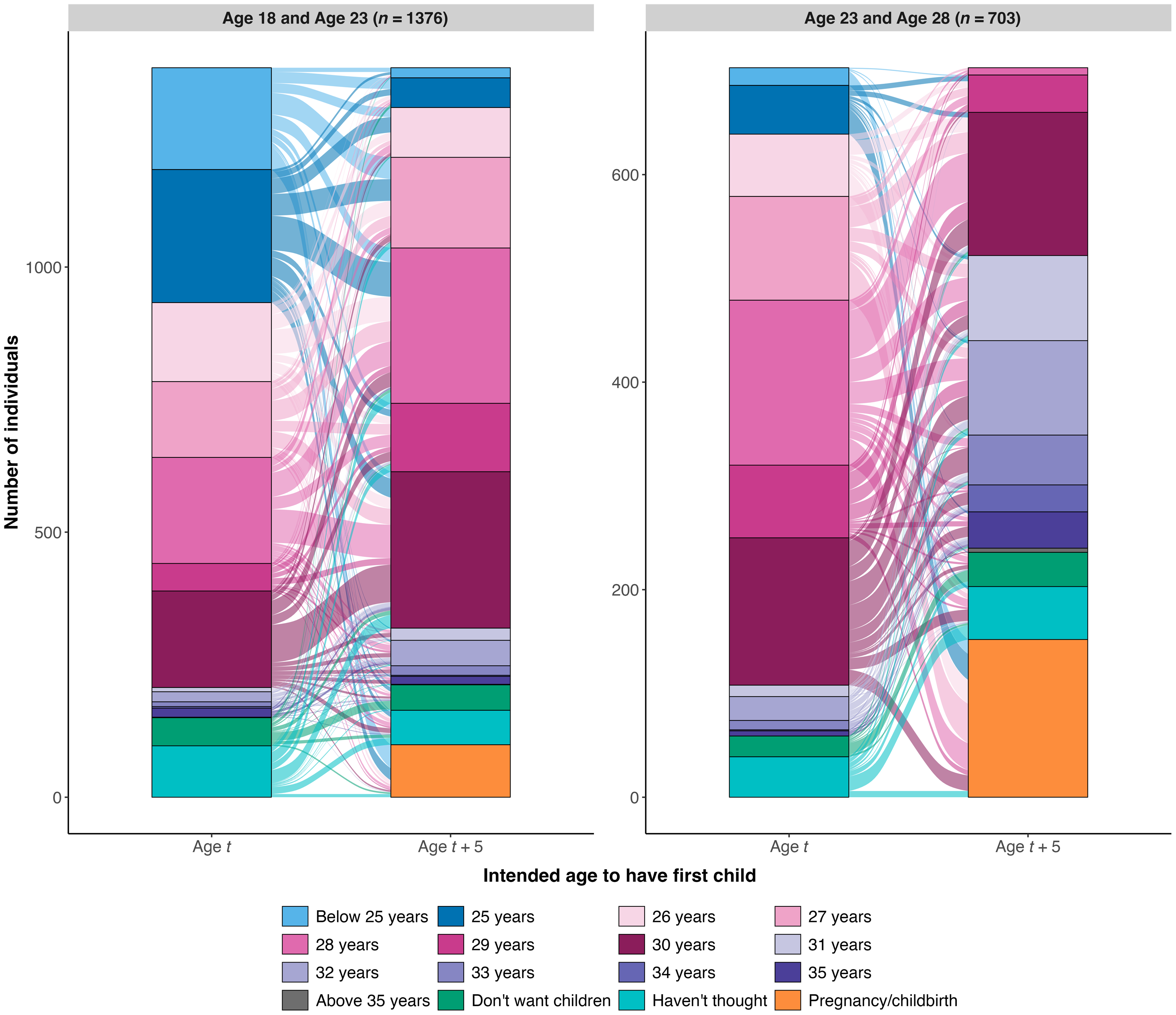
The figures below show what she found. Some simple facts become clear. Starting on the left, which describes changes from age 18 to 23, we can see that the share of 18-year-olds realistically expecting to have a child before age 25 (turquoise blue) is smaller than the share who had a child by age 23 (orange).
Figure 1. Transitions in responses on the realistic intended age at first childbirth over five years, among individuals who were childless at the start of the interval, with flows shown for age pairs 18-23 and 23 to 28 (1991-1993 birth cohort)
Source: Shalini Singh, "Fluidity in fertility timing intentions among childless men and women," Vienna Yearbook of Population Research 24 (May 2026)
That’s fine: Those fertility expectations could still be easily realized. On the right, Singh shows us how expectations among those who were still childless at 23 ended up changing by age 28. The blue boxes are those who expected a child a year or two later—if you follow the blue curves out of those boxes, you see that although a good share did have a child (transitioning all the way down to orange) and others still expected to have a child soon (the blue lines going to dark pink boxes), many later expected a first birth at age 31-34 (5 shades of purple).
The expectation of first birth in the early 30s skyrocketed from age 23 to age 28; the only way it couldn’t have is if fertility plans were fulfilled by age 28 (i.e., the orange share grew a lot more than it did). But also notice the share not wanting a first child (green) didn’t grow a lot between 23 and 28—the expected age at first birth went up a lot, but expectations of becoming a parent changed more modestly.
As people aged from 28 to 33, the share with realized fertility plans (orange) grew far more.
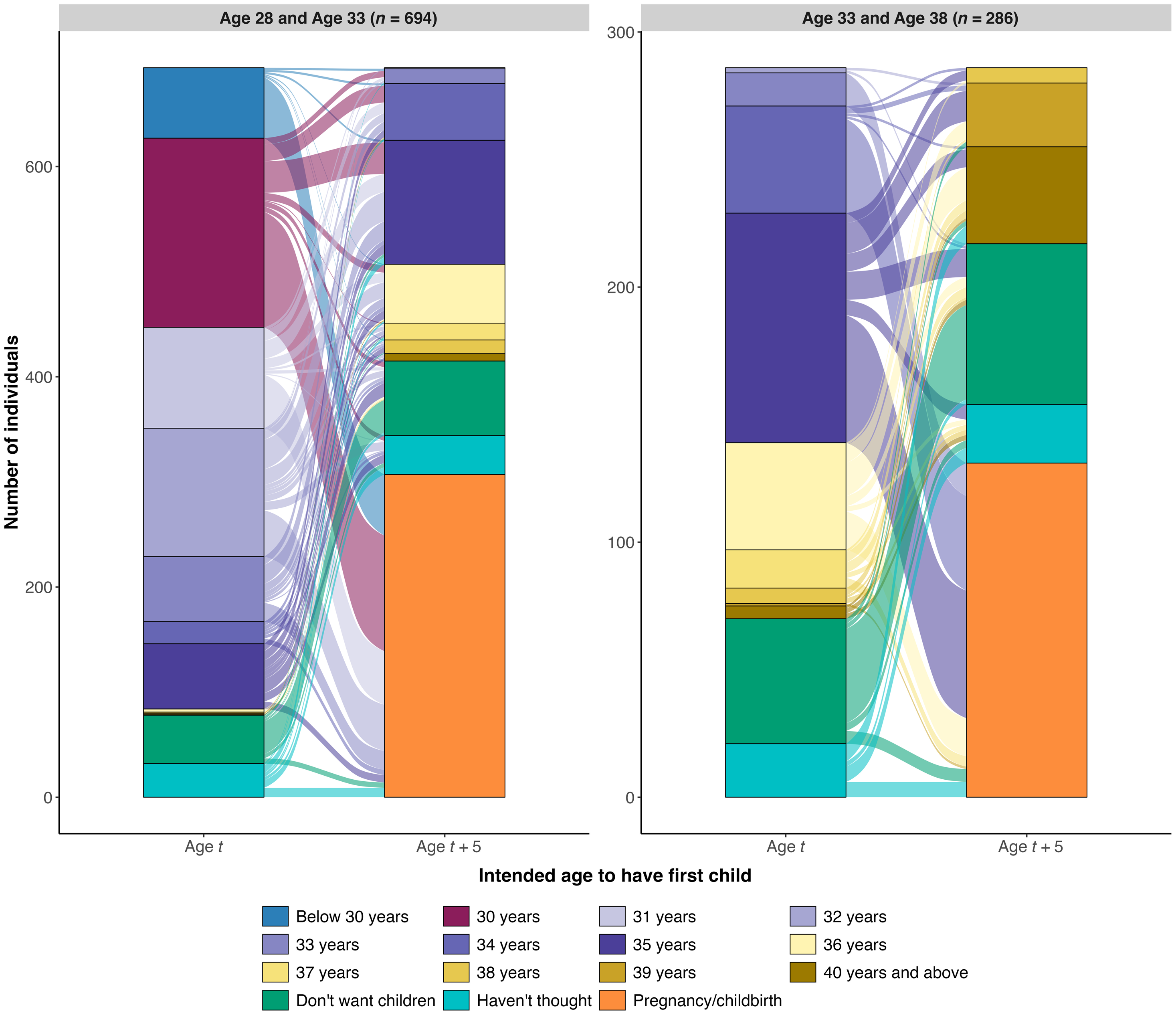
As Figure 2 below shows, almost all of those expecting at age 28 to have a child before 30 did so (blue to orange), and over half of those expecting to have one at 30 did so (dark red to orange). But now the olive-green bar that we could barely see in Figure 1 (representing those realistically expecting to have their first child after age 35) is replaced with a set of yellowish bars that distinguish between later ages.
Figure 2. Transitions in responses on the realistic intended age at first childbirth over five years, among individuals who were childless at the start of the interval, with flows shown for age pairs 28-33 and 33-38 (1981-1983 birth cohorts)
Source: Shalini Singh, "Fluidity in fertility timing intentions among childless men and women," Vienna Yearbook of Population Research 24 (May 2026)
This reveals that expectations about the timing of first birth were still getting pushed into the future for those who have remained childless longer than they initially expected. But unlike with younger women, the share not wanting children (green) grew between the ages of 28 and 33. It was primarily those who realistically expected at age 28 to start having children at age 35 who reported at age 33 that they did not want children (darkest purple to green). A 28-year-old expecting that it might take 7 years to find a committed partner and conceive and bear a child could report no longer wanting a child 5 years later—because they find age 40 unrealistic or undesirable.
Nonetheless, 33-year-olds who thought childbearing was realistic in the very near future were quite likely to have kids (Figure 2, right panel, the bulk in the first two shades of purple moved to orange), and most who expected to have a child by 35 had done so by 38 (over half of the darkest purple moved to orange). But now the other half of those who, at 33, realistically expected to start having kids by 35 didn’t just revise their starting age (darkest purple to various yellows); instead, a fair share claimed not to have thought about how old they expected to be when entering parenthood (darkest purple to turquoise), and a larger chunk now said they didn’t want children at all (green). They may have wanted them at younger ages but didn’t find it realistic to start trying to have children at older ages.
Fertility Expectations Are Fluid
Overall, Singh describes the window in which people envision future parenthood as
highly sensitive to changing life circumstances, such as partnership instability, career transitions or financial insecurity, which can alter both the perceived feasibility of parenthood and the point in time at which it is seen as attainable.
Fertility expectations were realized, maintained, adjusted, and discontinued—a variety of experiences that have added up to below replacement fertility in Germany.
Singh documents tremendous fluidity in fertility expectations over the life course, and she also concludes that partnership status plays a decisive role in determining the direction of that fluidity. That means exactly what you might guess: those in partnership were more likely to have a child or revised down their expected age at first birth; singles on the other hand were more likely to revise up the age of first birth, to express uncertainty, or to stop realistically expecting children altogether.
Singh documents tremendous fluidity in fertility expectations over the life course and concludes that partnership status plays a decisive role in the direction of that fluidity.
While her work could be summarized as showing how the relationship recession contributes to unrealized fertility expectations, it also tells a positive story about partnership and parenthood. That is, those who are most likely to change their minds from not wanting children to realistically expecting children in the near future were people in their 30s who transitioned from single to partnered. Even after the expectation to have a child is discarded, it can still be recovered by entering a partnership—as I found in my own life.
Overall, Singh’s work suggests that rather than unchanging fertility goals driving relationship choices, partnership and marital status may directly shape fertility goals—people in stable partnerships are more likely to have the thoughts and conversations that lead couples to have kids. This research lends more support to the conclusion that marriage still matters for fertility.
Laurie DeRose is a Nonresident Senior Fellow at the Institute for Family Studies, and served as the Director of Research for the World Family Map project.
1. Typical questions are “Do you want/intend to have a child?” and (if applicable) “When do you intend to get pregnant?”


