
Highlights
- The South Korean fertility rate began to decline immediately following the beginning of Japan-style celebrity idol culture in the early 1990s. Post This
- The timing of fertility decline in both Japan and South Korea can be explained by idiosyncratic changes in celebrity culture at the same time. Post This
Sometimes, a fertility trend change that looks like it was prompted by economic factors turns out to have important cultural elements, too. For a possible example of this dynamic, we can look at Japan in the 1980s.
Around 1973, Japan began a downward trend in the fertility rate. This was part of a similar pattern in many industrialized countries, but Japan’s trend continued downwards long after Western trends stabilized for a few decades, making it one of the first large countries to experience sustained very low fertility.
It Wasn’t the Economy
Some researchers have attributed this decline to the Oil Crisis of 1973 and the long-term “scarring” effects of serious economic disruption. Many other observers have remarked on Japan’s economic downturn in the late 1980s and its “lost decade” in the 1990s as a possible cause of low fertility. However, this account may be incomplete.
The first reason to be skeptical of these economic explanations is that there was nothing special about Japan’s fertility downturn beginning in the early 1970s. Many Western countries had begun their own downward trend in fertility in the 1960s as their baby booms came to an end and their sexual revolutions (complete with changes to legality and norms around contraception, abortion, and divorce) began. Japan experienced its sexual revolution from the early 1970s, and so arguably followed the same trend. Therefore, Japan beginning a fertility decline in the early 1970s might just have been another case of fertility decline beginning at the same time as changing norms around coupling and family.
Another piece of evidence against the economic explanation is that other developed countries did not show signs of beginning a new downward trend in fertility immediately following the Oil Crisis of 1973. Economic conditions do affect fertility, but we generally don’t tend to see a single economic shock precipitating a downward fertility trend for decades. So, either Japan in the 1970s was uniquely vulnerable to that kind of economic shock, or it was something else. It would be odd if Japan in the 1970s was uniquely vulnerable to economic shocks, because Japan experienced a large economic crisis in the 1990s without it coinciding with an acceleration in Japan’s downward fertility trend. The Plaza Accords, which occurred in 1985, would also struggle to explain the downturn in the Japanese fertility rate, since Japanese export value remained strong for some time after that agreement. Housing costs also only really began to accelerate in Japan in 1986 and 1987, and so cannot adequately explain the downturn in Japanese fertility beginning in 1985.
Maybe it Was the Pop Stars
But there is still more evidence. As suggested above, Japanese fertility trends were not atypical when compared to Western countries in the 1960s and 1970s. What set Japan apart from the rest of the West was the continuation and acceleration of Japan’s downward fertility trends in the 1980s. For example, here’s Japan’s total fertility rate against that of the US, France, and Japanese-Americans:
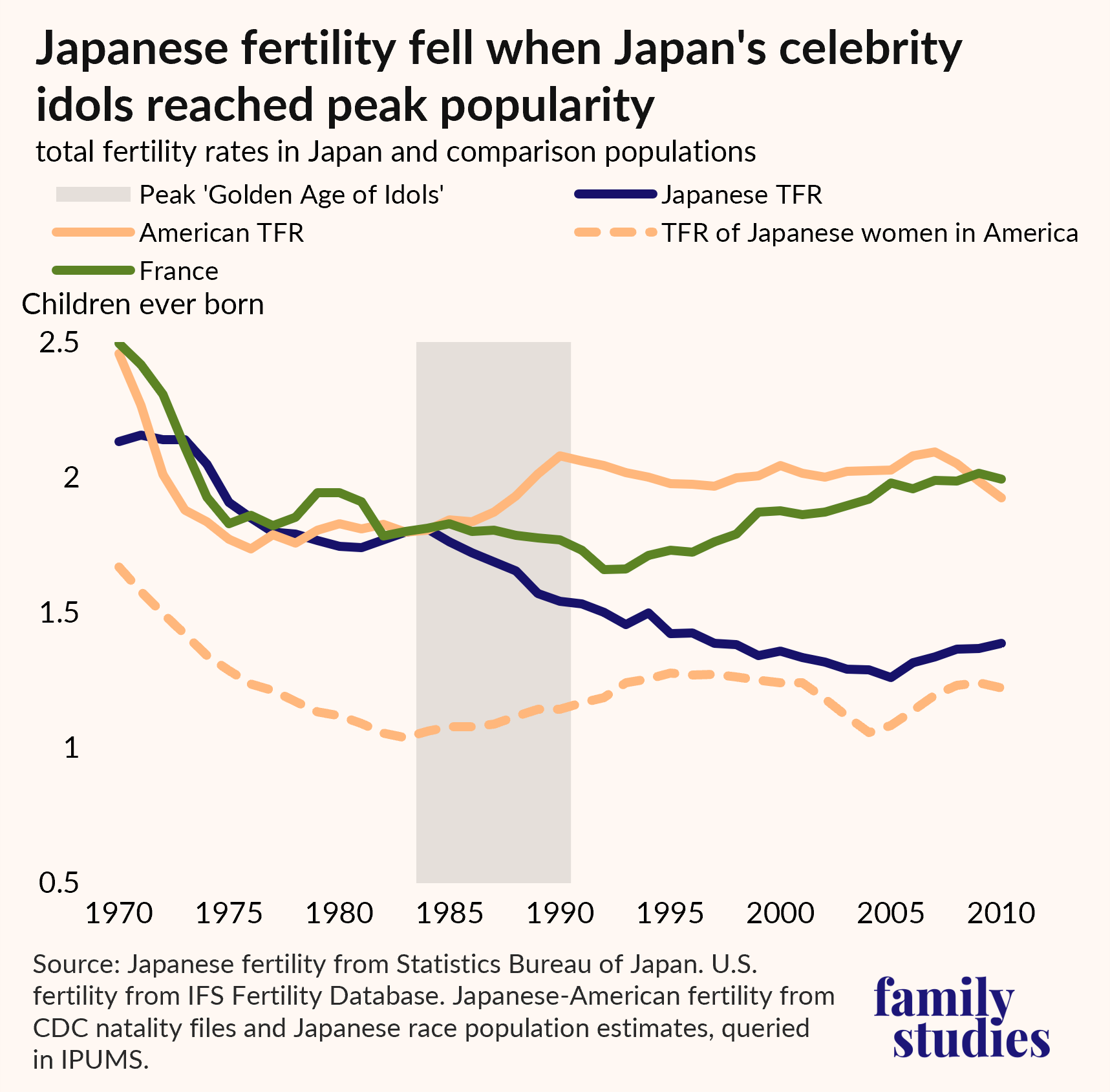
A visible departure from previously-similar patterns began in the mid-1980s. So, what happened in the mid-1980s that was peculiar to Japan? First, the late-1970s saw an expansion of TV channels, the introduction of color TV, and in particular the rise of audition-based gameshows designed to produce celebrity sensations. This dynamic really took off when satellite TV was rolled out in mid-1984 (and reached more stable access in 1985) and precipitated an explosion of Japanese celebrity culture, often called ‘idol culture.’ The rise of idol culture can be seen in the frequency of idol-related Japanese words in Japanese magazines and periodicals, below:
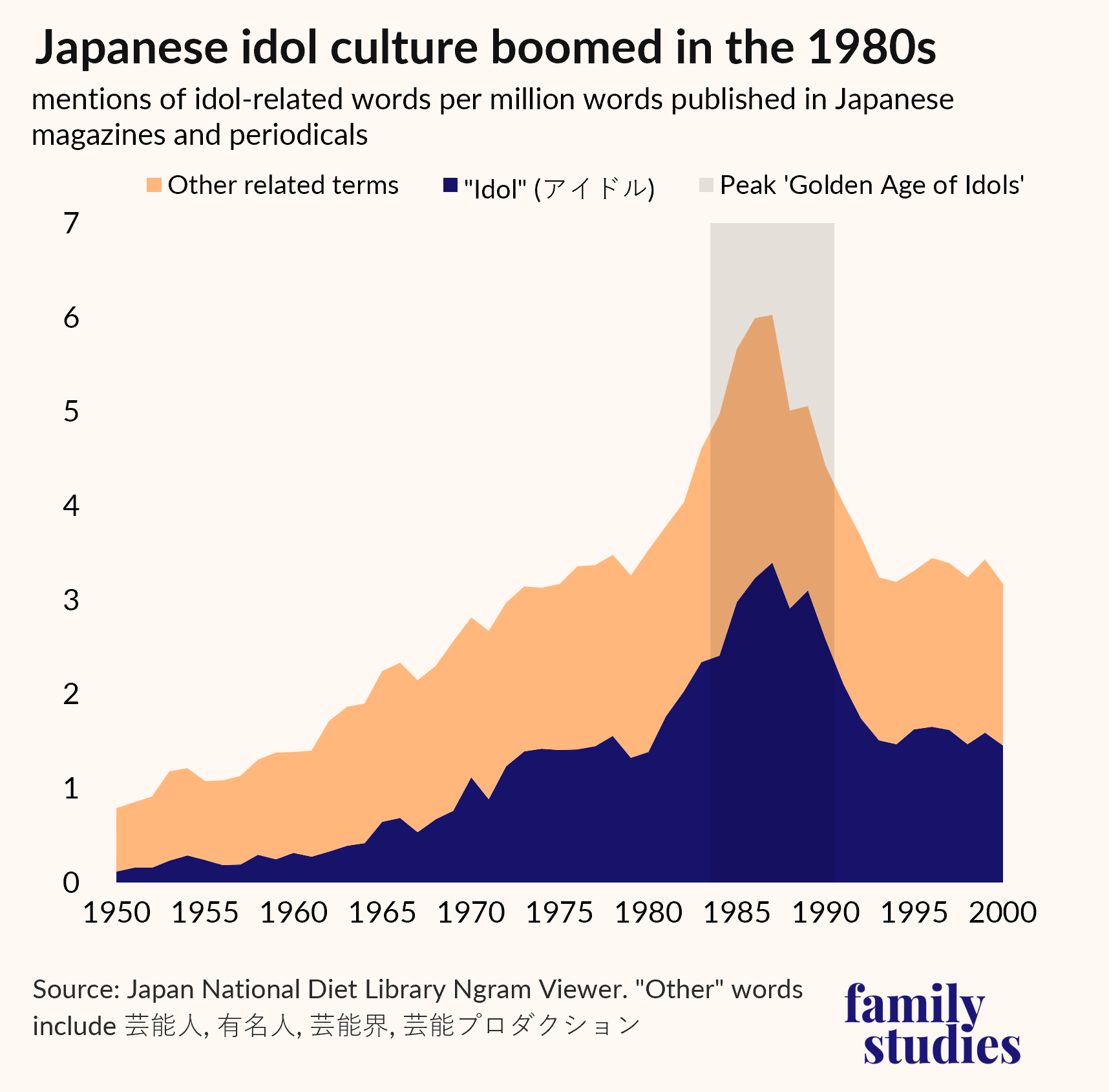
Distinct from Western celebrities, Japanese celebrities were routinely expected to appear emotionally available and minimize discussion of their personal romantic and family life (this norm has now spread to celebrity culture around Asia). The pernicious result of this norm is that the populace at large is simultaneously encouraged to develop parasocial relationships with celebrities (which may compete with their own relationships) and deprived of role modeling of romantic and family life by those with whom they have such parasocial relationships.
The correlation between Japan’s network- and satellite-TV-fueled ‘idol culture’ explosion and fertility decline raises questions about purely economic explanations for Japan’s unusual fertility decline, but still doesn’t provide a causal answer. If the theory is correct, it should be able to make accurate predictions of what happened when Japanese idol culture spread elsewhere.
South Korean Idol Culture
In South Korea, formalized ‘idol training’ bootcamps began in 1996, but this was a case of industry hopping on a pre-existing cultural trend. South Korean idol celebrity culture arguably began in 1992 with the explosion of Seo Taiji’s band. Taiji also showed clear signs of Japanese-like idol culture: in 1993, he met the woman who would become his first wife but kept their relationship and later marriage secret. Their relationship and marriage only become fully public in their divorce proceedings, marking a commitment to privacy unseen in Western celebrity culture. Identifying 1992 as the beginning of organic Japan-style celebrity culture in South Korea also separates trends from economic shocks: the Asian Financial Crisis would only hit in 1997.
Sure enough, the South Korean fertility rate began to decline immediately following the beginning of Japan-style celebrity idol culture in the early 1990s, and showed no immediate trend break in the late 1990s around a major economic crisis.
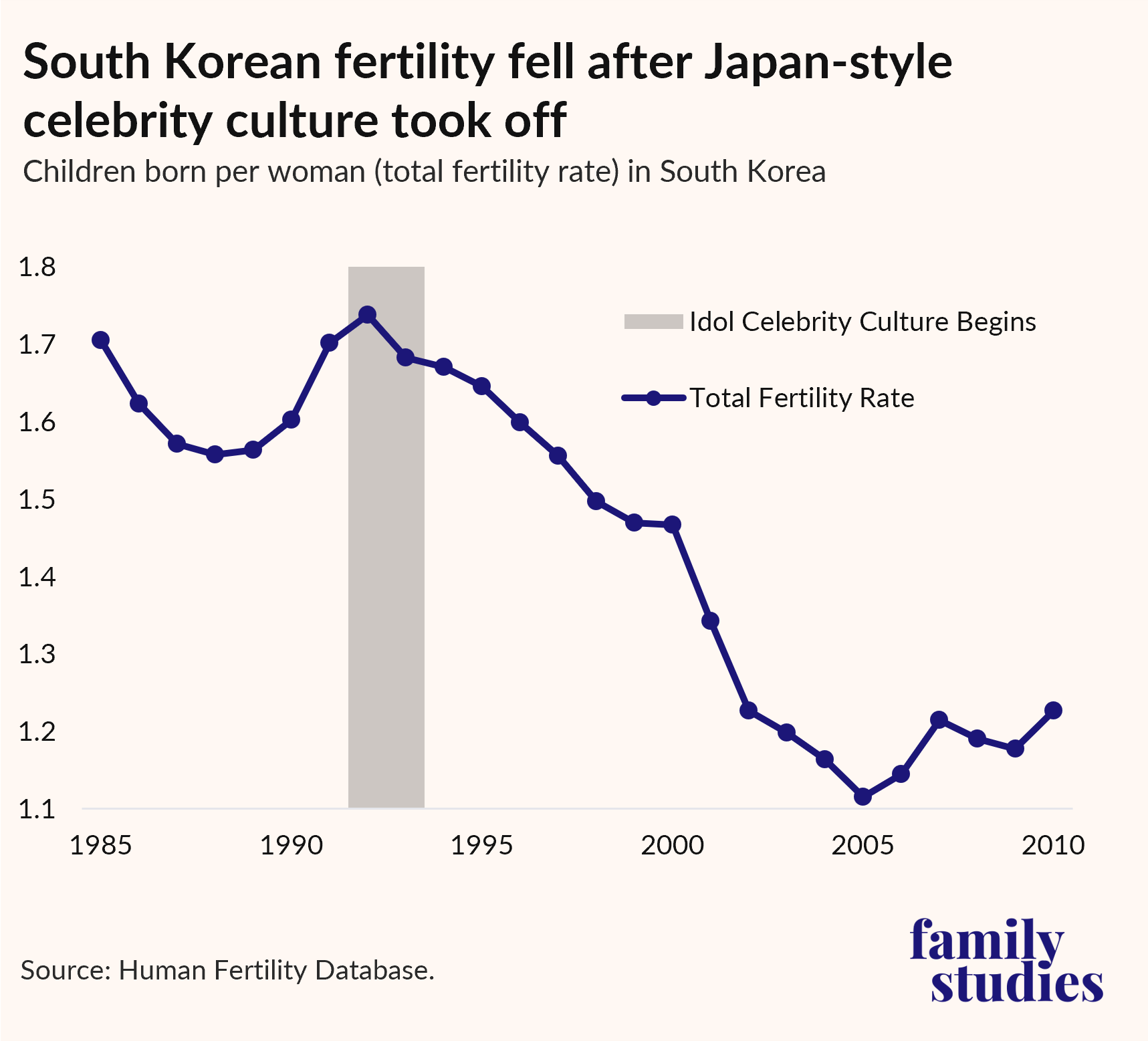
The idea that Japanese fertility decline is best explained by its economic crises does not match the timing of Japanese fertility trends relative to other developed countries. In contrast, the timing of fertility decline in both Japan and South Korea can be explained by idiosyncratic changes in celebrity culture at the same time.
Korean and Japanese exceptionalism in childless celebrity culture is borne out in the data. In a recent report, Baby Nudges, Lyman Stone, Jason Carroll and I surveyed respondents across more than a dozen countries: Japan and Korea reported the highest rates of admiring a public figure with no record of having children. Furthermore, the Japanese had the lowest rates of reporting admiration for a public figure with a family bigger than their own.
Could celebrity idols matter in Western countries, too? Probably so. In Baby Nudges, we found that respondents who most admired a celebrity with a larger family than their own had a 14% increased chance of intending to have another child. The Japanese and Korean examples provide further suggestive evidence that visible engagement with family life by cultural leaders matters for fertility. Unless family life is modeled clearly, people may continue to fall short of realizing their fertility desires and missing out on the joys of family life. And, since in Korea’s case, celebrity idols via K-Pop are not just natural cultural change but a state-sponsored industrial priority, these findings raise questions about what role policymakers might play in shaping celebrity culture. In Korea, the government exacerbated the phenomenon of childless celebrities. Could other governments establish nudges to generate familistic celebrities instead? We think it might be possible.
Peter Foreshaw Brookes is a Research Associate of the Pronatalism Initiative at the Institute for Family Studies. Lyman Stone is a Senior Fellow and Director of the Pronatalism Initiative at the Institute for Family Studies.


