

Highlights
- Fertility and family choices are still powerfully influenced by religion, but that influence is fading, and pop culture is becoming a new source of naming inspiration. Post This
- Today, we are once again seeing a large increase in what might be considered “deep cuts” from the Bible when it comes to baby names. Post This
A name can tell us a lot about a person. A large body of research in economics and sociology sees given names as a window into family background, and sometimes as a cause of later outcomes in their own right. For example, one 2003 study found that applicants with white-sounding names received about 50% more callbacks than otherwise identical applicants with Black-sounding names, likely because of how those names signal a wide range of socioeconomic traits besides just race. Among immigrants, names have tracked assimilation: For example, a 2016 study showed that children of early-20th-century immigrants with more mainstream American names reached higher-status occupations, partly because of what those names signaled to others, and a 2020 study revealed that immigrants, both a century ago and today, close about half the gap in naming styles with natives within 20 years of arrival. Names may even shape behavior through how others treat their bearers: some research suggests that that boys with feminine-sounding names act out more once they reach middle school.
Names also reveal parents’ values and the cultural forces acting on them. Because historical censuses rarely recorded religion, demographers have used biblical names as a proxy for religiosity. One study found that higher shares of biblically-named children coincided with higher marital fertility in 19th-century America; another found that couples who chose biblical names had more young children in 1880; while a third study showed that, in early-20th-century Ireland, traditional naming predicted higher fertility.
So, how are given names changing in America today? And what do we learn from those changes? To answer this question, we assembled two datasets: the Social Security Administration’s birth name database from 1880 to 2025, and a large dataset of American given names from the decennial censuses of 1850-1930. Using this data, we can see how naming trends have changed over time. Since prior research has suggested that religious names may predict fertility behavior, we can start by looking at names appearing in the Bible.
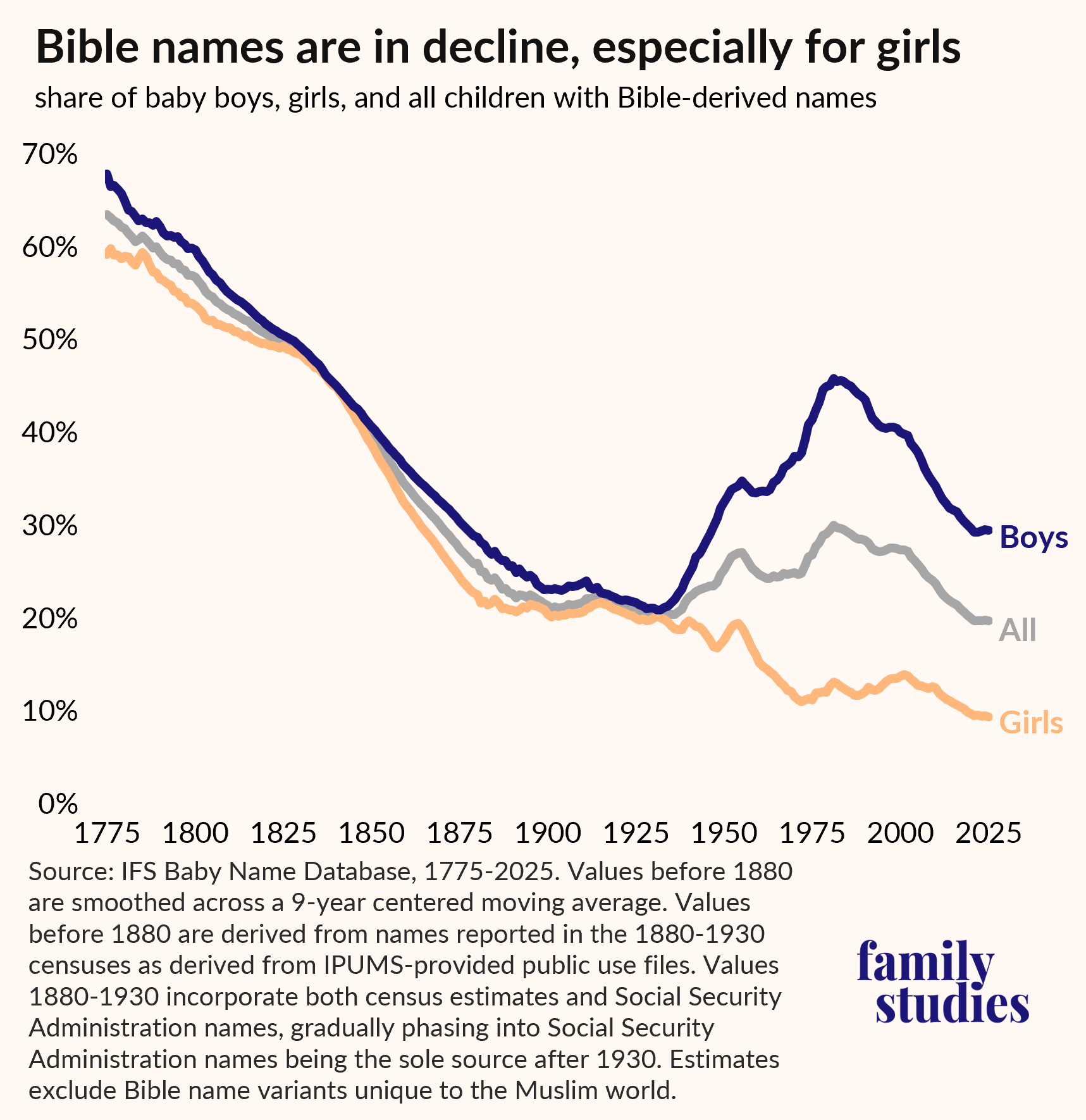
Bible names declined greatly in the 19th century, although boys’ Bible names stopped declining around 1900 and actually saw a resurgence in the mid 20th-century, perhaps since boys more often inherit their father’s names than girls do their mother’s names, and so boys’ names often less-accurately capture the naming zeitgeist. For girls, there was a further major decline in Bible names between 1915 and 1975.
However, even for girls, most of the Bible names in question may not be names people think of as “Biblical,” like “Daniel” or “Mary” or “Anna.” To really see how religious naming practices may be changing, we need to look specifically (and only) at rare Bible names, the names only religious people would be likely to give.
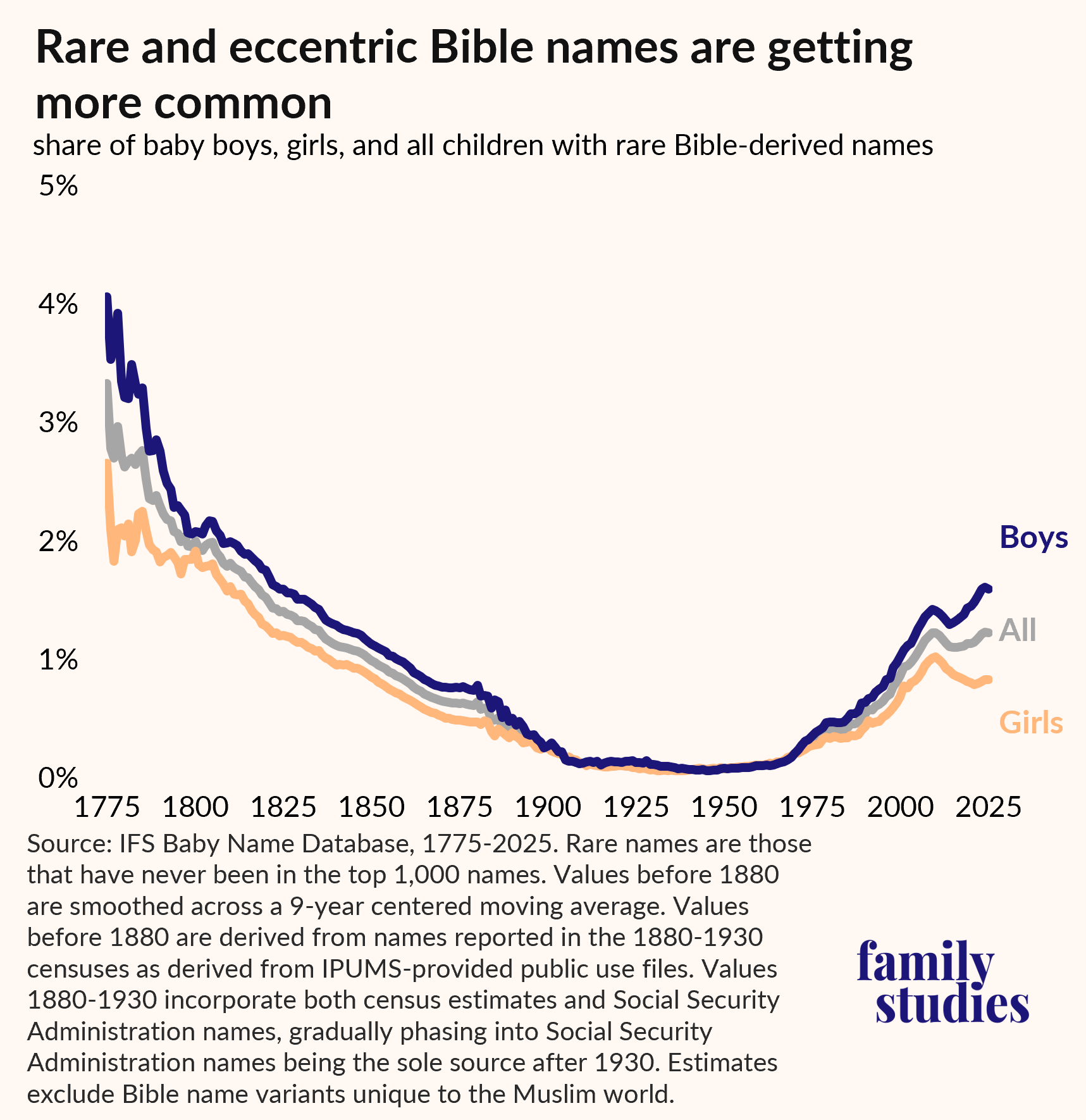
Girls with names like "Tamar," "Zilpha," or "Keturah" are becoming more common, along with boy names like "Lazarus" or "Joab." These names probably do reflect religiously-devout parents. They also reflect a particularly individualistic or nonconformist attitude among parents—a desire for their child to be known uniquely, or for their child to be marked with a particular set of values. This kind of individualistic, eccentric naming behavior was common in America in the 18th century but declined over time. The early 20th century saw an extraordinarily high degree of conformity in naming patterns, but now we are again seeing a large increase in what might be considered “deep cuts” from the Bible.
These changes point to a unique dynamic in American society. On the one hand, this is yet another sign that Christianity in general is continuing to decline, with each generation being less likely to receive even nominally Biblical names. On the other hand, a devout minority seems to be intensifying their religious commitments, giving their children names the parent would only have known about from more extensive Biblical knowledge or a specific search for rare Biblical names.
Other kinds of religious names have also risen sharply in prevalence.
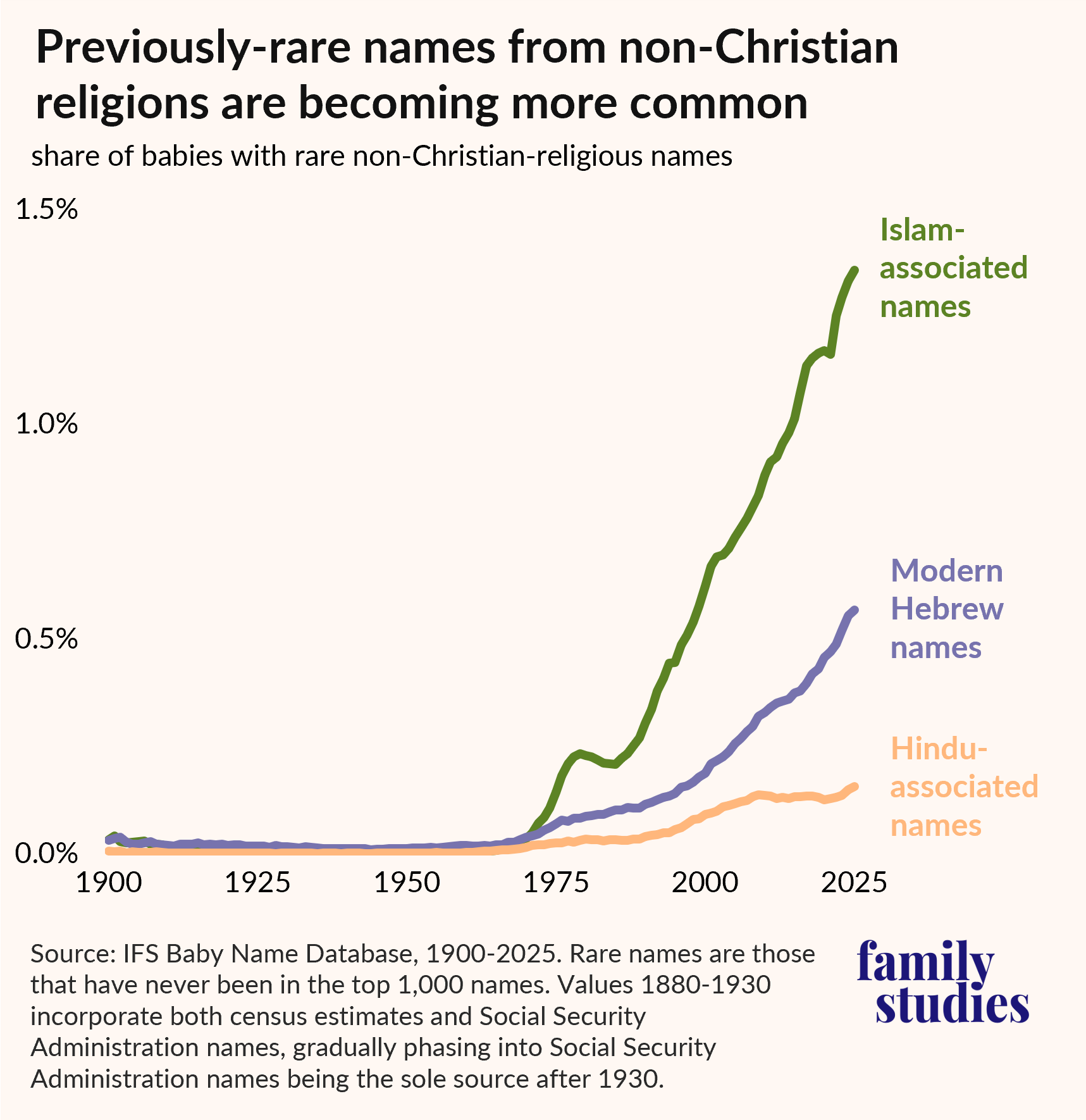
Distinctively Hindu names (like "Arjun," "Aditya," or "Kali"), names with origins in the Islamic world (like "Omar," "Aisha," or "Khalil"), and names associated with Judaism or Israel, usually due to being modern Hebrew name variants (like "Ari," "Moshe," or "Chaya"), have all seen increases in the United States. While Bible names still vastly exceed these names (excluding overlap cases, Hindu, Islamic, and Jewish-distinctive names add up to just 3.4% of births in 2025 vs. 20% for Bible names generally), America’s rising religious diversity is clearly on display in baby name data.
Religion is not the only major factor that shapes baby names, of course. Pop culture has a big effect, too.
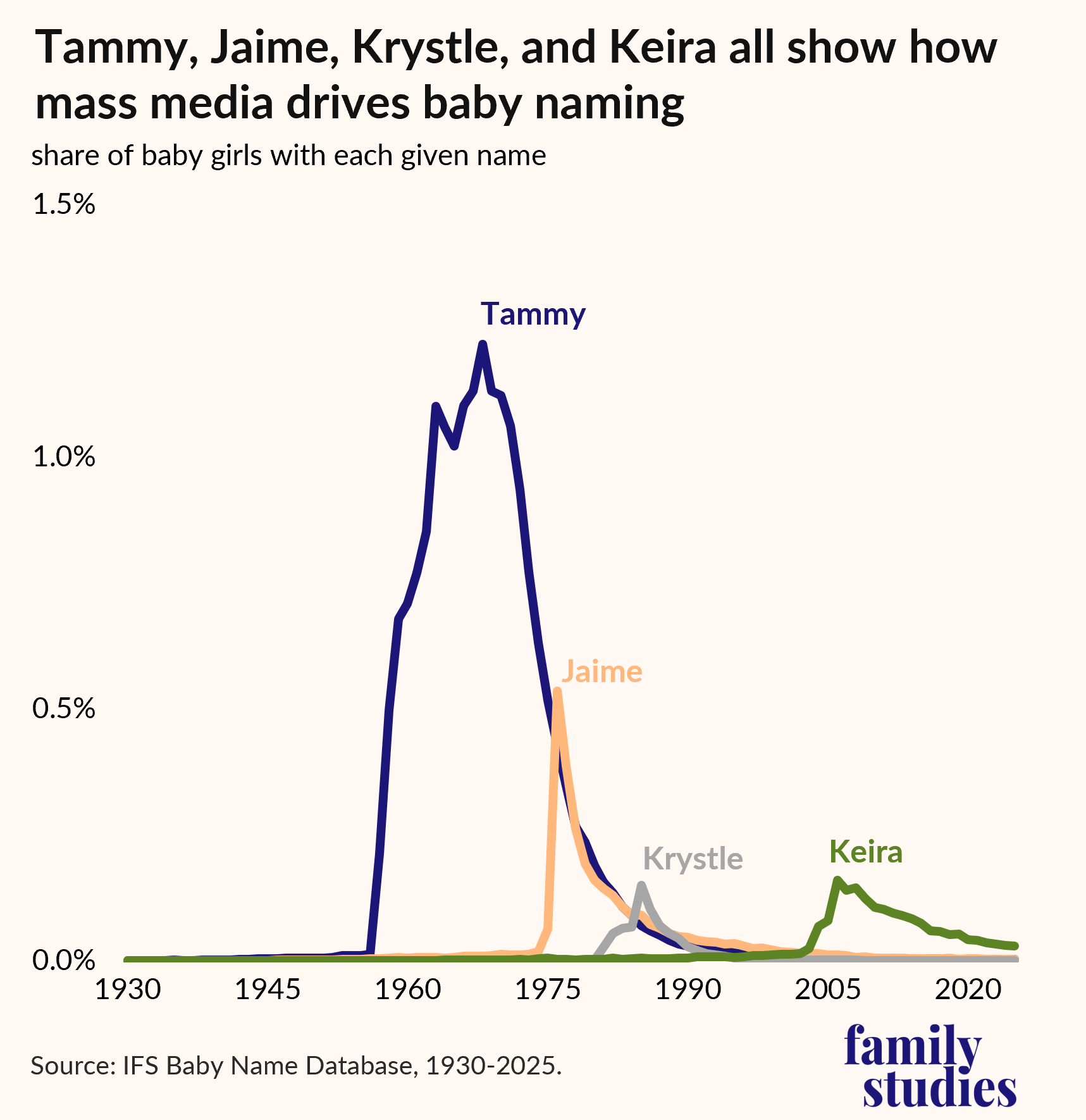
In 1956, very few girls were named "Tammy." By 1959, thousands were. Why? The popular show Tammy and the Bachelor, of course, and its theme song “Tammy,” which was a #1 hit on the charts for singer Debbie Reynolds. The name faded out over time, but for two decades, it was a staple of girls’ baby names. Likewise in 1976, the name “Jaime” surged from under 1000 births to almost 8000, probably because the movie The Bionic Woman had a heroine “Jaime Sommers.” In 1976, 40% of all girls given any variant of the name “Jamie” had “Jaime” as their specific spelling. In the 1980s, “Krystle” rose in popularity, probably driven by “Krystle Carrington” in the show Dynasty. And in the 2000s, “Keira” surged as actress Keira Knightley’s career made headlines with moves like Pirates of the Caribbean and Pride and Prejudice—by 2006, more children were born being named "Keira" than the closely-related “Kiara.”
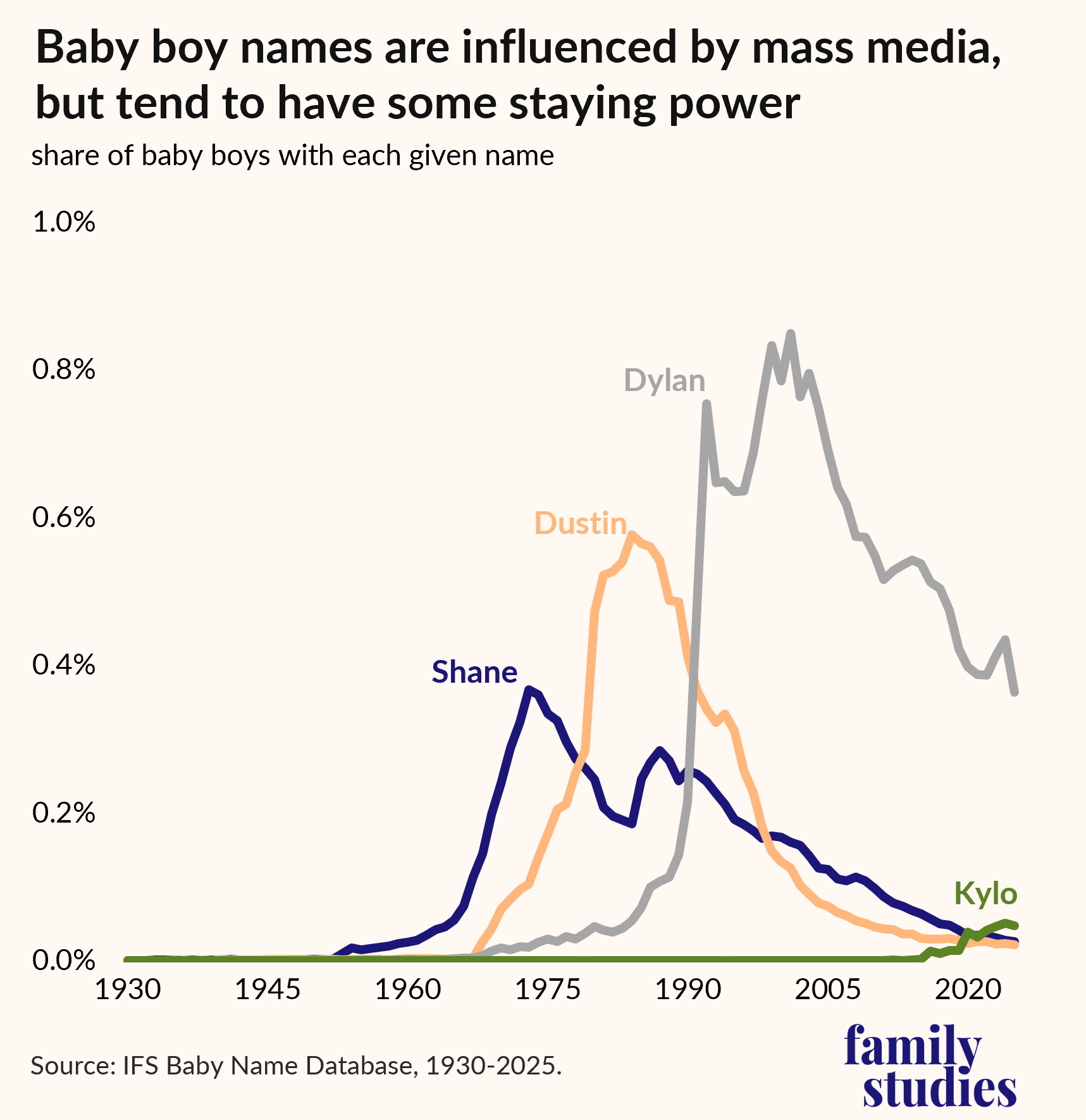
Similar trends can be seen for boys, although suddenly-popular boy names appear to have a bit longer staying power in many cases, perhaps not least because sons are more often named after their fathers than girls are named for their mothers. For example, the western movie Shane in 1953 triggered the rise of “Shane” as a boy name, yet that rise continued persistently in the 1970s, and it remains a not-too-uncommon baby boy name today, with a surge in the late-1980s as the “Shanes” born in the 1960s were reaching their own childbearing years. Likewise, Dustin Hoffman’s starring role in The Graduate might be to blame for the rise of “Dustin” from just 51 births in 1967 to over 1,000 by 1970; but “Dustin” had staying power and didn’t really peak until the mid-1980s. “Dylan” as a last name has been around for a very long time, but Dylan as a first name was pretty uncommon before the early 1990s—and only then probably changed thanks to Beverly Hills, 90210 (1990) character, Dylan McKay. Most obviously, the name “Kylo” was essentially nonexistent before 2015, but in the 2020s, hundreds of boys are named "Kylo" every year, most likely after the Star Wars character.
Sometimes, TV shows and pop stars can even cause remarkable replacements of historic names. “Killian” is a historic Irish name, but its proper Gaelic spelling, “Cillian,” was largely unknown in the past in the U.S., as was its historic English spelling, “Kilian.” Rather, the conventional American spelling “Killian” has dominated historic use of this Irish name in America.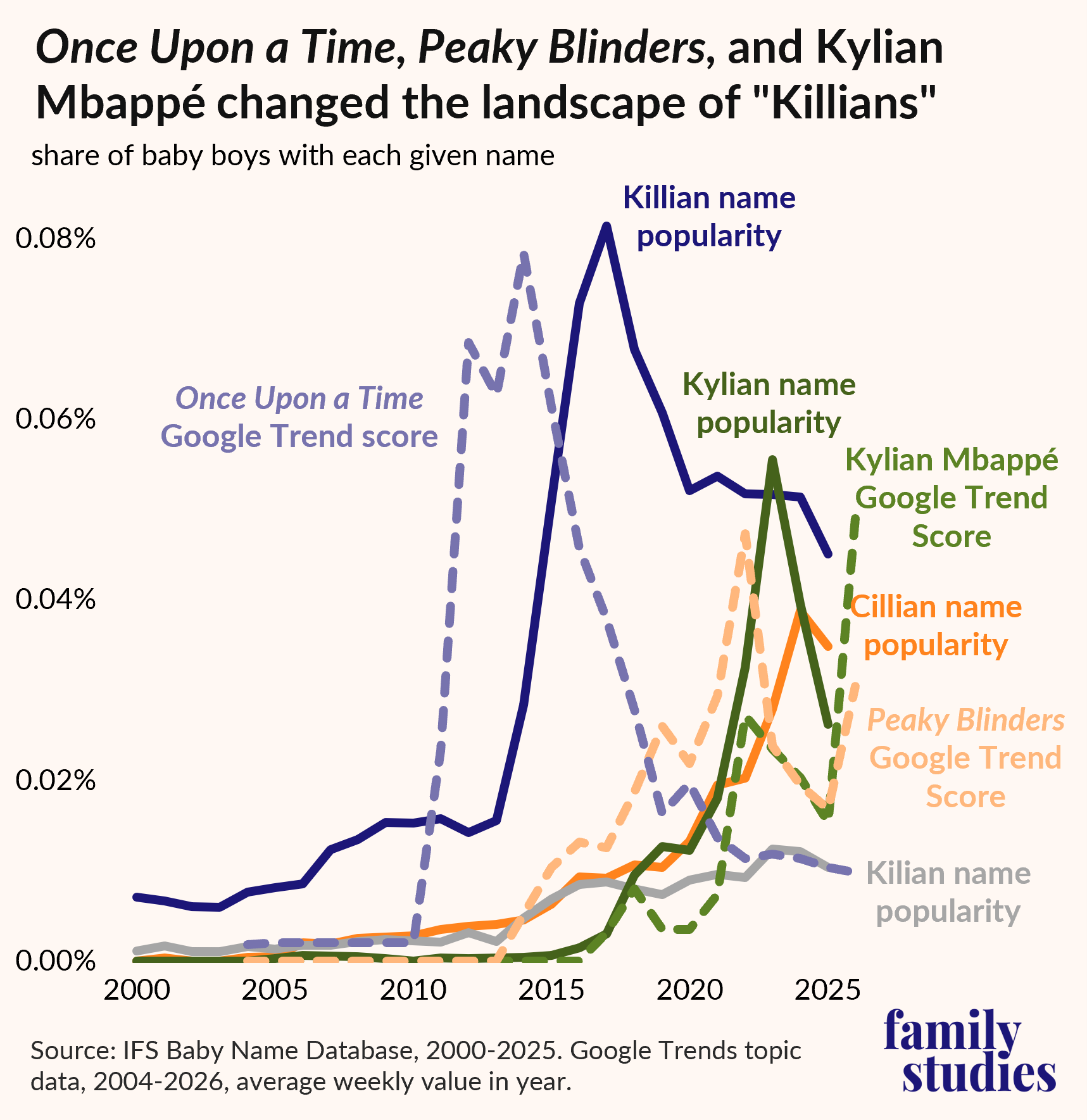 From 2013 to 2015, there was a huge increase in kids named “Killian.” Perhaps this was driven by ABC’s show Once Upon A Time, since seasons 3-5 of that show (which aired 2013-2015) featured Captain Hook prominently, and in ABC’s telling, Captain Hook’s proper name is “Killian Jones.” That may have driven some increase in alternative spellings like “Kilian” and “Cillian” as well.
But then after 2017 and especially after 2021, a new contender, “Kylian” rose to prominence. Likewise, from about 2014, “Cillian” makes a rise, and especially after 2021. What might explain these changes? Soccer star Kylian Mbappe’s career took off around 2017 and especially after 2021, as seen in a surge of Google searches related to him. Meanwhile, the show “Peaky Blinders,” which ran starting in 2014 but reached peak popularity in 2023, stars a prominent actor named “Cillian Murphy.”
The result is that while in the 1980s and 1990s, a historic name form (“Killian”) made up about 1 in every 32,000 boys in the U.S.—and this historic spelling represented over 80% of children born with variants of the “Killian” name—by 2025, “Killians” make up about 1-in-2000 baby boys (a major increase), yet fewer than 40% of the boys given a name that sounds like “Killian” are actually named “Killian.” A majority of baby boys with names that sound that way are in fact bearing names that only became popular in the last 15 years, thanks to televised celebrities, and these variants might someday actually displace the historic name in the long run.
Fertility choices, including how to name a child, are deeply personal. Because they are deeply personal, they are also highly sensitive to relationships, social influences, and ideas of the good, the true, and the beautiful. In other words, baby names capture a sense of identity and culture and tell us what sorts of social forces are influencing fertility today.
A big takeaway from the study of baby names is that fertility and family choices are powerfully influenced by religion, but that this influence is fading for all but a determined minority. In the place of religion is a new source of naming inspiration: popular culture. As we at IFS argued in our recent Baby Nudges report, understanding these kinds of social and mimetic influences is crucial for determining how to raise fertility today. Until the forces influencing modern family formation decisions (mass culture, media, celebrities, etc.) begin to become more positive about family life, any major turnaround in birth rates will be swimming up stream.
You can explore our full Baby Name database using the baby name browser on our Tools and Resources page!


