
Highlights
- Reel after reel of algorithm-driven content offers momentary relief from the daily disengagement, isolation, and loneliness experienced by many young men. Post This
- More video game time, more pornography use—and now the emergence of AI companions. Each one of these technologies represents a risk to healthy human flourishing. Post This
It’s no secret that young men and boys have been struggling. Whether it is decreasing college enrollment, lagging behind girls in high school graduation rates, or a steady increase in suicide rates among young men, we are currently facing a growing crisis when it comes to the successful development of young men. While there are many reasons for this modern male crisis, one of the leading culprits has been the ways young men spend time online and their changing behaviors around modern technologies. These technologies—from social media to newer AI tools—are among the leading reasons why young men disengage from family life, career development, or peer relationships and retreat into digital spaces. I believe the rise in “digital alternatives”—online technologies that can replace the time and resources put into real-life human interactions and personal growth—are among the most concerning trends in modern society.
The Nearly Constant Online Life
It is not surprising to anyone that young men spend a significant portion of their free time online. Whether browsing social media, gaming with friends, trying their hand at online betting, or simply messaging friends, the entertainment and social options online are nearly endless. But spending a lot of time online is different than most or all their time online, and this is exactly what more and more young men and teen boys are doing. Researchers have noted a shift in the online behavior of many teens and young adults when it comes to their time spent online, noting a dramatic increase in the percentage of youth who are online “almost constantly” in national surveys.
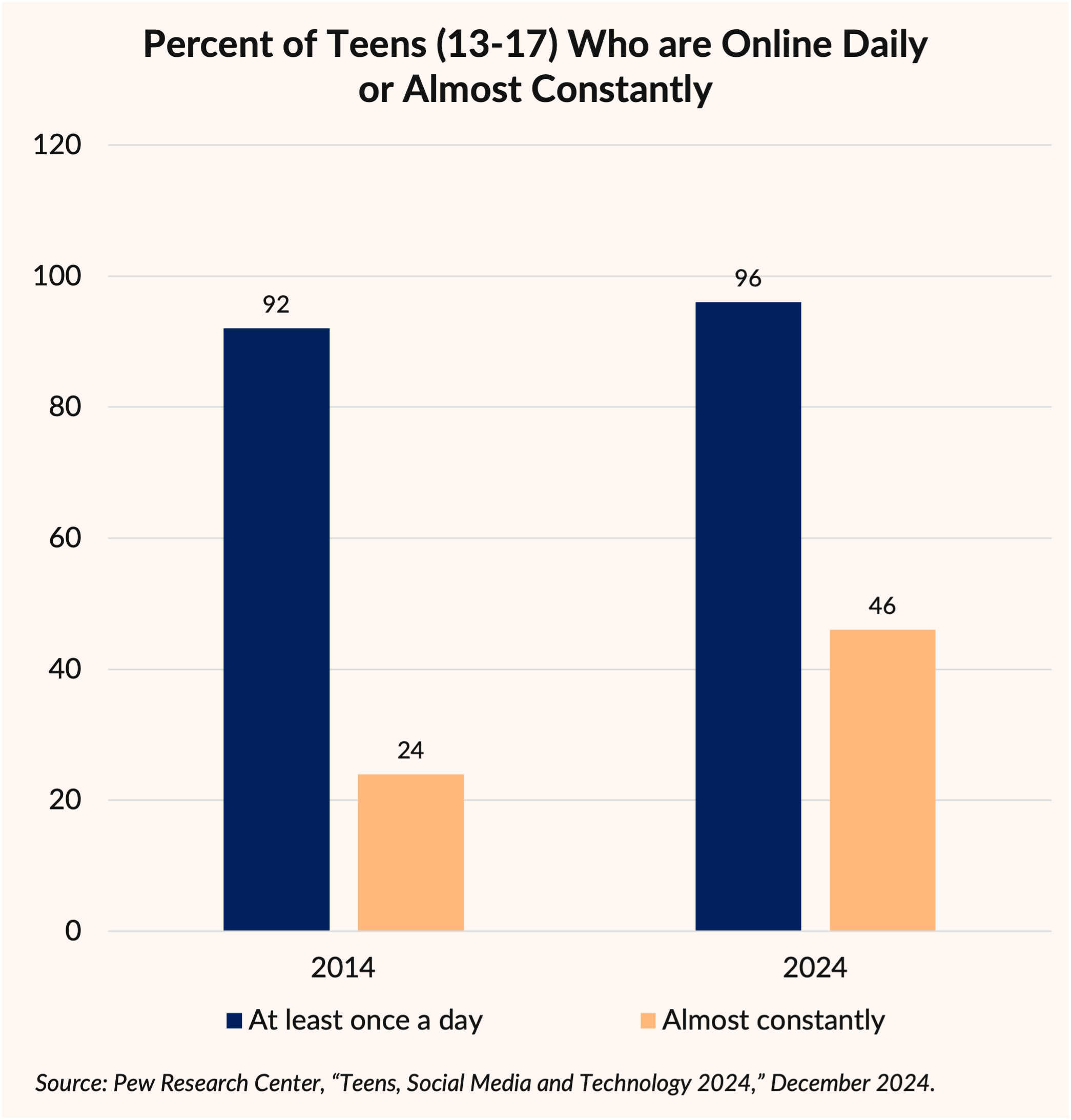
The figure below shows the percent of teens who are online either at least once a day or “almost constantly” from 2014 to 2024 based on data gathered by the Pew Research Center. While the percentage of teens who were online daily rose slightly (and approached 100%), the percentage who said they were online almost constantly almost doubled, reaching almost 50% of teens by 2024. Another Pew report found that 1 in 5 teen boys reported being on YouTube “almost constantly” while 17% reported being on TikTok “almost constantly.”
The appeal of being online constantly is rooted in very real needs for many young men. Young men are chronically lonely. Young men (and young women) are spending more time alone than in previous generations. A recent Gallup poll found that 25% of men under the age of 35 reported feeling lonely most of the previous day. A new study recently found that while most young men are open to dating, the majority are now single. When we are lonely, we crave either engagement or distraction. Online spaces mostly offer distraction. Reel after reel of algorithm-driven content offers momentary relief from the daily disengagement, isolation, and loneliness experienced by many young men, who increasingly have fewer friends and social interactions. Online technologies provide “dopa on demand” that creates a momentary sensation of happiness and pleasure that can distract individuals from the feelings of anxiety and loneliness they often feel.
These increases in the proportion of young men who are nearly constantly online coincides with increases in specific types of online behavior. While many forms of modern online technology are contributing to this digital retreat among men and boys, a few deserve a special call out and deep consideration for those interested in reversing some of these trends and helping young men make meaningful human connections in their lives and build genuine human relationships.
Young men are chronically lonely. Online spaces mostly offer distraction from loneliness.
The Changing Nature of Gaming
Video games have been a worry of parents and policymakers since their mass market appeal grew in the 1980s. Since then, many public commentaries, researchers, and politicians have weighed in on the potential harms of video game use—from worries about exposure to violent content to the potential for gaming to develop into an unhealthy and compulsive pattern of behavior. Yet, video games have generally not been identified as a major health concern over the last 40 years largely due to most young men and teens reporting relatively modest video game use even as recently as 2005.
Over the last 20 years, a shift toward more consistent online behavior among teen boys and young men has once again suggested the need to pay more attention to how video games and online gaming are becoming a persistent digital alternative for young men. From 2004 to 2015, young men increased their video game use 50%. Spurred on by the rise of free to play online games and the isolation of the COVID-19 pandemic, video game use among boys and young men has exploded in the last decade. A 2024 report found that over one-third of teen boys reported playing video games multiple times per day. Another quarter reported playing video games at least once per day. Together, well over half of all teen boys reported spending a portion of every day playing video games. A more recent IFS report on young adult men found that half reported playing video games either constantly or many times day.
Given existing research showing that excessive gaming does carry risks for teens and young adults, this increased portion of every day that many teen boys and young men are spending gaming is one feature of modern culture that is increasingly pulling men away from in-person interactions.
Consistent Engagement with Porn
The role of modern pornography in shaping the lives of young men cannot be overstated. With the advent of lightning-fast internet speeds and smartphones in the early 2000s, the online pornography market exploded. The largest online pornography clearinghouses now see billions of visitors each year. Most of these online pornography websites now get more visits per minute than Playboy had annual subscribers 75 years ago.
A recent review of teens’ online pornography use found that over 70% had viewed online pornography and almost half had viewed pornography on purpose. Of those who sought out online pornography, over half reported visiting a porn website once a week, while 40% reported viewing explicit sexual material on social media. All these behaviors were higher among teen boys than teen girls and increase as young men move into their 20s. As the recent IFS survey of young men found, over 40% of young men now report viewing pornography daily or at least several times per week.
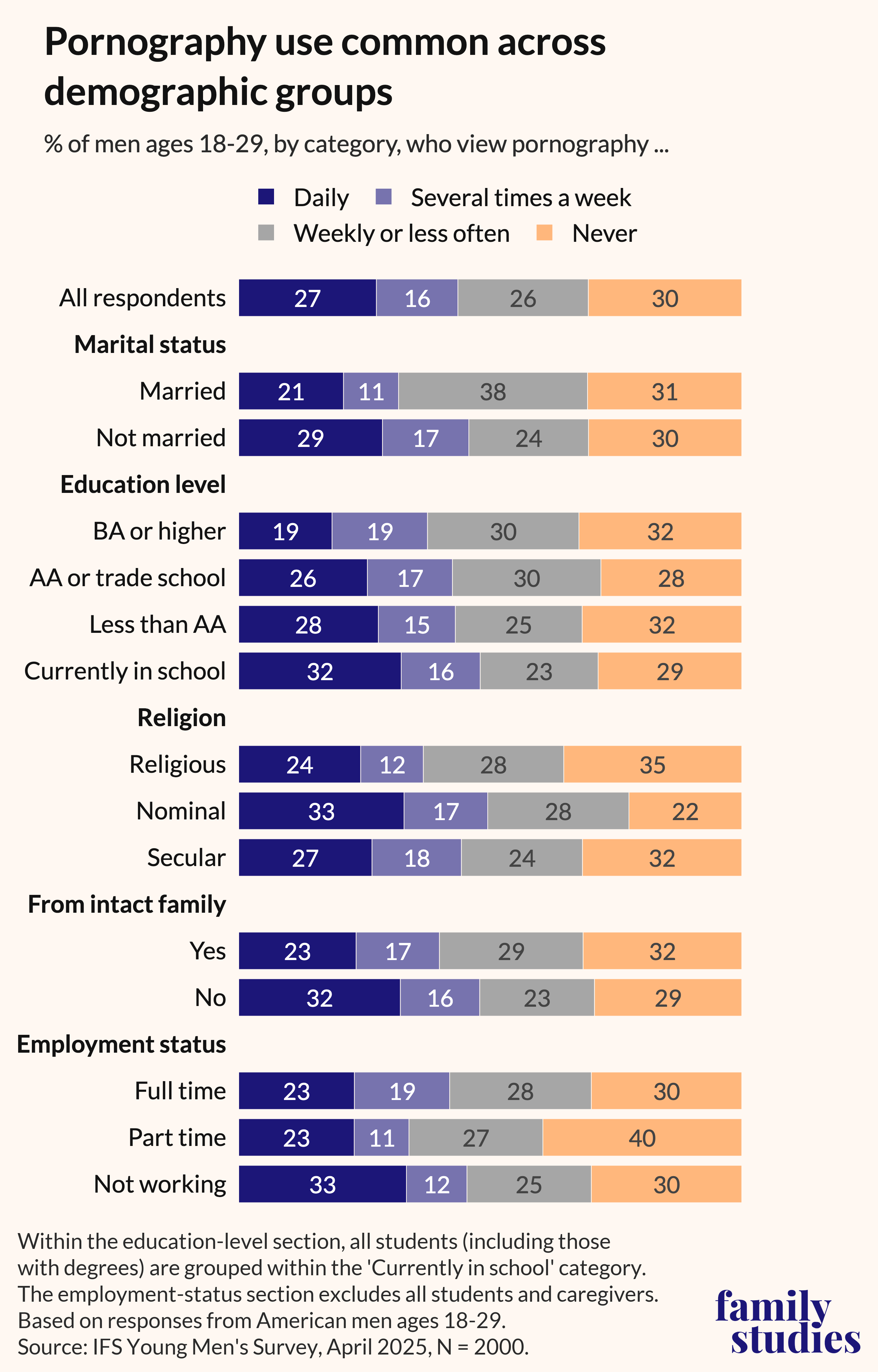
These numbers suggest large engagement with online sexual content among teen boys and young men. Why is pornography such a concerning digital alternative? Because we now have nearly two decades of research showing the potential harms that regular pornography consumption can have, especially for men. Not only does online pornography use have the potential to develop into a compulsive and addictive behavior that has severe mental health implications, but even occasional pornography use can have a negative impact on the lives of young men. Research has shown that retreating into a world of online pornography can skew perceptions of healthy human relationships and sexual intimacy. Men who regularly view pornography often have more violent thoughts about women, are more likely to struggle with sexual dysfunctions, and can develop unhealthy expectations about sexual intimacy. Down the road, online pornography use has been linked to greater relationship instability and less satisfying relationships, and even a higher likelihood of divorce.
We now have nearly two decades of research showing the potential harms of regular pornography consumption, especially for men.
Pornography use is a serious risk behavior for young men—and a risk behavior that most of them are engaging with regularly. That makes pornography use perhaps the most common and persistent risk behavior for teens and young adults.
The Looming Impact of AI Companions
There is also a new player when it comes to compelling digital alternatives that can draw young men away from healthy adult relationships and roles. Artificial intelligence has changed many aspects of our lives over the last five years. Specifically, AI chatbots, such as ChatGPT and Gemini, can influence daily productivity, the gathering and dissemination of information online, and how media is created and consumed. But these chatbots are increasingly performing another function for many young men—serving as romantic companions. According to three recent data collection efforts, all looking at national data within the United States, somewhere between 10 and 15% of young men are already engaging with an AI chatbot that is designed to mimic a romantic or sexual partner on a regular basis (for example, see here and here).
This growing use of AI “boyfriends” and “girlfriends” has the potential to impact the digital retreat of men even more than previous technologies. Why? Because AI can be infinitely customizable and infinitely novel. Instead of a single video, novel, or game, it is an evolving platform that can endlessly create content that is catered to the users’ tastes and preferences. Have a desire for a very specific type of sexual content or romantic exchange? AI can do that. What if I want to role play with a famous celebrity…or my next-door neighbor? AI can do that too.
Early studies suggest that AI tools represent yet another digital alternative for young men that may draw more of them away from developing healthy and productive adult lives.
Research is already showing the potential harms of these AI relationships, including that such interactions have a strong potential to become addictive—pulling the users further into an artificial relationship and away from the daily responsibilities of work and family. Research has also linked AI romantic chatbot use to elevated mental health risks and lower quality human relationships. These early studies suggest that AI tools represent yet another digital alternative for young men that may draw more of them away from developing healthy and productive adult lives.
Conclusion
In isolation, each one of these technologies represents a potential concern for the healthy development of men. Together, they speak to a vacuum of endless digital alternatives that draw men away from real relationships and meaningful success. More online behavior, more video game time, more pornography use—and now the emergence of AI companions. Each one of these technologies represents a risk to healthy human flourishing. These digital alternatives can bring young men and teen boys into online spaces that make it harder for them to develop strong interpersonal skills or develop the individual attributes that will lead to a successful and thriving adult life. We need more people to recognize this shift toward digital alternatives and help young men and teenage boys rediscover the benefits of human social and romantic interaction.
Brian J. Willoughby, PhD, is a professor and associate director of family life at Brigham Young University, a Fellow with the Wheatley Institute, and a Senior Fellow at the Institute for Family Studies.
*Photo credit: Shutterstock


