Highlights
- Parenting feels easier when parents feel their partners and the surrounding community are more supportive, per new IFS survey. Post This
- Parental-enforced rules are associated with better relationships with kids, both in the parent’s own assessment and in the assessments of the teens we surveyed. Post This
- For dads, parenting feels hardest when kids are under 2, and easiest when kids are 9 to 11. For moms, parenting tends to feel easiest when kids are under 2, and hardest when kids are 4 to 7. Post This
We recently surveyed 24,000 parents around the United States. One question we asked is on a lot of parents’ minds: how difficult is parenting? Many parents feel stressed or burdened by raising kids and would like to make it easier: 7.4% of parents in our survey say parenting is “very hard,” and 36.5% say it is “fairly hard.” We wondered if our data could point to ways in which parents could lighten their own load—both because we think parents could use a break, and because parents who describe parenting as easier are likelier to say they will have more children. Controlling for the number of kids, 48% of those who say parenting is very easy intend more children, vs. 38% of those who say parenting is fairly easy, 35% of those who say parenting is fairly hard, and 33% of those who say parenting is very hard. When parenting is too hard, fewer children are born.
First, we looked at factors that might not easily change. In a regression model, we estimated how several variables impacted how difficult parents said it is for them to raise children, on a four-point scale from “very easy” to “very hard.” These factors included: the ages of all children in the house; the number of children in the house; the degree to which parents felt their partner or the child’s parent was contributing their fair share to parenting; an index of several questions measuring the extent to which parents felt supported by their surrounding communities; recent changes in the family’s subjective financial conditions; and the family’s income and employment arrangement.
Parenting Is Easier With Support
Some of the findings are obvious: parenting feels easier when parents feel their partners and the surrounding community are more supportive, and parenting feels harder when the household budget is taking a hit.
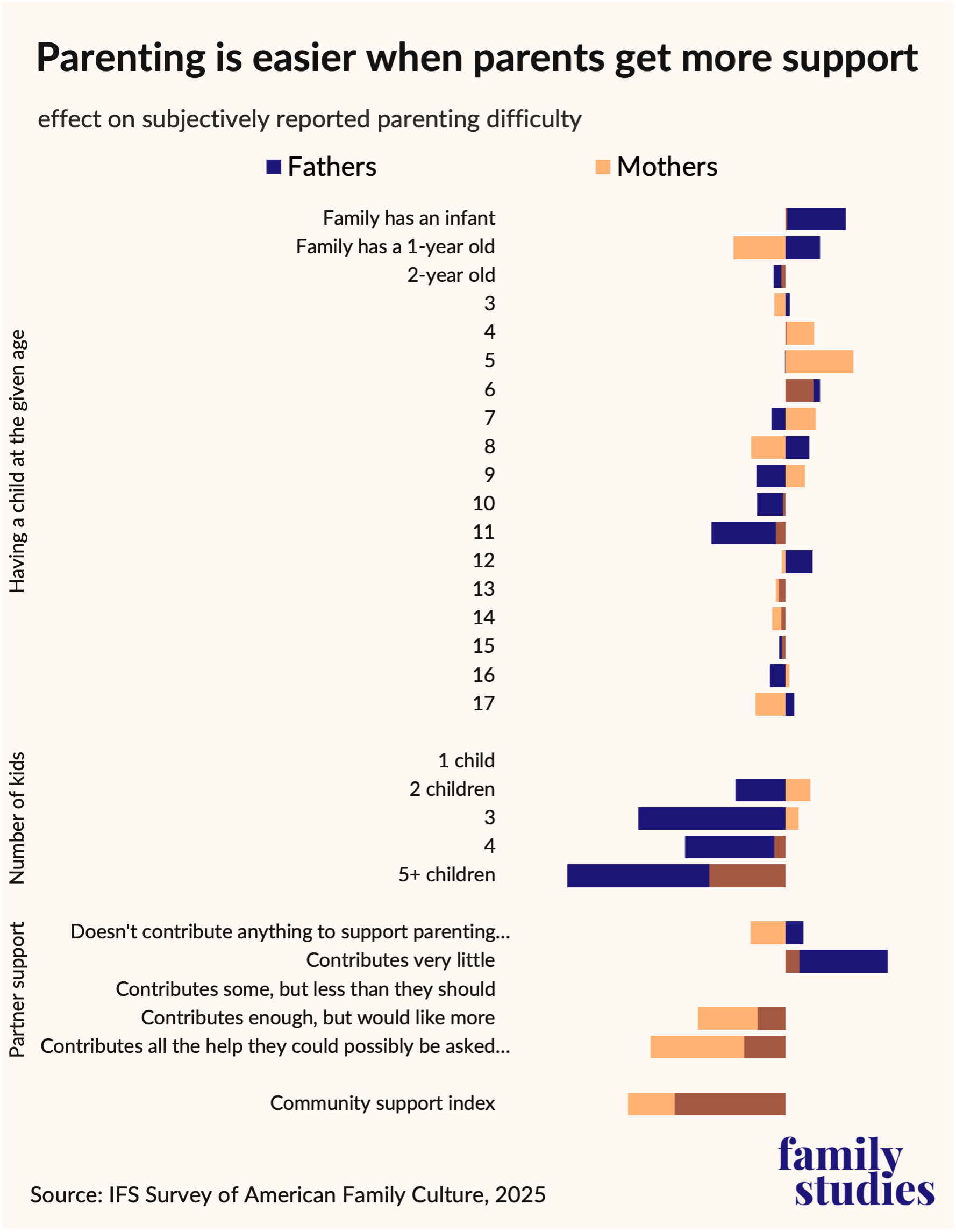
But it’s worth reflecting on the details: for dads, parenting feels hardest when kids are under 2 years old, and it feels easiest when kids are ages 9 to 11. For moms, parenting tends to feel easiest when kids are under 2, and hardest when kids are ages 4 to 7. When it comes to moms, what’s striking about this finding is that the years when moms say they feel parenting is easiest also tend to be the years when they carry the biggest load (for example, many mothers take time off work during these years, and infant feeding and care tends to fall more frequently on their shoulders). As their children make the transition to school, moms tend to describe parenting as harder.
In terms of the number of children, the more kids a family has, the easier parents say parenting is—especially dads. This points to an important source of confounding in our data: people who have an easier time parenting are likelier to have more kids. People who find parenting very difficult probably will have fewer kids. So, our findings don’t necessarily imply that having extra kids makes parenting easier, but rather, that people who find ways to reduce the difficulty and stress of parenting generally tend to have more kids.
Finally, we come to the support variables: moms in particular report huge benefits from feeling supported. When moms feel their husbands are contributing enough to parenting, they tend to report that parenting is a lot easier. Men also see benefits from supportive spouses, though the effects are somewhat smaller—except in one area: a partner who contributes “very little” is often seen as worse than a partner who doesn’t contribute at all. Totally non-contributing partners are mostly former partners who are no longer custodial parents. A bad coparent perhaps feels worse than no coparent.
Outside of the household, moms and dads alike report that parenting is a lot easier when they feel their local community supports their parenting, when they feel their peers parent in a similar way, and when they do not feel judged or criticized for their parenting (all elements of our “community support” score).
Family Finances and Parental Difficulty
Turning to financial factors, some of our results are unsurprising, but others may be counterintuitive. When families have recently experienced improvements in their finances, they feel that parenting is easier; and when their finances are worse, they feel parenting is harder. This makes sense, given that anxieties about providing for children might be a keenly felt component of family financial stresses.
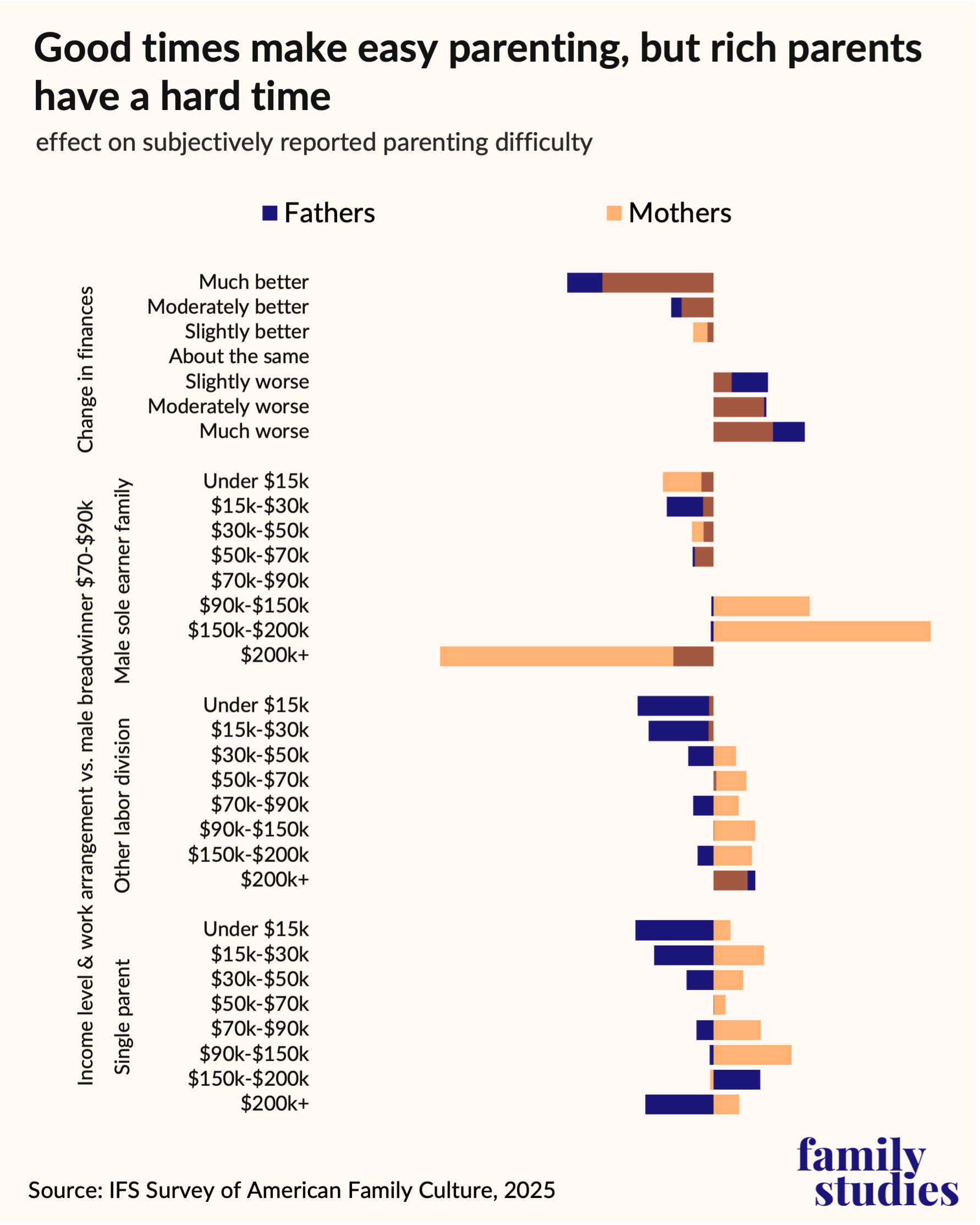
But overall, family income had the opposite effect: in most cases, lower-income families say parenting is easy, while higher-income families say it is hard. Nonworking wives of high-earning breadwinner dads actually have the highest reported parental difficulty of any group! That group of women is, if anything, the least financially strapped group in the sample, yet they report very high difficulty in parenting. At every earnings level and household division of labor, women feel that parenting is much more difficult than men, even in cases where the respondent is a custodial single parent.
What explains these trends? Again, the likeliest answer is not that higher income causes more parenting stress, or that moms feel parenting is harder due to a propensity to feel more stressed over parenting tasks. The more plausible explanation is that moms have more to do as parents and have more unforgiving expectations of their own parenting than dads do—and that higher-income families especially have demanding expectations. Higher-income families may also be able to purchase a high degree of ease and comfort in other parts of life, even as parenting remains a demanding, labor-intensive task, and thus parenting feels harder.
For Stricter Parents, Raising Kids Feels Harder
But some parenting choices also contribute to parenting difficulty. Some ways of raising kids are simply harder than others. We wondered if specific parent choices about “household rules” might influence how parents perceive the difficulty of parenting: do some rules actually make parenting easier and others harder? Simultaneously, we wondered if various household rules might influence parent-child relationship quality (as assessed in a battery of questions given to parents about all their children, and also provided to teenagers about their relationship with their parents).
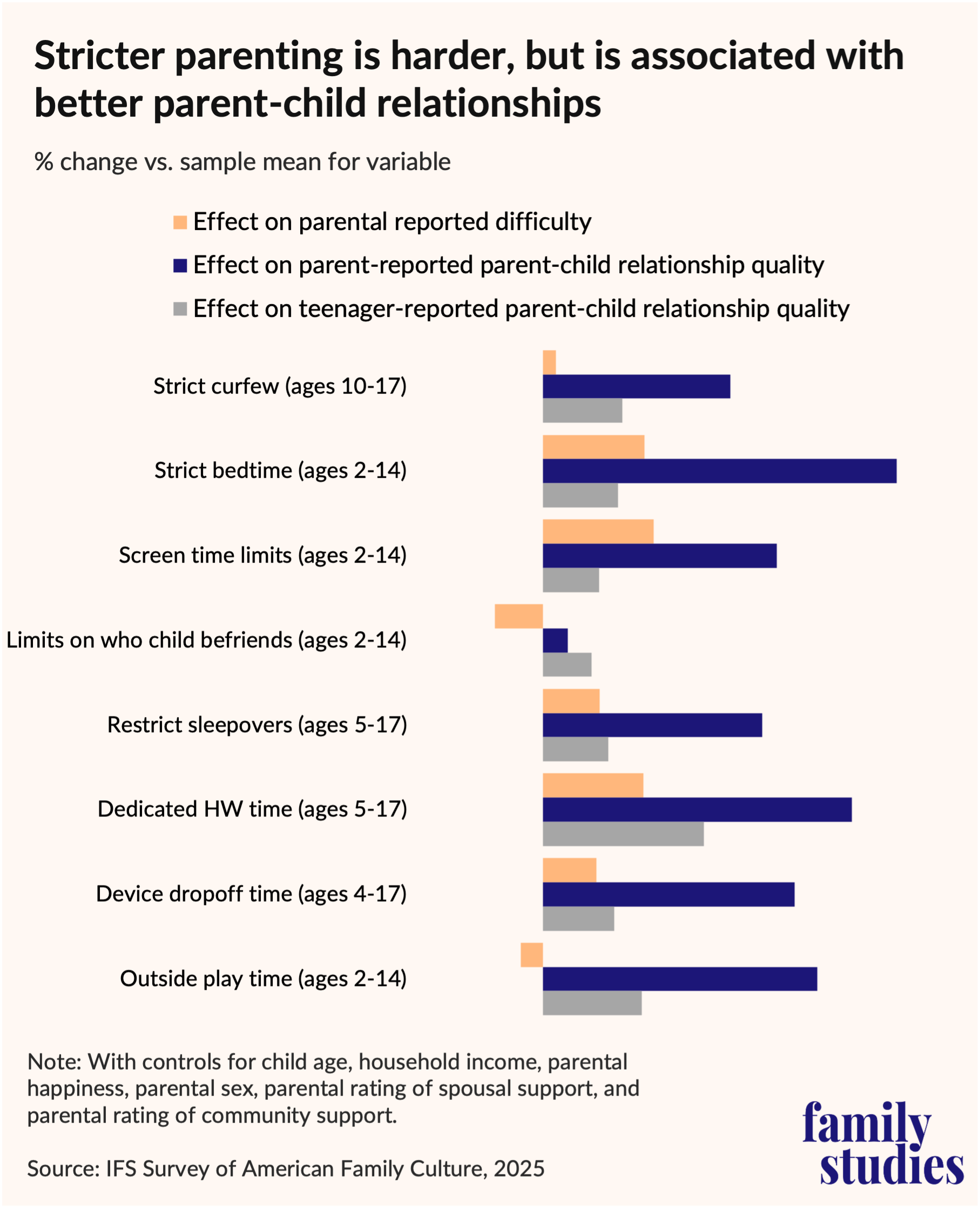
It turns out, pretty much every rule a parent imposes makes parenting feel harder. This isn’t really a surprise to most parents—enforcing rules and maintaining expectations really is a lot of work.
But, interestingly, parental-enforced rules are also mostly associated with better relationships with kids, both in the parent’s own assessment of that relationship, and the assessments of the subsample of teenage children we surveyed. Virtually every parental-enforced rule, except limitations on a child’s social ties, is linked to better parent-child relationships.
Still, every parent faces a tradeoff: we only have so much time and energy to enforce rules. To that end, it’s notable that screen-time limits had some of the smallest relationship quality benefits, yet some of the largest impacts on parenting difficulty. Screen-time limits can easily become a source of rules-lawyering and arguing with children. On the other hand, device drop-off times (i.e. a time when all members of the family deposit their devices somewhere and have offline time) have similar or better effects on relationship quality, but seem appreciably less difficult to parents. For parents concerned about devices at home, a hard and fast rule that “all devices are plugged in on the kitchen counter after 7 PM” is probably easier and more beneficial than specific limits on screen time.
One family rule turned out to have positive effects on relationship quality while perhaps slightly reducing parental difficulty: kicking the kids outside for a time each day. Controlling for extensive background factors, parents who send their kids outside to play report slightly less difficulty with parenting and better relationships with their kids (and the kids agreed!).
While these findings certainly cannot solve every parenting conundrum, they can provide some helpful guidance. Parents who want better relationships with their kids often feel pressured to relax expectations and rules (and our findings certainly don’t mean case-by-case exceptions are bad!), but the truth is that the hard work of maintaining household norms and rules pays off. Where parents set standards, parent-child relationships are warmer, more fulfilling, and more mutually respectful. It may be one of the hardest parts of parenting, but it is worth it in the long run.
Read our new research brief and view the interactive maps on parenting, here.
Lyman Stone is a Senior Fellow and Director of the Pronatalism Initiative at the Institute for Family Studies. He is also the Director of Research at the consulting firm Demographic Intelligence and a PhD candidate at McGill University.
*Photo credit: Shutterstock