Highlights
From 2010 to 2026, Ultra-Orthodox Jews in the New York City metro area averaged 7.5 children born per woman. During the same period and in the same metro area, college-educated, native-born non-Hispanic white women averaged 1.58 children per woman. In Ohio, Amish communities average around 6 children per woman—while Ohio itself has been below 2 children per woman for many years.
These contrasting trends highlight how people inhabiting similar economic worlds end up with radically different families. While nobody would dispute that economic and material factors may influence birth rates, there is good reason to believe that there is much more to the story. Clearly, culture matters. The differences in birth rates between various groups of people are not simply a function of differences in child care affordability or household incomes and parental opportunity costs; they are at least partly a function of differences in cultural norms and values—and those norms and values may be changing.
Unfortunately, “culture” has long been used as a catch-all term: any variation in fertility not explained by variables we understand well (like housing costs, contraception, child mortality, or marriage rates) too often ends up lumped together as “culture.” Why do Ultra-Orthodox Jews have higher birth rates? Because of their culture. The Amish? Culture! Latter-Day Saints in Utah? Apparently, again, culture. This “black box” approach to defining culture obscures more than it illuminates. Where does this nebulous “culture” come from? Why do members of some cultures reproduce more despite the same material circumstances as their neighbors? What is it about some cultures that makes them more pronatal and child centered than others?
Surprisingly little prior work has tried to untangle exactly which values and attitudes matter most for shaping family life. This is not to say scholars have not investigated “non-material” factors shaping fertility. In fact, scholars have long pointed to strong effects from fertility norms within social groups. If your family member, friend, or colleague has a baby, you are more likely to have one, too. This effect is not limited to real-life friends: television shows that depict smaller families have also predicted fertility decline. Negative portrayals of teen moms may also reduce fertility. At the same time, the full picture of how “culture” interacts with fertility has to include more than contagion of behavior; otherwise norms would never change.
Here again, scholars have not been absent, studying how Papal speeches shape Catholic fertility, how prestigious godparenting opportunities shape family size among the Georgian Orthodox, and how a sense of historic Irish national identity may influence fertility. Nonetheless, besides contagion, role modeling, and religion, appeals to culture and fertility have often been used to explain gaps in research and residuals in models, rather than hard evidence. We know fertility is contagious, but we do not know what exactly is being “caught.” We know religious leadership can sometimes influence fertility, but we have no idea what it is about that leadership that has an effect. In a new IFS and Wheatley Institute report, we begin the work of opening the black box of fertility culture. We explore the specific factors across and within societies that lead some people to have many more children than others.
The Survey and Interactive Tool
We used a survey of nearly 10,000 people spanning over a dozen countries from the U.S. to Israel to Korea. The survey asked about a wide range of family attitudes to explore how individuals who are sometimes called “cultural elites” (i.e., celebrities and other public figures of high social visibility) shape fertility desires, how peers influence each other, how parents and religious leaders encourage fertility, and other specific cultural norms and practices. Most of our survey covered questions that have rarely, if ever, been surveyed cross-nationally, or have not been surveyed in a research program that also studied fertility. As a result, we can present first-of-a-kind evidence on what specific cultural norms typify successful pronatal cultures.
To supplement this survey, we also created and analyzed a database of family behaviors among individuals who are seen as current and historic elites (i.e., socially visible people with Wikidata or Wikipedia pages) in several countries, exploring the role of social and cultural elites in shaping family culture. This report amounts to a bold experiment: can we study rarely investigated facets of social and cultural influences on family culture and fertility ideation using a survey instrument across a wide range of countries? The answer is: yes. Our survey has yielded reams of interesting results, which readers can browse in the interactive tool associated with this report.
Overall, our work barely scratches the surface of the relationship between culture and fertility, yet it nonetheless identifies many productive avenues where pronatalists might start talking to friends and family about the beauty and value of having and raising kids.
Major Findings
1. Friends and family matter to fertility intentions.
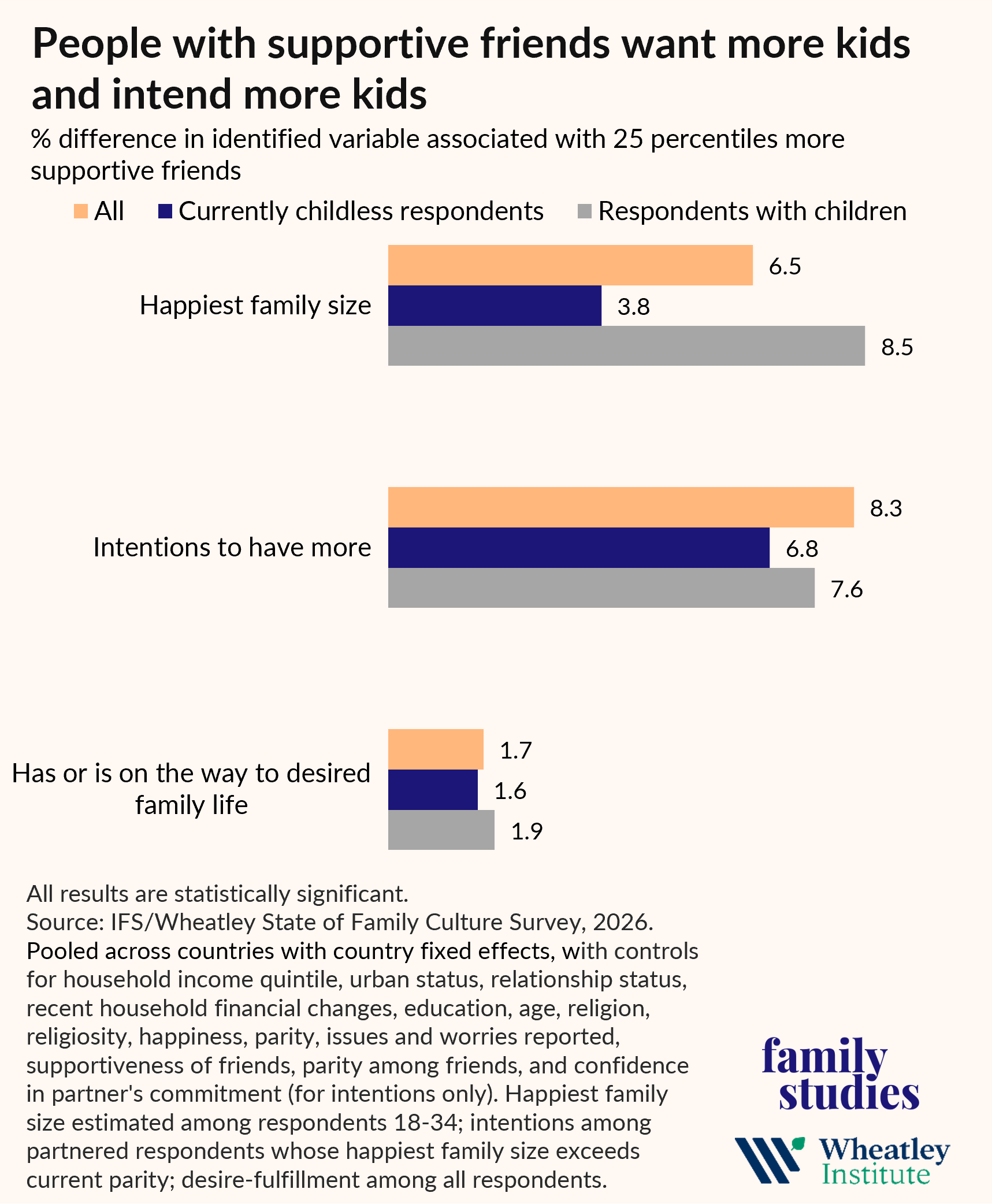
When people feel supported by friends, they desire, intend to have, and actually have more children. Likewise, when people feel encouraged to have children by their parents, they also desire and intend to have more children. Believing one's friends would celebrate a new baby is associated with a 10% increase in desired number of children and a 20% increase in the likelihood of intending to have another child, while parental encouragement to have children is associated with an 11% increase in desired number of children and a 30% increase in the likelihood of intending to have another one.
2. The family lives of celebrities, and the visibility of celebrity families, influence the family lives of fans.
Admiring a public figure with a family bigger than one's own is associated with a 14% increase in the likelihood of intending another child, and changes in cultural elites’ fertility or visible fertility have historically predicted changes in populations’ fertility. When low-fertility public figures capture more attention, fertility often falls.
3. Effective pronatal beliefs entail positive attitudes towards family life, but not necessarily any particular sense of obligation.
Belief that most people have a moral obligation to have children does not significantly predict intent to have a child, but beliefs that children are the greatest joy or represent the future of one's community does.
4. Division of household labor does not have a big impact on fertility.
Contrary to theories that low fertility may be due to unequal sharing of domestic labor, neither actual division of household chores nor perceptions around their fairness significantly predict any meaningful differences in fertility ideals or intentions.
5. Active faith matters to fertility desire and outcomes.
The most diligent religious attenders not only desire more children but actually have more children—and have a higher likelihood of intending to have more children. However, this association is not driven by the frequency of pro-family statements from religious leaders but is more likely due to greater support and encouragement from family and other religious community members.
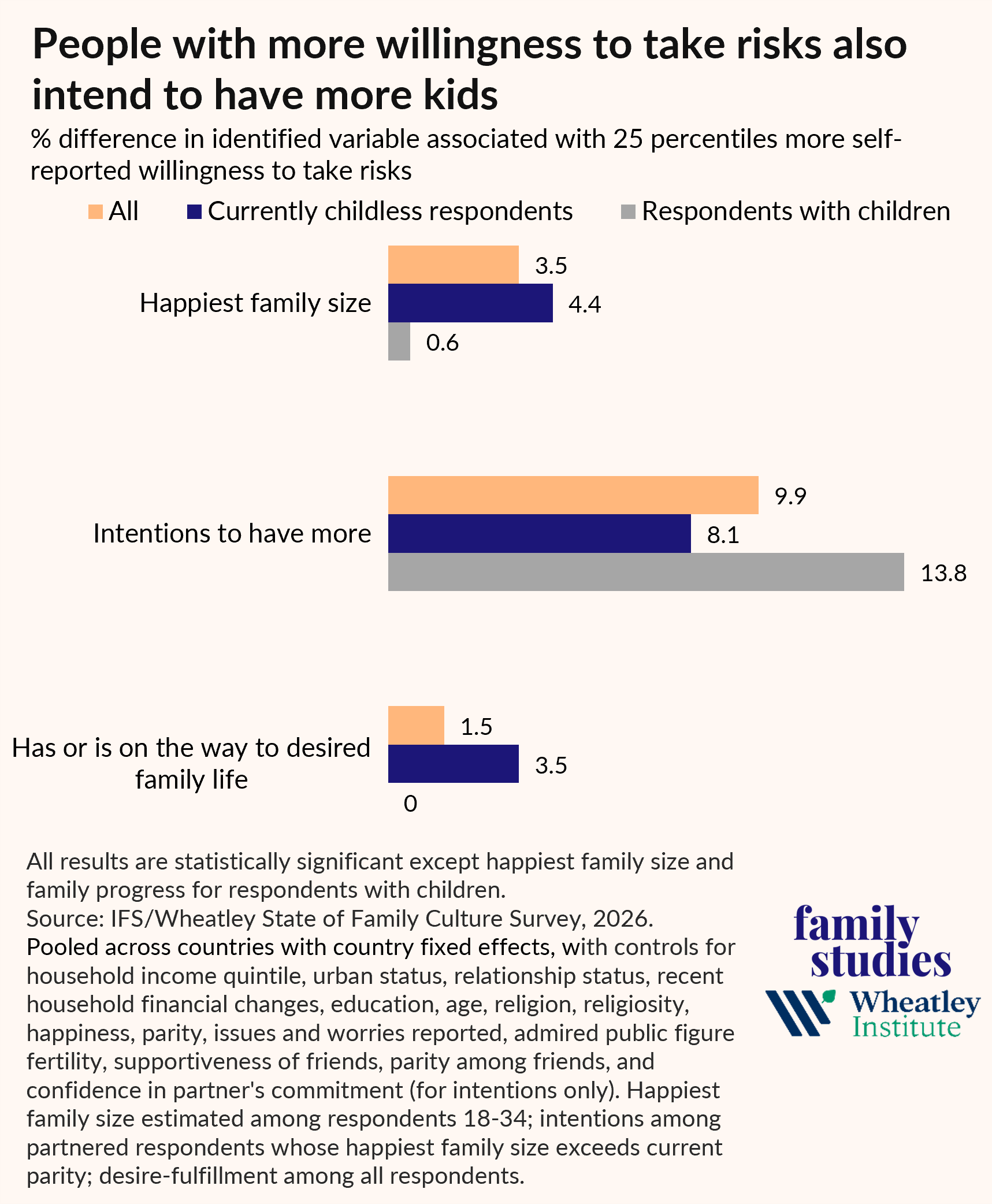
6. A willingness to take risks and an optimism about the future both predict intentions to have children and the number of children a respondent already has.
High levels of “safety-ism,” general anxiety, and pessimism about the future are all strong candidates for cultural changes that are driving falling fertility today, since other research has shown that these may be rising over time.
Editor's note: This article is adapted from the Executive Summary of the new IFS/Wheatley report, Baby Nudges. Read or download the full report here. And be sure to check out the report's interactive charts.