
Introduction and Executive Summary
From 2010 to 2026, Ultra-Orthodox Jews in the New York City metro area averaged 7.5 children born per woman. During the same period and in the same metro area, college-educated, native-born non-Hispanic white women averaged 1.58 children per woman. In Ohio, Amish communities average around 6 children per woman—while Ohio itself has been below 2 children per woman for many years.
These contrasting trends highlight how people inhabiting similar economic worlds end up with radically different families. While nobody would dispute that economic and material factors may influence birth rates, there is good reason to believe that there is much more to the story. Clearly, culture matters. The differences in birth rates between various groups of people are not simply a function of differences in child care affordability or household incomes and parental opportunity costs; they are at least partly a function of differences in cultural norms and values—and those norms and values may be changing.
Unfortunately, “culture” has long been used as a catch-all term: any variation in fertility not explained by variables we understand well (like housing costs, contraception, child mortality, or marriage rates) too often ends up lumped together as “culture.” Why do Ultra-Orthodox Jews have higher birth rates? Because of their culture. The Amish? Culture! Latter-Day Saints in Utah? Apparently, again, culture. This “black box” approach to defining culture obscures more than it illuminates. Where does this nebulous “culture” come from? What are its constituent parts? Why do members of some cultures reproduce more despite the same material circumstances as their neighbors? What is it about some cultures that makes them more pronatal and child centered than others?
Surprisingly little prior work has tried to untangle exactly which values and attitudes matter most for shaping family life. This is not to say scholars have not investigated “non-material” factors shaping fertility. In fact, scholars have long pointed to strong effects from fertility norms within social groups. If your family member, friend, or colleague has a baby, you are more likely to have one, too. This effect is not limited to real-life friends: television shows that depict smaller families have also predicted fertility decline. Negative portrayals of teen moms may also reduce fertility. At the same time, the full picture of how “culture” interacts with fertility has to include more than contagion of behavior; otherwise norms would never change.
Here again, scholars have not been absent, studying how Papal speeches shape Catholic fertility, how prestigious godparenting opportunities shape family size among the Georgian Orthodox, and how a sense of historic Irish national identity may influence fertility. Nonetheless, besides contagion, role modeling, and religion, appeals to culture and fertility have often been used to explain gaps in research and residuals in models, rather than hard evidence. We know fertility is contagious, but we do not know what exactly is being “caught.” We know religious leadership can sometimes influence fertility, but we have no idea what it is about that leadership that has an effect. In this IFS/Wheatley Institute report, we begin the work of opening the black box of fertility culture. We explore the specific factors across and within societies that lead some people to have many more children than others.
We used a survey of nearly 10,000 people spanning over a dozen countries from the U.S. to Israel to Korea. The survey asked about a wide range of family attitudes to explore how individuals who are sometimes called “cultural elites” (i.e., celebrities and other public figures of high social visibility) shape fertility desires, how peers influence each other, how parents and religious leaders encourage fertility, and other specific cultural norms and practices. Most of our survey covered questions that have rarely, if ever, been surveyed cross-nationally, or have not been surveyed in a research program that also studied fertility. As a result, we can present first-of-a-kind evidence on what specific cultural norms typify successful pronatal cultures.
To supplement this survey, we also created and analyzed a database of family behaviors among individuals who are seen as current and historic elites (i.e., socially visible people with Wikidata or Wikipedia pages) in several countries, exploring the role of social and cultural elites in shaping family culture. This report amounts to a bold experiment: can we study rarely investigated facets of social and cultural influences on family culture and fertility ideation using a survey instrument across a wide range of countries? We find that the answer is: yes. Our survey has yielded reams of interesting results, which readers can browse in the interactive online tool associated with this report.
Our findings are of enormous relevance to anybody wondering what is going on with family formation among their friends, family, parishioners, neighbors, or countrymen. First, we find resounding evidence that peers do matter to fertility. We replicate findings of fertility contagion from the academic literature and show that, across cultures, perceptions of peer support for childbearing matter a great deal. Likewise, we find evidence that public figures and celebrities influence fertility behaviors—though not as much as prospective grandparents might. Meanwhile, the frequency with which religious leaders emphasize family turns out to not be especially influential in our sample, much to our surprise (though regular religious participation remains important).
We also demonstrate new links between specific kinds of norms and attitudes and fertility. For example, we show that risk preference has a meaningful relationship with fertility, while “pronatal general norms” turn out not to have strong ties. In the societies we studied, a sense of general obligation to have children is not an important family formation motivator, even as personal enjoyment of children or parenting is.
Overall, our work barely scratches the surface of the relationship between culture and fertility, yet it nonetheless identifies many productive avenues where pronatalists might start talking to friends and family about the beauty and value of having and raising kids.
Major Findings
1. The family lives of celebrities (and the visibility of celebrity family lives) influence the family lives of fans.
Admiring a public figure with a family bigger than one's own is associated with a 14% increase in the likelihood of intending another child, and changes in cultural elites’ fertility or visible fertility have historically predicted changes in populations’ fertility. When low-fertility public figures capture more attention, fertility often falls.
2. Effective pronatal beliefs entail positive attitudes towards family life, but not necessarily any particular sense of obligation.
Belief that most people have a moral obligation to have children does not significantly predict intent to have a child, but beliefs that children are the greatest joy or represent the future of one's community does.
3. Division of household labor does not have a big impact on fertility.
Contrary to theories that low fertility may be due to unequal sharing of domestic labor, neither actual division of household chores nor perceptions around their fairness significantly predict any meaningful differences in fertility ideals or intentions.
4. Friends and family matter to fertility intentions.
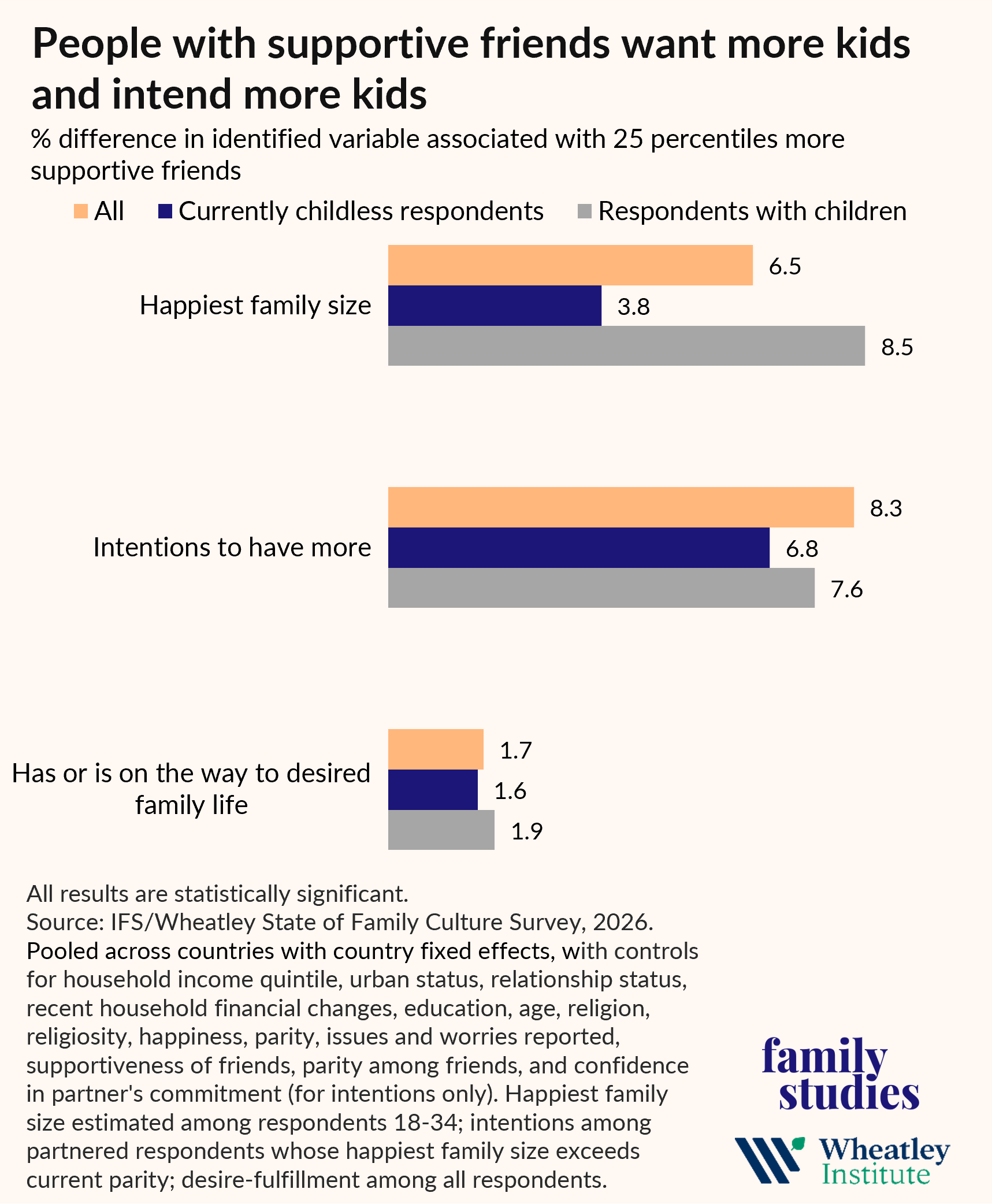
When people feel supported by friends, they desire, intend to have, and actually have more children. Likewise, when people feel encouraged to have children by their parents, they also desire and intend to have more children. Believing one's friends would celebrate a new baby is associated with a 10% increase in desired number of children and a 20% increase in the likelihood of intending to have another child, while parental encouragement to have children is associated with an 11% increase in desired number of children and a 30% increase in the likelihood of intending to have another one.
5. Active faith matters to fertility desire and outcomes.
The most diligent religious attenders not only desire more children but actually have more children—and have a higher likelihood of intending to have more children. However, this association is not driven by the frequency of pro-family statements from religious leaders but is more likely due to greater support and encouragement from family and other religious community members.
6. A willingness to take risks and an optimism about the future both predict intentions to have children and the number of children a respondent already has.
High levels of “safety-ism,” general anxiety, and pessimism about the future are all strong candidates for cultural changes that are driving falling fertility today, since other research has shown that these may be rising over time.
Supportive Friends Make a Difference: Alloparental Support

All of the authors of this report are fathers, and two of us relatively recently became dads. We all have, or hope to have, larger-than-average families. We have also enjoyed a common experience of parenthood that, sadly, is not universal: each additional child added to our families has resulted in enormous support from our community. Friends, extended family, or church congregations have shown up in major ways, providing meals, free babysitting, effusive congratulations, and celebrations, including public recognition in a memorial or baptism. We inhabit social circles where new children are celebrated and new parents are supported. Scholars call this alloparenting (meaning, “other parents”); that is, friends or family stepping in to help with child-rearing.
It’s not surprising that the three of us have these experiences, because, in our data, the United States (Jason and Lyman) and the United Kingdom (Peter) are tied with Israel for the highest self-reported alloparental support by friends and other close social ties. Within those countries, the most religiously committed people receive the most support and celebration from their friends. People in both countries report similar degrees of celebration and support as Israeli respondents, though we find that there is not much difference by religious devotion in Israel.
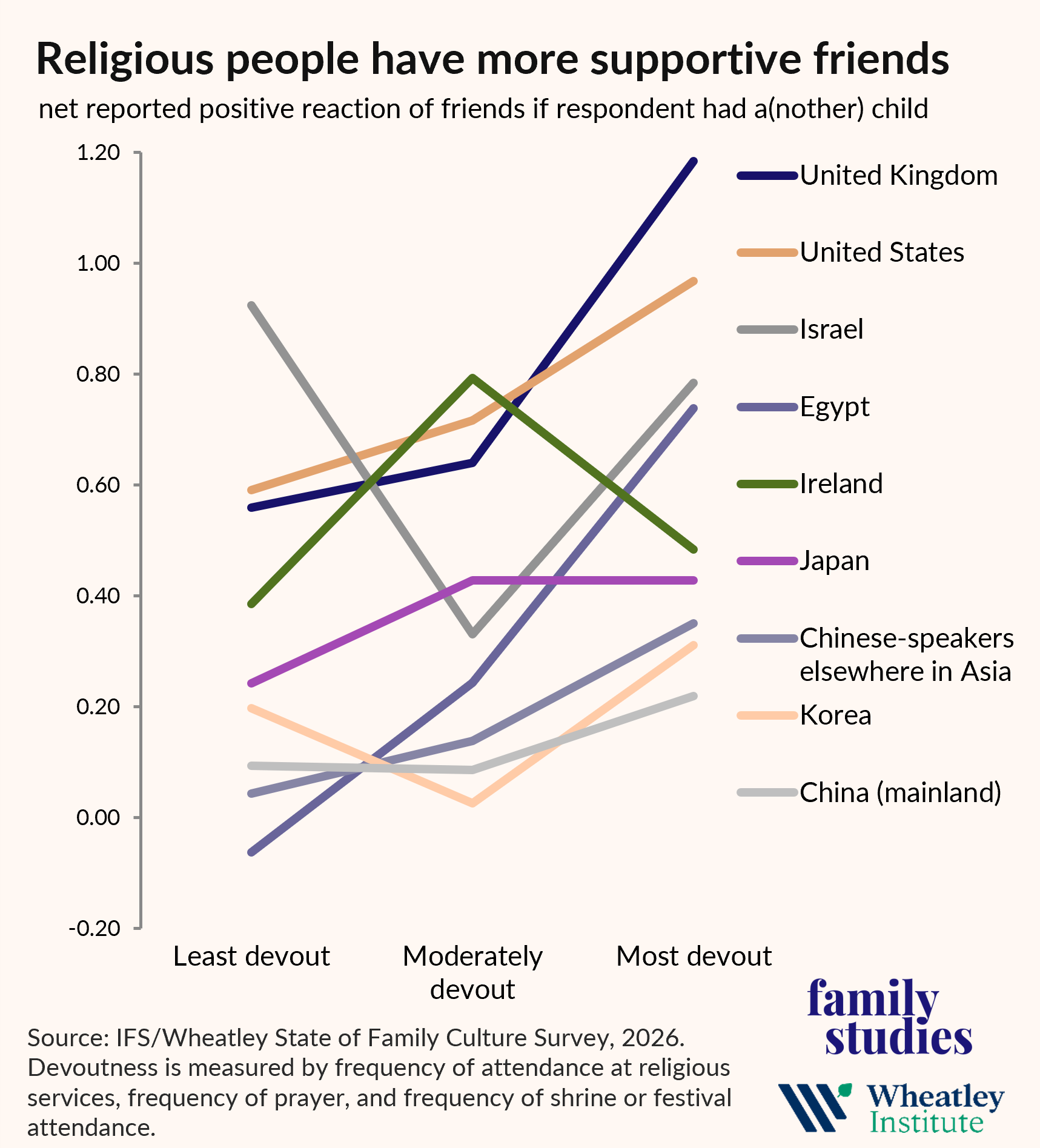
Figure 1. Net reported positive reaction of friends if respondent had a(nother) child, by country sample and religiosity
On the other hand, Chinese-speaking respondents throughout Asia, as well as Japanese and Korean respondents, overwhelmingly report very little support and celebration, even in some cases among the religiously devout. The stark divide in alloparental support between our East Asian survey samples and other countries is difficult to overstate.
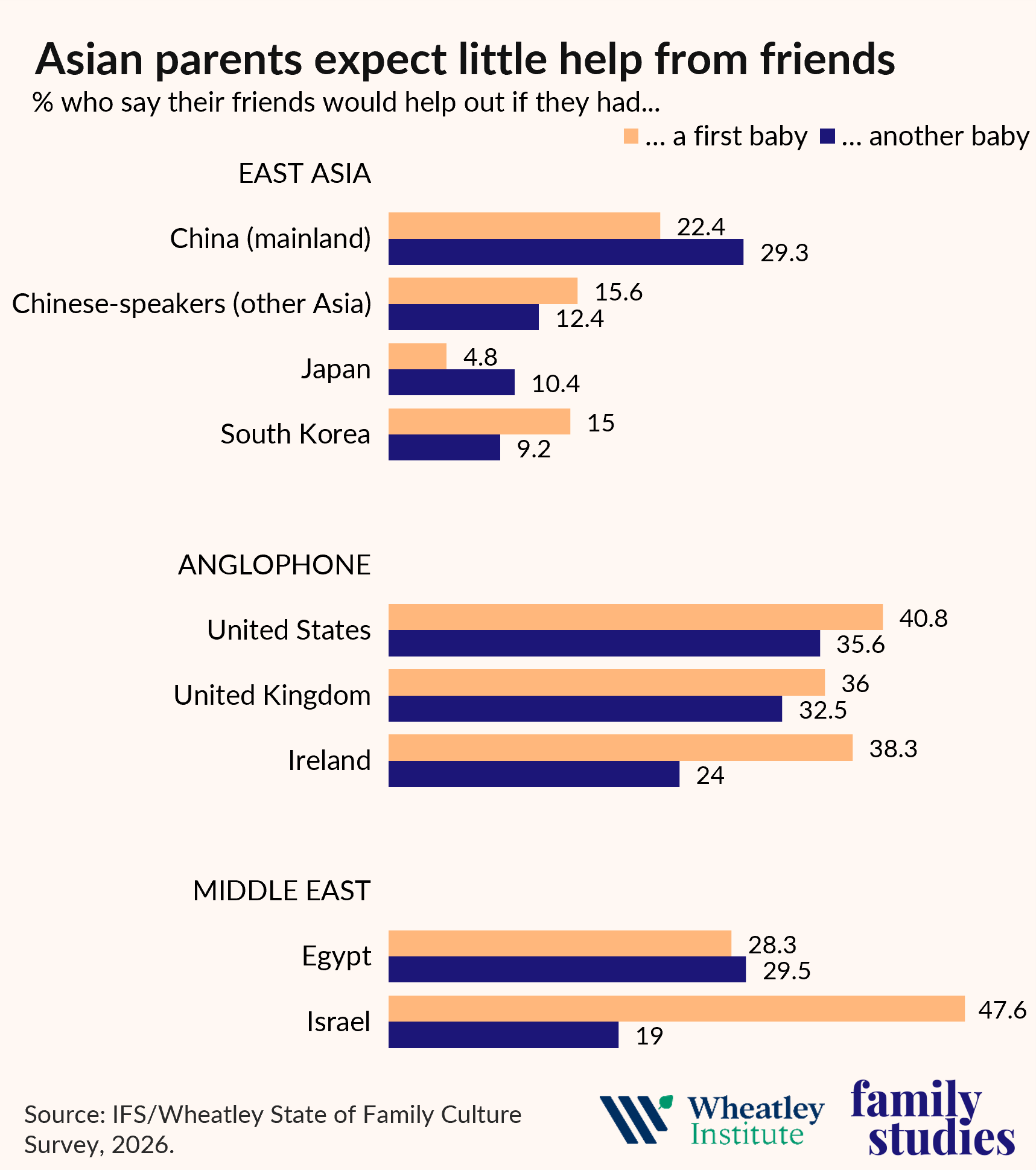
Figure 2. Share of respondents who say their friends help out upon childbirth, by country sample and child number
Around the Anglosphere, generally over a third of our survey respondents say their friends would help out with a new baby if they were to have one; values in our Middle Eastern samples are not too much lower. But in Asia (especially Korea and Japan) exceedingly few respondents expect their friends to offer them any help at all, as shown in the figure. On another question we asked, over 20% of our American respondents believe their friends will bring them meals after a new baby, but among our Japanese respondents, only 4% expect meals from friends. In South Korea, the picture is not that different: only 6% of Korean respondents report that they expect to receive this type of support.
The sense that Asian parents get little support appears time and time again in our data. We spotted a similar cross-country pattern in: 1) an index in a separate question about the kinds of help families receive from many sources; 2) a question about the number of days a week of free child care couples get from social connections; 3) the share who say their religious congregation would help them with a new baby; and 4) to a lesser extent, the share who say children represent the future of their community (Israel leads the way in this attitude). For whatever reason, parenting in East Asia seems to be very isolated, with parents largely feeling “on their own” in raising a child, and reporting very little help from friends or—especially in Korea and Japan—even from family members. Indeed, on a separate battery of questions that asked about how friends and family help out, Japanese and Korean respondents report not just the least helpful friends, but also the least encouraging families.
In other words, there is a systematic difference in the extent to which our Asian respondents feel that the choice to have a(nother) child would actually be supported and celebrated by their society. This is a striking difference between the view that parenting is a personal pursuit versus a collective investment. The cross-country gaps are large, and the difference between the lowest and highest countries for most of these values predicts a whole extra child difference in intended family size, and about half a child difference in actual children ever born at the time of the survey, as well as the family size that respondents say would make them happiest.
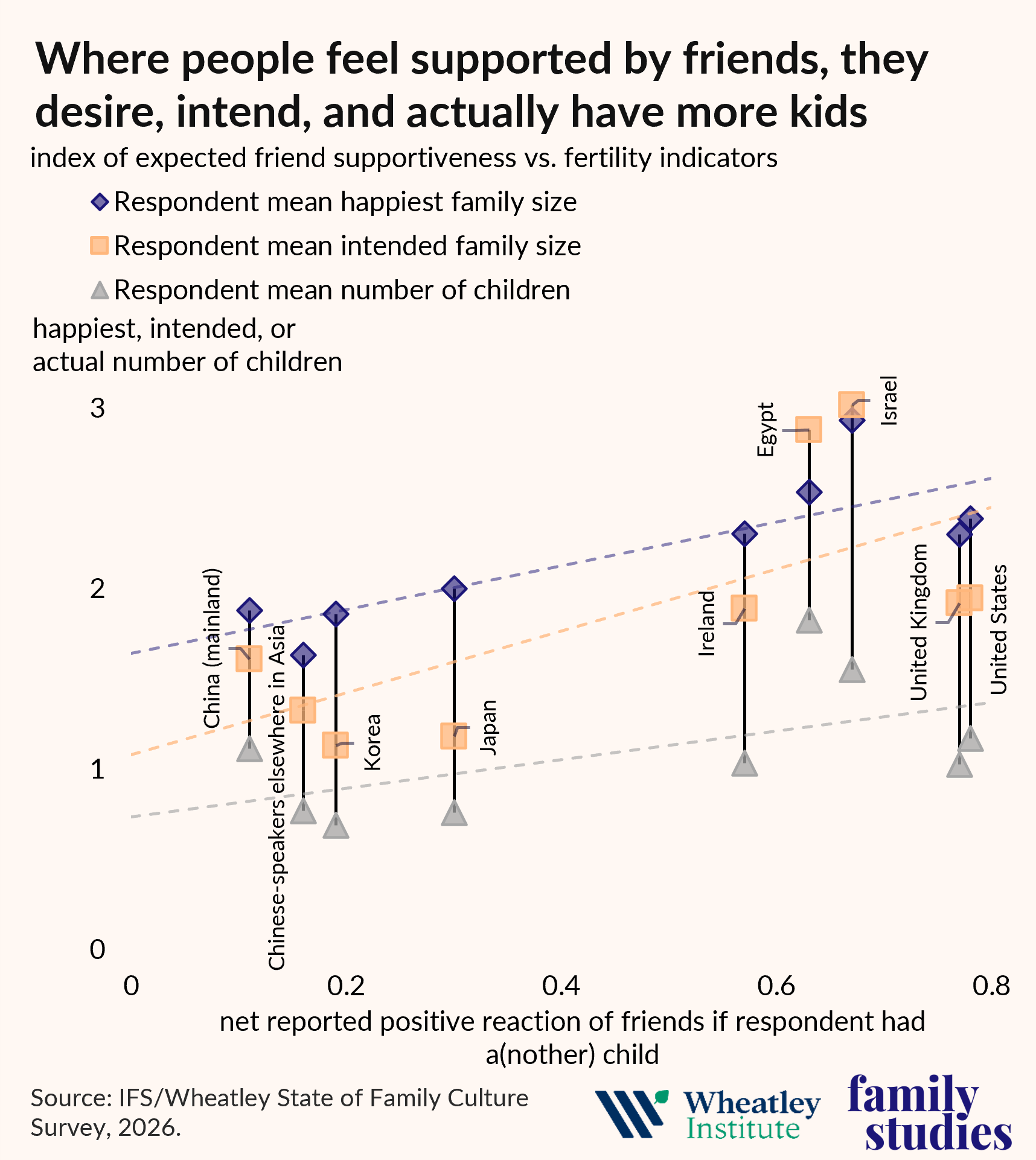
Figure 3. Index of expected friend supportiveness vs. happiest family size, intended family size, and mean number of children, by country sample
There are also large associations between supportive friends and key fertility indicators within countries, too. While it is certainly possible that individuals might select friends based on their likelihood of supporting their fertility, direct selection of this kind is unlikely for childless individuals in particular: many friendships long predate current family circumstances, and childless individuals report large numbers of childless friends.
Empirically, we find that the correlation between an individual’s own fertility and that of their close friends is not especially strong. For older parents, endogenous selection is more likely, as they may form friendships throughout their lives based on similar-aged children.
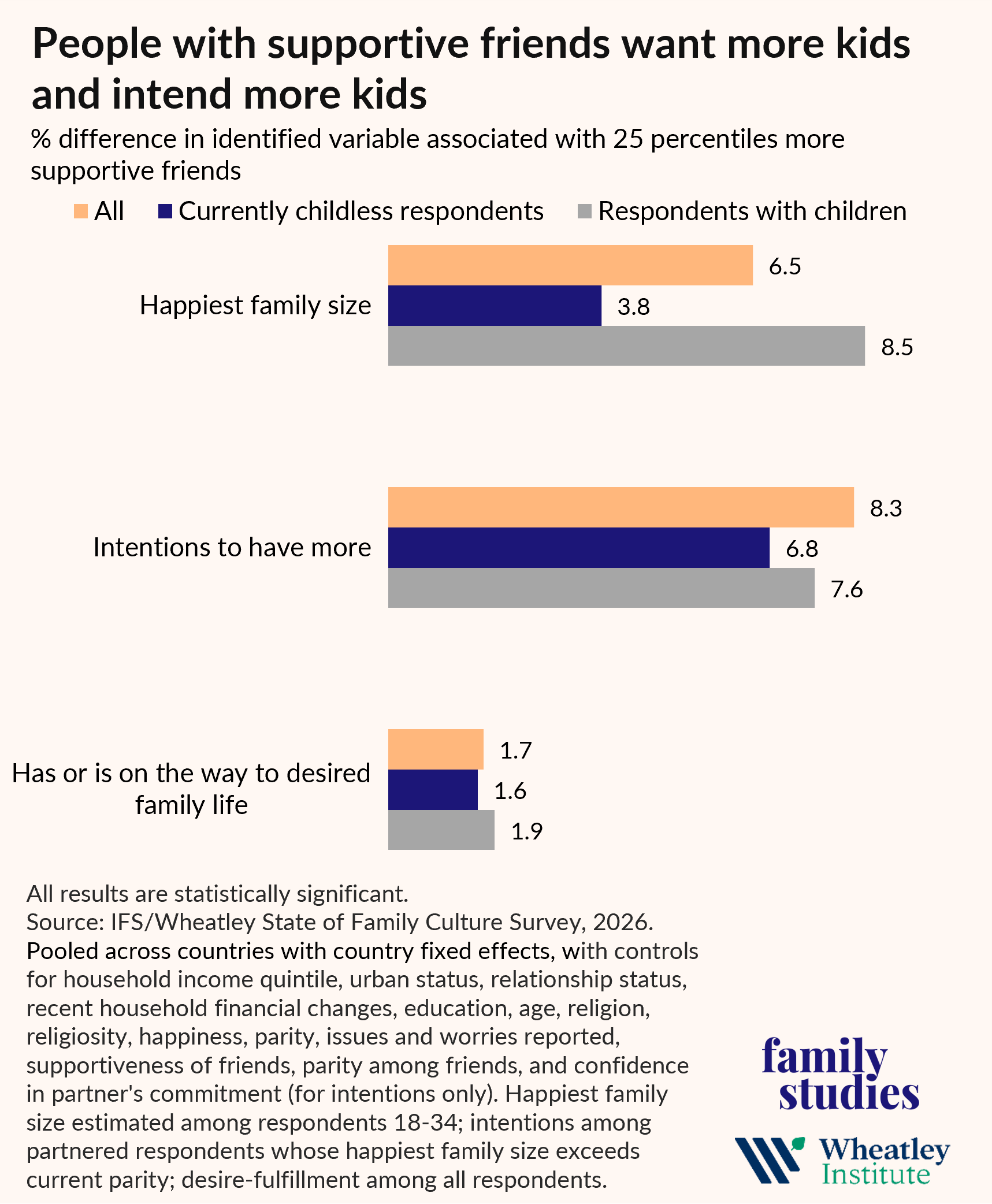
Figure 4. Percent difference predicted by 25 percentiles more supportive friends, for happiest family size among under-35 respondents, intentions to have more children among partnered respondents who desire more children, and family progress among all respondents, at mean of controls
Within countries, we find that moving up the distribution of friend-supportiveness by 25 percentage points is associated with: 1) an ideal family size about 7% higher among under-35s; 2) intentions to have another child about 8% higher for couples who haven’t hit their happiest family size yet; and 3) feeling like you have your ideal family life or are well on the way being about 2% higher. These associations remain statistically significant across numerous sets of control variables, model specifications, and subsamples. The extent to which individuals feel that their peers will celebrate and support their family plans may be a crucial part of how they make fertility decisions.
However, quite surprisingly, having more supportive friends is associated with a lower number of children ever born. This may seem to contradict our thesis that supportive friends boost fertility, but there are several intuitive possible explanations.
For example, it appears that having supportive friends primarily promotes the initiation of parenting and the intention to have a first child, but it does not necessarily influence the decisions of existing parents to have additional children. This pattern suggests that parents may experience rapid social learning and eventually untether themselves from needing highly supportive friends. The figure below shows the effect of supportive friends on intentions to have another child, among couples who ideally would like more kids, by their number of current children.
As can be seen below, having supportive friends has a quite meaningful association with the choice to try for a first child. It has essentially no association at all with trying for a third to fifth child. Perhaps partly because the association size of this variable collapses as the number of children already born (parity) rises, our model of how the variable directly relates to parity finds a negative association. Yet, what this result shows is that childless people’s reported intentions to initiate parenting are uniquely correlated with peer effects and peer pressure.
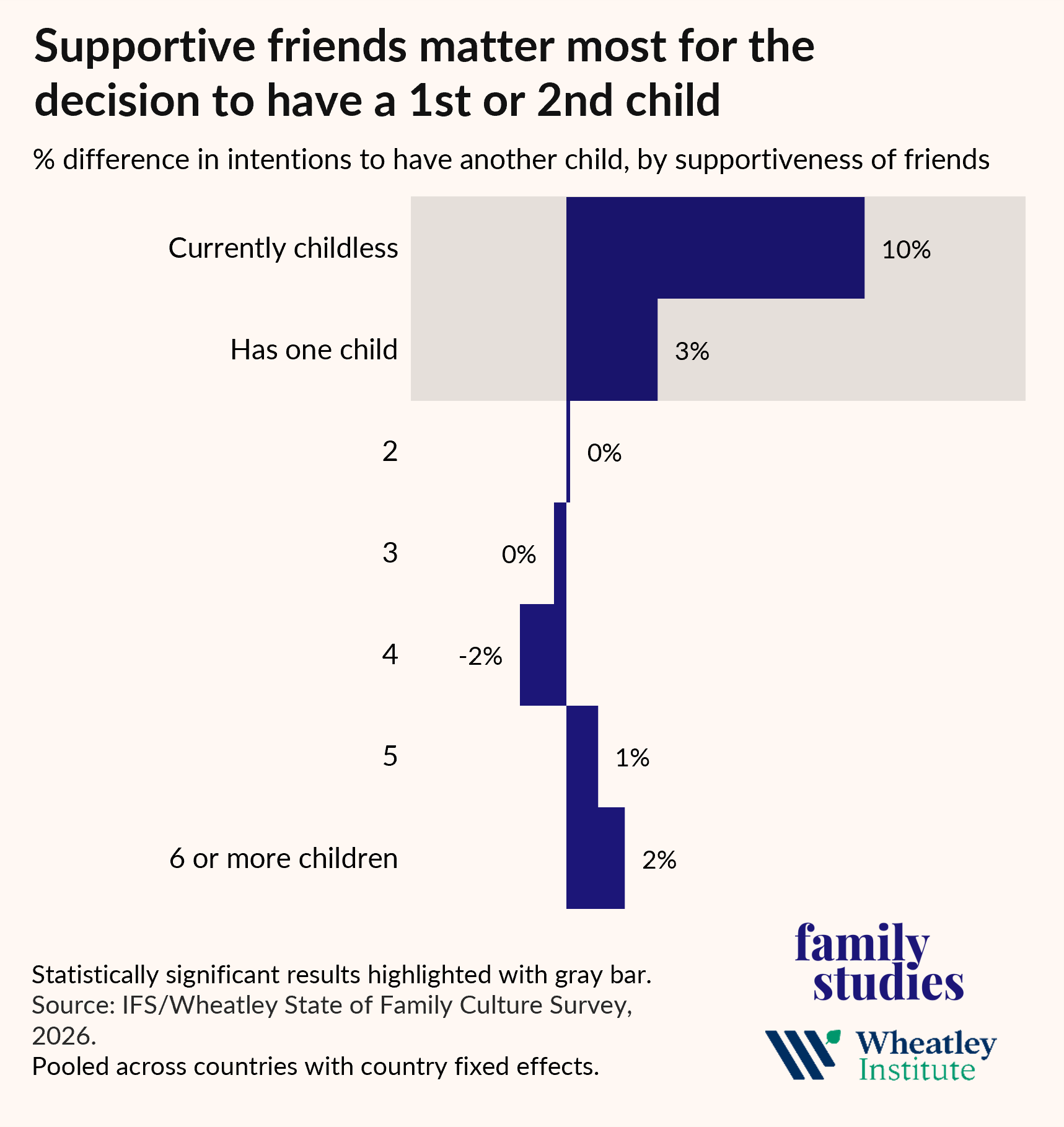
Figure 5. Percent difference predicted by 25 percentiles more supportive friends for intentions to have more children, by prior birth parity, with country fixed effects
By the time parents are considering their third child, they already have a clear idea of how they will care for a child, what parenting will be like, and how they will handle issues. Veteran parents have also been toughened up by toddlers and may have figured out substitutes for unsupportive friends. But young people considering their first child may be less certain and therefore uniquely sensitive to perceptions of how friends will react. Another possibility is that as parents have more kids, they experience more social pressure to stop, or even discrimination for having too many children. We also find evidence for this effect, as shown in the figure below.
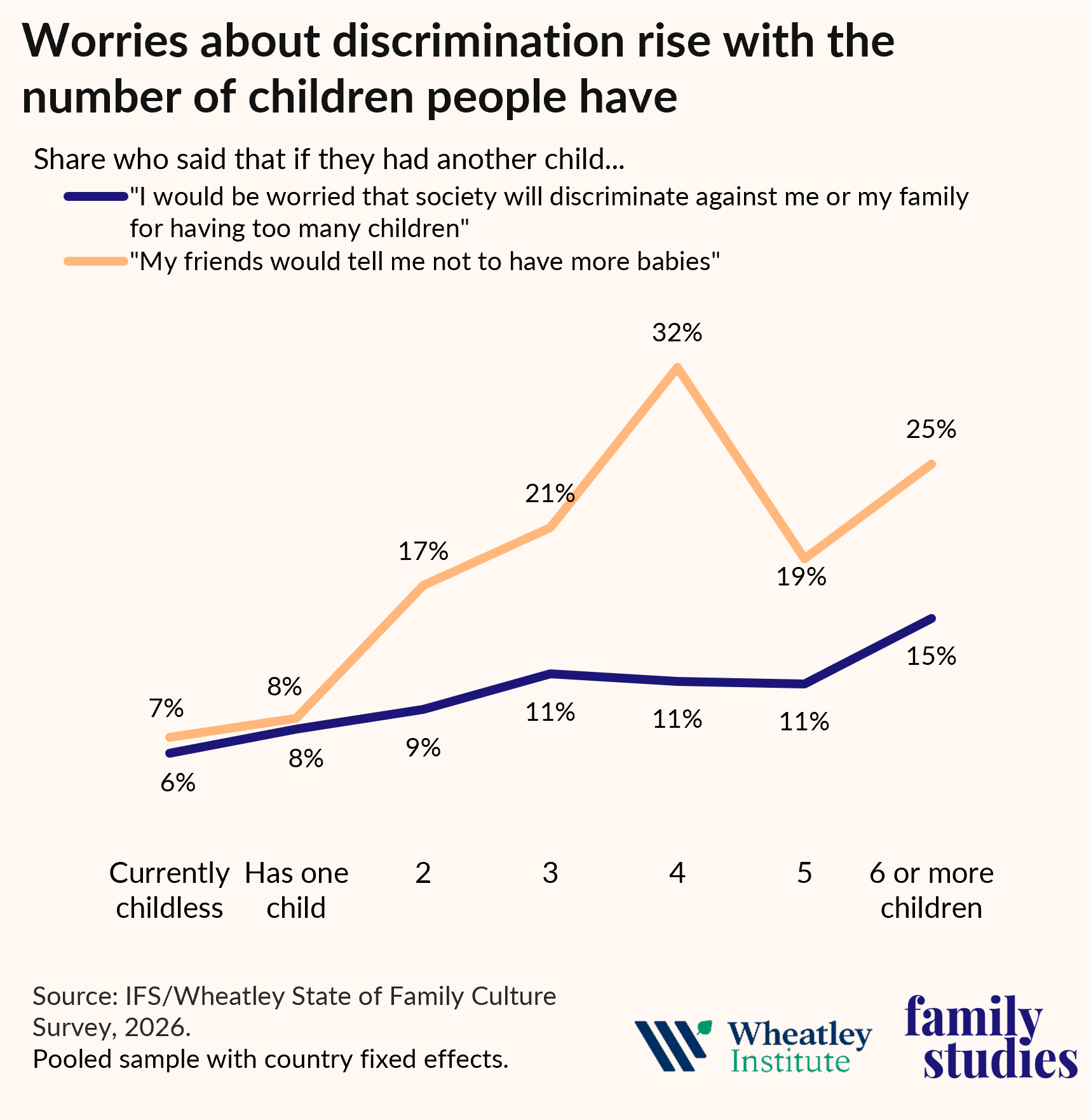
Figure 6. Share of respondents reporting concerns about family size discouragement, by prior birth parity
Overall, we find that as people have more children, society’s reaction gets less positive. Many people celebrate their friends and family members having their first baby—and first babies usually have more baby showers thrown for them. Many people will celebrate a second child, but perhaps not as many; and even fewer still would celebrate a third child. Social celebration continues to drop off further as a couple adds more children to their family.
In fact, in some cases, this dynamic becomes more than simply the absence of celebration, and becomes negative social pressure applied to larger families. We find that people with 3 or more kids report more negative reactions to their family size. It’s worth noting that these dynamics seem most severe in China—mainland China has the highest rate of worries over family size discrimination, and the second highest share who said that, if they had a child, their friends would tell them not to have any more.
Thus, the negative correlation between supportive friends and actual number of children is not because having supportive friends makes people have fewer kids. It’s because, as people have more kids, some parts of society turn against their choices, and the amount of help on offer declines. Luckily, we find that parents with more kids are a resilient bunch, and, as they have more kids, they tend to stop letting their friends' increasingly negative opinions shape their fertility intentions (similarly, the people who go on to have counter-culturally large families are probably just less swayed by peer opinions to begin with).
In other words, it is not just in countries where friends, family, and congregations help and celebrate children that new parents have more kids; the specific people who feel helped and celebrated want more kids, intend to have more kids, and are making better progress on their family life. This association with supportive friends is especially pronounced on first birth intentions—which also happens to be where the biggest recent fertility declines have been concentrated. On the other hand, even though bigger families’ fertility intentions do not seem highly impacted by peer reactions, it is concerning that social responses to children become more negative just because the child has more older siblings.
You Become Your Idols:
Celebrity Culture and Fertility
In 1984, satellite TV came to Japan. The result was that already-popular “music idols” were suddenly broadcast into millions of homes around the country, especially homes wealthy enough to install a satellite dish. This intensified what has been called the “Golden Age of Idols” in Japan, a period when musical pop culture reached an extraordinarily intense degree of popularity and social influence.
What happened next isn’t surprising: Japanese fertility declined sharply vs. other comparisons (below, we show Japan, the U.S., and fertility rates for ethnic Japanese women in the U.S.). Japanese birth rates seem to have turned abruptly towards a new, lower trajectory.
Our database of elites allows us to get a sense of one reason why expanded satellite TV may have reduced fertility in Japan but not in the U.S., where it was expanding at around the same time. New TV options increased the extent to which young people were exposed to the lifestyles and norms of celebrities with small families and expanded the demand for an ‘idol celebrity’ culture, which maintained secrecy around personal life—yet in the U.S., the famous faces likely to appear on TV (i.e., actors, politicians, musicians, businesspeople, etc.) had fertility rates very near the societal average. In the 1970s, when the U.S. and Japan both had birth rates around 1.7 or 1.8 children per woman, famous Americans also had around 1.7 children per woman.
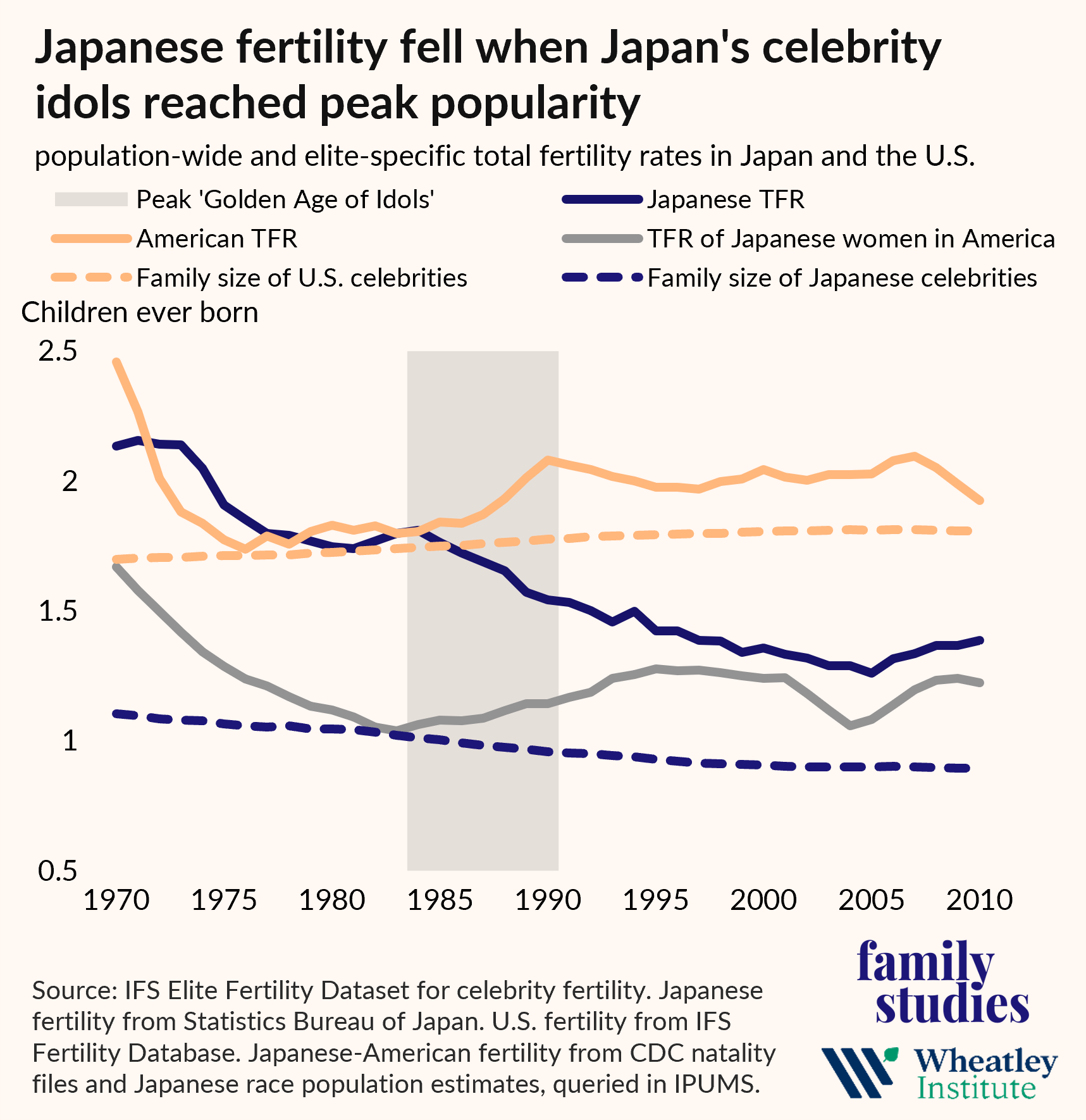
Figure 7. Population-wide and elite-specific total fertility rates in Japan and the U.S.
Yet, elite Japanese people already averaged only just a bit over one child each in the 1970s. The fertility of Japanese elites did not decline much after satellite TVs rolled out, and the fertility of Japanese-Americans rose, implying Japan-specific causes of Japan’s fertility decline beginning in the mid-1980s. One reasonable inference might be that increased exposure via satellite TV to largely-childless celebrities led normal Japanese people to adopt family norms more like the celebrities they saw on TV, just as happened in the well-studied case of soap operas reducing fertility in Brazil.
Japan’s experience was probably not an isolated incident. When Japanese idol culture-like celebrity activity first appeared in South Korea in the early 1990s with the band Seo Taiji and Boys, South Korea started plummeting towards lowest-low fertility. The singer Seo Taiji personally epitomizes the secrecy surrounding the family lives of cultural 'idols’: he kept the fact that he was married a closely-guarded secret. It only became public that he had been married many years later, because of divorce proceedings, betraying a culture that prioritizes the appearance of singlehood and childlessness even in cases where elites actually do have families. Numerous KPop stars have faced backlash for revealing romantic attachments. Chen (EXO), HyunA and DAWN, Seunghan (RIIZE), and Karina (aespa) are examples of artists who faced contract termination, boycotts, or other material economic losses after revealing relationships—and those are just high-profile cases since 2018. This culture of elite childlessness may percolate to wider society.
Certainly, there were other economic changes in Japan in the late 1980s and Korea in the 1990s that also may have influenced fertility like the 1985 Plaza Accord in Japan, the real estate bubble after 1987, and the Asian financial crisis for Korea in 1997 . Competitive educational arms races also kicked into high gear in both countries in this period, and private tutoring markets began their ascent to contemporary levels. Moreover, Japan and Korea both had rigid, inflexible labor markets and still maintained relatively uncompromising gender role attitudes in the 1980s and 1990s, both of which could set the stage for fertility decline.
We do not suggest that celebrities were the sole or even primary cause of fertility decline in either country. However, there was not a sufficiently radical change in labor markets or gender roles in this period that could explain the relevant fertility declines, and changes in education were ongoing throughout the modern period in both countries. Given the relatively weak apparent power of these explanations, elite role modeling of low fertility norms seems very likely to have acted as an important independent factor and may be more consistent with the specific timing of changing fertility trends in both Japan and Korea than more materialist or economic explanations.
There is historic precedent for this notion as well. Our dataset of famous British individuals can be compared to historic reconstructions of British fertility since 1600. The result is striking: in the early 1600s, our data shows that British elites may have had roughly similar fertility as the wider public. But, over the course of the 1700s, elites saw relatively stable or even falling fertility, while fertility generally in Britain rose, such that by the early 1800s, there was a yawning gap in fertility between the classes. However, censorship of the British press alongside social norms discouraging publication about and discussion of immorality meant that the smaller-family norms of elites were largely “walled off” from the public.
But, in 1877, the “Knowlton Trial,” also called the “Bradlaugh-Besant Trial,” sent that wall tumbling down. This trial testing censorship laws on a pamphlet about contraceptive methods shifted the Overton window on contraception, which had been hitherto widely regarded as morally wrong. The Knowlton Trial opened the door for public discussion of limiting family sizes and helped reveal to the British public practices that had long been more widely utilized among British elites. Up to that point, the increasingly libertine behavior of British aristocrats, which was the subject of much gossip within elite circles, was not discussed as much among members of wider society (who often lacked the means and the literacy required to buy and read any written materials distributing salacious information). It therefore failed to translate to changes in fertility behavior in the wider population. It took the Knowlton trial, during which claims that upper classes were privately limiting family size were widely circulated, for the populace to begin to more widely utilize contraceptive methods.
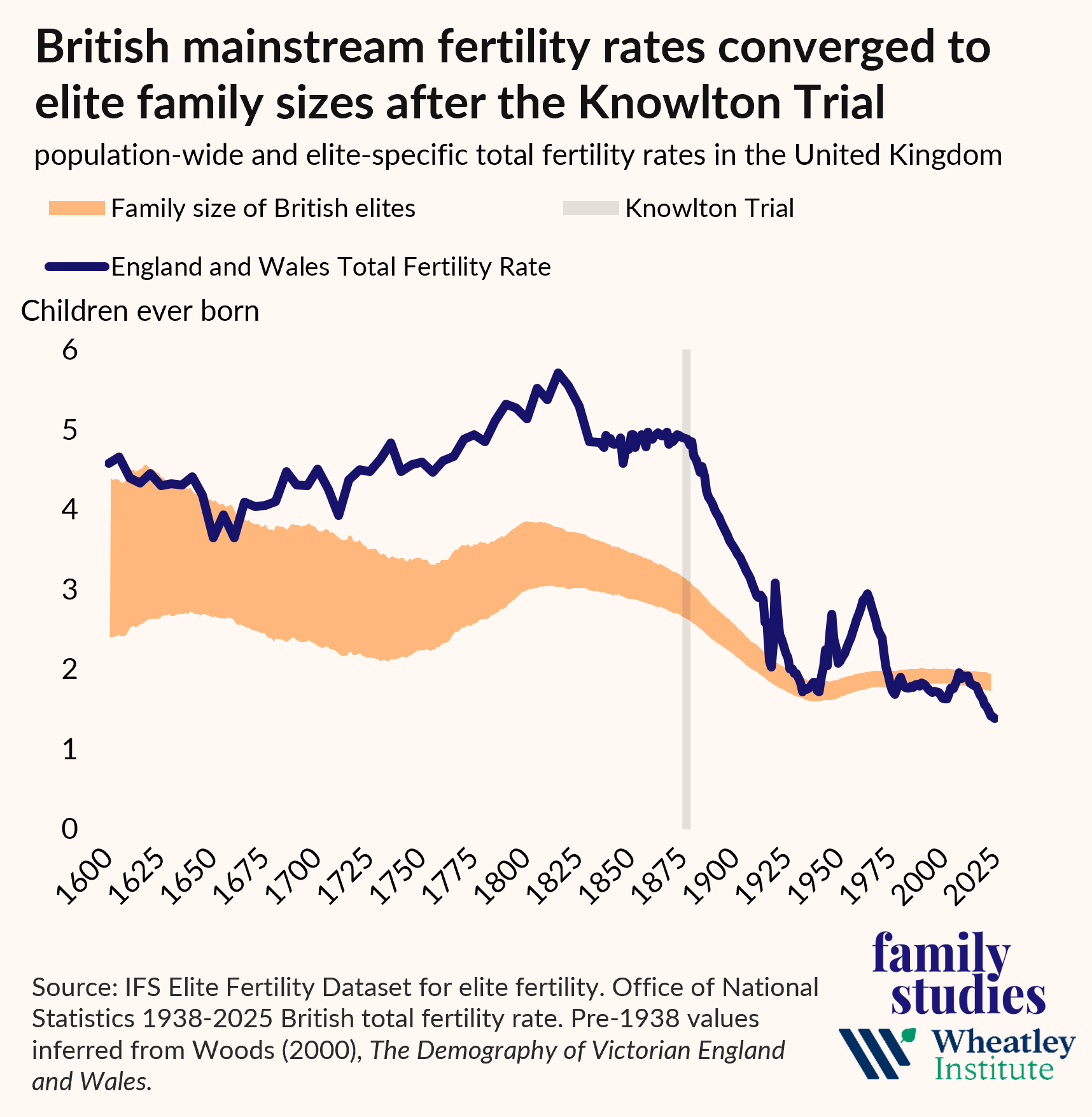
Figure 8. Population-wide and elite-specific total fertility rates in the United Kingdom
As in 19th century England, and in Japan in the 1980s, and likely many more cases, if elites act as “early adopters” of low fertility norms, and then elite visibility rises, non-elites may undertake rapid “catch-down” declines in fertility. Moreover, one can easily imagine how a shift in the composition of elites could shift fertility. For example, if people begin to admire foreign celebrities with smaller families, this might have a similar effect on fertility in that country. This is very similar to the hypothesis advanced by Arland Thornton and other scholars of “developmental idealism.” Moreover, not only do aggregate national fertility trends seem related to the extent to which public figures have families, but at the individual level, people who admired public figures with smaller families wanted and had smaller families themselves.
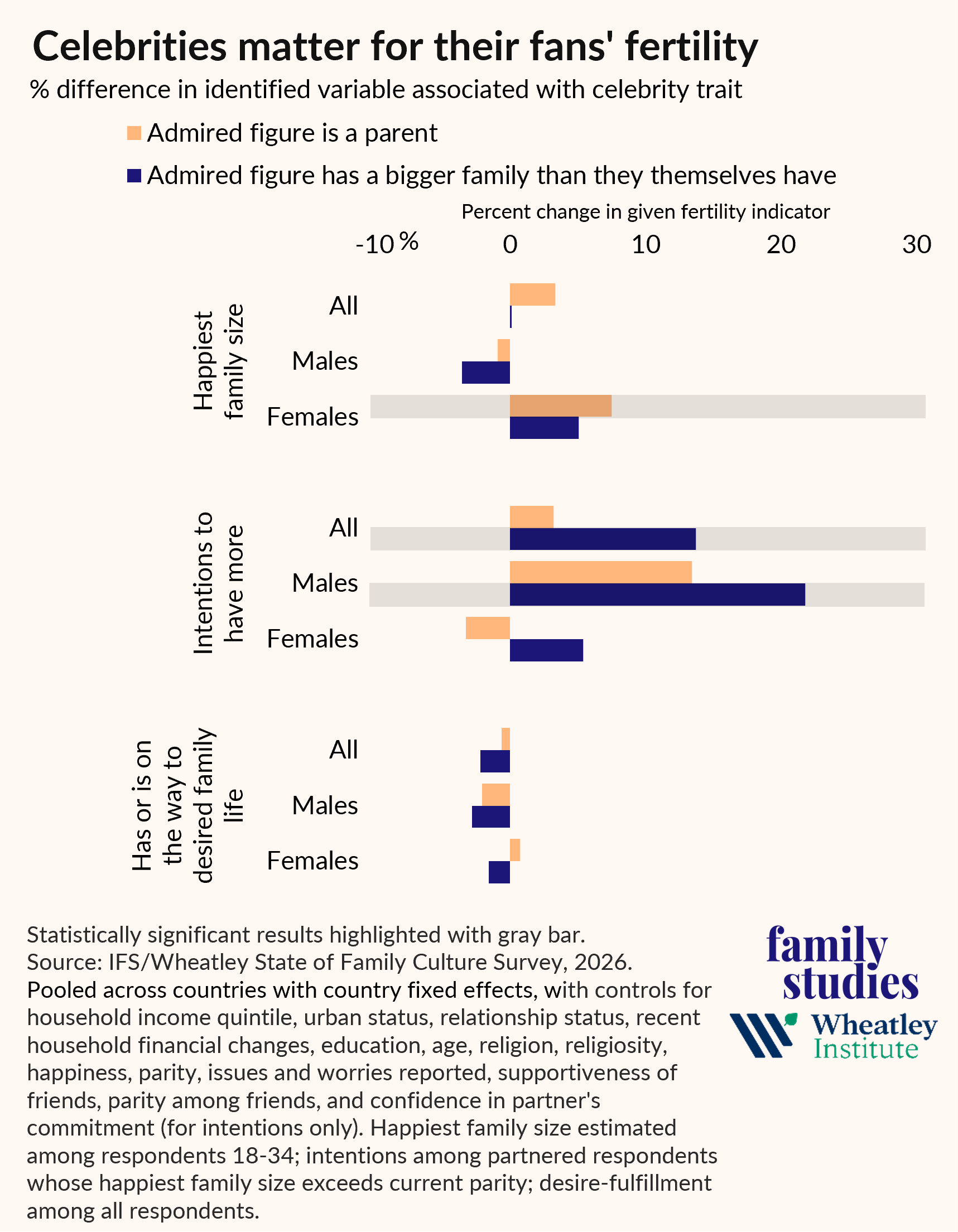
Figure 9. Percent difference predicted by celebrity family size, for happiest family size among under-35 respondents, intentions to have more children among partnered respondents who desire more children, and family progress among all respondents, at mean of controls
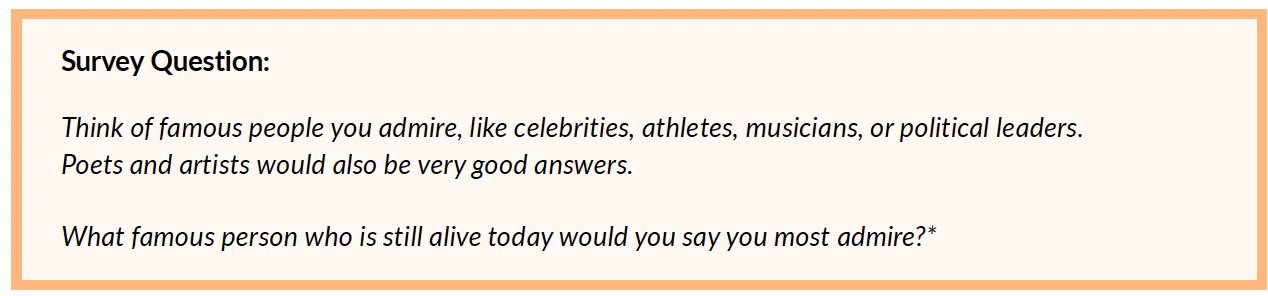
Our survey provides still further evidence about the importance of visibility and attention in assessing how perceived elite fertility influences that of wider society, finding that people’s most admired public figure predicts their ideal family size and their likelihood of intending to have an additional child.
While the effects are not consistent and not always large, for women, admiring a celebrity with children is associated with moderately larger family sizes when compared to admiring a childless celebrity. For partnered men, admiring a celebrity with more kids has predicted a higher likelihood of intending to have more children.
Our survey measure of publicly admired figures was crude. We captured only one admired figure per respondent rather than a broad picture of their cultural milieux; we did not check to see if that public figure’s family size was widely advertised or kept rather quiet; we also did not ask respondents if they were aware of the celebrity’s family size. Most importantly, we did not assess public figures’ public statements about family life. Some public figures may be childless simply by virtue of not having children yet (Taylor Swift may be one such example), while others may be outspokenly opposed to ever having children (such as Seth Rogen).
It is striking that even our limited measure of celebrity family influences reveals some evidence of the importance of elites. It is also worth highlighting the massive differences in admired celebrity family sizes across countries, as shown below. In Japan, the average admired celebrity named by respondents in the State of Family Culture Survey has just one child; in Korea, the average is 1.7. Meanwhile, in Israel and Egypt, the typical admired celebrities have more than 2.5 children. A high value for mainland China is inflated by several dozen Chinese respondents who report that Elon Musk is their most admired public figure—if the sample is limited to figures from the same country as the respondent, all of the Asian countries’ values drop considerably (though Israel's value rises).
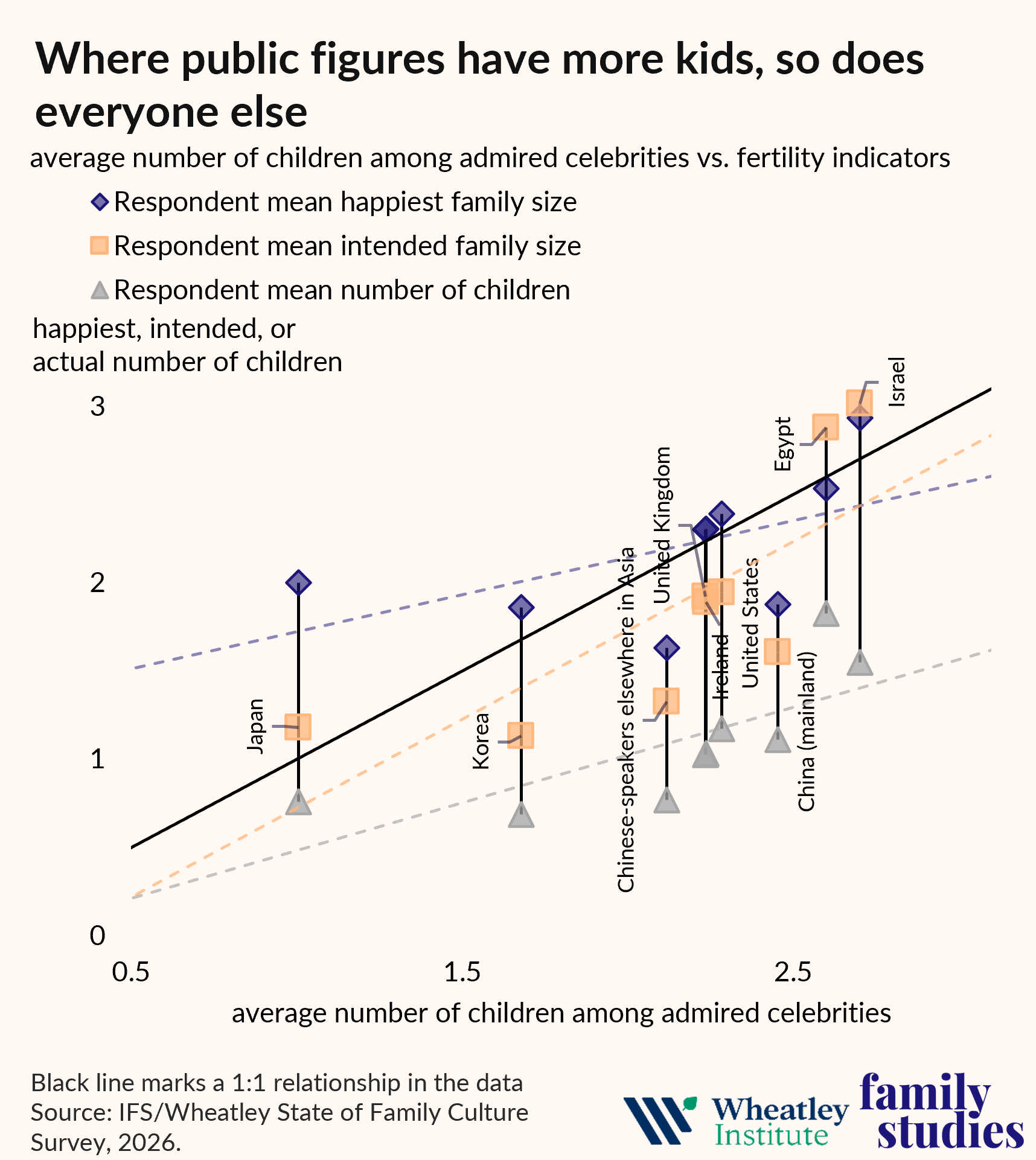
Figure 10. Average number of children among celebrities vs. happiest family size, intended family size, and mean number of children, by country sample
Thus, whether in historical analysis, or across contemporary countries and celebrity fandoms today, the leadership of socially visible individuals likely matters for fertility. Humans are imitators and especially tend to imitate perceived elites. Simply put, the fertility and family patterns of celebrities, politicians, athletes, influencers, and other public figures is very likely to shape the desires, intentions, and—ultimately—the behaviors of their young admirers.
Baby Fever: Personal Attitudes vs. Social Obligations
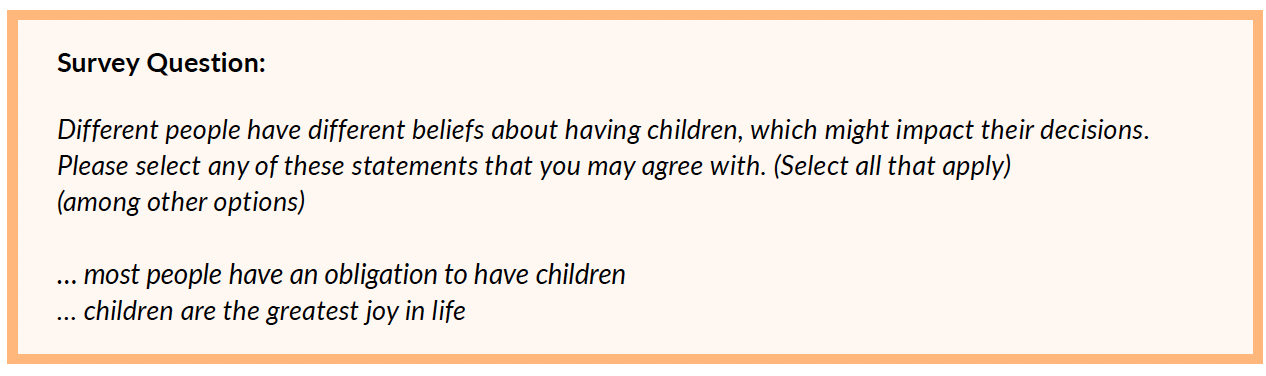
Some people really love and enjoy kids. Many women, in particular, can recall periods of intense, visceral desire for children, colloquially referred to as “baby fever.” On the other hand, some people may feel that having kids is, in principle, a very important thing for people to do, such as being a duty one owes to one’s family or community.
These kinds of beliefs often overlap, but not always—and there may be important differences in these beliefs and attitudes. Beliefs about the abstracted good of family life and childbearing, which we call “general norms,” are not synonymous with personal subjective positive attitudes towards childbearing, which we might call “personal values.” Researchers have often delineated between these different types of beliefs pertinent to fertility choices as follows:
- Normative/obligatory beliefs (beliefs about what actions people in general 'should' do)
- Attitudinal beliefs/ideational values (beliefs and values about what you would ‘like’ to do, or that pertain to you personally)
In many ways, normative or obligatory beliefs are ‘cheap’—they state a view about what one believes people should do in general but are not necessarily reflective of how one lives his or her own life. They can be divorced from positive or negative attitudes towards the actions which would be involved were the perceived obligation followed. Some people believe it is very important to have children, but do not personally want to have children themselves. In another case, people can believe that having children is good or even obligatory for the sake of the nation without thinking parenting is fulfilling or virtuous.
So, which matters more? Are birth rates more associated with general norms (views of the normative importance of family), or with “personal values” (views of the personal enjoyment and benefit of family)?
Beliefs about the general, abstract good of family life and childbearing sometimes predict higher fertility, but they often do not. These “general norm” type beliefs do not appear to be as effective a pronatal motivator as might be thought.
On the other hand, personal values about the subjective enjoyment of children turn out to be extremely important for predicting fertility differences across countries and individuals. Regardless of the general norms prevailing in a society, people who value children, and who see more personal benefits from having them, want, intend to have, and actually have far more children.
With our survey, we now have the data to test the relevance of general norms and personal attitudes. The results are clear: “pronatal” general norms are not pronatal in effect or consequence. Believing that people in general should behave in a certain way is only weakly associated with more positive fertility indicators across countries and barely associated with more positive fertility indicators within countries. General norms consistently fail to show any association with the likelihood of intending to have another child (among those who had not yet achieved their desired family size) or with the number of children already born (adjusted for controls, including marital status, partnership status, and age).
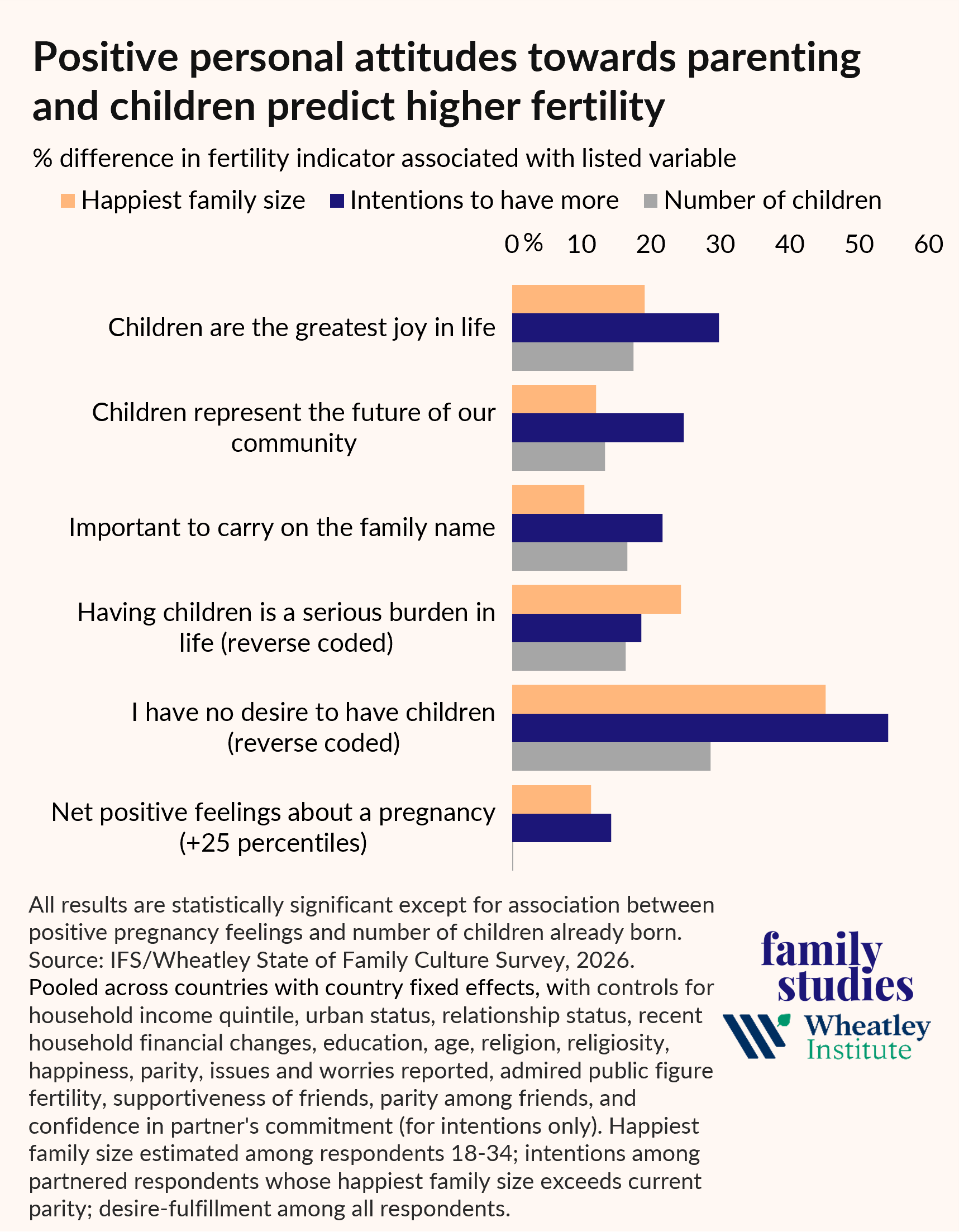
Figure 11. Percent difference predicted by personal attitudes towards fertility, for happiest family size among under-35 respondents, intentions to have more children among partnered respondents who desire more children, and family progress among all respondents, at mean of controls
In contrast, personal attitudes that indicate a positive viewpoint towards family life consistently have statistically significant positive associations with the desired number of children, the likelihood of intending to have another child, and the number of children already born.
Such beliefs are strongly associated with intentions among childless people: for example, the belief that having children is a serious burden in life is associated with a 19% reduced chance of intending a child and a 24% lower desired family size. This suggests that these beliefs affect the appeal of different life courses. Childless people are vastly more likely to say that having children is a major burden than parents, which may suggest that a lot of people discover that parenting is easier or more reinforcing than they expected after they have children. This gap in perceptions turns out to be very important, because among parents, a belief that parenting is a significant burden is associated with 9% lower intentions to have more kids, but for the childless, it is associated with an 18% decline. Childless young people's erroneous beliefs about the difficulty of parenting and the positive benefits of parenting may be shunting them away from desired parenthood.
Both within and across countries, people tend to want, intend, and have more children when they derive more joy from children, have positive feelings about becoming pregnant, do not view childrearing as burdensome, and see reflections of their own future in other people’s children.
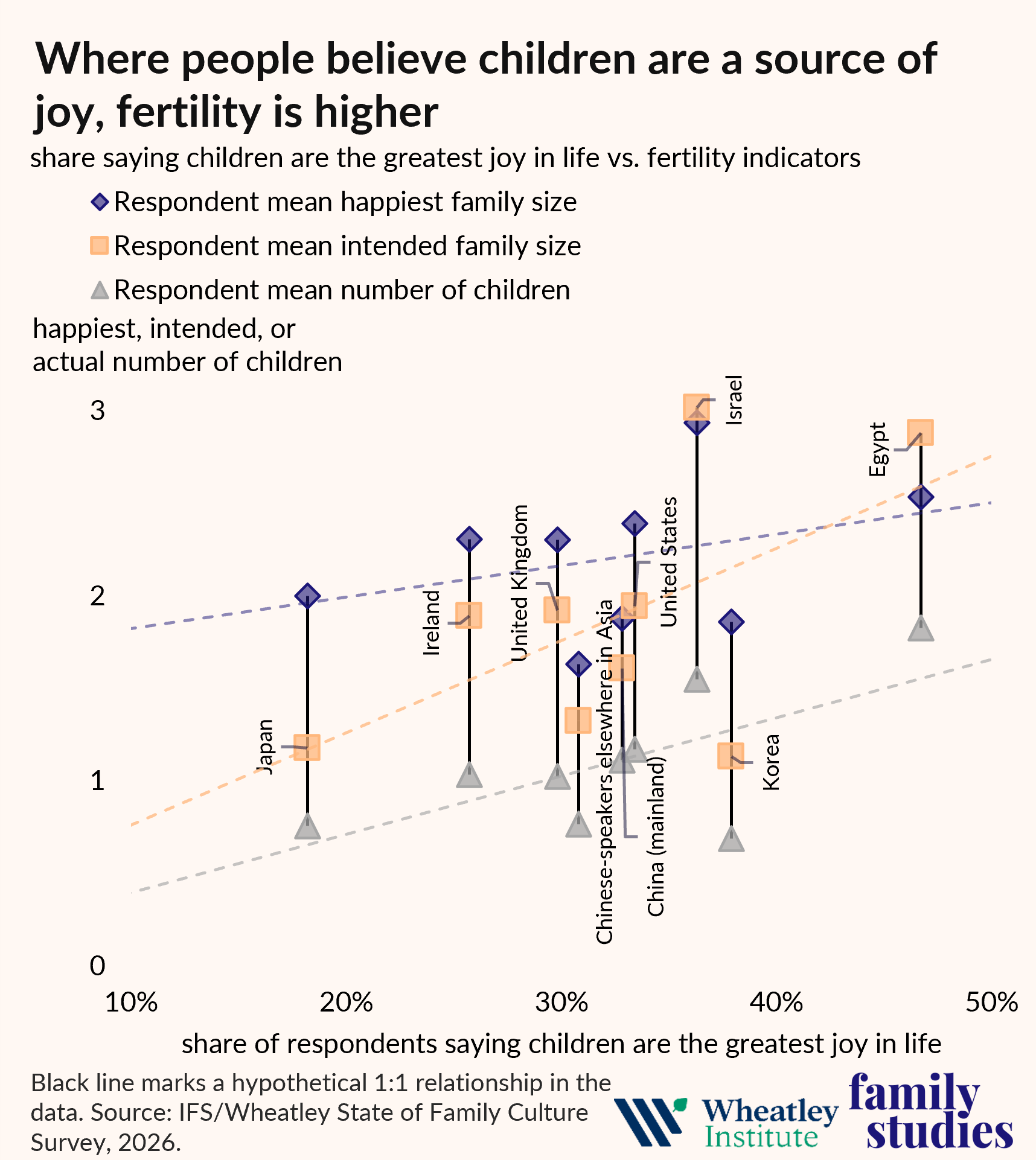
Figure 12. Share of respondents saying children are the greatest joy in life vs. happiest family size, intended family size, and mean number of children, by country sample
On the other hand, views about the general or abstracted social good of children are not as consistently associated with actual childbearing.
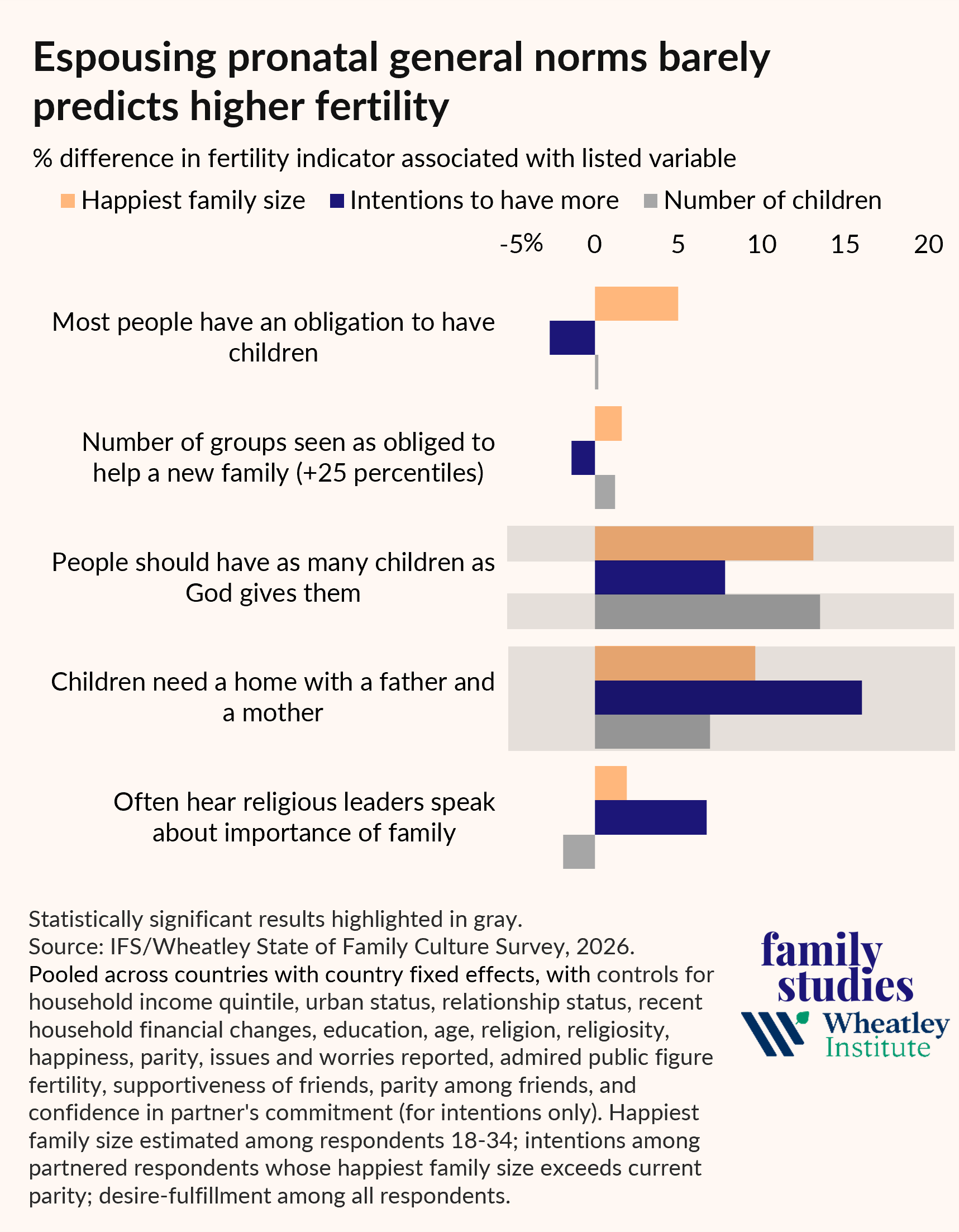
Figure 13. Percent difference predicted by belief in pronatal general norms, for happiest family size among under-35 respondents, intentions to have more children among partnered respondents who desire more children, and family progress among all respondents, at mean of controls
Overall, belief in strong general norms around pronatal culture does not seem to lead to higher fertility. There are also no meaningful cross-country correlations in most cases—societies where people feel obligated to have more kids do not actually have more kids, nor do people who believe in such an obligation actually fulfill it more often. Believing many groups in society owe parents help also does not predict higher fertility. Notably, the country where respondents are likeliest to say most people have an obligation to have children is mainland China, at about 16% of respondents—yet Chinese fertility is below 1 child per woman today. Of course, some general norms do have positive associations with fertility, such as the belief that people should have as many children as God gives them—but respondents who espouse that belief are, overwhelmingly, also very religious, and favorable-to-family religious attitudes likely explain the observed association, not the general norm.
Moreover, believing that people should have as many children as God gives them correlates with believing that children are the greatest joy, and therefore could also be explained through its link to personal values and attitudes, rather than the actual normative nature of the statement. For example, over half of those who believe people should have as many children as God gives them also believe children are the greatest joy, compared to under a third of those who do not believe people should have as many children as God gives them). As documented by Catherine Pakaluk in her book Hannah’s Children, religiously devout women frequently see children as a divine blessing and gift from God and, on that basis, as a source of great joy.
We can see other evidence that individual preferences are key drivers of fertility outcomes by looking at beliefs about various alternatives to family life. Beliefs that idealize alternative sources of meaning predict lower fertility across many indicators. Satisfaction from “pet parenting” (i.e., being a parent to a pet) and desire to protect leisure both have appreciably negative relationships with all fertility indicators. The idea that travel is a way to find yourself does not have such a negative associational effect (and for coupled individuals desire for travel in the form of “couple getaways” may actually positively correlate with fertility intentions); yet, nonetheless, it seems that “rivalrous values” with family may be important considerations.
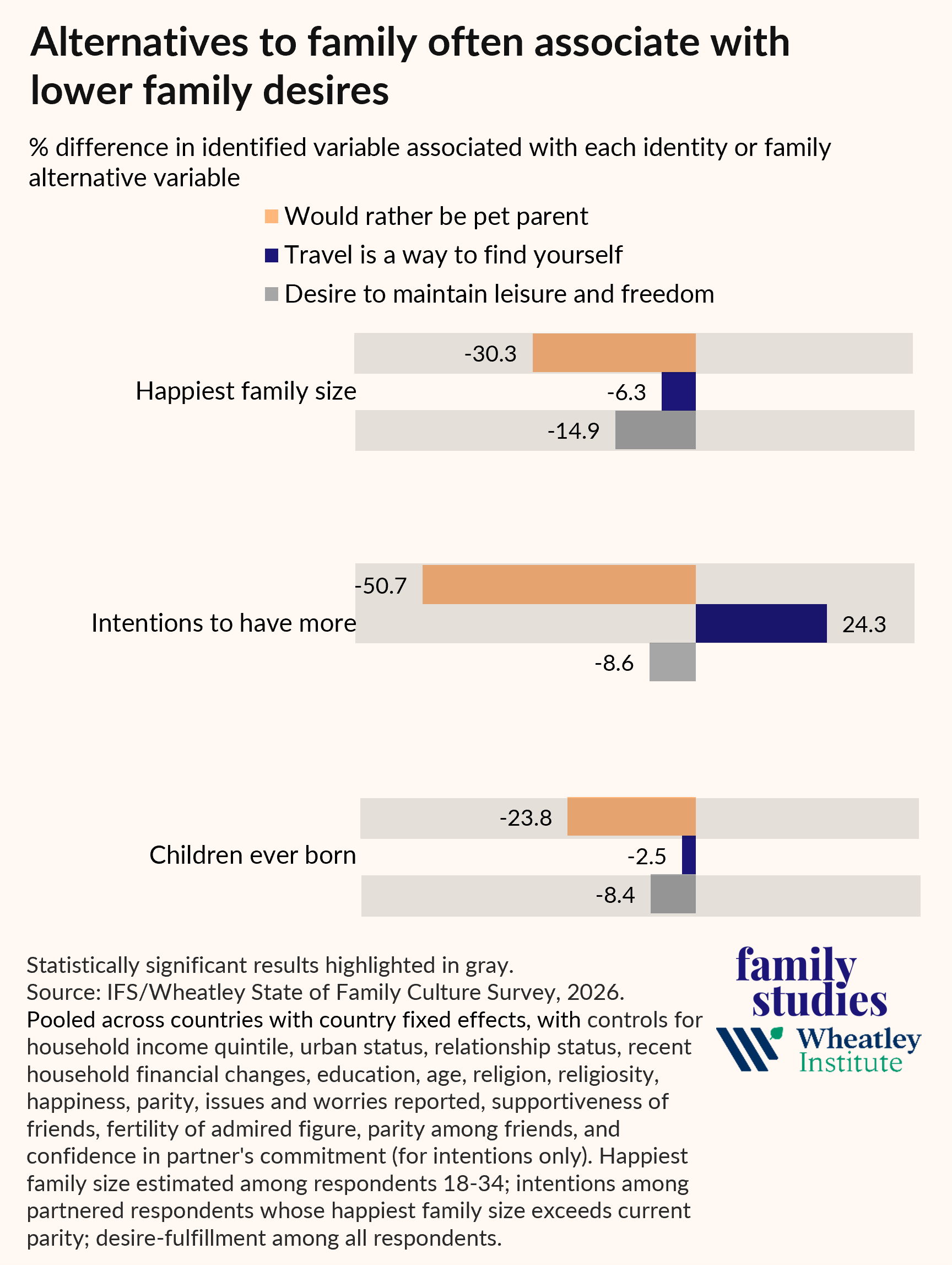
Figure 14. Percent difference predicted by endorsement of alternative lifestyle choice, for happiest family size among under-35 respondents, intentions to have more children among partnered respondents who desire more children, and family progress among all respondents, at mean of controls
Continuing the Family Name: Parental Encouragement to Reproduce

Young people around the world share the experience of their elders asking them, “When are you going to get married?” and “When will you have children?” And we find that the belief that it is important to carry on the family name (a hybrid value that can be construed as a personal value or a general norm) does predict more pronatal behaviors. Would-be grandparents may wonder if there’s even any point to asking—does badgering (or bribing) a child about their family formation accomplish anything?
In defense of meddlesome parents the world over, we find that, in general, when parents encourage their children to marry and give them grandchildren, the children do want more kids and intend to have more.
Parents encouraging their children to become parents is associated with an 11% higher average desired number of children and 30% higher likelihood of intending another child in our pooled sample. The association with the desired number of children is insignificant in many countries, but the association with intentions was robust across many of our samples. We also find that parental encouragement is associated with slightly higher odds in the respondent feeling like they were making progress towards their desired family life. It appears that parents nudging their kids into family life is a good thing.
Parental encouragement is negatively associated with having already become a parent and the number of children already had. However, this is probably an artifact of parental encouragement to have children declining as a result of having already responded to any such encouragement. Just as parents start to face more social pressures as they have kids, we find that respondent-reported parental encouragement to have (more) children declines as the respondent's family size grows—nearly 40% of childless respondents said their parents encourage them to have kids, compared to just 20% of those with four children. The pressure to produce grandchildren tends to abate once some grandchildren exist, and most would-be grandparents today themselves are from generations for which 2 or 3 children was the prevailing normative family size.
This association has only modest variation across countries (the confidence intervals always overlapped), so parental encouragement appears to have a cross-culturally shared association with fertility desires and intentions.
This finding has clear lessons for parents: providing explicit encouragement to have children very likely may influence whether or not a partnered adult child intends to give their parents a(nother) grandchild.
But what should that encouragement look like? Similar to our previous discussion, pronatal beliefs that reflect personal appreciation for children and family life predict fertility intentions, but general beliefs about the morality of having children tend not to do so. Therefore, parental encouragement that focuses on appeals to morality and obligation seem less likely to succeed, while grandparents emphasizing their willingness to help, the joy of parenthood in their own lives, and how parenthood can create a generationally shared experience, may be more effective. Would-be hopeful grandparents are better off telling their adult children how wonderful parenthood was in the early years and how excited they are to help with a grandchild, rather than emphasizing duty or simply nagging.
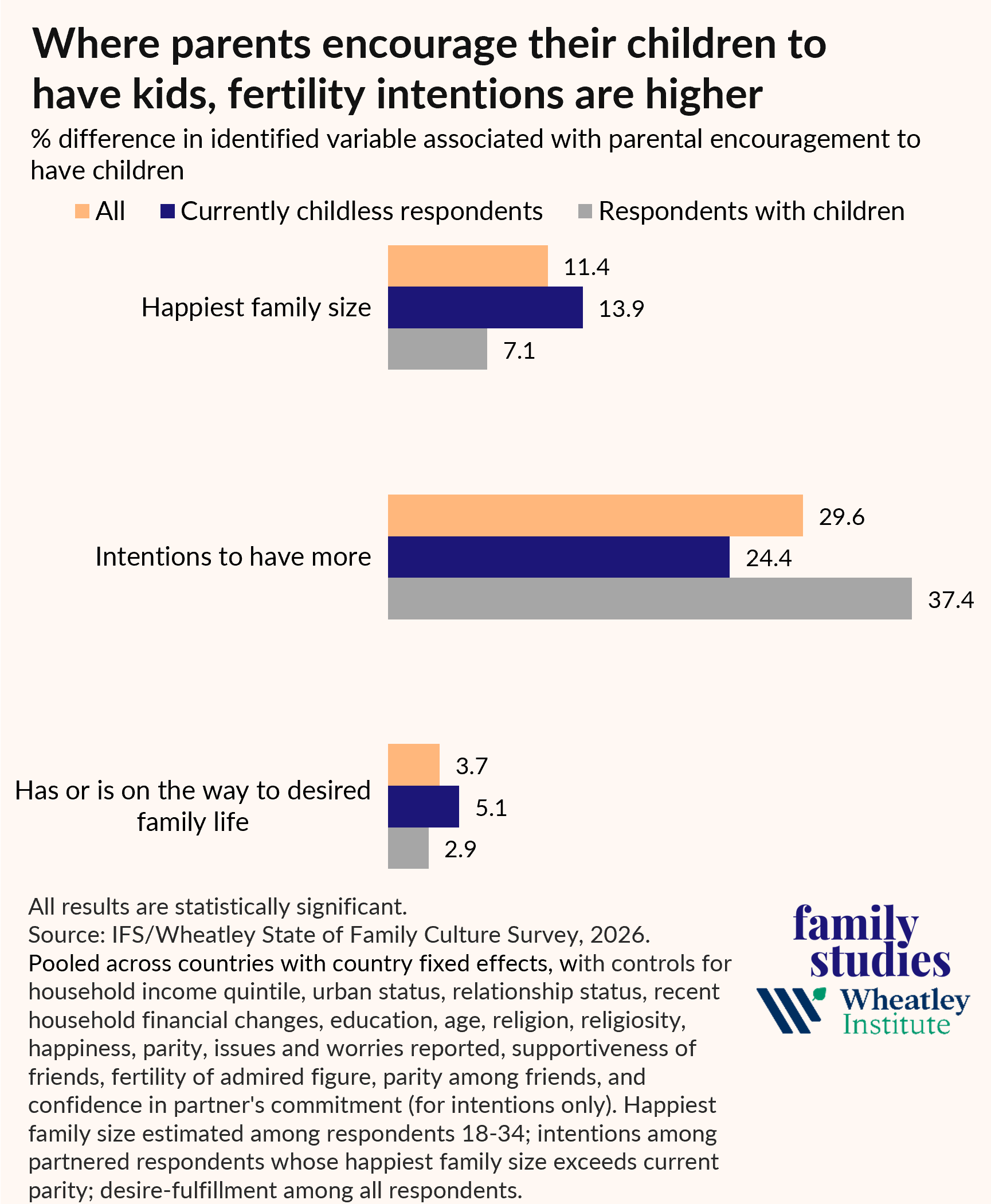
Figure 15. Percent difference predicted by parental encouragement to have children, for happiest family size among under-35 respondents, intentions to have more children among partnered respondents who desire more children, and family progress among all respondents, at mean of controls
Parents encouraging their children to get married also has large associations with important variables, predicting a 14% higher likelihood of intending a child amongst childless respondents who would like to have children. That estimate was limited to partnered children, suggesting that when parents encourage their cohabiting children to pursue formal marriage, it may also shift their childbearing intentions in a positive direction—nudging adult children towards marriage also tends to nudge them towards parenting.
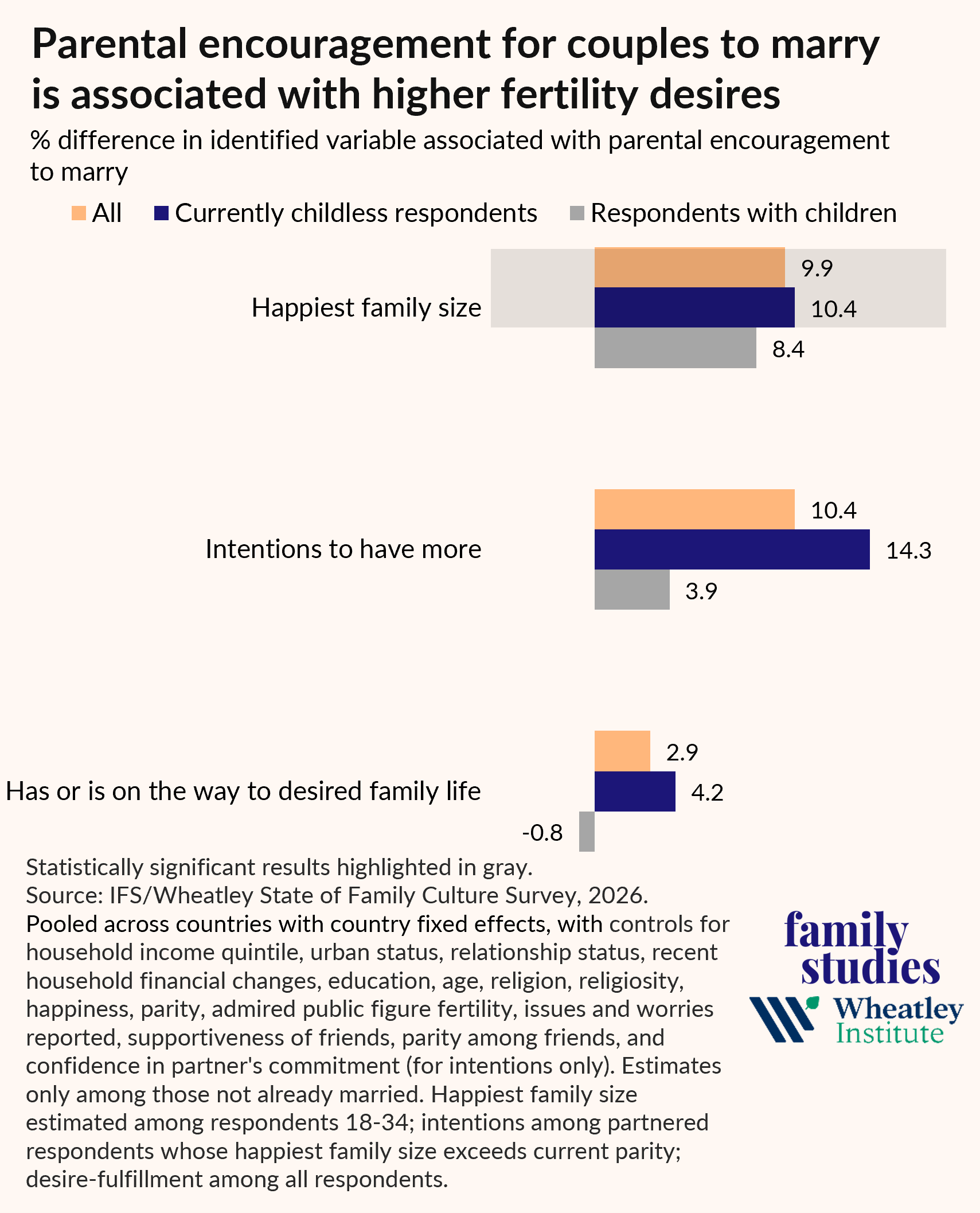
Figure 16. Percent difference predicted by parental encouragement to marry, for happiest family size among under-35 respondents, intentions to have more children among partnered respondents who desire more children, and family progress among all respondents, at mean of controls
Many factors influence the quality of relationship between a grown child and their parent, and every relationship has its own unique history. What kind of communication will be most influential is a question best answered by the individuals in question. However, our data suggest that parents longing for grandchildren from their grown children should not discount their own influence. Heaping burdens, obligations, or shame on one’s grown children may not accomplish much, but prospective grandparents who offer their children winsome encouragement or who emphasize the joy of parenthood have a good chance of getting down to the business of playing with their grandbaby sooner rather than later.
Getting Lucky? Risk Preferences and Fertility

If one theme seems to pervade almost all modern parenting discourse, it seems to be a rising tide of worry and anxiety about children’s futures. More parents today seem to carry heavy burdens of worry22F about the exact food their kids eat,23F the preschool they attend,24F small injuries,25F or extremely rare threats26F to personal safety.27F There is simply a lot of anxiety around modern parenting. Could it be28F that generalized risk tolerance and views of the future could be shaping family formation? We tested this possibility.
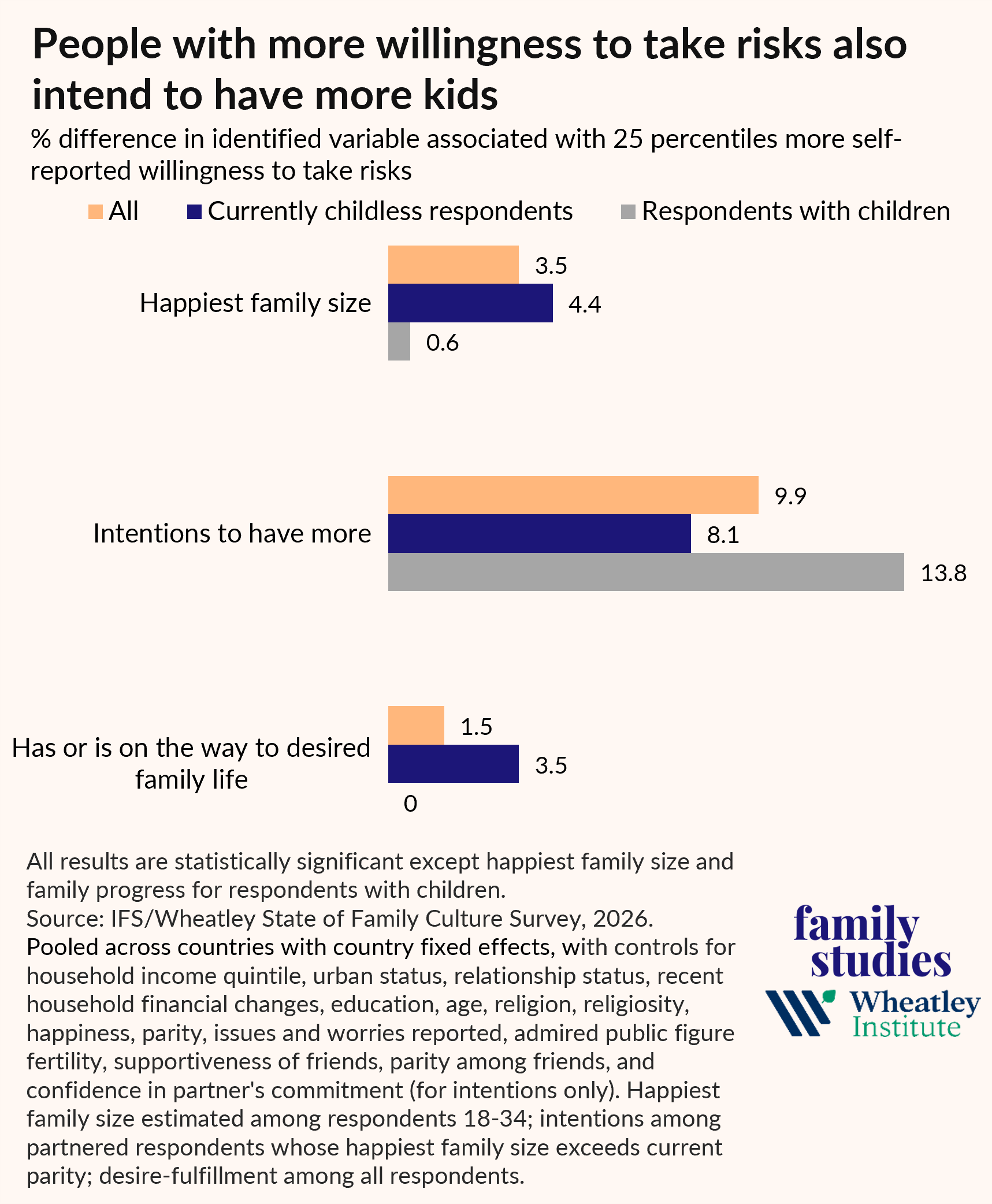
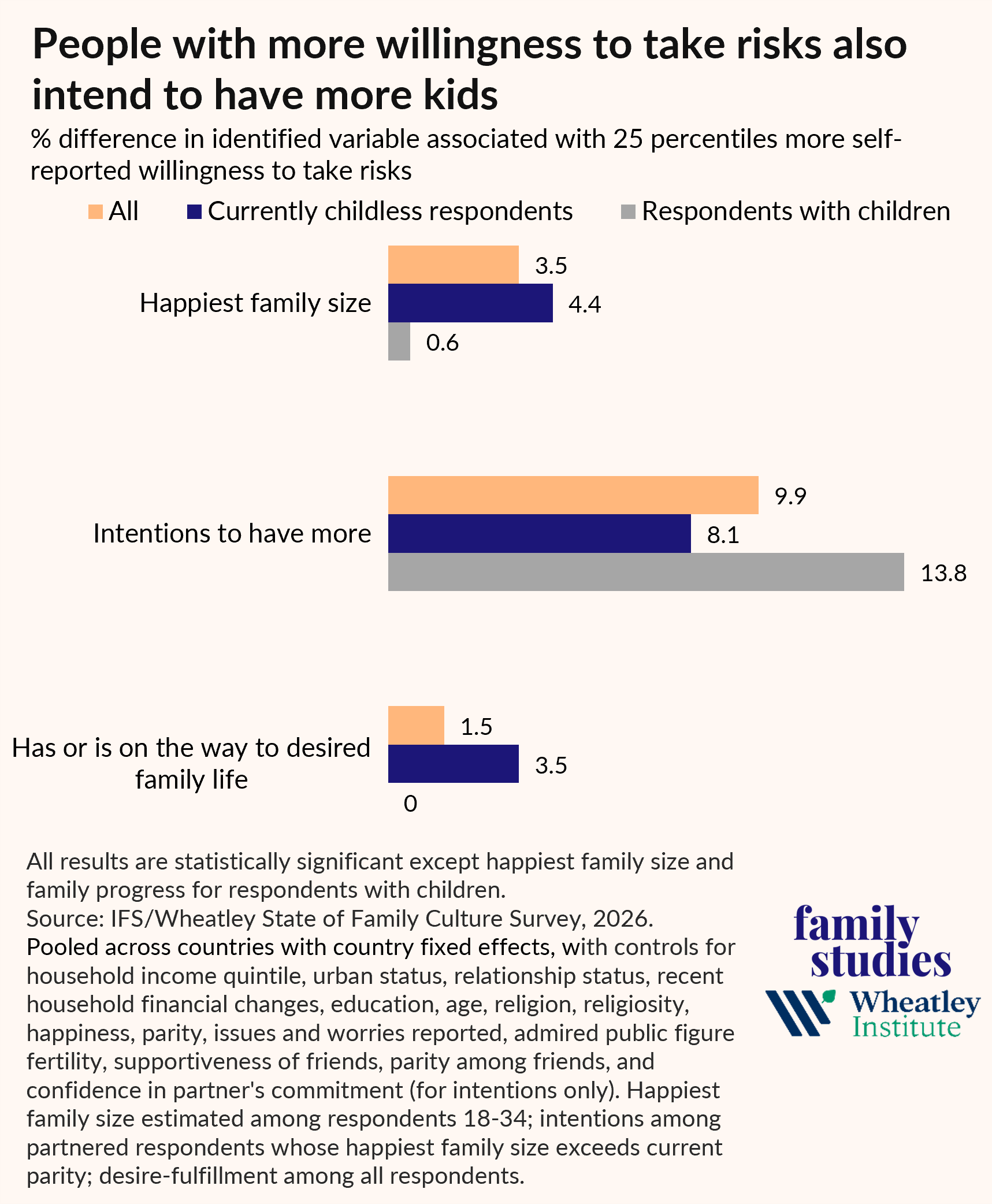
Figure 17. Percent difference predicted by 25 percentiles more self-reported willingness to take risks, for happiest family size among under-35 respondents, intentions to have more children among partnered respondents who desire more children, and family progress among all respondents, at mean of controls
Respondents’ self-rated willingness to take risks predicts higher family desires, higher intentions to have kids among couples who want kids, and more kids overall. On the other hand, caution, anxiety, and safety-ism seem to be a key limiting factor on fertility. This dynamic also held up across countries: respondents in low-fertility Japan and Korea rate their risk tolerance the lowest, while Americans and Egyptians report the greatest willingness to take risks. Across countries, more risk-tolerant societies have higher fertility desires, intentions, and outcomes.
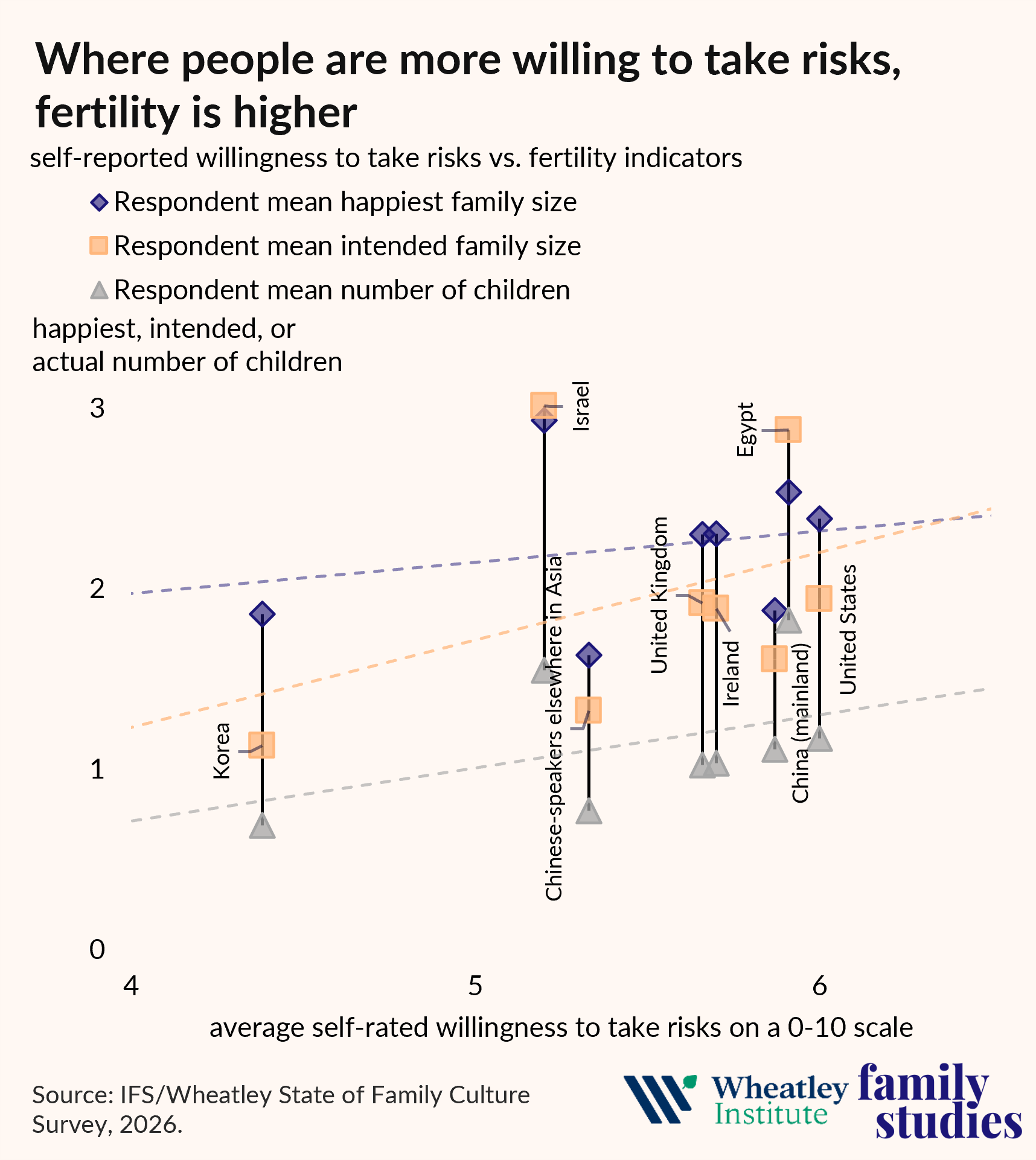
Figure 18. Average self-rated willingness to take risks vs. happiest family size, intended family size, and mean number of children, by country sample
These associations vary across countries. For example, within specific countries, the association between risk preference and fertility is positive in the pooled sample and within most countries, but not within Israel and Egypt. On the other hand, associations with ever becoming a parent are positive in almost all countries.
Other variables related to risk and uncertainty are also important. Individuals who report higher social trust both desire and intend to have more children, though there is little correlation across countries. Individuals who feel they had a clear idea of their future: desired more children, are likelier to be parents, and report that they are making more progress to their goals. Regardless of certainty about the future, respondents who believe their life is getting better have more positive fertility indicators across the board, and more optimistic societies (like Egypt) have higher fertility indicators than less optimistic societies (like Japan).
We suspect there is a simple primary culprit for widespread risk intolerance: social media. It has been widely demonstrated that social media and other elements of the digital revolution contribute to anxiety, worry about the state of the world, and social isolation. More broadly, the rollout of constant digital connection via smartphones has been clearly linked to falling coupling and fertility. We find some evidence in support of this dynamic: respondents who spend at least two hours on social media in a day have, on average, 5% lower desired family sizes.
Go Forth and Multiply: Religion and Family Formation
Religious people tend to have more children than the nonreligious—a fact we replicated in our survey. Being in the top third of respondents in religiosity is associated with having 9% more children than other respondents, with positive effects showing up in many countries. This is also associated with desire for more kids (+15%) and a higher likelihood of intending to have another child (+12%).
Across countries, religiosity is also strongly associated with fertility: going from the least religious countries in our sample (Japan and China) to the most (Egypt) added 1 child to intended total family size.
But what is it about religion that shapes fertility?
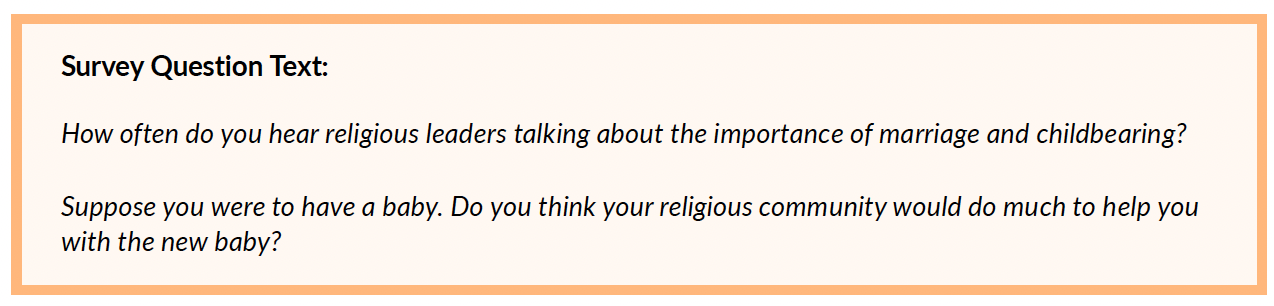
We tested whether religious people frequently hear religious leaders talk about family and the importance of having children. Across countries, we find that in places where religious people report having religious leaders who are more outspoken about having children, desired family size, intended family size, and current family size are all higher.
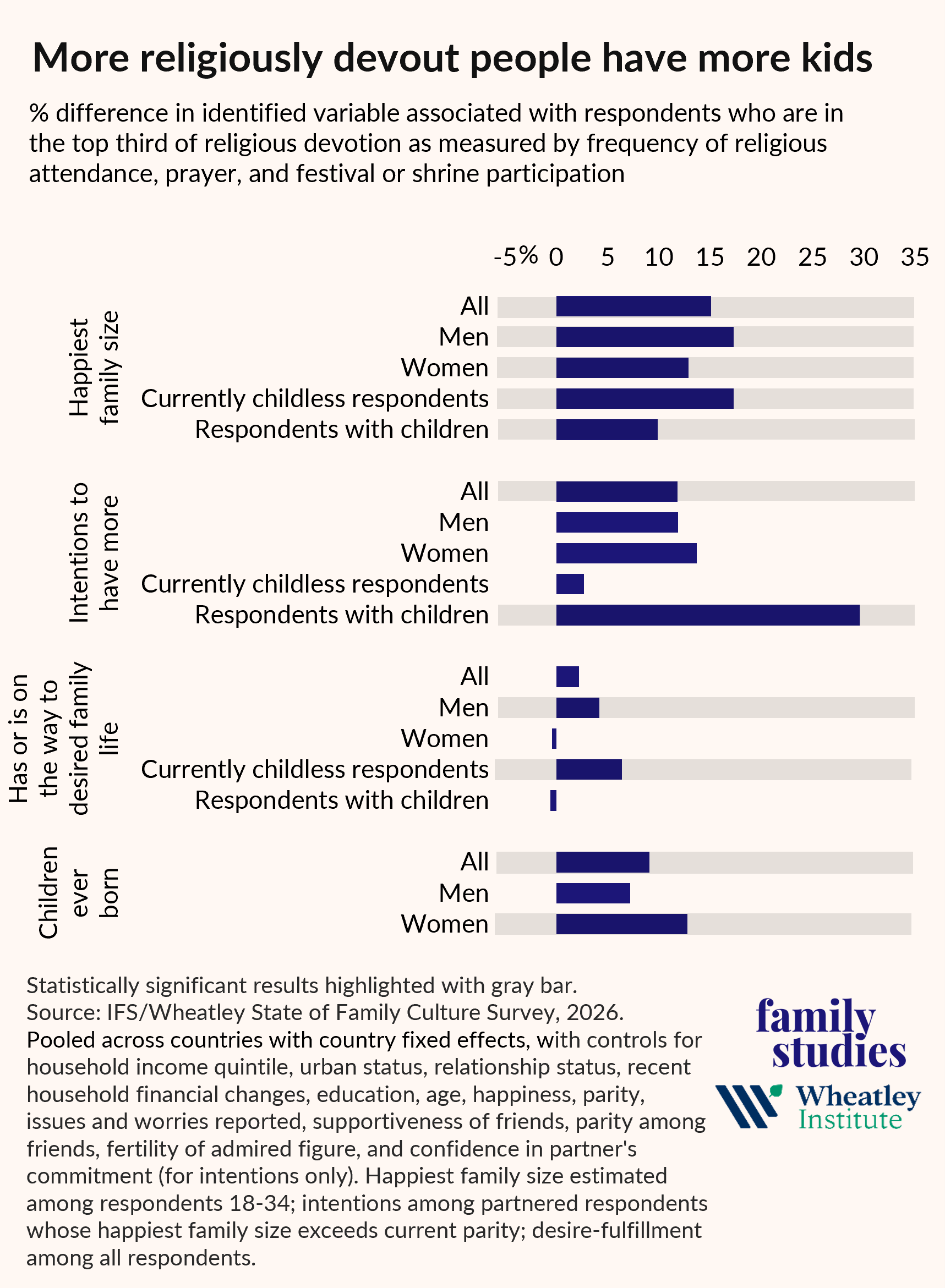
Figure 19. Percent difference predicted by having top-tercile religious activity, for happiest family size among under-35 respondents, intentions to have more children among partnered respondents who desire more children, family progress among all respondents, and children ever born, at mean of controls
Yet within countries, there is no significant association between religious leaders being more frequently outspoken on family and fertility and any actual fertility indicator. Religious leaders’ frequency of explicit exhortations is not associated with any detectable difference for any fertility indicator for any sample in any country.
This is surprising, since the academic research suggests that religious exhortation on family issues probably is effective at raising fertility. A likely explanation for this is that academic studies of this issue focus on elite religious leaders (Popes, patriarchs, etc.) who exert a kind of influence akin to that described in our celebrity results above. Moreover, we asked respondents about the frequency with which leaders talked about the importance of marriage and childbearing, but frequency may not be what matters. One highly persuasive sermon about family probably matters more than a constant drumbeat of obligation. And finally, the kinds of messages given by elite religious leaders may differ from those given by local religious leaders. It is possible that communication by local religious leaders could contain more obligation than inspiration or may be more focused on proclaiming general norms around family and less on communicating the beauty of family life.
When we asked religious people if their religious community would be helpful to them if they had a baby—a measure of alloparenting—we found positive effects in some model specifications, but not others. People who feel their religious communities will support their childbearing may desire bigger families on average (an association that was largest for women and childless respondents), but the association with helpful religious communities is surprisingly diffuse. That more supportive congregations do not predict larger effects surprised us.
However, as we showed at the beginning of this report, people in religious communities do expect more support from their friends. On our index of supportiveness among friends, individuals not attached to any religion average a score of 0.41, while religious people who expect no help from their congregation if they had a(nother) baby score a 0.32, and religious people who expect some help score a 0.76, while religious people who expect lots of help score a 1.09. While respondents may not expect formal help from their congregation, help from church members is clearly a big part of what respondents had in mind when they envisioned help from their friends. For many religious people, their fellow congregants are synonymous with friends, even if formal help from a shared institution may be modest.
Thus, while religious leaders promulgating pronatal norms may not always be very effective, religious communities that choose to support young families, create role models for joyful family life, inspire higher family aspirations, and motivate communities of mutual support among members, can be very effective at encouraging family formation.
Helping at Home: Domestic Responsibility and Fertility
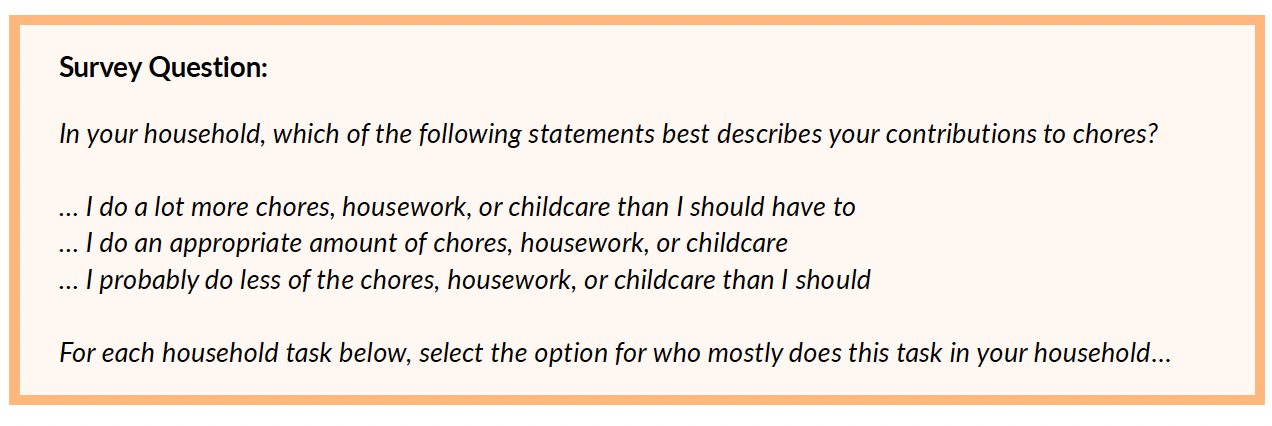
For several decades, scholars have argued that unequal chores and child care burdens might be causing women to forego children. In this telling, women obtaining workplace equality without domestic equality might rationally choose to invest in the life domain where they are better treated (careers) rather than a domain still mired in inequity (the home).
By asking respondents who in their family performed a range of household tasks, we were able to create indices to measure how much men help out at home. We also asked respondents whether they felt their housework duties were a fair share or not.
The results are counterintuitive: people who feel they are doing more than their fair share of housework have virtually no significant difference in desired family size, intentions to have more kids, or their progress to desired family life. Nor are there many cases where these variables matter in just a few countries—overwhelmingly, division of labor simply does not predict differences in specific countries. Men who feel overburdened at home have somewhat lower fertility intentions in some countries, but women do not, and there are no associations with fertility desires. Unsurprisingly, we find a positive correlation between the number of children women have and their likelihood of feeling they are doing more than their fair share of housework. But this does not seem to translate into any difference in other fertility indicators. It should be noted that countries where women feel more unfairly burdened by domestic work have higher birth rates. This is not shocking (higher birth rates could be a cause of feeling unfairly burdened if more births create more domestic responsibilities), but it cuts against the typical narrative circulated by some scholars. In our data, Egyptian, Irish, American, and British women feel more unfairly treated than the Chinese, Korean, and Japanese women who are so often the focal point of conversations about unreasonable care obligations or unhelpful husbands.
We also asked respondents who took care of their children on weeknights and on weekends, enabling us to get a general sense of child care obligations. And, again, there is little to no predictive effect on any indicator studied. There is a weak negative association across countries between men helping with child care more often and all three fertility indicators, such that societies where men help more with child care may indeed have slightly lower overall fertility, but otherwise there are few or no notable relationships.
When we assess a broader range of “female-typical” or “male-typical” chores, we likewise find no relationship of note: men and women adopting less differentiated chore sets is not associated with any differences in fertility at the individual level. However, at the more aggregated level—across countries rather than within them—women doing more chores (whether female- or male-typical) is associated with lower values for most fertility indicators. This is consistent with the idea that housework obligations may be a barrier to family formation; yet the countries with the highest reported chore frequency by women (China and South Korea) do not tend to see their chore loads as unfair. As we have argued elsewhere, the problem in Asia is not the division of labor but the amount of labor: workers are expected to log exceptionally long hours, even as prevailing cultural and economic norms impose a very high standard of housework while discouraging some domestic labor-saving technologies. The result is not necessarily an unfair or uneven burden of duties between couples, but rather an unbearable overall burden of duties upon families.
Contrary to popular narratives, unequal division of domestic labor does not appear to be a key factor shaping fertility in our sample. Other factors matter a great deal more. This does not mean families do not struggle with this issue, and more sophisticated versions of the theory may yet find some evidence to support them, but—at least in our sample—we find that the problem is much bigger than that which a couple can solve by adopting a better chore chart.
Conclusion: Cultural Lessons
Our survey asked respondents what kind of family would make them happiest. No doubt, their answers vary by how much thought respondents put into them, how much their answers really meant, and the reasons and motivations behind their answers. Yet, we still believe these desires should be taken seriously—just as a person’s vote should be taken seriously, even if it comes from mixed motivations or incomplete consideration. If we take our 10,000 respondents from a dozen countries seriously, a simple conclusion emerges: in every country we studied besides Israel, actual fertility rates are lower than respondents said would make them happiest (even in Egypt, where birth rates around 2.3-2.4 children per woman undershoot stated desires of 2.4-2.6). Thus, for pronatalists to help families around the globe achieve alignment between their family aspirations and their family outcomes, it is incumbent upon us to understand why this undershooting occurs.
This study has extended the work of exploring the kinds of cultural factors that shape fertility desires, intentions, and behaviors into new domains. While the gap between desired and actual family sizes has not been our primary analytic focus, ultimately, helping young people around the world close that gap is our goal.
Financial obstacles are not the only obstacles for a young person trying to obtain their family goals—cultural obstacles also exist. In this study, we highlight several areas in which cultural norms and practices may matter for fertility, and a few areas in which—against popular impressions—they may not. Our estimates for intentions intrinsically measure how certain variables are associated with young people’s perceptions of the feasibility of narrowing their personal fertility gap. Our estimates for “having achieved or being on the way to achieving desired family life” are explicit measures of how variables of interest relate to a central notion of global reproductive justice: individuals have a right to achieve their family goals.
Ultimately, social influences matter for young people trying to have families. Fertility intentions and desires are both significantly positively associated with affirmative attitudes toward parenthood, celebration of parenthood by friends, and parental encouragement to have children. Yet, they are not significantly associated with belief in a moral duty to have children, nor some measures of religious persuasion.
As such, a serious attempt to move ‘the culture’ in a pronatal direction (that is to say, to ensure that people experience a closer correspondence between their family aspirations and their family outcomes) should look to help young people recognize and understand the role children can play in leading flourishing, meaningful, and fun lives. Likewise, to the extent we hope for young people to see their childbearing as part of a collective project, that sense cannot be rooted in any notion of duty or obligation, but rather pride in shared contribution to the future of the community (sometimes including the national community, as in Israel’s case most especially), and even optimism about the future.
This means, in practice, that would-be pronatal cultural influencers must emphasize the potential of children to be the greatest joy in life, their compatibility with other good parts of life, and how voluntary and chosen parenting can be a valuable part of building the future of your community. It means fostering celebration of parenthood across a wide range of life circumstances, regardless of the parity of birth. Ultimately, the most potent pronatalism today involves inspiring young people to see how meaningful and pleasant parenting can be, helping them overcome anxieties about risks, ensuring they feel their choices will be met approvingly by peers, and helping older relatives find productive ways to initiate conversations about continuing the family.
For that purpose, here we provide some suggestions for various social actors who wish to play a part in creating a more supportive and pro-family environment. These suggestions are just that—suggestions, made with the understanding that every social relationship is somewhat unique, and thus, not all our suggestions apply to all or even most social ties.
Takeaways for Hopeful Prospective Grandparents
-
Talk to your adult children about the joys of early parenthood and offer to help them, such as by offering to watch the baby or to provide financial assistance. This will go a lot further in encouraging fertility than imposing obligations or communicating that they “owe” you grandchildren.
-
For cohabiting adult children, gently encourage consideration of marriage and express support and admiration for a potential spouse.
-
For adult children who already have kids, think twice before expressing discouragement against having more. The sentiments which, to you, may seem like wise caution, to your child may sound like you piling on with a society already pressuring them not to have more kids. Young people starting families today already hear from plenty of sources about how unwise it is to have too many kids; they are unlikely to benefit from hearing it from a parent.
Takeaways for Friends Who Want to Be Supportive
-
Be proactive in inviting your childless friends into your life, so that they can observe that, though sometimes exhausting, parenting is also a source of joy far more than it is a source of anxiety and heavy burdens. Explicitly communicating this outlook is likely important.
-
Lend emotional and instrumental support. Across all partnered respondents who wanted more kids, believing friends would celebrate the new baby is associated with a 21% higher likelihood of intending another child. Likewise, disapproval from friends has a large negative association with likelihood of intending another child (-22%), so friends hoping to provide a supportive environment may be well advised to tread carefully around the concerns they raise to friends considering having another child. Remarks that imply disapproval, such as on the number of children already born, may be heard more negatively than the speaker intends. On the other hand, excited and encouraging remarks may help your friends feel empowered to pursue the families they personally desire.
Takeaways for Religious Leaders and Communities
-
Preach positive messages about family life and children, such as that children are a beautiful contribution to a positive, shared future. Religious leaders hoping to cultivate pro-family sentiments among their flocks may wish to consider the results on what kind of norms and attitudes predict individual actions: beliefs about what people should be doing are not associated with likelihood to intend to have a child, but positive attitudes towards having children are.
-
Recognize and reinforce whatever supportive family norms already exist. Pronatal norms often already exist in religious communities, as our evidence shows. The most religiously devout third of our respondents were far more likely than the least religious respondents to report that their friends would celebrate a new baby, suggesting that most religious communities already have latent pronatal norms.
-
Facilitate supportive outreach and ministries for having more children or that make it easier to have them. Most religious communities already have one mechanism or another to support new families: parties, baby showers, meal trains, etc. Religious leaders can facilitate these, such as by ensuring there are sign-up sheets widely available, proactively approaching expecting families about signing up to receive help, and encouraging members of all ages to sign up as helpers, babysitters, or meal train providers. Churches can run adopt-a-grandparent programs, or adopt-a-grandchild programs, or even help link young families to retirees with spare housing space, who might appreciate having young people in their home and some extra rent.
Takeaways for Policymakers
-
Focus fertility policy on making family life pleasant and joyful. Most modern people do not respond to “have one for the country”-type arguments; appeals to obligation and duty are unlikely to succeed. Rather, policy must focus on ensuring that it does its bit to ensure that couples feel meaningfully supported in having a family, and that they feel they have opportunities to enjoy a good life with their families.
-
Cultural messaging should emphasize the joy of children, pointing to whatever programs of support already exist, and reinforcing that parents are making admirable contributions to the country’s future by raising children.
-
Regulators could consider the role played by algorithmic social media. Negative portrayals of family life likely have serious adverse consequences on young people's family lives. Whether social media companies may choose to voluntarily consider how their algorithms propagate content that threatens young people's mental health and future family lives, or whether policymakers should choose to directly regulate this content, is an open question, but one worthy of reflection.
-
Promote policies that protect human togetherness and carve out space for in-person social relationships. Federal holiday expansions, “Blue laws” restricting certain weekend businesses, “digital blue laws,” improvements to public parks, strict policing of public disorder in public spaces that discourages their use by families—these are all likely important parts of restoring healthy public life.
-
Take the fear of downside risk, which is clearly an important factor for people’s fertility choices, seriously and help young people hedge those risks. For example, more generous unemployment insurance coverage has been academically demonstrated to reduce divorce. Allowing families in low-performing schools access to voucher-based school choice is also an important hedge against risk. Our previously-advanced American Birthday Account program would provide families with an immediate nest egg for a new child, limiting fears about under-saving for their future.
-
Policymakers should focus on increasing the joy of parenting rather than simply offsetting some costs. Airports should have large, well-equipped, high-quality playgrounds or “family lounges.” Parks and recreation-sponsored “date night child care” may not work everywhere but is the right general idea. Prenatal care should include referrals to centralized registries and matching systems helping expecting parents find other expecting parents with similar-age children and other similar traits; prenatal care should also include a designated process to help expecting parents pre-plan who they would like to visit them in the hospital and who they would like to ask for help with their new baby.
- Promote remote work and on-site child care. Additionally, governments and companies should take seriously the evidence that remote work can boost birth rates and employee satisfaction, but also worsens promotion potential and mental health for single, childless workers. Restructuring remote work as an explicit “benefit for family,” similar to parental leave, may be the best choice for parents and non-parents alike. Likewise, setting aside some child care subsidies specifically for “on-site day cares” for large employers, enabling working parents to visit their children freely throughout the day, is a way of transforming child care from a “warehousing children” model to a model more like traditional alloparenting.
Editor's Note: For methodology, references, and more, please download the full report below.


