
Highlights
The American family with young children is changing rapidly with respect to the relative educational attainment—and potential earning power—of mothers and fathers. Just how much things have changed can be seen by looking at parental education entries on the birth certificates of a recent cohort of American newborns, namely, babies born in the United States in 2023.1
Based on the birth certificates of the 3.1 million children that contain this information,2 I sorted those attainments into eight categories ranging from 8th grade education or less, up to doctoral or professional degrees.3
Comparing the attainments of newborns’ mothers with those of their fathers, I found that:
- 44% of newborns have mothers and fathers with equal educational attainment,
- 36% have mothers with more education than their fathers, and
- 20% have fathers with more education than their mothers.
This means that 80% of newborns will grow up in families where Mom has as much as or more education than Dad. This is quite a contrast with families of the past where men were the more educated breadwinners.
As shown in the figure below, there are more newborns who have mothers with bachelor’s degrees as their highest credential than infants who have fathers with the same highest degrees. There are also more newborns with mothers who have master’s degrees than infants with fathers with a master’s degree. And there are now equal proportions of newborns—3.5% —who have mothers with doctoral or professional degrees as have fathers with such degrees.
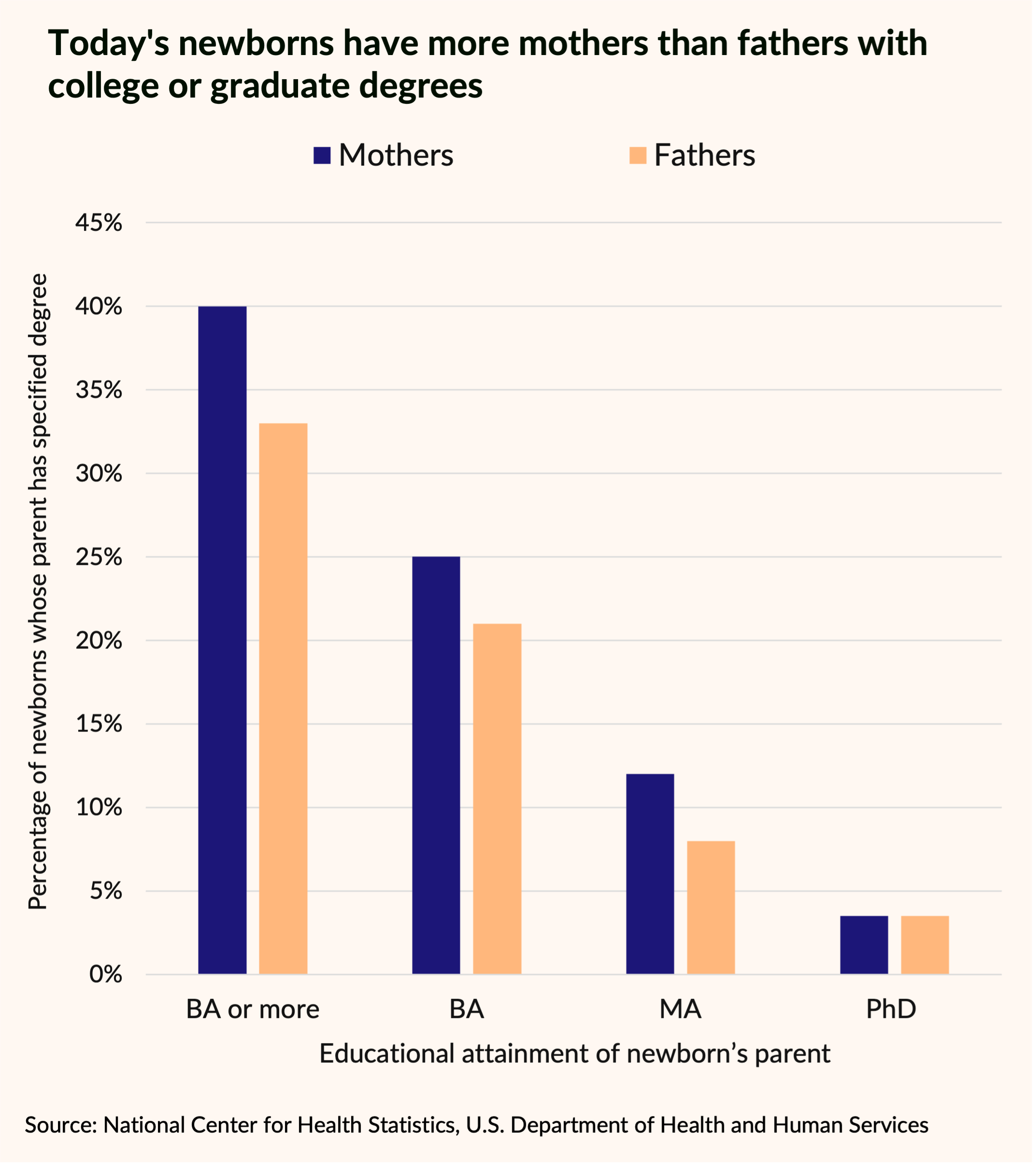
Note that comparing the respective levels of educational credentials without looking at the specific subjects in which those degrees were awarded underestimates the economic advantages of male wage earners today. This is due to men outnumbering women in degrees in the physical sciences, mathematics, computer science, and engineering. These are fields with higher earning power, on average, than most of the fields in which women tend to dominate. Also, men with high school diplomas and relevant work experience may make as much or more in trades like welding than women with bachelor’s or master’s degrees make in fields like social work. For example, social workers earn a median annual wage of $61,330, while, for welders, the median wage is $51,000. But welders with extensive experience or specialized skills can earn as much as $65,000 to $100,000 per year.
Increasing maternal education is a positive development for children. Having a college-educated mother benefits a child in terms of family stability, freedom from want, and academic achievement, as I argued in a previous IFS blog post. But the surge in diplomas also further magnifies the economic and class divide and the many advantages enjoyed by children who grow up with married parents versus those who do not.
Nicholas Zill is a research psychologist and Senior Fellow of the Institute for Family Studies. He directed the National Survey of Children. He previously served as the first project director of the Head Start Family and Child Experiences Survey, and he is the founder of the organization, Child Trends.
Editor's Note: The opinions expressed in this article are those of the author and do not necessarily represent the views, policies, or positions of the Institute for Family Studies.
*Photo credit: Shutterstock
1. The results reported herein are based on the author’s analysis of public use files on Births, U.S., 2023 obtained from the National Center for Health Statistics, U.S. Department of Health and Human Services.
2. Birth certificates with educational attainment information on both parents made up 86.6% of the total of 3.6 million birth records for 2023. 13.1% were missing educational information for fathers, 1.8% missing for mothers, with 1.5% missing for both parents. Missing information was more common at the lower end of the educational attainment continuum than at the upper end. For example, there was 28% missing information on father’s attainment for mothers who were high school dropouts versus 2% missing for mothers who had master’s degrees. This means the statistical picture drawn here is biased toward better educated, intact families.
3. The categories were 8th grade or less, 9th through 12th grade with no diploma, high school graduate or G.E.D., some college credit, associate’s degree, bachelor’s degree, master’s degree, and doctoral or professional degree.


