Highlights
Last week, I discussed the rise of materialism among teens and young adults and how over-prioritization of money, possessions, and careers is playing an underappreciated role in disrupting family formation today. This week, I extend that discussion by addressing two ways that research has shown that materialism harms marriages and, most importantly, what can couples do to safeguard their marriage from these harms.
Most people assume that financial problems in marriage are simply an income problem. The basic belief is that if a couple has a lot of money, they won’t have financial problems, and if they don’t earn a lot of money, they will have financial problems. This is the core assumption of those who endorse materialism as a practical fix to the economic realities of modern life—you just need to make more money!
However, research has consistently challenged this assumption. This is because materialism harms marriages in two distinct ways—one obvious, one far less so—and understanding both is essential for any couple or family navigating the financial realities of modern life.
The Spending Problem
First, the most obvious way that materialistic attitudes can have a negative impact on marriage and family relationships is because spouses who give a high priority to money and the accumulation of material possessions are more likely to create “real money problems” by over-spending and not living within their means. This pursuit of possessions is amplified by the misuse of credit cards and other forms of lending that lead to stressful debt, financial strain, and conflict between spouses.
The Perception Problem
The second and less obvious way materialism harms marriages operates below the surface. Materialism quietly resets the perception threshold for what a spouse considers to be a financial problem in the first place. Simply put, the more you expect, the easier it is to feel distressed by financial limitations. Materialistic spouses carry a heightened sensitivity to financial matters that lowers the bar for what gets defined as a problem. For a highly materialistic spouse or couple, it takes less financial disturbance to trigger distress and dissatisfaction. This increased sensitivity then raises the stakes, making financial problems more likely to spill over into broader marital dissatisfaction.
In a study my colleagues and I conducted with a nationally representative sample of 600 married couples, we found that about one-third of spouses can be classified as highly materialistic—and those spouses were approximately 40% more likely than their non-materialistic counterparts to frequently experience finances as a problem in their relationship. Nearly half of highly-materialistic spouses reported that financial matters were "often" or "very often" a source of trouble, compared to roughly one-third of low-materialistic spouses. And most striking of all, materialism proved to be a stronger predictor of perceived financial problems than the couple's actual income level.
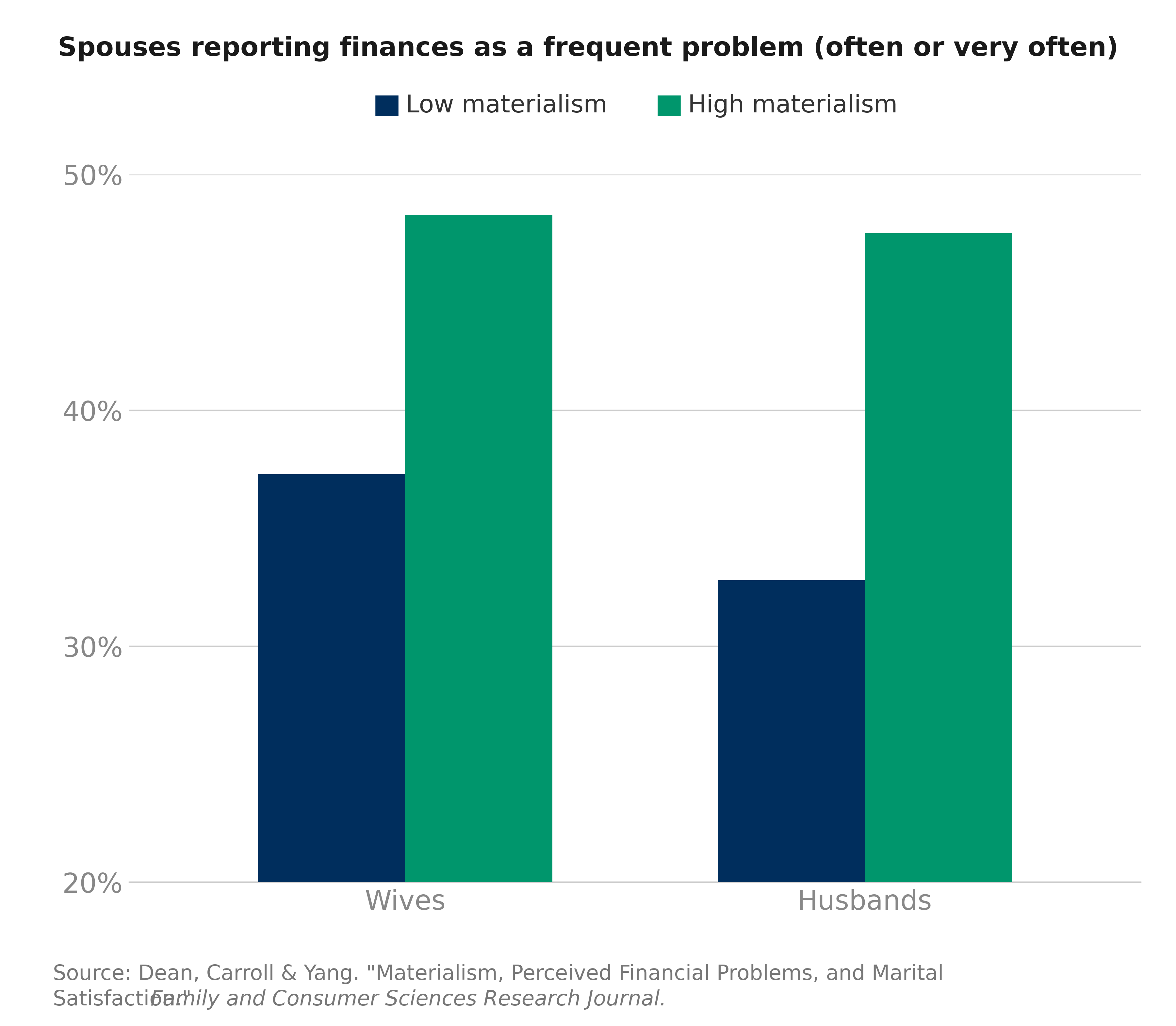
Let me say that again: materialism has a more profound impact on the perception of financial problems than income. The threshold for what counts as a financial problem in a marriage is not set by the bank account—it is set by the mindset. As family finance expert Dr. Bernard Poduska has observed, “financial problems are frequently behavior and attitude problems rather than money problems.”
The practical implication here is that we need to stop assuming that all couples experience financial matters the same way. Couples who habitually compare themselves to those who have more are likely to feel a chronic sense of entitlement and resentment that contributes directly to marital conflict. Couples who can view their situation through the eyes of those who have less are far more likely to cultivate the contentment and gratitude that research consistently links to stronger marriages.
Financial prudence is not just good money management—it is an act of care for the relationship itself.
So, helping couples lower their financial expectations benefits marriages in two concrete ways—1) spouses become more willing to avoid the debt-creating purchases that generate ongoing stress, and 2) they become more inclined to interpret their current financial situation with positive appraisal rather than chronic dissatisfaction. If a couple is already experiencing financial strain, scaling back expectations is often the most important first step toward regaining both financial stability and relationship peace.
Joint Materialism Is Still Harmful
One natural follow-up question is whether the harm materialism causes in marriage is really just about conflict between partners who have different financial values. Is this just a problem for couples where one spouse is a spender and the other is a saver? Does shared materialism smooth things over?
In a follow-up study, my colleagues and I looked at this relationship dynamic. Using a national sample of over 1,700 married couples, we created a 2x2 typology of couple materialism that distinguished couples where 1) both spouses were low in materialism (congruently nonmaterialistic); 2) couples where both were high in materialism (congruently materialistic); and 3) two incongruent groups where spouses differed (husband high/wife low, and wife high/husband low).
We found that couples where both spouses reported low materialism were better off on every measured dimension of marriage quality—including better communication, more effective conflict resolution, less problem areas, higher relationship satisfaction, and greater relationship stability. Congruently materialistic couples, by contrast, consistently reported the most problematic patterns and the fewest positive outcomes across every measure we looked at. Incongruent couples—those where one spouse was materialistic and the other was not—fell in between. What this tells us is that each additional materialistic spouse in a marriage compounds the harmful effect of materialistic attitudes. It doesn't seem to matter which spouse is the materialistic one—what matters is how many materialistic spouses there are in the marriage.
It is important to note that just like our previous study, materialistic couples with higher income levels still fared worse on relationship quality than non-materialistic couples with lower income levels. This is perhaps the most important finding of the study for couples to hear—a high level of financial resources does not protect a marriage from the corrosive effects of materialistic values. When we examined the character traits of the spouses, highly-materialistic spouses reported lower levels of other-centeredness and reduced emotional maturity, and placed a lower level of importance on their marriage compared to other pursuits.
In a more recent study, we again found that materialism was negatively associated with how important people perceived their marriage to be. And that diminished sense of marriage importance, in turn, predicted lower marital satisfaction. Materialism harms marriages, not because partners disagree about money—but because of what placing money at the center of a relationship does to a marriage. Joint materialism is not a shared value that bonds partners. It is a shared liability.
Joint materialism is not a shared value that bonds partners. It is a shared liability.
Our research also revealed something sobering about the prevalence of the problem. In our study, 1 in 5 married couples (20%) consisted of two partners who both self-identified as highly materialistic—and because congruently materialistic couples were significantly younger than their nonmaterialistic counterparts, these patterns are likely to become more pronounced as today's younger, more materialistic generation moves into their prime marriage years.
What Couples Can Do
Research on materialism and marriage doesn't just diagnose the problem—it also points toward solutions. Drawing on findings from these and other studies, five recommendations emerge as particularly important for couples navigating the current financial environment.
1. Live Within Your Means Together
Materialistic values frequently drive overspending and debt, which in turn creates the real financial strain that damages marriages. Couples who build and follow a shared budget, approach debt cautiously, and maintain financial reserves avoid one of the most potent and recurring sources of marital conflict. Financial prudence is not just good money management—it is an act of care for the relationship itself.
2. Distinguish Needs from Wants
One of the most important things a couple can do is sit down together and honestly examine their spending through the lens of necessity versus desire. Consumer culture is extraordinarily effective at blurring this line—as the saying goes, “yesterday’s luxuries have become today’s necessities.” This doesn't require asceticism, but it does require patience and intentionality. Couples who regularly revisit this distinction together are better positioned to make spending decisions that reflect true family needs, rather than cultural pressure.
3. Beware of Financial Comparisons
A recurring theme in the research is that materialistic spouses are more likely to evaluate their financial situation by comparing upward—measuring themselves against people who have more. This creates a persistent perception of deprivation even in the absence of genuine scarcity. This approach to life generates a sense of entitlement and resentment that can infect their relationship. Couples who habitually look downward—considering how fortunate they are relative to those with less—are more likely to cultivate gratitude and contentment, both of which are strongly linked to marital satisfaction.
4. Resist the Capstone Mentality
For younger couples and those approaching marriage, be careful about getting caught in the trap of believing that marriage and parenting should wait until every financial milestone has been achieved. Completing every educational goal, reaching a certain income, owning a home—when these become prerequisites rather than shared aspirations, they can delay or prevent marriages that might otherwise thrive. Couples willing to build a life together rather than waiting until that life is already built often find that doing so strengthens rather than strains their relationship.
5. Put the Marriage Before the Money
While all families must pay attention to the financial realities of life, couples should regularly and intentionally invest in the marriage itself—through time together, expressions of appreciation, and protecting relationship rituals—rather than allowing the pursuit of financial goals to crowd out the relationship. Couples under financial strain often report that they stop appreciating the dimensions of their relationship that money can’t buy—conversation, laughter, shared purpose, physical touch, trust. Deliberately investing in simple, inexpensive relationship rituals, such as regular connection, daily expressions of affection, and a weekly date, tends to reinforce the sense that the relationship itself is the most valuable thing the couple has.
Economic pressures are real, and they do matter. But the answer to financial stress in marriage is not always more money. Sometimes, it is a different relationship with money altogether—one grounded in realistic expectations, delayed gratification, gratitude, shared purpose, and the recognition that the most important things in life can’t be bought.
Jason S. Carroll, Ph.D. is the Director of the Marriage and Family Initiative at the Wheatley Institute at Brigham Young University. He is also a Senior Fellow at the Institute for Family Studies. Dr. Carroll is a past recipient of the Berscheid-Hatfield Award for Distinguished Scientific Achievement given by the International Association for Relationship Research.
*Photo credit: Shutterstock