
Highlights
- There is no one singular cause of the plight facing young men. But one of the biggest culprits is the proliferation of online gaming and gambling. Post This
- Baked into the operating systems of online gaming platforms today are gambling and gambling-adjacent features that prime the underdeveloped brain for addictive habits. Post This
It is no secret that young men today are struggling. Thought leaders on both the left and right have written extensively on the crisis plaguing boys in an attempt to educate the public and provoke change in society. IFS’s own research confirms that widespread demoralization among Gen Z men persists.
In a therapeutic culture such as ours, it is tempting to try to fix the problem from the top down. By prescribing anti-depressants, ADHD meds, shaming men for addictions, or simply telling men to “man up,” we run the risk of failing to understand the root causes and therefore allowing the next generation of young boys to continue suffering the same fate as their slightly older peers. As a mother to two Gen Alpha boys, analyzing the societal trend lines can be disheartening, to say the least. A generation of boys who are more interested in growing up to be YouTubers rather than astronauts is proving to be a recipe gone wrong.
Certainly, as in most things in life, there is no one singular cause of the plight facing males. But one of the biggest culprits is the proliferation of addictive screen media marketed toward boys, specifically online gaming and gambling.
A generation of boys who are more interested in growing up to be YouTubers rather than astronauts is proving to be a recipe gone wrong.
A New Epidemic?
Melanie Hempe, founder of ScreenStrong and mother to three young adult men, has referred to the cohort of young men struggling today as the “Basement Generation.” Hempe recently told me that “parents of preschoolers need to be educated on the dangers facing boys today. We must start early.”
As young girls have spent ever increasing time scrolling social media feeds, boys have retreated to playing online video games in basements, virtually connected to friends, as well as strangers who care little about their well-being. Baked into the operating systems of online gaming platforms today are gambling and gambling-adjacent features that prime the underdeveloped brain for addictive habits.
Michelle Dirst, Associate Executive Director for the American Academy of Addiction Psychiatry (AAAP), says that youth gaming and online gambling, especially mixed with AI, leaves her very concerned. “There are red flags that this could look like the scale of opioid addiction,” Dirst told me, noting that tens of millions of people have been impacted by the opioid epidemic.
Although overdose deaths are not at play with gambling, suicide is. Dirst explained that of all addictions, gambling is most associated with suicide though anxiety, depression, and substance use. Financial problems are also of concern.
Days after speaking with me, her worries were echoed by former Surgeon General Jerome Adams writing on X,
Sports betting is the new opioid crisis. Our kids—especially our boys—are getting exposed and hooked early.
Despite decades of data on gambling, almost all the research is focused on adults, and for good reason. Prior to online gaming and sports betting apps, you were required to show an ID to buy a lottery ticket or enter a casino. As Dirst pointed out, youth gambling is a relatively “new problem, but we are already in the middle of it,” thanks to the ubiquitous smartphone and social pressures placed on young boys to become gamers.
Roblox, a game with over 120 million daily active users, many under the age of 12, even boasts its own currency where users can buy virtual game passes or avatar “skins” to increase the player experience. Loot boxes are also a popular digital tool among video game developers, used in a similar fashion to a slot machine. Most players will gain nothing of substantial value for game play, while the allure of winning big dangles in front of hopeful players chasing the ever elusive “rare” item. Depending upon the game, these loot boxes can be purchased with digital currency earned during excessive hours of play or by using real currency, further perpetuating the gambling-like behavior.
These predatory practices have led to lawsuits against companies such as Roblox, and warnings from some mental health providers that minors stay off these platforms altogether. Most Gen X and elder Millennial parents are unaware of the inherent gambling features in modern games, as these were absent from games that they may have grown up playing in the 1990s.
As boys enter adolescence already primed for addictive behaviors thanks to online gaming, they are then flooded with access to sports betting and casino games where users are enticed with free incentive and 'risk-free bets.'
The Risk of Addiction
Gaming addiction was formally recognized as a disorder by the World Health Organization (WHO) in 2019, with pushback from the online gaming world. Thus far in the U.S., the Diagnostic and Statistical Manual of Mental Disorders (commonly known as the DSM-5) lists Internet Gaming Disorder as a “Condition for Further Study.” It notes symptoms of concern which can include, “irritability, anxiety, or sadness” when a gaming system is taken away, “loss of interests in previous hobbies and entertainment,” and deceiv[ing] family members, therapists, or others regarding the amount of Internet gaming.” The lack of inclusion in the DSM-5 has been a frustration point for years for families and pediatrics therapists and psychiatrists alike. With no official diagnosis, treatment plans and insurance coverage are lacking. The most recent update reports that the “DSM-5 work group reviewed more than 240 articles and found some behavioral similarities of Internet gaming to gambling disorder and to substance use disorders.” While most parents would quickly disallow drug use in the basement, many are unknowingly allowing an equally sinister harm to invade their homes.
As pre-teens enter adolescence already primed for addictive behaviors thanks to online gaming, they are then flooded with access to sports betting and casino games where users are enticed with free incentive and “risk-free bets.”
Presenting in March 2026 to the American Academy of Child & Adolescent Psychiatry, Allison Chang, MD described “risk-free bets” in this way,
when we have a first-time player, they lose a bet and then they are refunded their losses in the form of site credits that can then be utilized for future gambling endeavors.
Dr. Chang continued, “Teens are at particularly elevated risk for developing a gambling disorder due to development vulnerabilities.”
In fact, the concern is far deeper than this. Currently, there is very little in the way of federal funding streams to support gathering and interpreting data surrounding youth gaming and gambling addictions, yet these activities proliferate childhood in ways that were unimaginable even 10 years ago. A simple trip to a big box office supply store will meet you with large format gaming monitors and cool-designed gaming chairs. “Yo, that’s FIRE, bro!” you may hear a pre-teen exclaim as he settles into the leather-like oversized chair with armrests and head support designed specifically for multiple sedentary hours of online play.
Even gaming-centric web sites such as GameWatcher.com are starting to call into question the “thin line between gaming and gambling” for minors. Survey data from a Common Sense Media report showed,
online gaming environments expose boys to chance-based systems that closely mirror gambling… Among boys who gambled in the past year, nearly two-thirds (64%) participated in gaming-related gambling, making it the most prevalent form reported.
In the last five years, Les Bernal, National Director for Stop Predatory Gambling, told me he’s seen an uptick in teenage boys attending Gamblers Anonymous meetings. “Parents need to talk to their kids about gambling in the same way they talk about drug use,” he cautioned.
On average, as Dirst told me, it takes 17 years for research findings to be put into practice. Like turning a cruise ship, cultural change is a slow process. She hopes the recent gains seen in restricting younger users from social media apps will encourage a more rapid adoption of policy changes surrounding online gaming and gambling.
Research from NIH’s Adolescent Brain Cognitive Development study (ABCD Study) shows structural changes to the brains of teen boys who spend time participating in online gaming. These findings will require more research before any concrete guidance is issued. While a measured approach to scientific study is always prudent, the short-term consequences for developing brains cannot be overlooked.
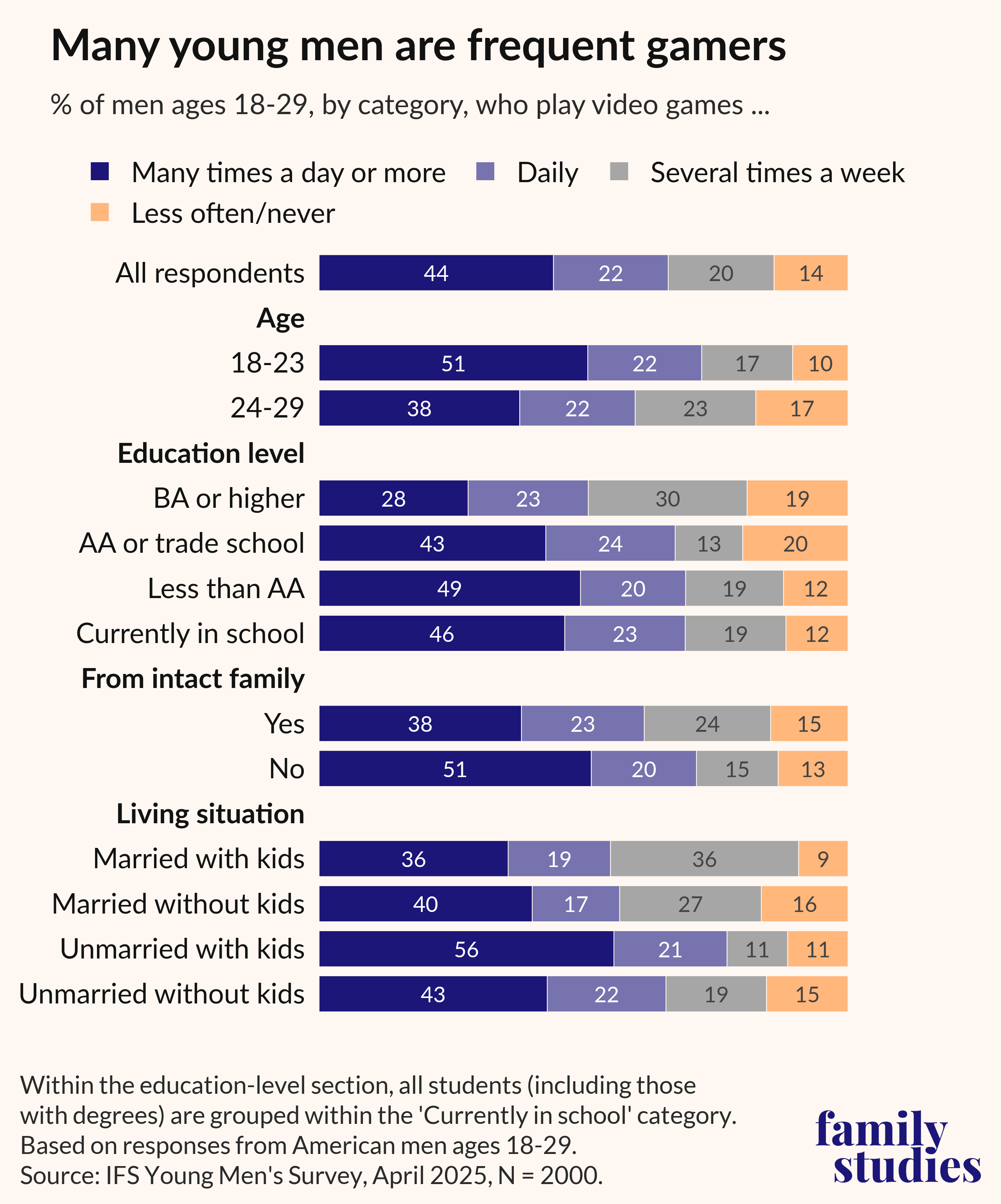
After all, parents cannot wait nearly two decades to find out if these platforms are safe for their boys. An entire childhood—and future—hangs in the balance. According to IFS research, nearly 1 in 4 young men report daily gambling and two-thirds of those same men report daily video game play, with half agreeing that online gaming gives them “an opportunity to feel a sense of mastery or accomplishment.” Like the virtual loot boxes, these experiences don’t translate into the real world, leaving young men feeling demoralized and lonely.
Not Worth the Gamble
For Hempe, whose oldest son has publicly disclosed his online gaming addiction, she hopes her organization can help prevent other parents from missing the warning signs percolating in their basements. It was her son’s addiction that led to the creation of ScreenStrong, and her family’s story that encouraged me to disallow online games in my own home.
Dirst, with her front-row seat to the bits of national data that are available, has been left wondering,
With the amount of access everyone has [to these platforms], the scope of addiction that’s possible for young people, what are the long-term impacts? How can I know what’s safe for my own child?
For now, she’s choosing to not allow these platforms for her own son, believing them to not be worth the gamble.
Emily Harrison is a writer, advocate, and speaker on digital media and family. She is a Fellow with the Colson Center for Christian Worldview, Ambassador for the Phone Free Schools Movement, and ScreenStrong, and a member of Fairplay’s Screen Time Action Network. She blogs weekly at DearChristianParent.Substack.com.
Editor's Note: The opinions expressed in this article are those of the author and do not necessarily represent the views, policies, or positions of the Institute for Family Studies.
*Photo credit: Shutterstock


