Highlights
- When people overprioritize money, possessions, and careers, their marriages often pay a serious price. Post This
- Materialism doesn't just undermine existing marriages—it often creates significant barriers for marriages to happen in the first place. Post This
- As a culture, we are taking the financial steps that couples used to achieve together and turning them into milestones individuals must accomplish on their own. Post This
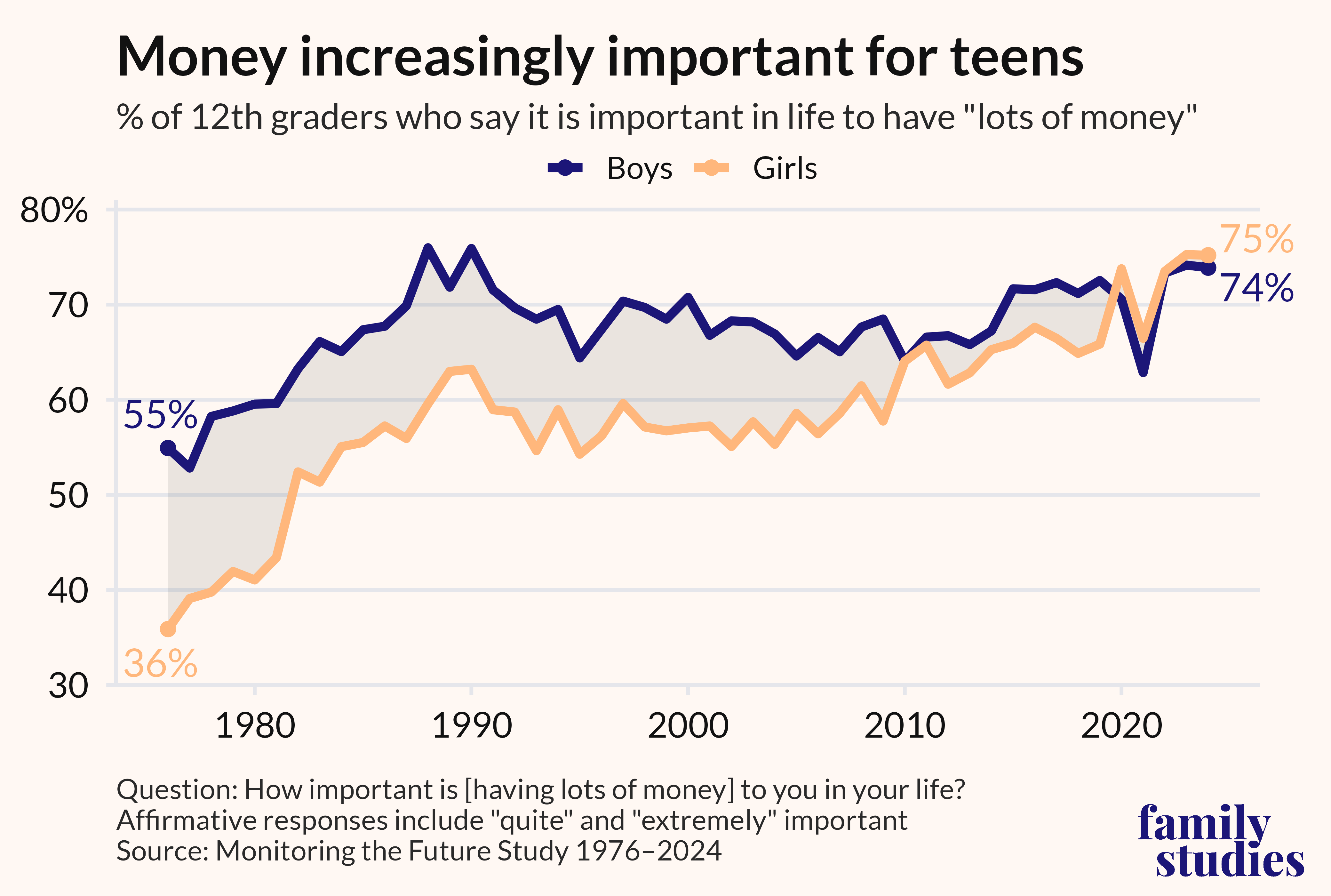
Recently, Grant Bailey, my colleague at the Institute for Family Studies, used data from the Monitoring the Future Study to look at trends of materialism among high school-aged teens over the last 50 years. Two main findings emerged. The first is that materialism is surging among teens in our culture, and the second is that materialism is now an equally shared life ambition for high school boys and girls.
Specifically, what Grant’s analysis found was that in 1976, about 1 in 2 (55%) high school senior boys and just over 1 in 3 (36%) high school senior girls said having “lots of money” was important in life. By 2024, 3 out of 4 of both teen boys (74%) and teen girls (75%) endorsed the sentiment that it is important to have lots of money.
This amounts to an increase of 19 percentage points for high school boys and an increase of 39 percentage points for high school girls (more than double the previous rate). It is clear from this trend that materialism isn't just a cultural undercurrent anymore. For many in the rising generation, materialism may be emerging as the defining value of their lives.
Money and Happiness
This trend deserves our attention—not just because it provides needed commentary on our modern consumer culture, but as a direct warning about what's coming for the American marriage culture. However, I was surprised by much of the social media response to these trends. Many of the commentators dismissed the significance of these findings and others strongly asserted that this increase in materialism is simply a practical and reasonable response to the cost of living in our modern society. Many labeled putting a high priority on having lots of money as a “rational reaction,” a “survival assessment,” and “simply necessary.” Many rejected the label of materialism all together, with one responder noting, “Having an average amount of money is not good enough for a good life anymore, lots of money is critical to be happy.”
Materialism doesn’t solve financial problems; it makes them worse.
I certainly do not intend to demean the important role that economic resources play in improving conditions for individuals and families. And I understand how reasonable people could quibble about how to interpret responses to a simple question in a national survey about having lots of money. But as a marriage researcher who has studied materialism over the last 20 years, I am worried about endorsing materialism as simply being a needed approach to modern life. In fact, this type of endorsement is completely backwards. Materialism doesn’t solve financial problems; it makes them worse. If the last two decades of scientific research on materialism and marriage have taught us anything, it's that when people overprioritize money, possessions, and careers, their marriage and family relationships often pay a serious price. Not because financial concerns aren’t real—they are—but unchecked materialism not only influences how couples spend their money (often in excess), but it also shapes how they perceive their finances (as never being enough).
An Underappreciated Threat
We should be concerned if we are indeed raising a generation of young adults who are more materialistic than their parents and grandparents. As Brad Wilcox has pointed out, the rise in materialism is a part of what he calls the “Midas Mindset,” or the idea that fulfillment and happiness in life comes from career, money, and freedom from the encumbrances and responsibilities of family life. He warns that fostering this approach to life ultimately ends up devaluing love, marriage, and children. To avoid this Midas Mindset, we need to help young people understand the difference between having “enough money” versus having “lots of money”—and that financial security is often more about learning how to spend money prudently than it is about simply earning more.
Having a balanced cultural conversation about the proper pursuit of financial security versus enthusiastically embracing materialism is critical if we are going to bolster family formation in the rising generation. In a culture defined by consumerism, single adults and couples today face pressures that go far beyond having enough money to balance their household budgets. Consumer culture pushes an ever-increasing expectation for standards of living that now involve possessions, entertainment, travel, and home sizes that look very different than previous generations. These expectations greatly influence the timing and priority of marriage in many young people’s lives and then shape the timing and priority of having children after marriage.
The research is clear: materialism is quietly one of the most underappreciated threats to the health of marriage and family formation in America today.
Materialism and Marriage Readiness
Researchers have identified three core traits that characterize materialistic individuals.
- First, materialistic individuals place the accumulation of money and possessions at the center of their lives, prioritizing it above relationships.
- Second, materialistic individuals believe that money and material goods are essential to their happiness and well-being.
- Third, materialistic individuals judge their own success and the success of others by the quantity and quality of material assets they possess.
My research on marriage readiness among single adults reveals that materialism doesn't just undermine existing marriages—it often creates significant barriers for marriages to happen in the first place. In a study of young adults, my colleagues and I found that many of them have developed extensive checklists of financial milestones they believe they must complete before they can get married. At the top of the list, we found that 91% of young adults said that financial independence from parents was necessary for marriage readiness. And 88% said they need to no longer be living in their parents' house before they can get married. I’m sure that these are criteria that nearly all parents would heartedly endorse as well.
In a culture defined by consumerism, single adults and couples today face pressures that go far beyond having enough money to balance their household budgets.
But the list didn't stop there. Many young adults endorsed reaching financial milestones before marriage that were the foundational milestones of early married life for their parents and grandparents. For example, about half said they needed to be entirely finished with their education and settled into a long-term career, and about 1 in 4 said they needed to purchase a house, before they would feel ready to marry.
What concerns me is how materialism compounds and inflates each of these benchmarks over time. In our materialistic culture, the bar for what counts as "financially independent" keeps rising. As a culture, we are taking the financial steps that couples used to achieve together and turning them into milestones individuals must accomplish on their own. Marriage in the young adult years has traditionally been the way that couples start building a life together—a cornerstone. However, for many young adults (and their parents), marriage is becoming the option you consider only after life is already built—a capstone. But, once again, the so-called solution is actually becoming the problem.
Home ownership is one example. As new analyses from Scott Winship, the Director of the Center on Opportunity and Social Mobility at AEI, recently showed, married young adults have always been much more likely to be homeowners than single young adults – by a wide margin (2025, ages 25 to 34; 59% of young married couples vs. 15% of single young adults). He concludes, “Simply put, married couples are in a better position than single young adults to afford a home and always have been.”
For young adults who genuinely want to marry, it is worth asking an honest question: Are my financial expectations realistic enough to allow me to strongly pursue marriage during my young adult years? That's a hard question to ask in a consumer culture that emphasizes financial success as the primary prerequisite for marriage. But, with materialism surging among today's teens, we may see an ever-longer list of financial reasons they're not ready to commit. (Next week, in a second post, I will address two ways that materialism harms marriage and how to avoid this threat.)
Jason S. Carroll, Ph.D. is the Director of the Marriage and Family Initiative at the Wheatley Institute at Brigham Young University. He is also a Senior Fellow at the Institute for Family Studies. Dr. Carroll is a past recipient of the Berscheid-Hatfield Award for Distinguished Scientific Achievement given by the International Association for Relationship Research.
*Photo credit: Shutterstock