Highlights
- Female-breadwinner couples were more likely to separate regardless of the proportion of people in the country who endorsed traditional beliefs or supported dual-earner marriages. Post This
- Female-breadwinner couples were 36% more likely to separate than male-breadwinner couples, all else equal. Post This
This year's most talked-about wedding featured a bride who earns far more than her husband. Pop superstar Taylor Swift earned at least four times as much as NFL star Travis Kelce last year and her net worth is much higher than his. This reflects a broader social trend. Marriages in which the wife earns more than the husband have become increasingly common in the United States, rising from about 5% of married couples in 1972 to roughly 16% today. The trend is likely to continue as young women outnumber men in universities and increasingly dominate many professional occupations.
For decades, sociologists and other scholars predicted that this economic shift would gradually erode the traditional male-breadwinner norm. As women became more economically successful, they argued, people generally would become more accepting of role reversals within the household, and the greater instability historically observed among female-breadwinner couples would disappear. According to this view, those higher separation rates were largely the product of social disapproval and conflict arising from violations of traditional gender norms.
That prediction received support from a widely discussed 2016 study, which reported that although wives earning more than their husbands increased the risk of divorce among couples married in the 1960s and 1970s, this was no longer true for more recent marriage cohorts. The authors of that study argued that changing gender norms had weakened the influence of the traditional male breadwinner ideal. Other studies, however—including research previously discussed on this page—found that female-breadwinner couples continued to face a higher risk of divorce, even among recent marriage cohorts.
The issue has now been revisited by one of the authors of the 2016 study, Pilar Gonalons-Pons, together with Allison Dunatchik, using high-quality data on 544,911 married and cohabiting couples across 29 affluent countries between 2004 and 2020. Their findings strongly support the earlier findings: couples in which the woman is the primary breadwinner—defined as earning more than 60% of the couple's total income—are more likely to separate in every country except Hungary and Cyprus (Figure 1).
The size of the effect varied across countries. In the Netherlands and Spain, female-breadwinner couples were about twice as likely to separate during the four-year study period as male-breadwinner couples. In Estonia and Bulgaria, there was little difference between couple types, while in Poland and Slovenia, the increase in risk for female-breadwinner couples was relatively small. The researchers also found that the relationship between female breadwinning and separation has diminished but not disappeared among younger cohorts.
Figure 1. Proportion of couples separating by women's relative earnings category
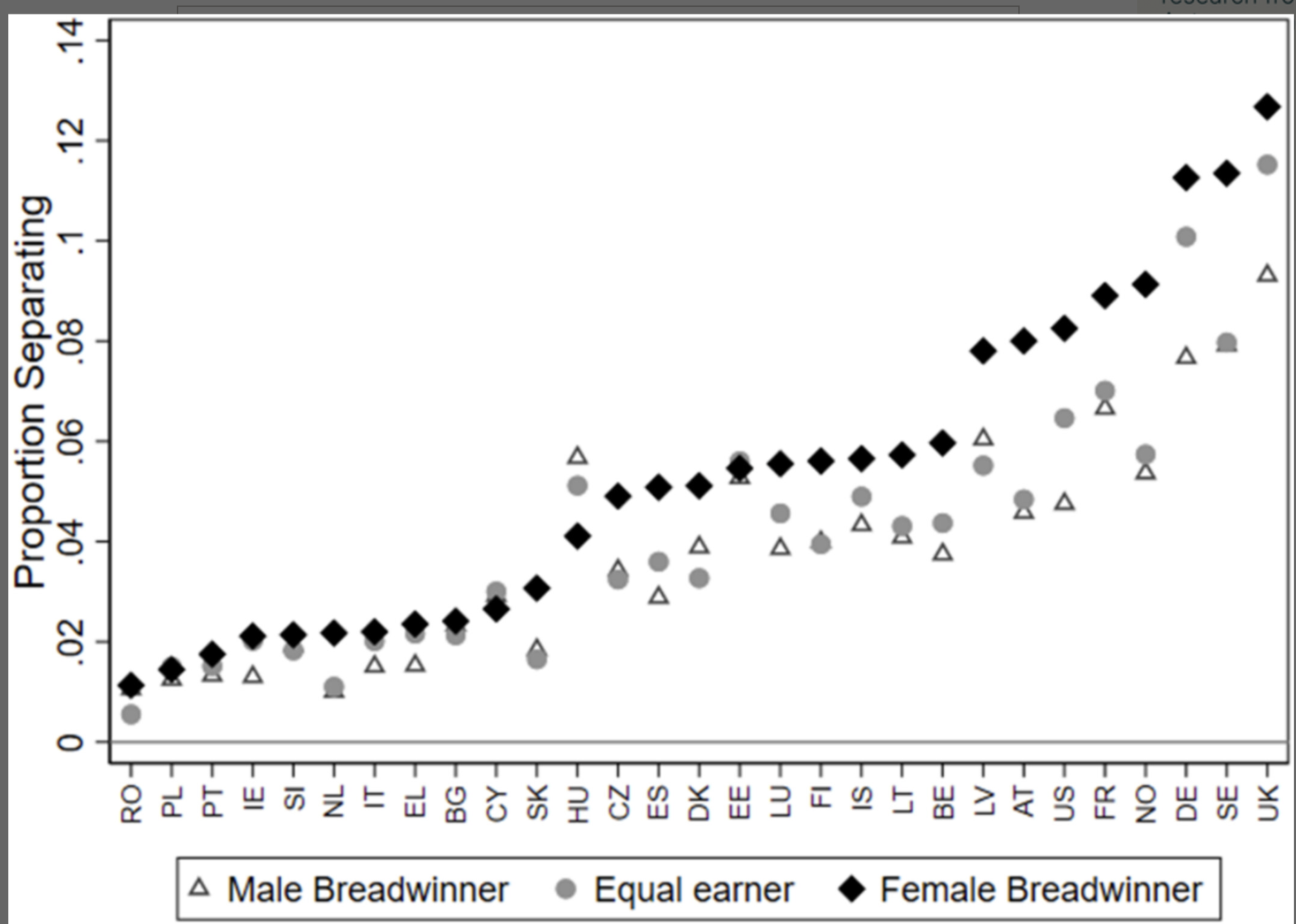
Data sources: SIPP (US), GSOEP (DE), BHPS and UKHLS (UK), and EU-SILC (all other countries). Country legend: AT = Austria, BE = Belgium, BG = Bulgaria, CY = Cyprus, CZ = Czech Republic, DE = Germany, DK = Denmark, EE = Estonia, EL = Greece, ES = Spain, FI = Finland, FR = France, HU = Hungary, IE = Ireland, IS = Iceland, IT = Italy, LT = Lithuania, LU = Luxembourg, LV = Latvia, NL = Netherlands, NO = Norway, PL = Poland, PT = Portugal, RO = Romania, SE = Sweden, SI = Slovenia, SK = Slovakia, UK = United Kingdom, US = United States
Multivariate analyses controlling for factors known to affect relationship stability—including the education of both partners, marital versus cohabiting status, parenthood, and homeownership—produced similar results. Female-breadwinner couples were 36% more likely to separate than male-breadwinner couples, all else equal. Equal-earner couples also faced a slightly higher risk, being about 6% more likely to separate than male-breadwinner couples. As expected, higher education, having children, and homeownership were all associated with greater relationship stability, but none of these factors explained the higher separation rates among female-breadwinner couples. As other studies have found, cohabiting couples were more likely to separate than married couples, but the increase in separation risk associated with having a female breadwinner was similar for both married and cohabiting couples.
National Gender Norms or Other Factors?
The authors also examined whether this relationship was influenced by differences in national gender norms. It was not. Female-breadwinner couples were more likely to separate regardless of the proportion of people in the country who: endorsed traditional beliefs such as "a man's primary role is to be the breadwinner," supported dual-earner marriages, believed that children suffer when mothers work, or agreed that employed mothers can develop relationships with their children that are as warm and secure as those of stay-at-home mothers (Figure 2).
Figure 2. Average marginal effects of women's relative earnings categories
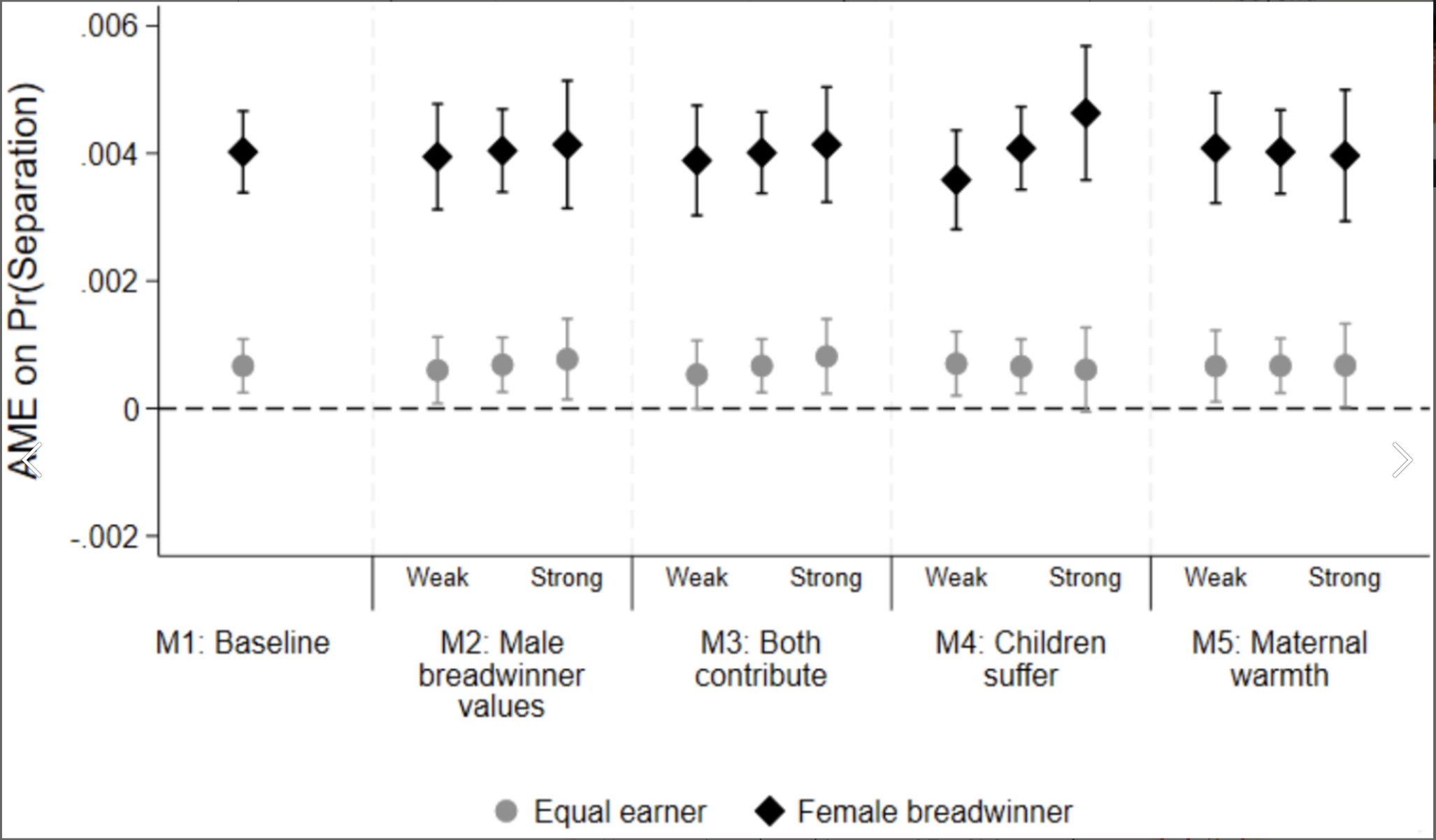
Data sources: SIPP (US), GSOEP (DE), BHPS and UKHLS (UK), and EU-SILC (all other countries).
Nor did the association vary systematically with broader measures of gender equality, such as the prevalence of female-breadwinning couples in the country, the country's gender wage gap, or women's educational advantage over men. The study likewise found little support for several other commonly proposed explanations. Female-breadwinner couples were not substantially less stable because women had greater financial independence, or because women increased their earnings in anticipation of divorce, or because husbands were unemployed, or because female breadwinning reflected financial hardship within the household.
Despite changes in gender norms, the relationship between female breadwinning and couple instability is remarkably persistent.
So what factor did matter? The presence of children. Among couples with dependent children, female-breadwinner couples with children were 49% more likely to separate than male-breadwinner couples, a much higher rate than the 23% higher risk of separation faced by female breadwinner-couples without children. The authors suggest that this pattern is consistent with work-family conflict contributing to relationship instability, although it does not fully explain the association between female breadwinning and the risk of couple instability. Even female-breadwinner couples without dependent children faced a higher risk of dissolution.
Overall, the study provides strong evidence that female-breadwinner couples remain more likely to separate than other couples across a wide range of developed countries. Contrary to a common expectation, this pattern cannot be explained by the prevalence of traditional gender norms or by several other leading sociological explanations. Although work-family conflict appears to play some role, much of the association remains unexplained. The authors conclude that existing theories are insufficient and call for further research into why female-breadwinner couples continue to experience higher rates of relationship dissolution.
Why These Findings Matter
These findings are unexpected. With the dramatic changes in women’s educational attainment, labor-force participation, and earnings over the past half century, gender norms have changed in many developed societies. Yet despite these changes, the relationship between female breadwinning and couple instability has proven remarkably persistent. Evolutionary psychologists suggest that this is because sex differences in mate preferences, shaped over humanity's long evolutionary history, continue to influence modern relationships. From this perspective, the association between female breadwinning and relationship instability reflects enduring psychological predispositions rather than simply social norms. Perhaps this is why there has been discussion in the media about the fact that Taylor Swift is a billionaire and Travis Kelce a mere millionaire, even though at those stratospheric levels of wealth, it might appear irrelevant. Whether this explanation is correct remains a matter of debate, but these new findings suggest that the phenomenon of the greater instability of female-breadwinner couples is unlikely to disappear simply because societies become more gender egalitarian.
Rosemary L. Hopcroft is Professor Emerita of Sociology at the University of North Carolina at Charlotte. She is the author of Evolution and Gender: Why it matters for contemporary life (Routledge 2016), editor of The Oxford Handbook of Evolution, Biology, & Society (Oxford, 2018), and author (with Martin Fieder and Susanne Huber) of Not So Weird After All: The Changing Relationship Between Status and Fertility (Routledge, 2024).
*Photo credit: Shutterstock