
Highlights
- Too many young Americans are struggling to achieve self-sufficiency and form and sustain the strong marriages they need to thrive. Post This
- States should have skin in the game when it comes to helping young people form and sustain healthy relationships and marriages, instead of relying exclusively on federal initiatives. Post This
The “success sequence” is set of early life transition markers that, when accomplished in order, are associated with very low risks of experiencing poverty. Specifically, when youth 1) complete at least a high school education, 2) become employed full time, and 3) marry before having children—in that order—then 97% are not in poverty in their mid-30s, and 86% reach at least the middle class.
These findings are especially relevant for lower-income youth. Institute for Family Studies (IFS) researchers have found that 70% of upper-income Millennials have followed or are on track with the success sequence, while 76% of lower-income Millennials have missed one or more steps or gotten them out of sequence. When youth skip these steps or get them out of sequence, more than half (52%) are poor in their mid-30s. Moreover, the positive effects of this sequence of early life-course events are robust across a set of important demographic dividers.
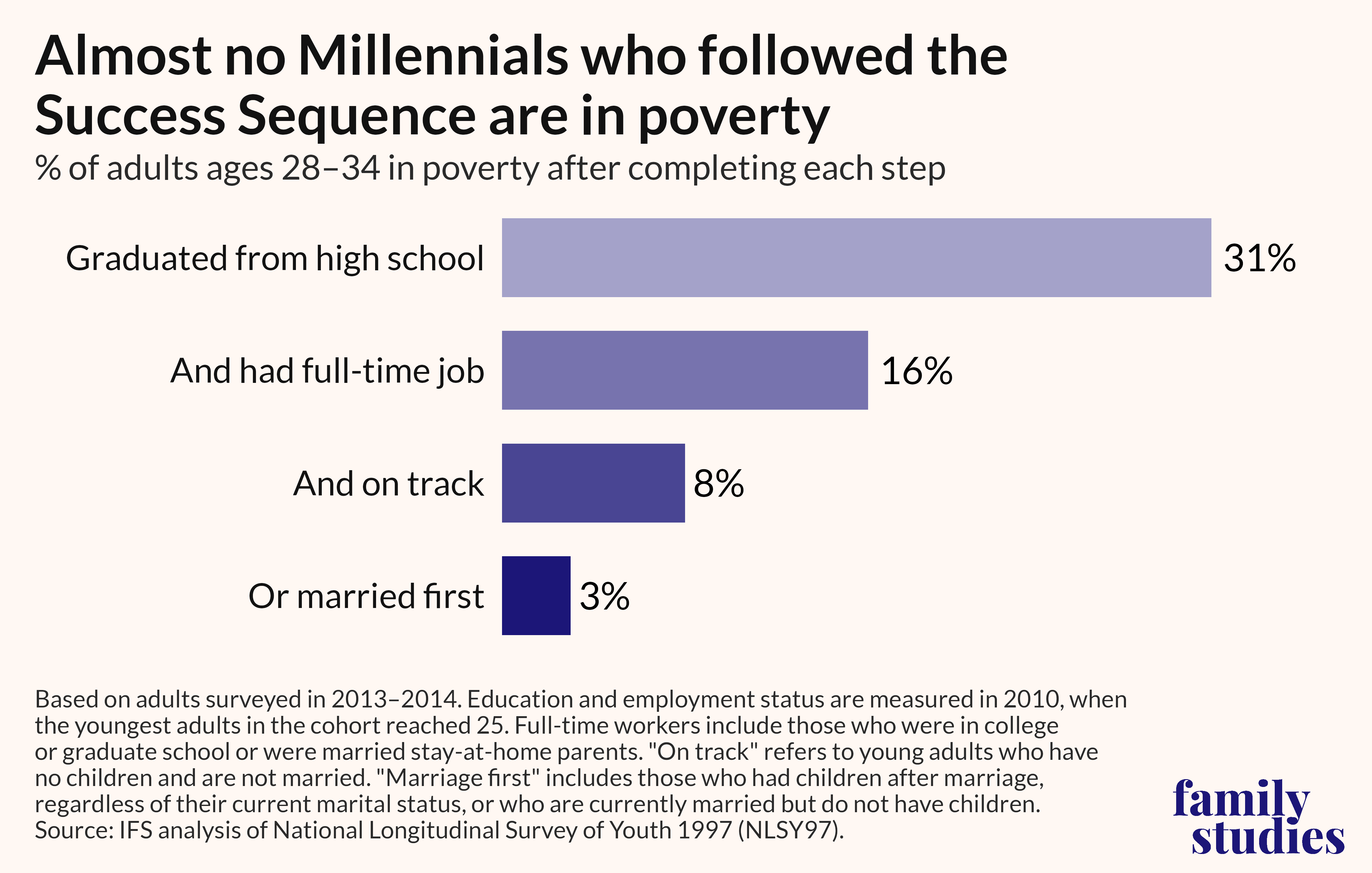
And it’s not just economic success. The odds that 30-somethings experience poor emotional health are cut in half for those who follow the success sequence (even after controlling for a wide range of demographic factors). Young women and men who follow the sequence are also markedly more likely to forge stable families and avoid divorce.
Of course, the success sequence concept has its critics, and good-faith critiques deserve a response. In our new report for the Institute for Family Studies on the success sequence, released today, we dive into these critiques, as well as some concerns and questions. Here, we focus on policy steps that states can take to operationalize the success sequence and teach it at scale to youth and young adults.
Implementing the Success Sequence
Since 2006, the federal Administration for Children and Families has funded community organizations serving youth and young adults to help them form healthy relationships, some of which include teaching about the success sequence. But we believe a multi-state, federalist experiment ultimately will be more effective than a federal, top-down, one-size-fits-all model, allowing states (often in better fiscal positions) to lead these efforts. We think states should have skin in the game when it comes to helping young people form and sustain healthy relationships and stronger marriages and not rely exclusively on federal initiatives.
What should states do and how should they do it? Below, we outline some feasible action steps from our report to help states teach the success sequence to the next generation.
- Work with the State Board/Office of Education—and legislature, if needed—to require teaching the success sequence in public schools. The most efficient way to reach nearly all youth is to develop state standards and benchmarks that implicitly or explicitly include the success sequence and measure students’ knowledge against the standards. Then, this should be accompanied by a plan to embed success sequence lessons into a required course (or courses) that all young people will take. In the full report, we provide more details and recommendations for how to take on this challenging step.
- Invest in social media and traditional media campaigns. Formal lessons on the success sequence are important. But young people today are digital natives and absorb messages via various social media platforms. We shouldn’t underestimate the power of creative, viral messaging as a supplement to formal instruction, which is why states should invest in an ongoing social media campaign. There is emerging evidence that well-designed social media campaigns can nudge knowledge, attitudes, and beliefs, and can initiate behavior change. It may be wise to target some traditional-media messages to parents and older adults, as well, so that they can reinforce the messages that their children are receiving through other means.
- Create a first-year experience initiative for embedding the success sequence as a roadmap for freshmen attending technical schools, community colleges, and universities. Don’t forget about 18–25-year-olds; they are living in perhaps the most crucial success sequence years of their lives. Even if most were exposed to success sequence lessons in high school, reinforcement and deeper development of success sequence concepts will benefit young adult students who are becoming more active in developing romantic relationships and making sexual choices. Many colleges and universities have mandated first-year experience instruction as a part of the graduation requirements. Advocates should target these kinds of first-year experience initiatives for teaching success sequence principles.
- Organize and empower a formal state commission to oversee efforts to scale-up teaching the success sequence and other marriage-strengthening efforts. Getting from conceptual A to effectively implemented Z is hard work. The action steps recommended here take both strategic leadership and a lot of day-to-day hard work. States should organize a formal commission or office to oversee the success sequence initiative and other marriage-strengthening activities. This can be done with a lean staff. But they need to be funded appropriately. Funding can come from federal TANF block grants to states that are explicitly designed to support these kinds of educational purposes (but seldom are). In addition, states can consider setting aside a portion of marriage license fees for this work. The commission can be hosted in a number of places, such as a Governor’s Office, Department of Human Services, State Office of Education, or a land-grant university Extension Service.
Too many young adults today are struggling to achieve self-sufficiency and form and sustain the healthy relationships and strong marriages they need to thrive. But there is a sequence of known life events that, when followed, nearly guarantee young adults avoid poverty as they approach midlife and dramatically increases their chances of reaching at least the middle-class. When youth get at least a high school education, become employed full time, then marry—before having children—they become self-sufficient, have better mental health, and integrate themselves into a life-script of deep meaning and connection.
Teaching the success sequence to teens and young adults does not trump the public need to build a society with good educational opportunities, better employment prospects, and a positive cultural orientation towards the fundamental institution of marriage. But working together, these policy efforts will reinforce each other and assist more youth in achieving their aspirations for success.
Click here to read the full report.
Alan J. Hawkins, PhD, is a Non-resident Senior Fellow with the Institute for Family Studies and Vice-chair of the National Alliance for Relationship and Marriage Education. Connie Huber, EdD, is a Senior Curriculum Fellow with the Institute for Family Studies.


