

Highlights
- The path forward on the debate between work and family is not to “blame” the girlbosses, nor is it to “white knight” for them, or blame men for being unmarriageable. Post This
- Brown's article rests on a crucial misreading of "girlboss." When we properly specify the data to actually measure the “girlboss,” it turns out there may indeed be some cause for concern. Post This
- “Girlbosses” have far fewer children than other women, especially if “girlboss” refers to women who are determined to never take a year or two off from formal employment. Post This
In a recent Free Press article, Patrick T. Brown of the Ethics and Public Policy Center, a frequent contributor to the IFS blog, argued that it is improper to “blame” falling fertility on “girlbosses,” since fertility has mostly fallen for lower socioeconomic status women. There’s a grain of truth to his argument: fertility really has fallen most for lower socioeconomic status women.
Brown noted that the gap in completed fertility between highly-educated women and less-educated women has narrowed in recent years, and that this is due to less-educated women marrying less, in part, because of a lack of suitable men. As far as it goes, these empirical claims are plausible and, in some cases. undoubtedly correct. However, his article rests on a crucial misreading: “girlboss” does not first and foremost refer to “high-socioeconomic status women,” and when we properly specify the data to actually measure the “girlboss,” it turns out there may indeed be some reasonable cause for concern.
But first, it must be said: high educational attainment is not a reasonable proxy for “girlboss.” My wife has a degree in a STEM field from a selective university but is a stay-at-home mom. I’ve publicly argued elsewhere that women like her may be classifiable as some variety of “girlboss” (a “momboss” maybe?), but a stay-at-home mom homeschooling her kids is clearly not at all what society’s “girlboss” rhetoric is about. Rather, it seems what most people mean by “girlboss” is a woman in a demanding, high-status career in formal, paid employment, and especially women prioritizing those careers very highly in their life vs. other priorities, such as family ties.
Girlbosses Do Have Lower Birth Rates
To see what’s really happening with “girlbosses,” I use the Current Population Survey’s fertility supplements from 1972 to 2024. I classify every occupation based on its typical education: if a job has lots of women in it with higher degrees, it has a higher score; if the job is mostly less-educated women, it’s a lower score. Thus, I identify occupations typically preferred by educationally qualified women. These tend to be higher-paying, or higher-status, or more demanding jobs.
Next, I see how completed fertility changed over time for women in their 40s who hold those jobs. Large shares of women in their 40s hold no particular job, and I classify them as a separate group; many of them are stay-at-home moms. Moreover, I group together jobs in the bottom 40%, because many of these jobs are individually uncommon, and so the overall sample size of women in these occupations is small, and includes many women with weak labor force attachments in general.
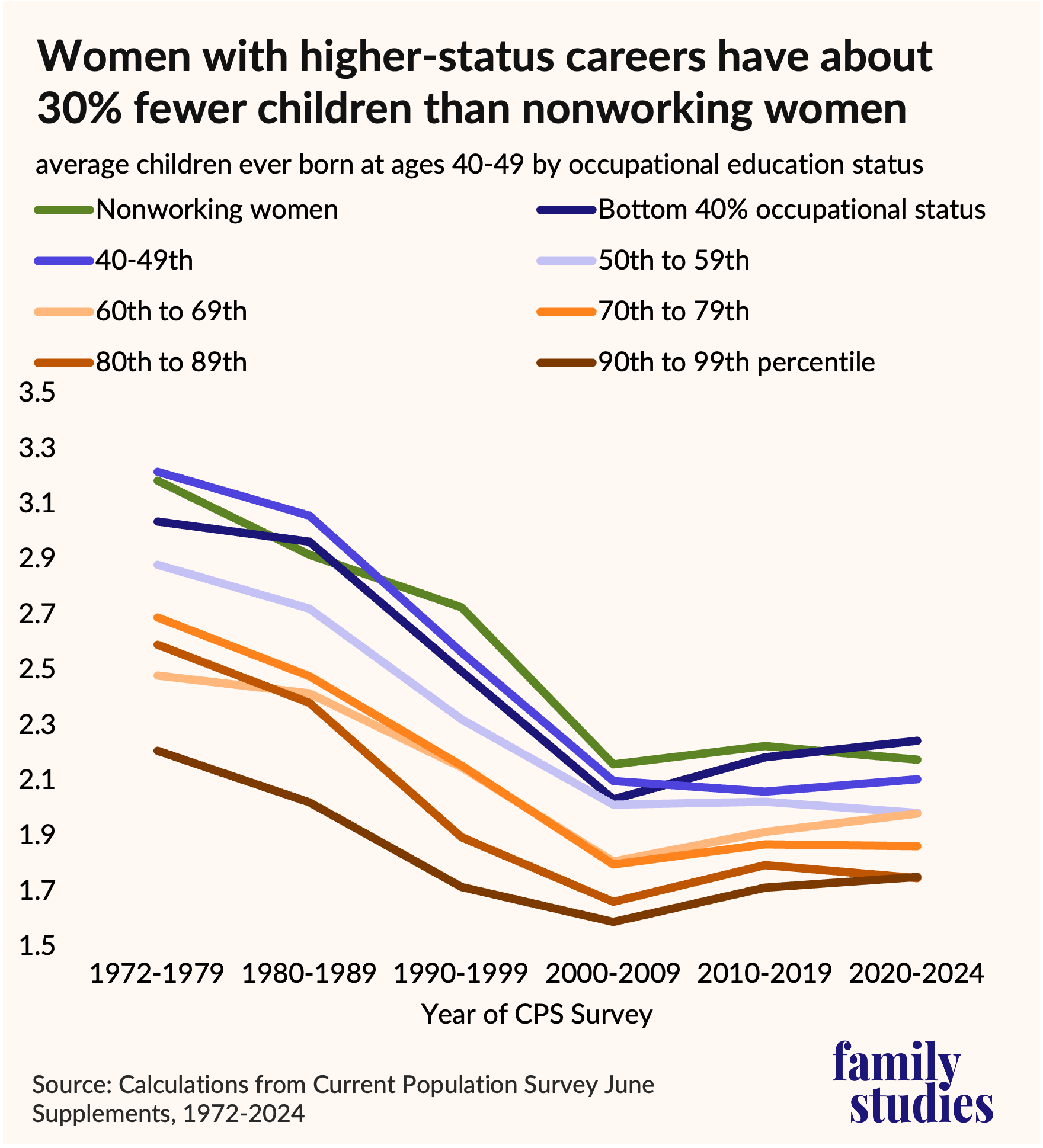
The standout fact here is that fertility trends have been similar across occupational status. Women at every occupational status level saw their fertility fall from the 1970s to the 1990s, and there has been a modest increase since then. But at any given period, it clearly is true that women with high-education occupations had fewer children. The gap is about 25-35% in every period, which is nothing to sneeze at.
But completed fertility is a backward-looking indicator. It tells us what happened with fertility when women who are now finished having kids were in their childbearing years—10, 20, or 30 years ago. We want a forward-looking indicator. Moreover, some women holding “girlboss” jobs at 47 were not holding those jobs at 27, when they had kids. We want to know the actual birth rates of women in specific jobs, while they hold those jobs. For that, we can calculate the occupation-status-specific total fertility rate.
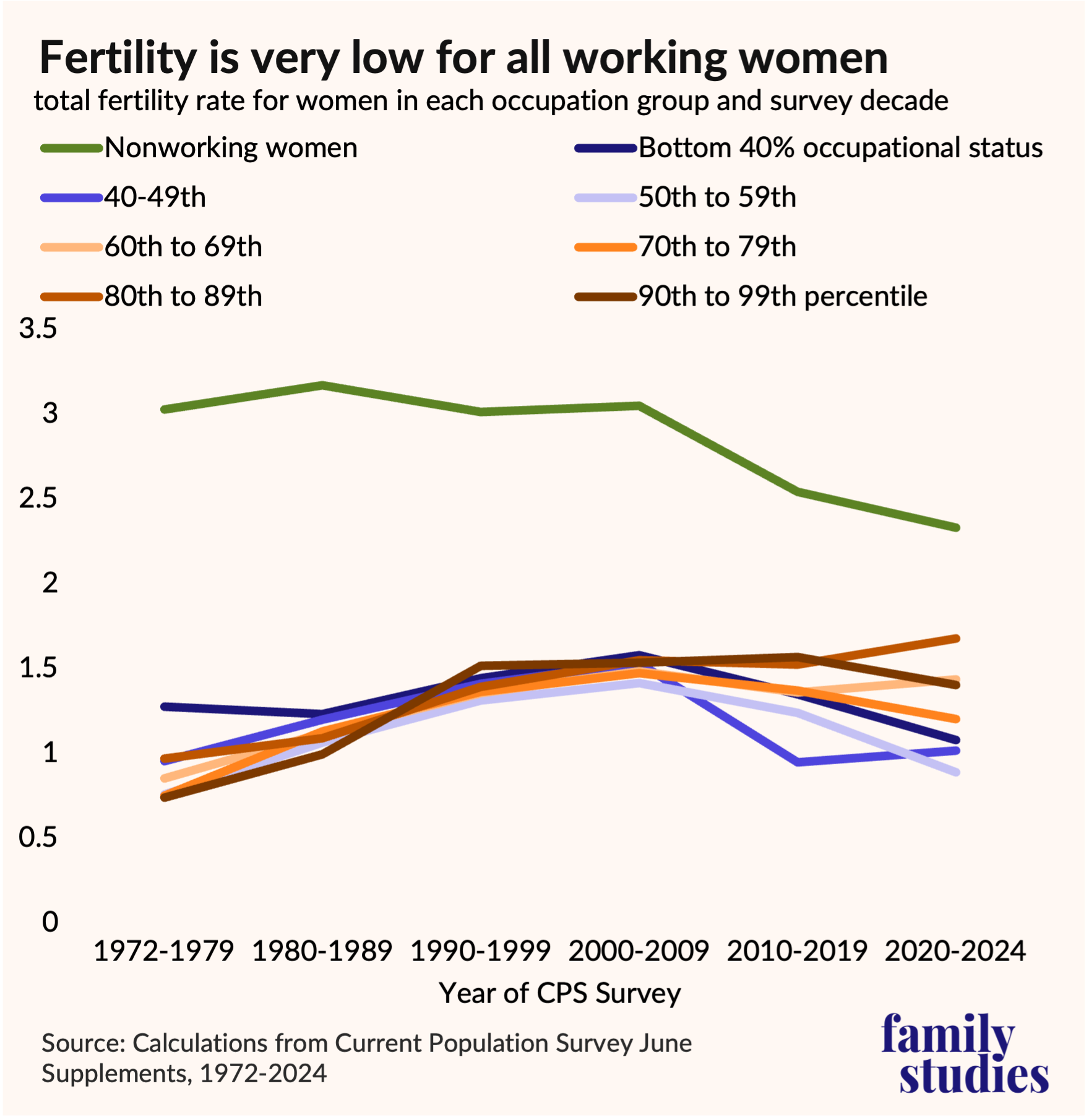
Here, we can see two major facts clearly.
First, only nonworking women have above-replacement fertility rates. If America had the typical fertility behaviors of working women, our birth rate would have been around 1.2 children per woman in 2020-2024, instead of around 1.6 as it actually was. This doesn’t mean career women have few children—it means when they have kids, they will often take a break from their career. The CPS marks women who have an occupation but are temporarily unemployed or on leave, and I count those women as “working.” Likewise, a woman who shifts down to, say, 10 hours a week, but stays in a high-prestige occupation, would count as working in that occupation, not nonworking. The non-working category here is women who have no contractual right to return to a job, are not actively job-hunting, and regularly work nearly-zero hours. In other words, to have 2 or more kids, most women will take a break from formal employment for at least a year or two. Certainly, there will be women who pull it off without a break, but that’s not easy.
On the other hand, there has been some real convergence over time! Whereas in the 1970s, women in the top 10% of the occupational hierarchy could expect less than 1 child each, today they could expect perhaps 1.4, whereas for nonworking women there has been a decline from 3 kids per woman to 2.3. “Girlbosses” don’t have as large of a fertility penalty as they had in the past.
The absolute lowest fertility nowadays is for women with jobs below the 60th percentile of the educational distribution. Women with “mostly non-college” jobs, what we might consider “working-class jobs,” have fertility rates of around 1 child per woman (while working in these jobs). In other words, fast food and retail workers aren’t having many babies.
There is genuine tension between 'girlboss' careers and the families Americans desire.
Thus, far from the triumph of the girlboss, what we really see is that in every era, the only women hitting the family sizes most Americans want are those willing to take a career break. The jobs typical of lower and even many middle-socioeconomic status women are, today, the very lowest-fertility jobs, while high-socioeconomic status jobs have somewhat less severely low fertility rates.
On the whole, we can say that “girlbosses” have far fewer children than other women, especially if “girlboss” refers to women who are determined to never take a year or two off from formal employment. To the extent “girlbosses” do achieve bigger families, it’s often achieved by taking a break for a few years to have kids—girlbosses using their salaries to put kids in day care and staying on the job don’t end up with as many kids as women who take a pause or a pay cut.
Thus, it turns out that while “girlbosses” are not to blame for falling fertility (since the decline is broadly shared across occupational status categories, and in fact “girlboss” jobs are becoming less anti-natal over time), it is the case they are behind low fertility (since the “girlboss” career path really does have chronically lower birth rates).
Girlbosses Are Getting More Common
Moreover, “girlboss” type jobs are simply becoming more common:
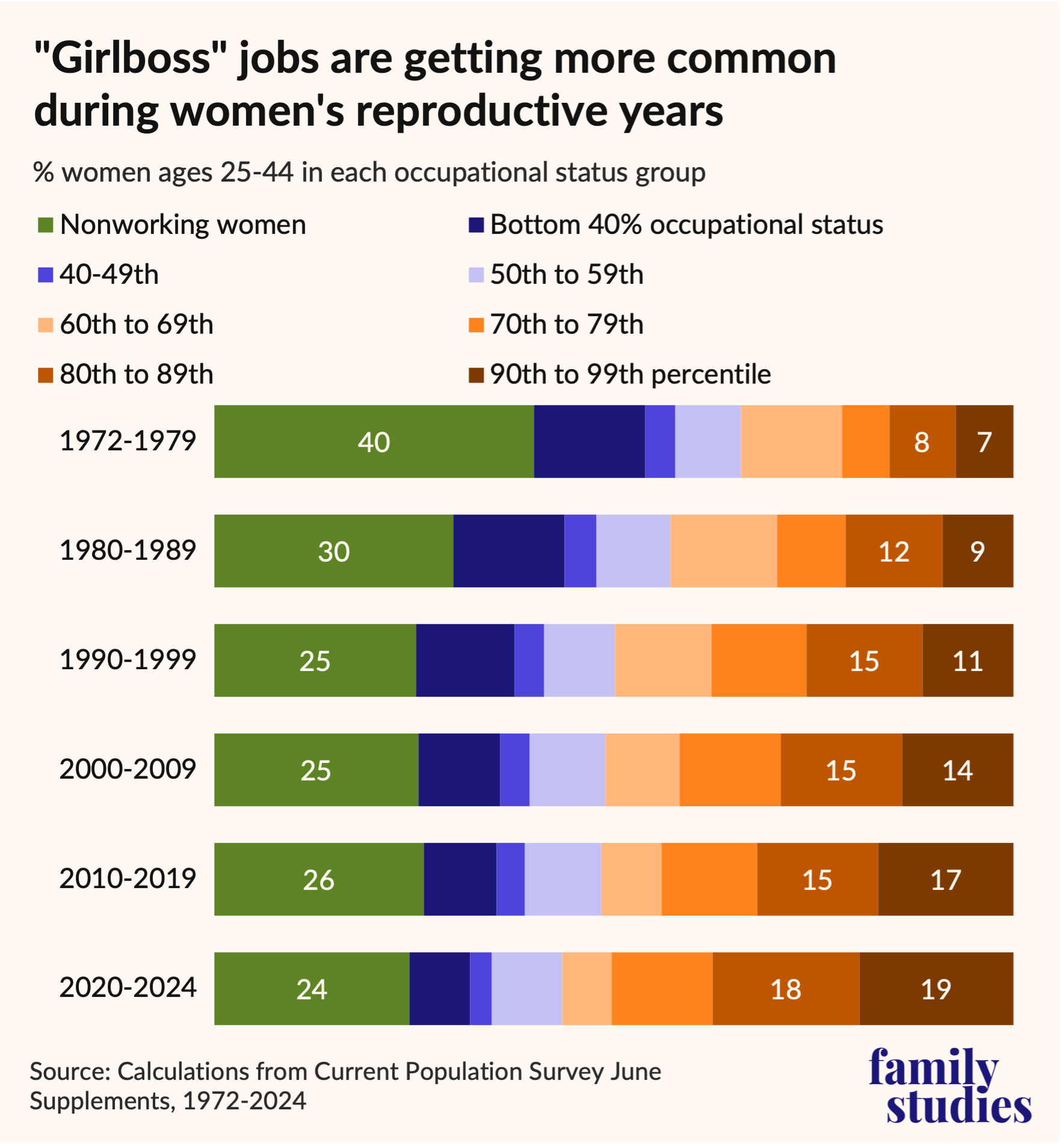
In the 1970s, 40% of women 25-44 were not employed, and a majority were nonworking or working jobs in the lowest 40% of educational qualifications. By 2020-2024, it was just 24% not working, and 31% either not working or in the bottom 40 percent. Meanwhile, the share of women’s reproductive years spent working a job in the top fifth of the educational distribution rose from 15% in the 1970s to almost 40% today. When just 15% of women’s reproductive years were spent in “girlboss” careers, the very low birth rates of those careers may not have had much effect on societal birth rates. But now that 40% of women’s reproductive years are spent in such jobs, those jobs’ effects on birth rates matter more for society.
The extent to which society has pushed women to advance their careers by pretending women have the same fertility life cycle as men, insufficiently accommodating women’s specific career trajectories, and cultivating a social ideal of work-centrality (i.e. “the girlboss”) really is a problem. Most women will need to, and many want to, take a few years off from “girlbossing” when they have young children. Treating this kind of temporary exit as a demotion (as the “girlboss” sobriquet implicitly does) is obviously a bad thing. Poking fun at the “girlboss” meme is perfectly justified, since “girlboss” merges an overt high-status claim (“boss”) with an infantilizing reference to adult women (“girl”) in order to communicate that women taking a different life course are lower status (not “bosses”). The rise of the “girlboss” creates low fertility rates that few people, even “girlbosses” themselves, actually see as ideal.
Marriage Doesn’t Explain Low Girlboss Fertility
Brown also incorrectly suggests that “girlbosses” can’t be blamed for falling fertility because the fertility decline is driven by falling marriage rates, noting that well-educated women are still getting married.
But are women in elite professions getting married? Here’s the share of women ages 25-44 who were married, by occupation status and decade:
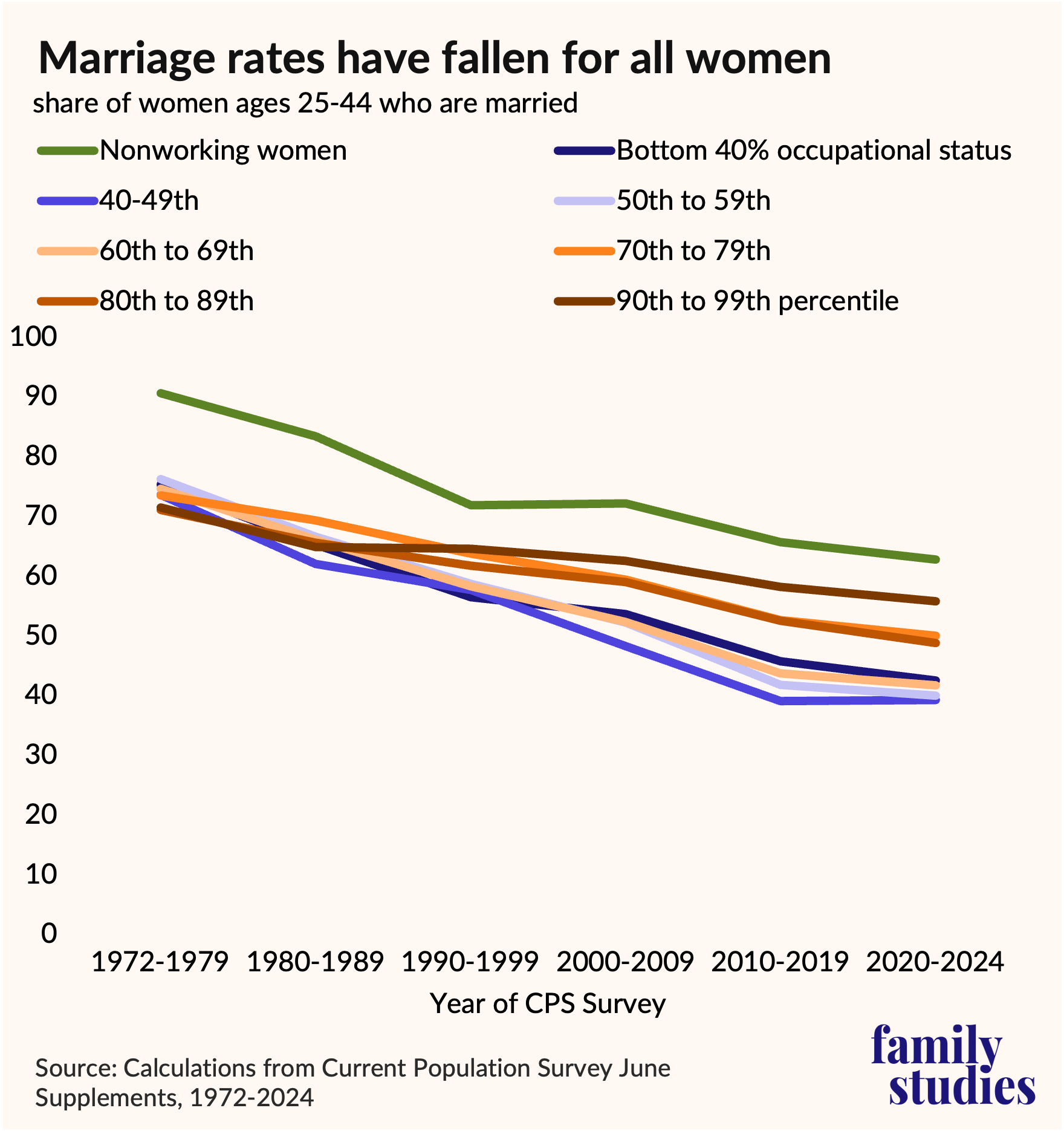
While it’s true that marriage has fallen the most for working-class women, the share of women with high-status jobs who are married has also fallen, from 71% to 56% for women in the top 10% of occupational status, and 71% to 49% for the next 10% of women. It simply is not the case that marriage is fine for upper-class women. Yes, they might eventually marry—but it takes them a long time, and as such, marriage during reproductive years really is declining for everyone, and so the available years for hitting fertility goals are in decline across all occupational groups.
Furthermore, conditional on marriage, girlbosses still have lower completed fertility than other women.
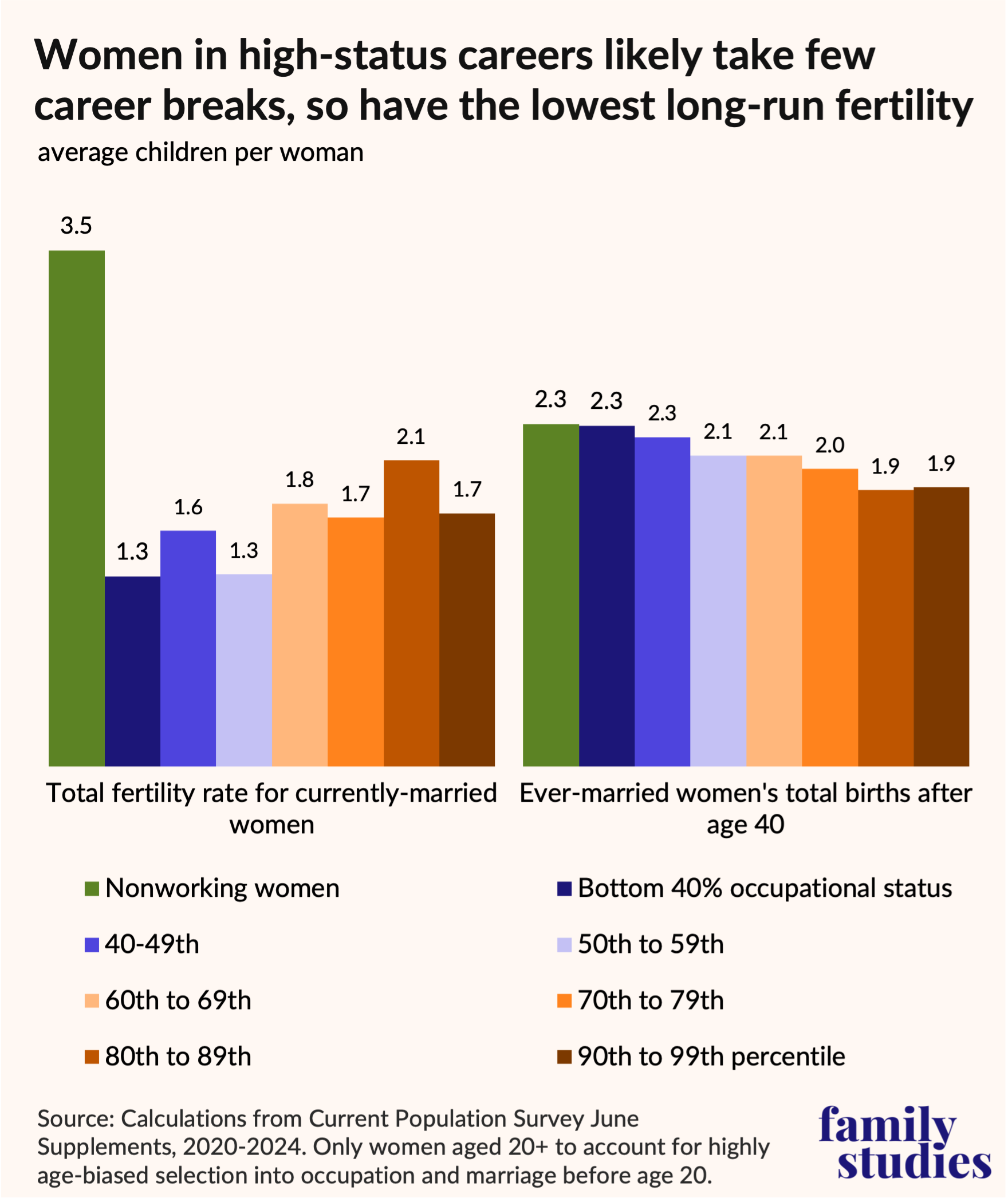
When looking at women’s completed fertility in their 40s, it is clear that birth rates for married women are appreciably lower among women in the top decile of occupational status than for most lower-status women. For current total fertility rates, the correlation is positive, but, again, only if we ignore married nonworking women, who have more than double the fertility rate of married “girlbosses.”
This Doesn't Mean Women Shouldn’t Work
Ultimately, Brown’s article is defending the idea that women, even those who want to be moms, should be free to pursue ambitious working lives, and that treating this freedom as a problem for low fertility is mistaken. I agree at a level of principle, and the Pronatalism Initiative first and foremost is aimed at trying to help American families, men and women alike, achieve their family goals, and many peoples’ “ideal family” includes ambitious careers as part of the family story! But my rebuttal shows, that, in fact, ambitious working lives really are a source of low birth rates. There is genuine tension between “girlboss” careers and the families Americans desire.
So, does this mean that the path to fertility rebound is for women to stop working? No!
First, a major decline in women’s labor force participation is simply unlikely to happen: the growth in the number of dependent retirees in society will create enormous demand for labor in the future and in particular labor in care sectors where women predominate. Going back to 1950s labor force participation just isn’t even in the cards; it’s hardly worth discussing, and anyone bringing it up is living in a fantasyland.
But perhaps even more importantly, the evidence I’ve shown here does not suggest that women's careers and family life are somehow intrinsically incompatible. Our economy really could create more career paths that allow taking 1 or 2 (or 5) years off, or more hybrid-models with reduced hours. We could, as a society, make family breaks a viable part of even highly ambitious career paths. Remote work, job-share arrangements, flexible hours, onsite child care providers, and other changes in how work and family are configured really can make career advancement more compatible with family for moms, as well as for dads. (All too often, we forget how many dads also “lose out” from demanding careers.) The relationship between fertility rates and careers has changed over time and is different in every country, which means it is not intrinsic or immutable.
The path forward on the debate between work and family is not to “blame” the girlbosses, nor to “white knight” for them, nor to pivot and blame men as a group for being unmarriageable, as Brown does. Yes, some men may not be marriage material—but the pathologies of modern society do not discriminate by gender; many women aren’t marriage material, either. The best solution is to recognize that “girlboss” memes are a dismal product of a society with an unhealthy relationship to the workplace for women and men—but perhaps it's a relationship we can fix.
Lyman Stone is a Senior Fellow and Director of the Pronatalism Initiative at the Institute for Family Studies.


