Highlights
- Fewer young men are becoming fathers at all. The number of men ages 25-45 who are childless has risen from 10 million in 1980 to 23 million in 2024, a record high. Post This
- Liberal men have seen fatherhood rates fall 21 percentage points since the 1980s, while fatherhood among conservative men has declined only 7 percentage points. Post This
There is good news about fatherhood in America today: dads are more engaged in their kids’ lives than ever, a fact heralded by scholars, advocates, and journalists. The Atlantic writer Derek Thompson saluted dads who “became the parents their fathers never were.” Richard Reeves of the American Institute for Boys and Men points to how men “have massively increased the amount of childcare” they are doing. Noting the time that married fathers are devoting to their families has tripled since the 1960s, the Institute for Family Studies’ Lyman Stone put it this way: “American Dads Rock.”
But there is also sobering news to report on the fatherhood front. Fewer young men are becoming fathers at all—we are seeing the rise of what might be called the “Vanishing Father.” In fact, a big reason that today’s dads look so good is that fatherhood has become much more selective, increasingly concentrated among men with the financial resources, social capital, or cultural commitments that make family formation a possibility and a priority. The ranks of the childless, meanwhile, are surging among younger, less-educated, liberal, and secular men.
In fact, the share of men in their prime family-building years (25-45) who are fathers has fallen from two-thirds in 1980 to 53% in 2024. This means that almost 1 in 2 men in this group are not dads. It also means that the number of men ages 25-45 who are childless has risen from 10 million in 1980 to 23 million in 2024, a record high.
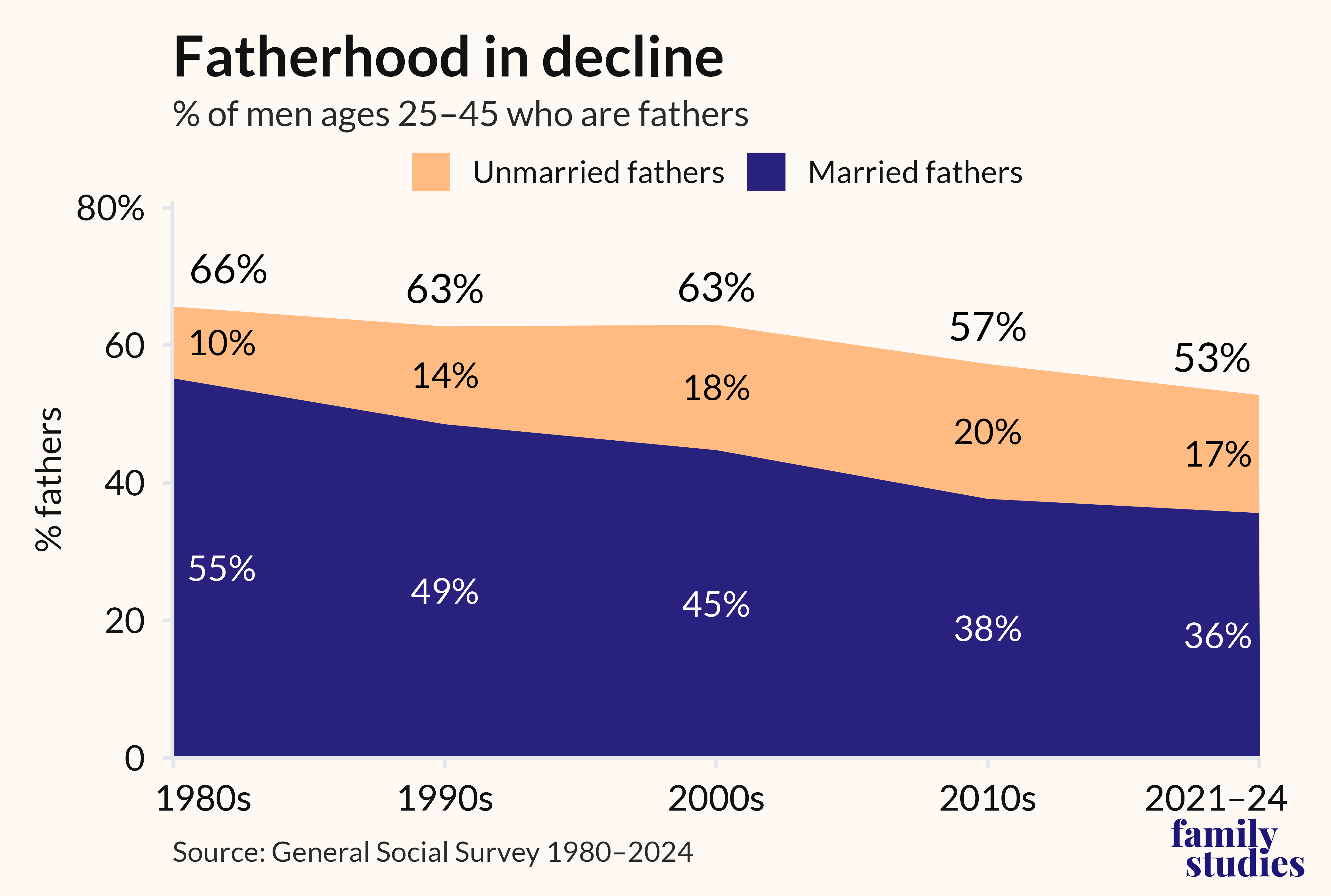
This Institute for Family Studies (IFS) report spotlights the growing share of men who are not crossing the threshold into fatherhood, the ways age, class, and culture shape entry into fatherhood today, and the likely consequences of declining family formation among men for them and the nation. We draw on the General Social Survey (GSS), a decades-long survey of American adults run by NORC at the University of Chicago. For this analysis, we focus on American men ages 25 to 45. Data from the Human Fertility Collection suggests that over 80% of births are fathered by men between these ages. While the average age at childbirth is rising, and many men are delaying fatherhood, fertility data suggests younger cohorts will see higher rates of childlessness. We include younger men in our sample to see which groups are most likely to be affected by these projected declines in fatherhood.
Declines by Age
Declines are most prominent among younger men. Whereas the majority of men ages 25–35 were fathers in the 1980s, just 38% are today. Part of this story is delayed parenthood. The average age of new fathers has been rising for decades, alongside that of women.
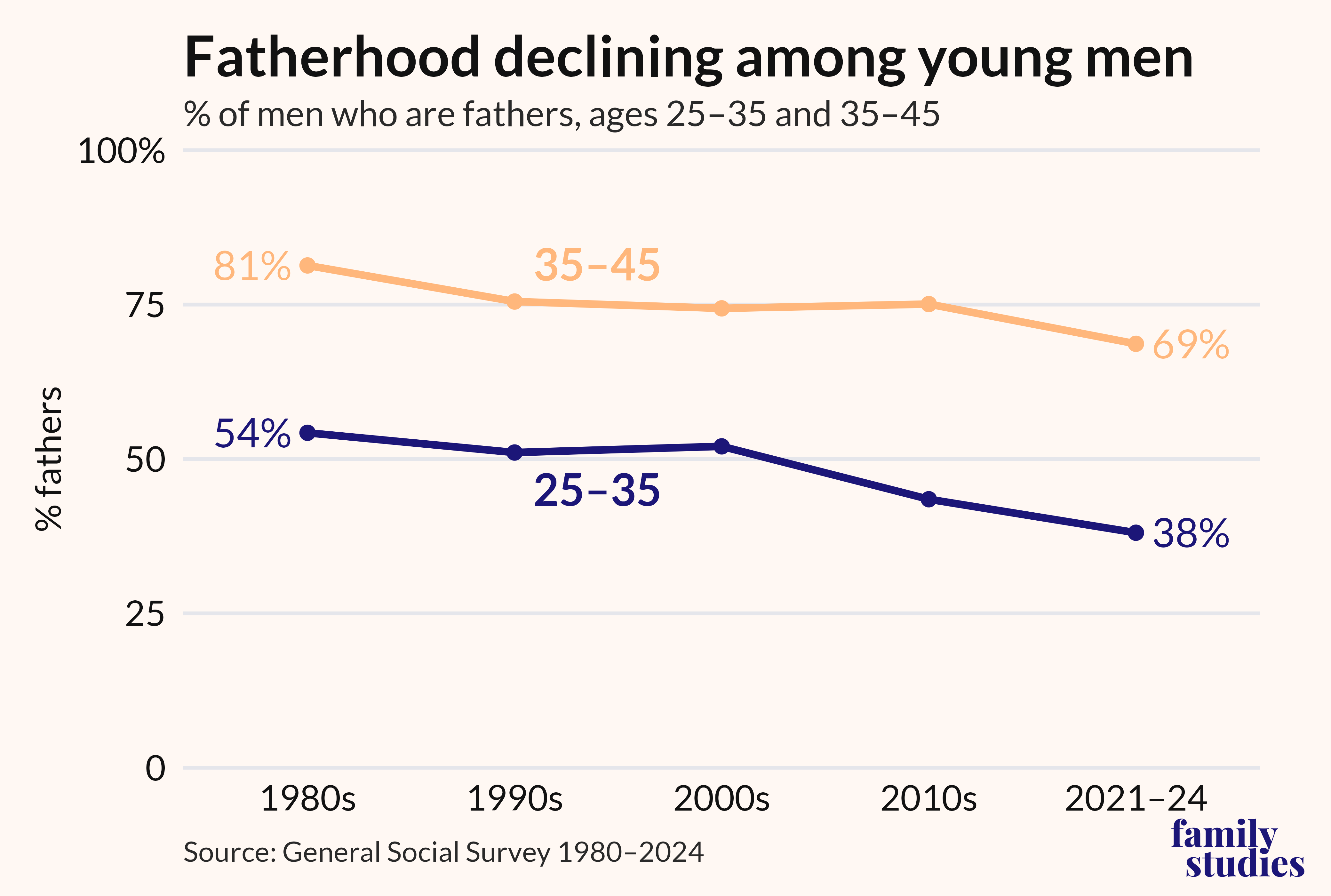
But delayed fatherhood isn’t the whole story. An analysis of the latest birth rate trends by IFS Senior Fellow Lyman Stone suggests that 1 in 4 young women today will never have children, up from the 15% historic baseline. This dramatic rise in childlessness will be paralleled among today’s young men.
Declines by Education
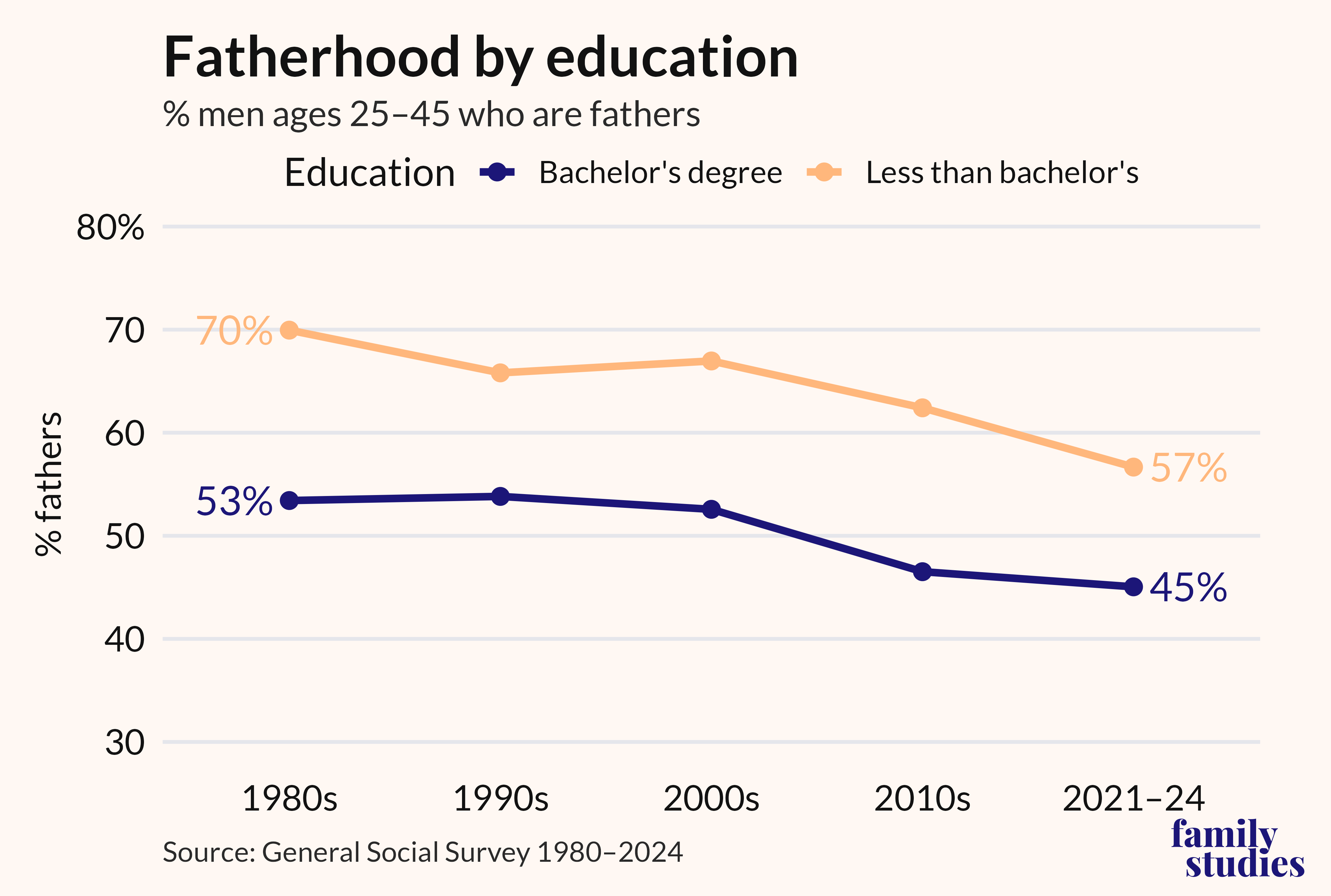
Historically, men in their prime family building years without a college degree were much more likely to be fathers than their college-educated peers. In the 1980s, 70% of men between 25 and 45 who did not have a bachelor’s degree were fathers, compared to just 53% of those with a higher degree. Today, 57% of men between ages 25-45 without a college degree are fathers, a 13-percentage-point decrease from the 1980s. Although less-educated men are still more likely to be fathers, they have seen larger declines than the college-educated. The share of college-educated men who are dads has only fallen by 8 percentage points.
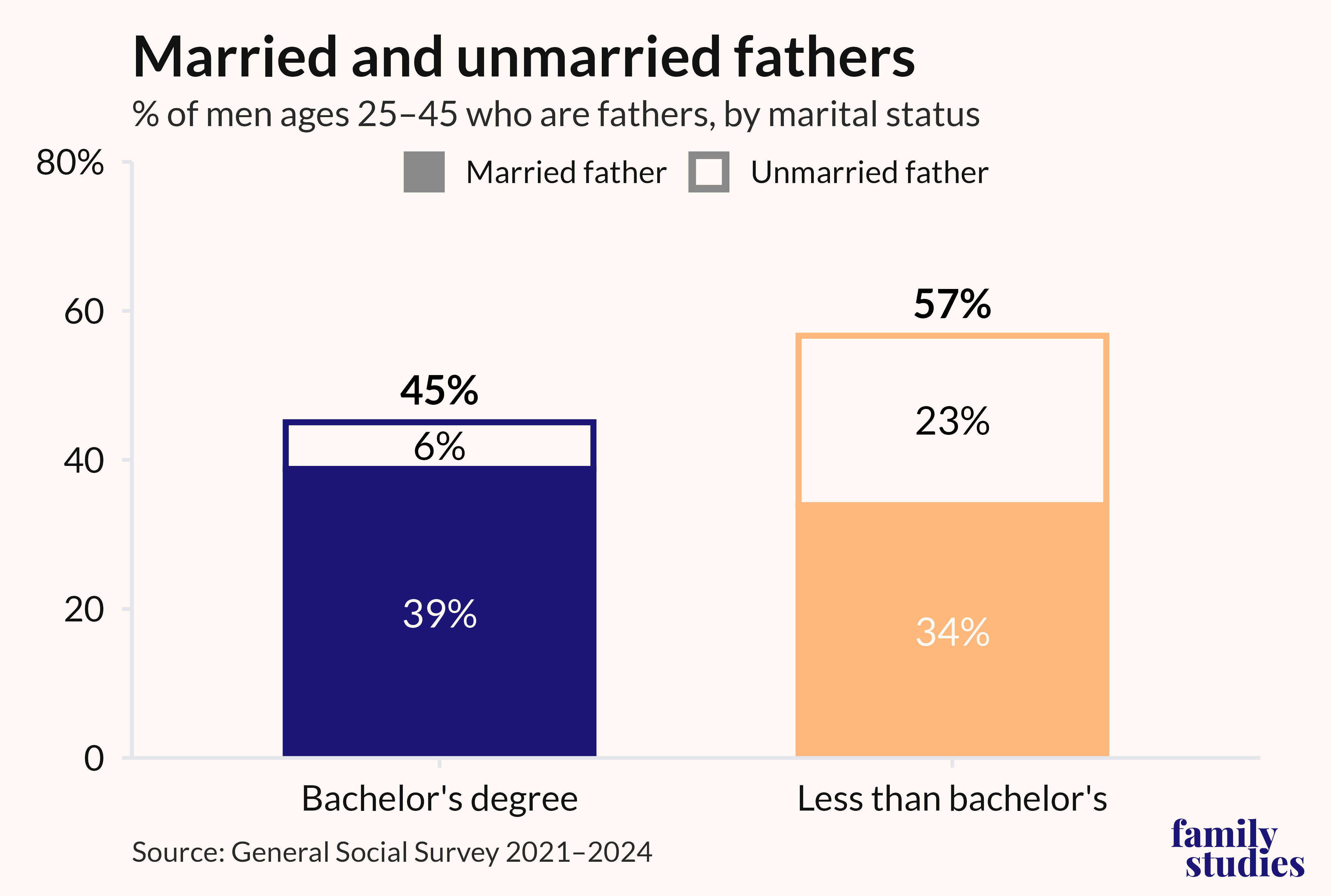
Over the past few decades, the connection between marriage and fatherhood has also changed among working-class men. In the 1980s, the vast majority of working-class dads were married: 58% of less-educated men between ages 25 and 45 were married fathers—just 12% were unmarried with children. But unmarried fatherhood has risen since then, while married fatherhood has declined for this group of men. Today, 34% of working-class men between ages 25 and 45 are married fathers, and 23% are unmarried fathers.
By contrast, unmarried fatherhood remains just as rare among well-educated men today, at just 6%, as it was in the 1980s, at 5 percent. This means that declines in fatherhood among college-educated men are almost entirely declines in married fatherhood.
Declines by Ideology
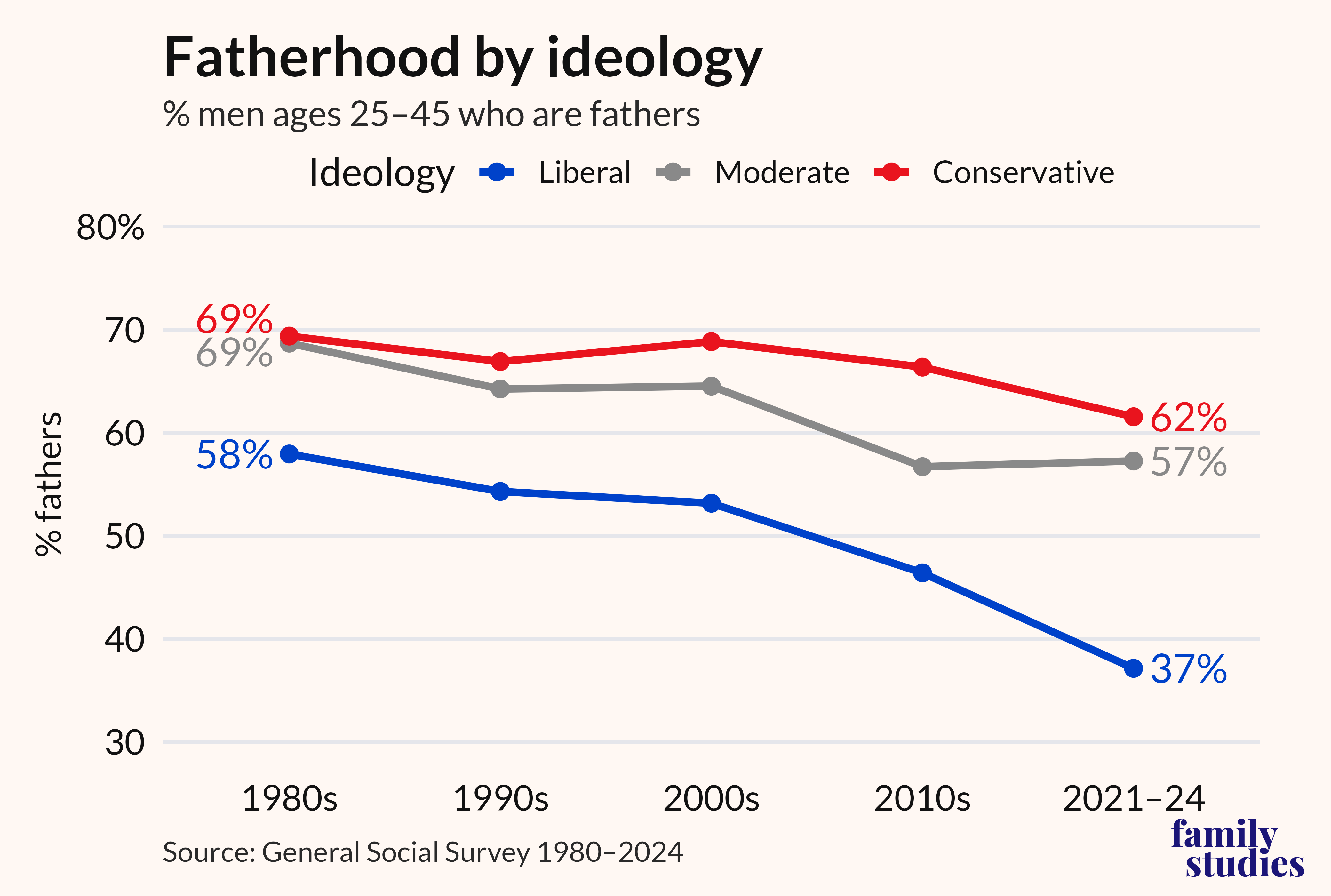
Class disparities in family formation get plenty of coverage. But today, cultural factors—ideology especially—are stronger predictors of entry into fatherhood than class. Using the latest GSS data, we find that just 37% of liberal men ages 25–45 are fathers, compared to 62% of their conservative peers. That 25-percentage-point gap dwarfs the 12-point gap between college-educated and less-educated men.
Today, cultural factors—ideology especially—are stronger predictors of entry into fatherhood than class.
The divergence has widened sharply over time. Liberal men have seen fatherhood rates fall 21 percentage points since the 1980s—down from 58%—while fatherhood among conservative men has declined only 7 percentage points. When it comes to predicting which men are becoming fathers today, culture looks more determinative than class.
There is little difference between married and unmarried fatherhood across ideological lines. We find that, today, 68% of liberal fathers between ages 25 and 45 are married, compared to 72% of conservative fathers. These differences are statistically insignificant. It should be noted that conservative men have seen a substantial increase in unmarried fatherhood since the 1980s, rising from 1 in 10 to around 1 in 4 fathers ages 25 to 45.
Declines by Religiosity
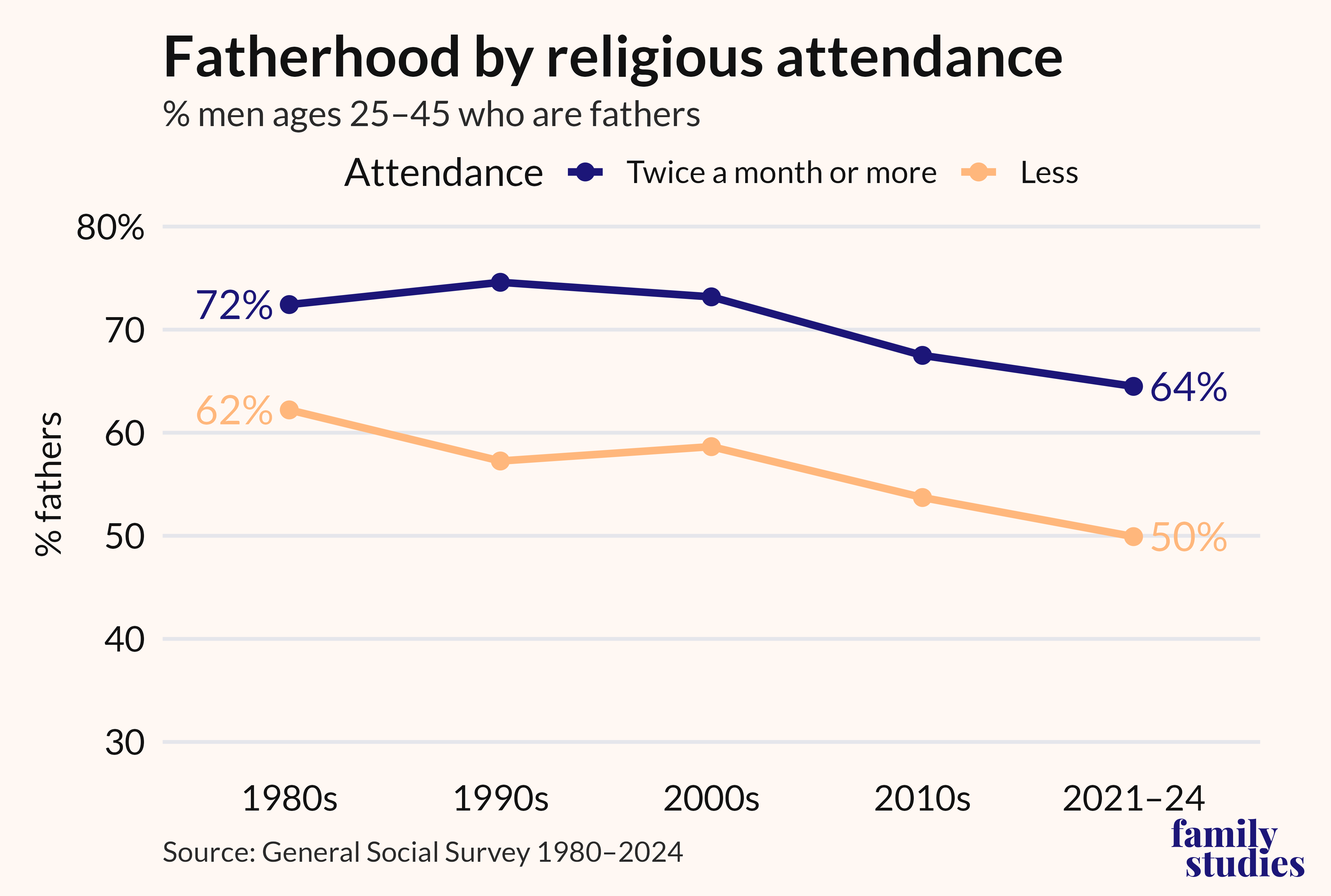
Religiosity, measured by religious attendance, is another strong predictor of who is a father in America today. The latest data shows that 64% of men between ages 25 and 45 who frequently attend religious services are fathers. Just half of secular men in that age range have children. Both groups, notably, have seen similar declines in fatherhood in recent years.
Men Without a Mission
After surveying dozens of cultures, the anthropologist Margaret Mead concluded that masculinity is not a natural state but a social accomplishment. Cultures had to work hard to channel men’s talents, energies, ambitions, and interests in prosocial directions. In Male and Female , published in 1949, she further argued that fostering prosocial masculinity was inseparable from family life—because “every known human society rests firmly on the learned nurturing behavior of men.” So long as it is tied into the fabric of family life, fatherhood, in her view, gives men something few other institutions can: a clear mission in life.
Half a century later, Nobel laureate George Akerlof made a similar case from economics. In his 1998 paper “Men Without Children,” he concluded that without the responsibility and commitment that marriage and fatherhood demand, men often tend to drift—toward atomization, idleness, and higher rates of crime and substance abuse. Recently, USC psychologist Darby Saxbe put the positive case well in the New York Times: engaged fatherhood cultivates in men “strength coupled with a willingness to look out for the young and vulnerable, to teach but also listen, to lead by example, to tackle daunting challenges and to persevere with grit.”
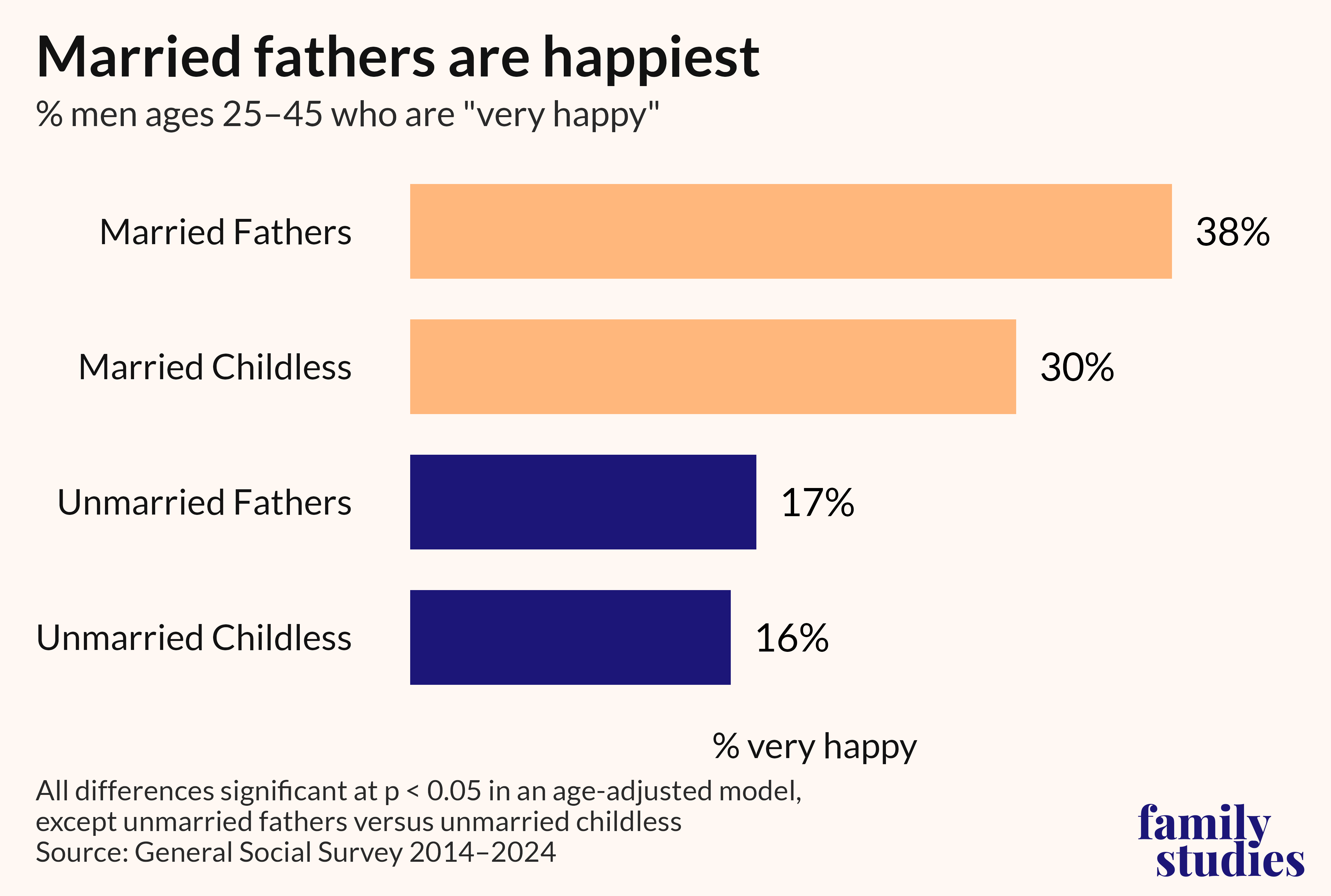
There is no question that some men do not seem to require the disciplines of family and fatherhood to thrive—work, or sport, or faith is enough to orient these male lives in meaningful and fulfilling ways. But contemporary research confirms the wisdom of Akerlof, Mead, and Saxbe: for most men, life is better when it is grounded in family and fatherhood. Men without children are typically living lives that are lonelier, less purposeful, and less happy than their peers who are engaged fathers—most typically in the context of marriage. Indeed, there is no question that married fathers are the happiest men in America today—they are more than twice as likely to be “very happy” with their lives, compared to their peers who are childless and unmarried.
The evidence, in short, suggests that separating men from marriage and family is bad for men—and, likely, bad for the country. That’s because such men are significantly more likely to succumb to idleness, crime, and deaths of despair. And if current trends hold, it is younger, less-educated, liberal, and secular men who will pay the steepest price for the rise of the Vanishing American Father.
Grant Bailey is a Research Fellow and IFS Insights Editor at the Institute for Family Studies.
Brad Wilcox is Melville Foundation Jefferson Scholars Foundation University Professor of Sociology and Director of the National Marriage Project at the University of Virginia, Future of Freedom Fellow and Director of the Get Married Initiative at the Institute for Family Studies, and a nonresident senior fellow at the American Enterprise Institute.
*Photo credit: Shutterstock