
Highlights
- Stay-at-home mothers are less likely to have experienced a major depressive episode (about two-thirds as likely, in fact) than women who are not stay-at-home mothers. Post This
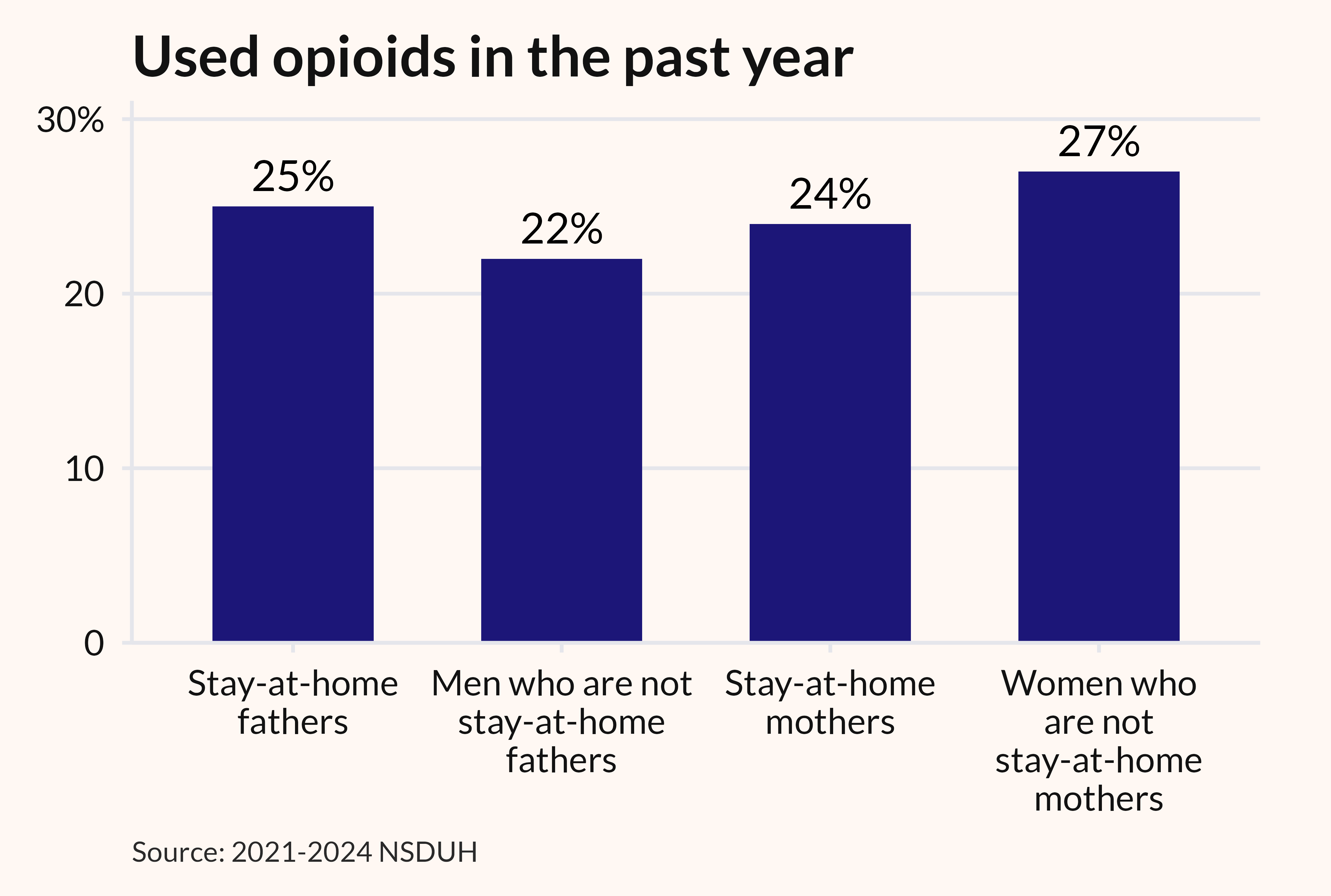
- Women who are not stay-at-home mothers are more likely to use prescription drugs, such as opioids, per the NSDUH. Post This
The classic, gendered trope of the depressed, anxious, stay-at-home mother is an old one. In her landmark book The Feminine Mystique Betty Friedan called it “the problem that has no name,” arguing that mid-century housewives were functionally unhappy because they were out of the employed labor force. This trope is so classic at this point that it is hardly even disputed, and is part of the popular culture air, from Betty Draper in Mad Men to the litany of movies that patently deprecate the suburban housewife, including Stepford Wives, Edward Scissorhands, and Pleasantville, along with common “stay-at-home mother” exposes. As Lyman Stone has reported on these pages, policy commentators often take it as a given that stay-at-home mothers are emotionally unfulfilled.
But is this true? Are housewives particularly prone to depression and unfulfillment? Is there something about the stay-at-home lifestyle that makes one particularly sad?
While prior IFS research has shown that married mothers are happier than other demographics of women, less research has been done on stay-at-home mothers, in particular. This is not just a theoretical question. In a time of cratering births, the full-time parenting option might make more logistical sense for larger families who can afford it, and disparaging the stay-at-home lifestyle makes replacement fertility or above an even more uphill battle than it needs to be. Unfortunately, the literature on stay-at-home mothers is a fraction of the size of the literature on employed mothers (although one paper I published showed that stay-at-home mothers are as satisfied with their work as employed mothers).
To help answer this question, I drew on perhaps one of the most comprehensive datasets for the drug- and emotional-health-related variables that tap into this stereotype: The National Survey on Drug Use and Health covers a gamut of behaviors traditionally associated with stay-at-home parenting, such as drug use, suicidality, and depression.
I focused on three-to-four years (depending on the variable) of pooled data: 2021-2024. To focus on the non-retired, childrearing-age population, the sample includes 18 to 49-year-olds. This leads to a sample of 144,383 for all four years, and 107,781 for the three-year variables. While the tropes and stereotypes almost exclusively deal with women, I examine both men and women for this analysis. Homemakers are identified as people who indicated that they are “keeping house full-time” and who have at least one child under 18 in their home.
The Mental Health of Stay-At-Home Parents
The NSDUH survey asked whether respondents had experienced a major depressive episode in the past year (see figure below).
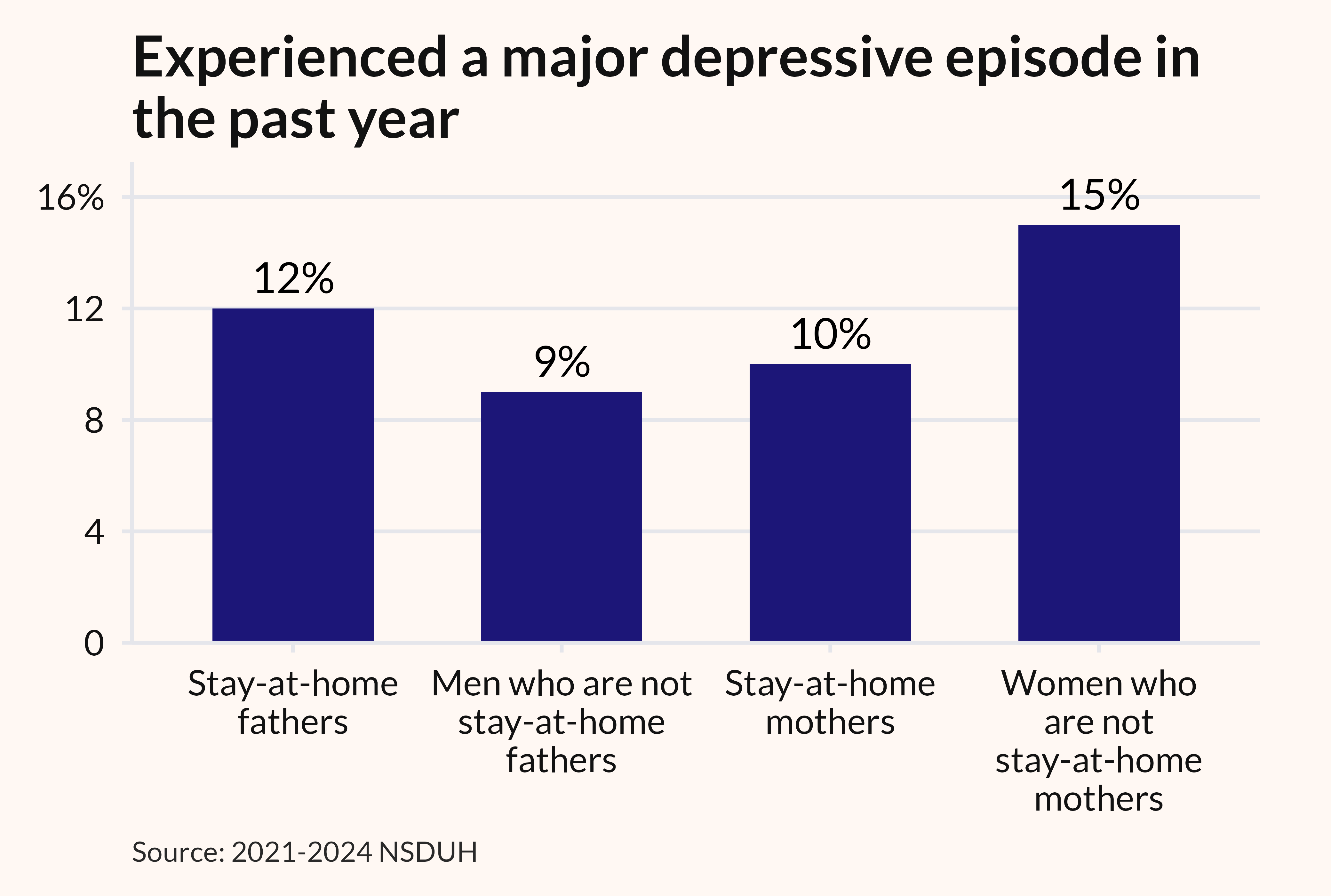
As the figure shows, stay-at-home mothers are less likely to have experienced a major depressive episode (about two-thirds as likely, in fact) than women who are not stay-at-home mothers. It is worth noting here and in the other comparisons that the reference group is all other women, including students, unemployed women, part-time workers, and full-time workers. Therefore, highlighting positive results for the stay-at-home option in order to counteract stigma is not implicitly attacking the career option that some may also choose.
What about suicide? In the critically acclaimed film, The Hours, Julianne Moore plays an unhappy housewife who plans out her death in a hotel room with a bottle of pills. In the first episode of “Desperate Housewives,” the domestically capable narrator just can’t take it anymore and takes her own life.
Again, how common is this? In fact, about 7% of both stay-at-home and non-stay-at-home men had suicidal thoughts in the past year. For stay-at-home mothers, it was 5% versus 8% for their non-homemaker counterparts. So, while there are suicidal homemakers, homemakers are actually much less likely to consider taking their own life.
It is worth noting that mental health is not simply the absence of problems, it is also the presence of positive emotions like happiness, and Lyman Stone has shown that stay-at-home mothers are as happy as their employed counterparts.
Are Stay-at-Home Parents More Likely to Use Drugs and Wine?
To use another example from "Desperate Housewives," Lynette Scavo is so exhausted by her maternal responsibilities that she steals her children’s ADHD medication to be able to cope with domesticity. The substance-using, stay-at-home mother trope is evidenced by the popular term “wine mom,” which conjures up images of women imbibing substances to be able to cope with the hollowness and demands they experience as a stay-at-home parent.
Certainly, there are some mothers who struggle with these issues, as Erica Komisar recently noted on these pages. But is this really a common problem among stay-at-home parents?
The NSDUH defines psychotherapeutic medication as “use of prescription psychotherapeutic medication (pain relievers, tranquilizers, stimulants, or sedatives) for any reason. This could include use of prescriptions of one’s own as directed by a doctor or misuse of these medications.”
So, according to the NSDUH survey, are stay-at-home mothers in general popping Adderall pills to deal with the stresses of parenting? In fact, 32% of stay-at-home mothers have taken psychotherapeutic medication in the past year, while 38% of non-stay-at-home mothers have. (For men it is 33% and 31%, respectively). By far, women who are not stay-at-home mothers are the most copious users of prescription “pain relievers, tranquilizers, stimulants, or sedatives.”
When we look at just opioids in particular, the story is much the same:
Finally, a direct test of the “wine mom” stereotype. When they were asked how many days in the past 30 days they had one or more drinks:
- Stay-at-home fathers and men who were not stay-at-home fathers reported drinking about 4.5 days (4.5 and 4.6, respectively).
- Stay-at-home mothers drank one day less than women who were not stay-at-home mothers (2.4 vs. 3.5).
Conclusion
The existential questions posed by Friedan can be reformulated to fit just about any role. As she wrote:
Each suburban wife struggled with it alone. As she made the beds, shopped for groceries, matched slipcover material, ate peanut butter sandwiches with her children, chauffeured Cub Scouts and Brownies, lay beside her husband at night—she was afraid to ask even of herself the silent question—'Is this all?’
This famous quip from Friedan could be easily tweaked to apply to any woman (or man), including those who work full time. The fact is that depression, suicidality, and drug and alcohol use are certainly not limited to stay-at-home mothers (or parents), and, in fact, they are less likely to suffer from these things, contrary to popular second-wave feminist stereotypes.
Stephen Cranney is a data scientist who occasionally teaches at the Catholic University of America.
Editor's Note: The opinions expressed in this article are those of the author and do not necessarily represent the views, policies, or positions of the Institute for Family Studies.
*Photo credit: Shutterstock


