

Highlights
- There’s an increasingly strong link between how quickly an area adopted 4G and lower marriage rates for the non-college-educated men (but not college grads) who live there. Post This
- The increase in men’s screen time during the smartphone era has mostly displaced time with friends and other forms of leisure, impacting marriage rates. Post This
Young men, especially those without a college degree, have been working less, marrying less, and spending more time on screens. Researchers have been puzzling over how these trends relate to each other, and Nathan Hudson and Hernan Moscoso Boedo—two economists from the University of Cincinnati—provide a fresh look at the issue in a new working paper.
Their narrative goes something like this: The increase in men’s screen time during the smartphone era hasn’t come directly at the expense of work. Instead, it mostly displaced time with friends and other forms of leisure. These shifts in social dynamics, in turn, seem to have reduced marriage rates, especially for men who were less marriageable to begin with. On top of that, since married men have always worked more than single men, reducing marriage rates eventually reduces men’s work, too.
The authors admit this is only a partial explanation for everything that’s been happening with young men—which is good, because declining work and marriage are both trends that started well before the advent of the iPhone. They’re also careful to present their findings as supportive and suggestive evidence for a theory, rather than definitive proof.
Let’s take a closer look at how they get from Point A to Point B, as there’s a lot going on here.
Hudson and Boedo start with some straightforward numbers. In the mid-2000s, for example, about 32% of non-college-educated men ages 21 to 30 were married, which fell to 21% in the late 2010s. By itself, more men remaining in the unmarried category—where non-work has long been more common—statistically explains around a third of the drop in labor-force participation during the same period. Incidentally, the opposite happens for women, who tend to work for pay less after marrying and having kids; the decline of marriage thus “redistribute[es] labor supply across the genders.”
But why a decline in marriage to begin with? The authors have a clever way to see if changing technology has something to do with it.
They focus on one development in particular: The rise of 4G mobile internet, which drastically improved web access on smartphones. Importantly, 4G rolled out earlier in some places than others, starting in December of 2010. Depending on both when and where you lived, your formative years might have been free of 4G or practically defined by it.
Hudson and Boedo use 4G deployment as of 2013 as a measure of which “commuting zones” (cities and their surrounding areas) adopted the technology quickly and which lagged. Then they turn to the American Community Survey (ACS) to see how the most- and least-exposed groups fared.
The upshot is that 4G seems to reduce marriage—or at least delay it. Starting with the cohorts that came of age after the technology debuted, there’s an increasingly strong link between how quickly an area adopted 4G and lower marriage rates for the non-college-educated men (but not college grads) who live there.
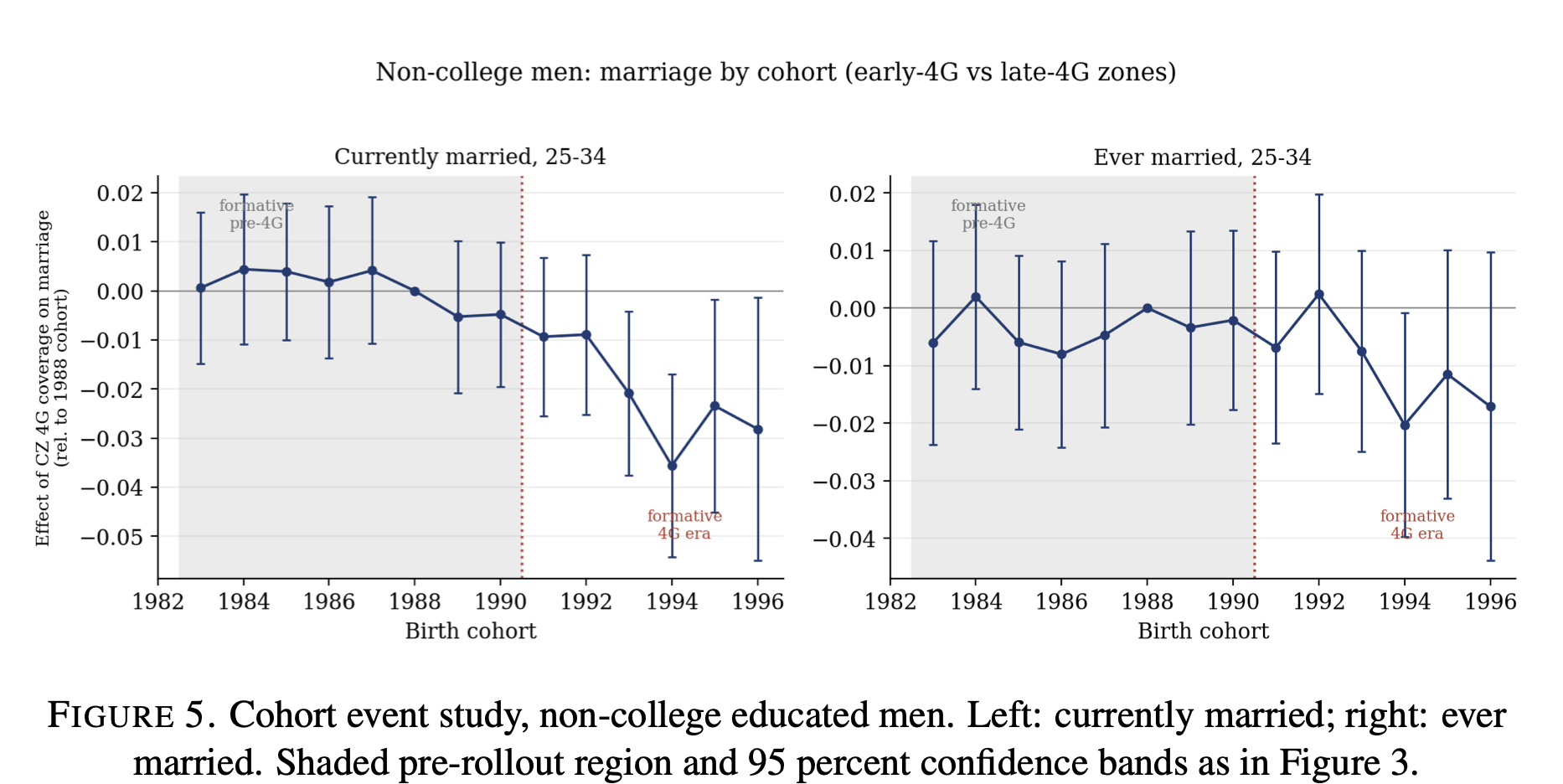
Source: Nathan Hudson and Hernan Moscoso Boedo, “Disengaged: Digital Life, Marriage, and the Young Male Labor-Force Decline,” working paper, July 21, 2026.
As noted above, the decline of marriage and work are long-running trends—smartphones, much less 4G specifically, can’t be the whole explanation. But 4G is just one chapter of a very long story about Americans becoming more connected to technology, less connected to other people, and more absorbed in screens of all kinds. If 4G really reduced marriage, similar tech developments both before and after it could have easily had similar effects. Recent survey work here at IFS revealed that nearly a quarter of young men are now gambling daily, more than two in five watch porn every day, and about the same share play video games daily.
Guys don’t quit their jobs to play Fortnite and stare at their phones, but these habits do hold up their relationships, especially if they weren’t great catches to begin with.
To shed some more light on why technology and marriage might be linked, the paper features some interesting analysis of the American Time Use Survey, in which respondents report a detailed diary of what they did on a single day.
While some have blamed video games for the decline in work among less-educated men, for the most part, the extra time that single men are spending alone with their screens is not taking them away from work, the authors report—it's taking them away from other forms of leisure like TV, as well as time with friends. (Interestingly, solitary screen leisure increased far less among women and married men.) This would be consistent with screen time having a direct effect on men’s social lives, but more of an indirect one on work.
In other words, guys don’t quit their jobs to play Fortnite and stare at their phones, but these habits do hold up their relationships, especially if they weren’t great catches to begin with (some might say “duds”). This stops them from marrying, taking on more responsibilities, and eventually working harder as a result. Of course, one might also ask if 4G and smartphones affected how women approach dating and evaluate potential partners, which the paper does not go into.
This is a working paper with a lot of caveats, studying a tangle of issues where causation can run in a lot of different directions at once. So we should not take its findings as gospel. But the study joins a growing body of research concerned with the effects of smartphones on young Americans’ social lives, school performance, and mental health.
Earlier this year, as the authors note, other researchers used the iPhone’s exclusivity deal with AT&T to study smartphones’ effects on fertility—much the way the new study leverages the spread of 4G to study marriage—finding that births fell disproportionately in AT&T’s coverage window, but not in those of competing services.
Instant connectivity clearly has its attractions; smartphone adoption wouldn’t be above 90% otherwise. But there’s a lot we’re giving up when we put technology in the driver’s seat of our lives.
Robert VerBruggen is a senior fellow at the Manhattan Institute.
Editor's Note: The opinions expressed in this article are those of the author and do not necessarily represent the views, policies, or positions of the Institute for Family Studies.


