
Highlights
- About two-thirds of the cohort fertility rate in Finland was due to births in unions with at least one highly-educated partner. Post This
- Researchers found that the more highly-educated couples in Finland contributed more to cohort fertility because there were more of these couples and their unions lasted longer. Post This
Education is an important predictor of fertility. That's because people who are studying are more likely to postpone having children until after they graduate, and the age at which people begin having children can influence how many children they eventually have. This is particularly the case for women, since female fertility declines with age more rapidly than male fertility.
Yet most of the literature on fertility examines the effects of individual education on fertility. There is much less research on how the educational pairing of parents influences how many children they have. The research that does exist on this topic usually examines couples in a particular time period and is based on data from a sample of the population and not the whole population itself.
The Scandinavian registries—which follow all individuals in the population of countries like Finland, Denmark, and Norway throughout their lives—offer a unique opportunity to see how couples’ educational pairing—and the time spent in each type of pairing—influence the fertility of an entire cohort of individuals born in the same years. A new study by Linus Andersson and coauthors leverages the Finnish registry data on all women born in 1969 through 1975 and examines their fertility until the age of 45 to determine how the experience of different educational partnerships influenced the number of children born to this cohort of women.
Finland is a good test case since it was at the forefront of trends that now influence almost all developed nations. Relative to other European countries, Finland had an early expansion of tertiary education, so that by 2021, nearly 50% of the population had a college degree or higher. It was also one of the first countries to see the reversal of gender inequality in education—that is, the switch from men being more educated on average to women being more educated. In this respect it is comparable to the U.S., where in 2024, 40.1% of women and 37.1% of men ages 25 and older had a bachelor’s degree or higher. Like other developed nations, it also has seen a recent increase in childlessness to about 19% for women, a little higher than the current rate in the U.S. which is about 15 percent. Because it was in the forefront of these trends, examining Finland can give us insight into the long-term effects of these trends on fertility.
In this study, a partnership was measured as either a marriage or cohabitation. Educational pairing was measured using the highest level of education of each individual in the couple during the time they remained together. Educational attainment was measured as high (tertiary education), medium (high school and/or vocational training), and low (less than a high school education).
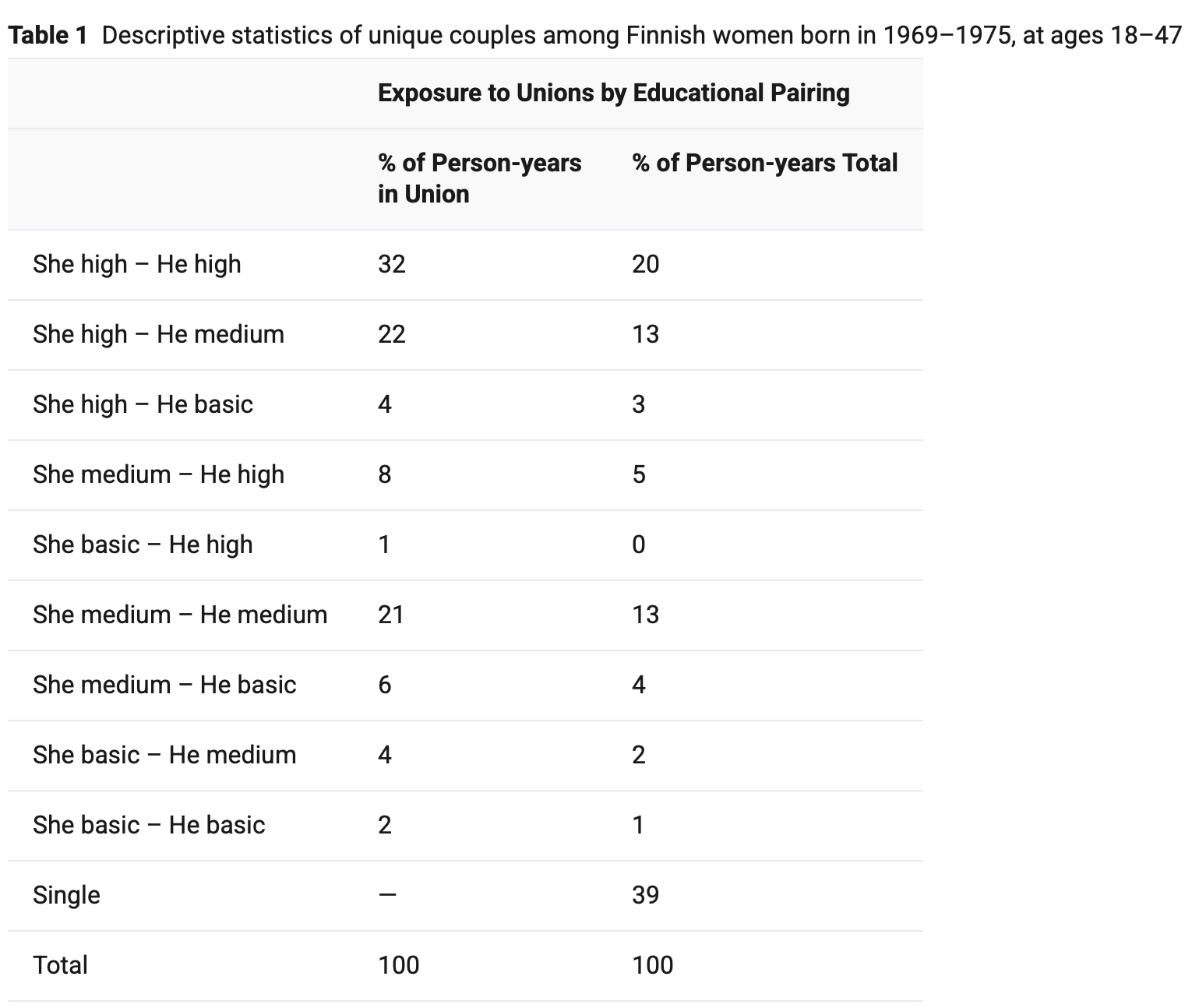
The study found that in this population, the most common and durable unions1 were those in which both partners had high levels of education, followed by couples where the woman had a high level of education and the man a medium level of education, followed by couples where both partners had a medium level of education. These three educational pairings were the most common and long-lasting forms of partnership in this cohort of Finnish women. Notably, the traditional partnership of a more highly-educated man with a less-educated woman was much less common.
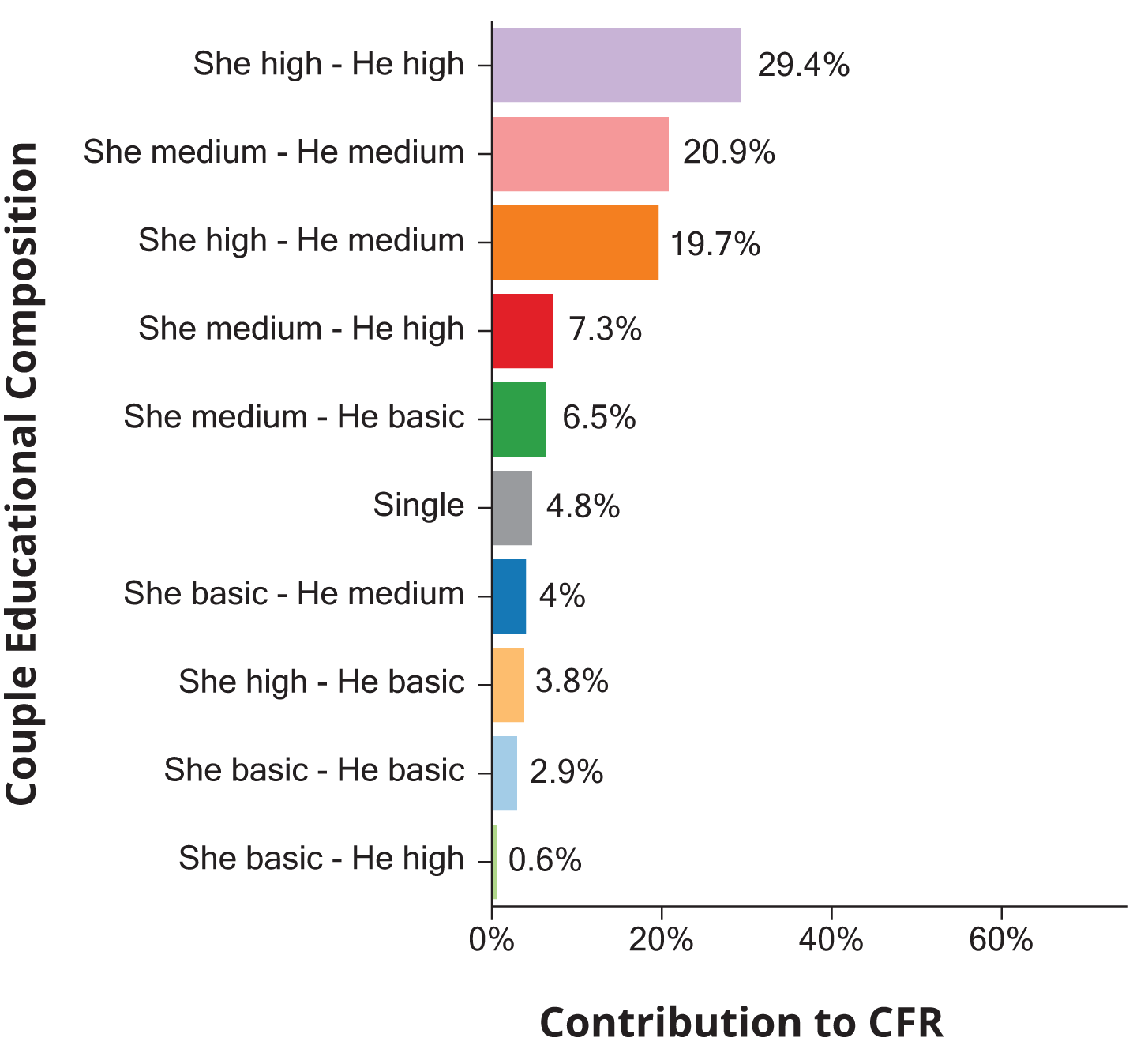
As might be expected, these common and durable relationships were the ones that contributed the most to cohort fertility, as measured by the cohort fertility rate, which is the average number of children born to these women. Slightly less than a third (29.4%) of the cohort fertility rate was due to births in unions where the woman and her partner both had a tertiary level of education. About 21% of births in the cohort came from unions where both partners had a medium education, and about 19.7% of births came from unions where the woman had a tertiary education and the man a medium level. Single women contributed only about 4.8% to the completed cohort fertility rate. Among single women, births were more common to those with a medium level of education (2.4% of total cohort fertility).
Figure 1. Contribution to completed cohort fertility rate (CFR) by age 47 of Finnish women born in 1969‒1975, by couple educational composition
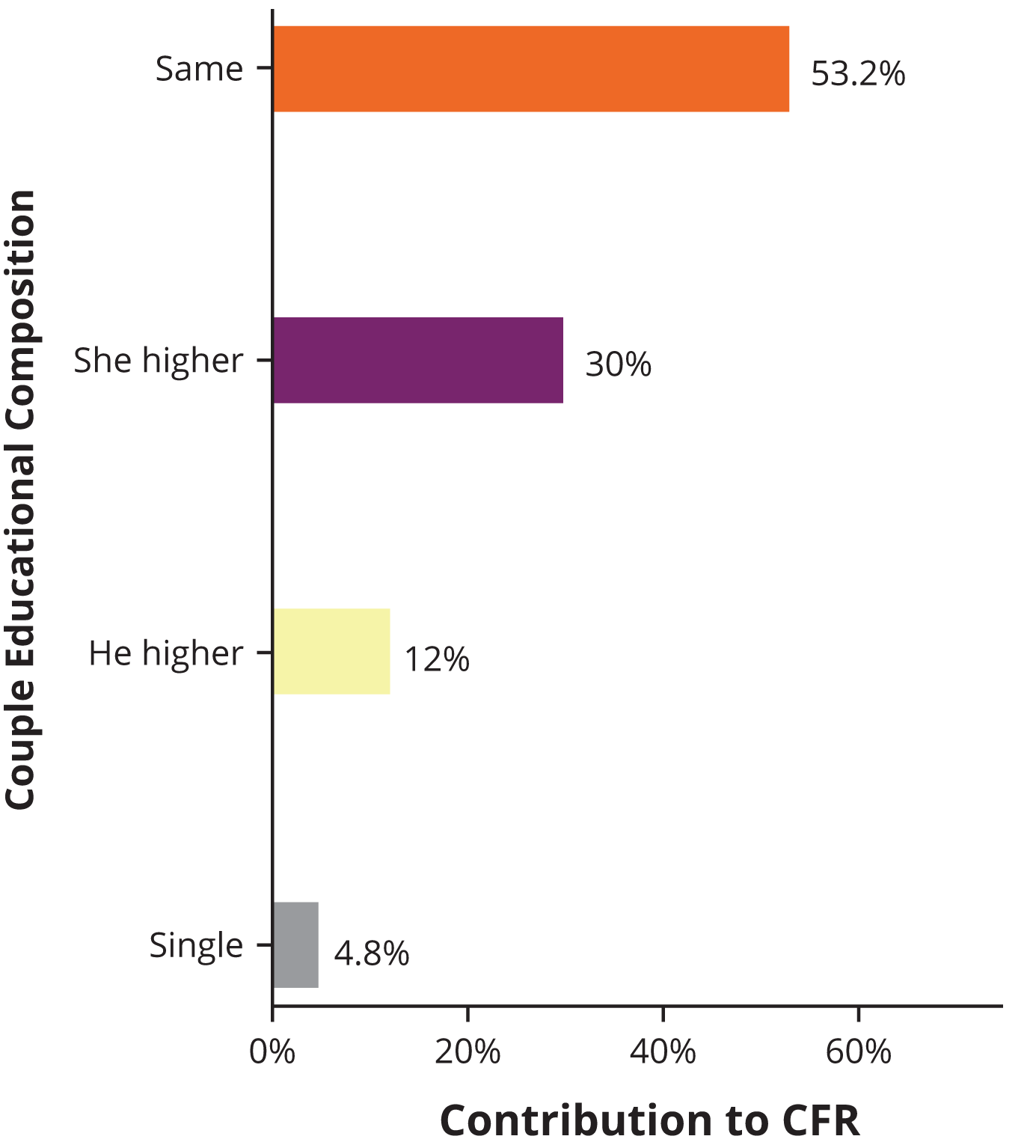
This figure shows that the better-educated couples contributed more to this cohort’s fertility than all others. Overall, about two-thirds of the cohort fertility rate was due to births in unions with at least one tertiary educated partner. These results were found by measuring couple education using the highest level of education of each individual during the time they remained together, but the results were much the same using other methods of measuring the relative education of partners. The researchers also found that the reason that more highly-educated couples contributed more to cohort fertility was that there were more of these couples and their unions tended to last longer, not because they had more children on average.
Figure 2. Contribution to completed cohort fertility rate (CFR) by age 47 of Finnish women born in 1969‒1975, by simplified couple educational composition
There is evidence that this phenomenon—more partnerships and marriages among the better educated and better off, and therefore proportionately more births to those couples—is occurring in most developed countries, not just Finland. In the U.S., there is also evidence of declining marriage among the less educated and peer marriage among the better educated, as previously discussed on these pages.
This research suggests that as education becomes more important for both economic success and family formation, the educational characteristics of couples—not just the education of individual women—are likely to be increasingly important for understanding fertility. Who partners with whom, and how long those partnerships last, may be just as important for fertility as the education of either partner alone.
Rosemary L. Hopcroft is Professor Emerita of Sociology at the University of North Carolina at Charlotte. She is the author of Evolution and Gender: Why it matters for contemporary life (Routledge 2016), editor of The Oxford Handbook of Evolution, Biology, & Society (Oxford, 2018), and author (with Martin Fieder and Susanne Huber) of Not So Weird After All: The Changing Relationship Between Status and Fertility (Routledge, 2024).
*Photo credit: Shutterstock
1. As measured by the number of years women spent in each type of partnership.


