Highlights
- Spouses who don’t share a surname divorce at about a 50% higher rate than those who do share a surname, and their divorces come about 30% earlier in their marriages. Post This
- Among younger women, preferring to keep a maiden name or hyphenate predicts a higher likelihood of believing unhappy couples stick together for too long. Post This
Should a woman take her husband’s last name when she gets married? It’s a hotly contested question today, including this week where it’s been a particular topic of conversation on X. The Pew Research Center suggests that 79% of women take their husband’s last name. Yet while the debate over married names vs. maiden names still rages, online at least, it is rarely informed by actual data. Are couples in which the woman keeps her maiden name or chooses to hyphenate her last name systematically different from couples who share the husband’s surname?
To answer that question, I looked at two sources: first, Pew’s 2023 survey, which asked about surnames but also asked about other family values; second, the state of Texas’ public divorce datafiles include both spouse’s surnames in 2016 and 2017, making it possible to look at divorce among couples who shared a surname before divorce, did not share a surname, or partially shared a surname through hyphenation of one or both couples.
The overall finding from these two surveys is simple: spouses who don’t share a surname divorce at about a 50% higher rate than those who do share a surname, and their divorces come about 30% earlier in their marriages. These huge effects reflect very large selection biases, since who chooses to share a surname in a marriage is not remotely random, and so we can’t say these effects are entirely or even mostly causal. Nonetheless, there are some reasons to believe surname sharing might have some modest causal effects on which couples stay together.
Who Takes His Name?
Does taking her husband’s last name say anything statistically notable about a woman? It turns out, it does. For these analyses, we focused just on women, because Pew did not ask husbands what their wives did.
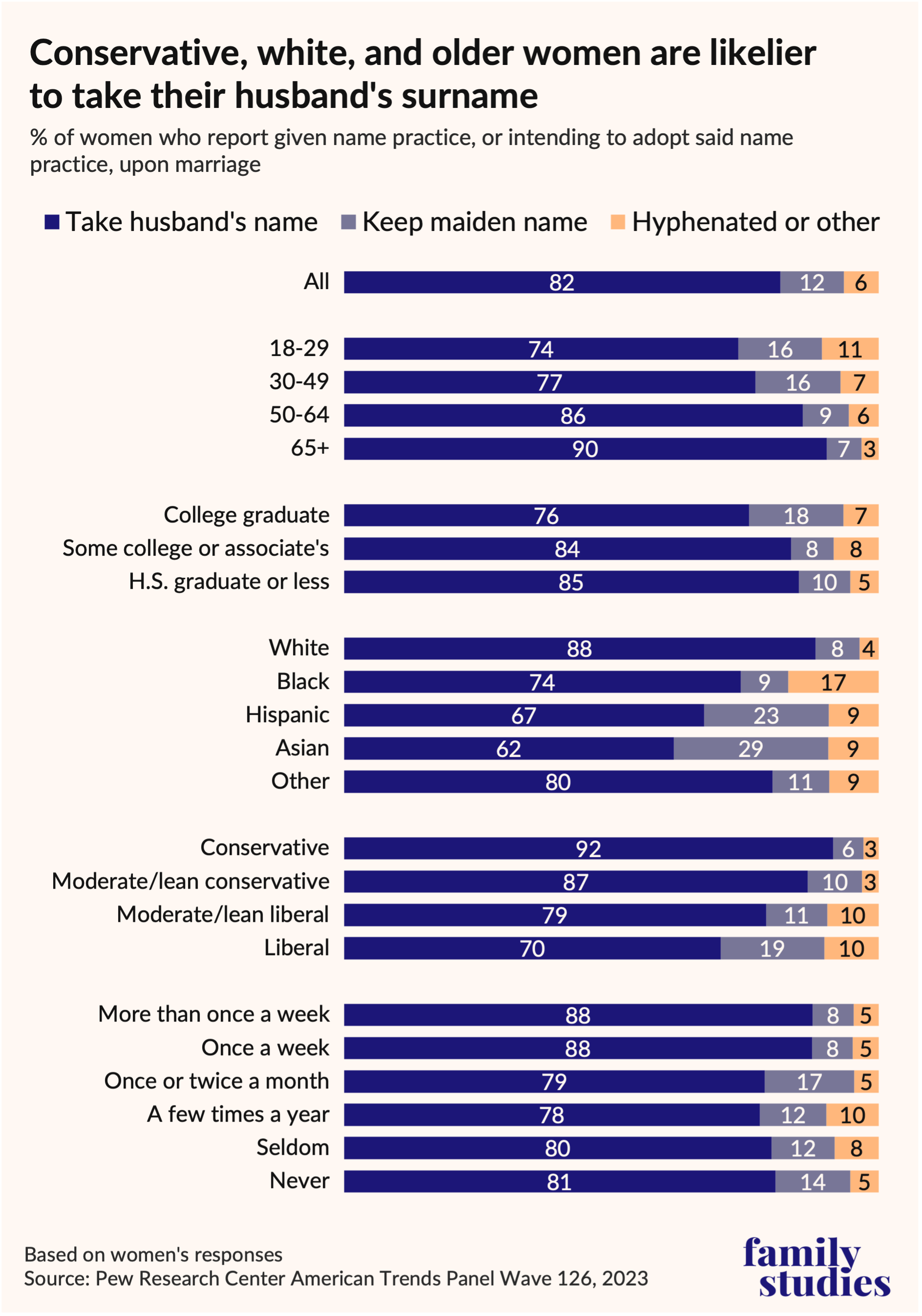
The standout point here is that there are large differences in naming norms by politics, age, and race. While 88% of white women in our analysis took or will take their husband’s name, it’s less than 70% of Hispanic1 and Asian women. And while 92% of conservative women adopt the patronym, just 70% of liberal women do. These gaps are as big or bigger than the observed age gaps, and they parallel gaps observed by my colleague Brad Wilcox in his book Get Married. In a 2022 YouGov survey of married women, he found that more educated, secular, and left-leaning women are less likely to share surnames with their husbands.
But are there differences in how women view divorce based on surname adoption? For the below analysis, we combine women who kept their maiden name with women who hyphenated, in order to simplify analysis and ensure sample sizes are sufficient. Because age is closely related to surname behavior, we stratify the data by women’s ages, looking at attitudes towards divorce within age groups.
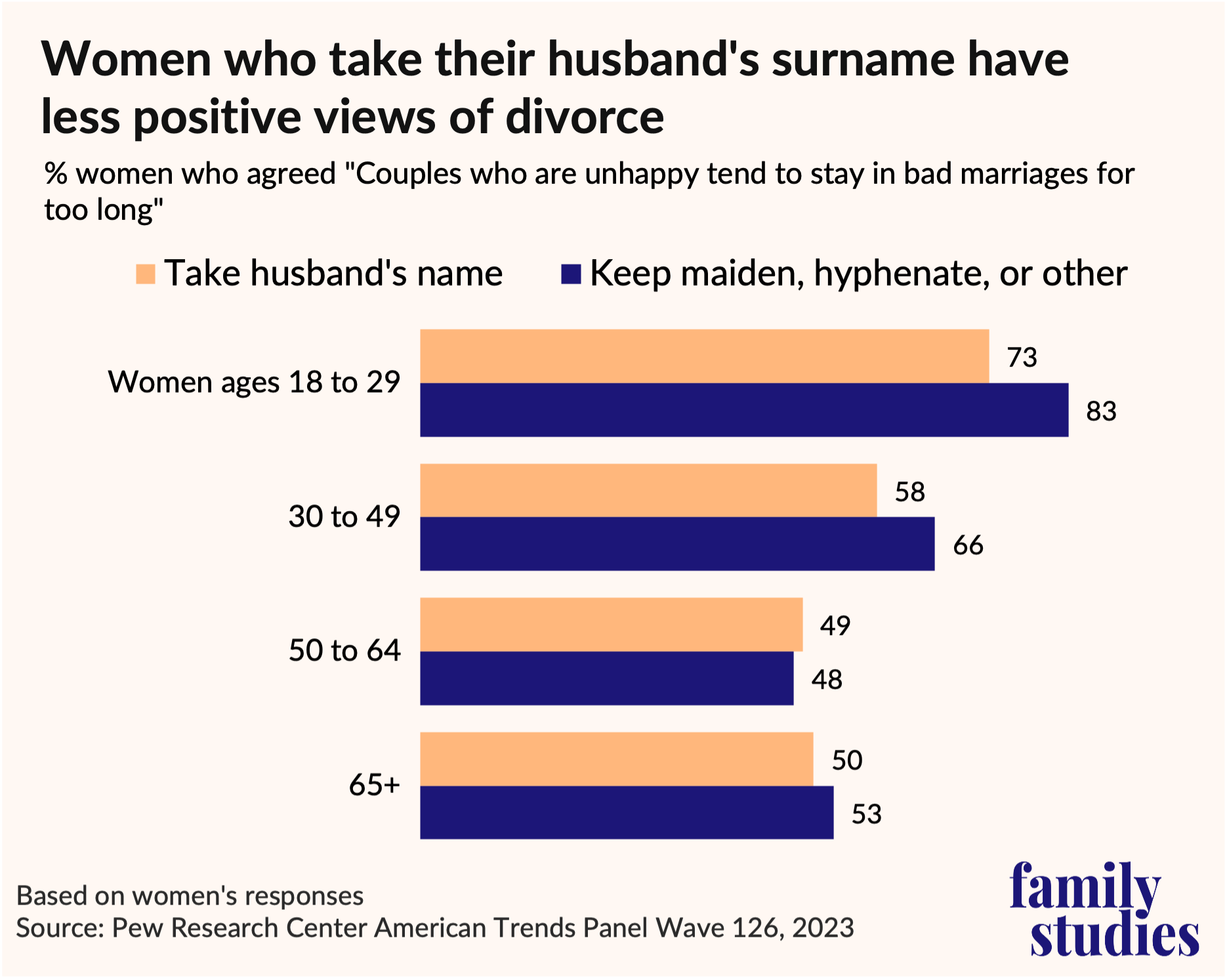
While there is not much difference for older women, among younger women, preferring to keep a maiden name or hyphenate predicts higher likelihood of believing unhappy couples stick together for too long. In Get Married, Wilcox also found that couples who share the same last name are more likely to be happily married and less likely to have plans for divorce.
But do couples who don’t share the same last name actually divorce at higher rates? The evidence suggests the answer is yes.
Couples Who Share a Name Tend to Stick Together Longer
Only one prior study has analyzed divorce rates by surname adoption, and it used a sample of just a few hundred divorce records from one town in Canada. However, the state of Texas makes all marriage and divorce records public in an easily machine-readable format. In the 2016 and 2017 files (the two most recently released), Texas also began recording the surnames of both spouses in all divorces. Because this data also contains information about marital duration and the presence of children, and because names can be used to credibly infer racial-ethnic background in many cases, we can use this data to actually analyze the divorce rates of couples with different naming patterns.
To start, we can just look at duration of marriages before divorce, by naming practice. We cannot technically say if couples who share a surname took the husband’s name—they may have created a joint name or may have taken the wife’s name. But, in most cases, identical surnames are likely to indicate women who took their husband’s surname.
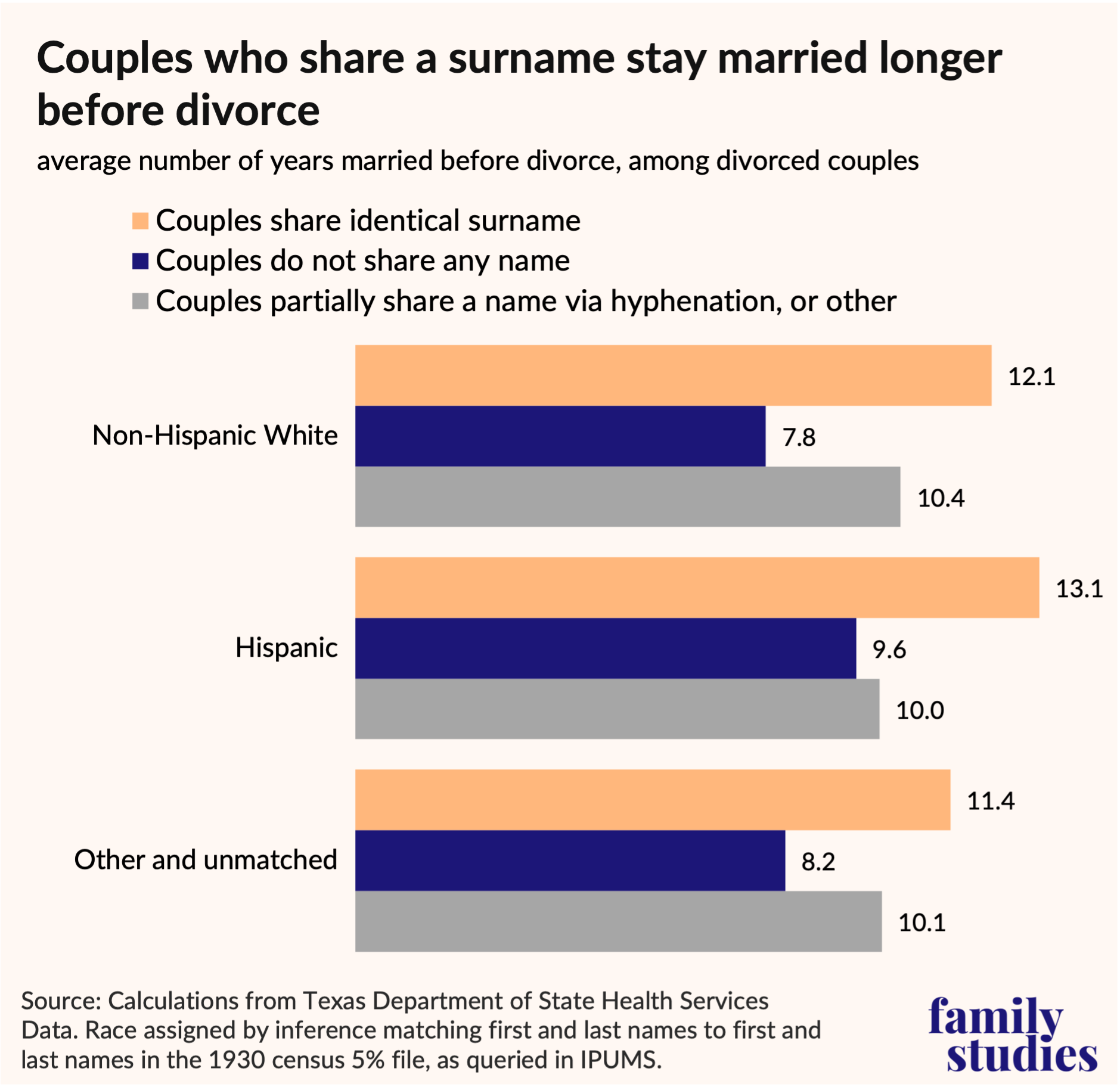
On average, couples who share a name stick together much longer before divorce: about 12 years before divorce, whereas couples with other naming practices tend to make it 8 to 10 years before divorce.
Nor is this explained by children: the following figures shows the duration of marriage before divorce by naming practice and number of children at the time of divorce.
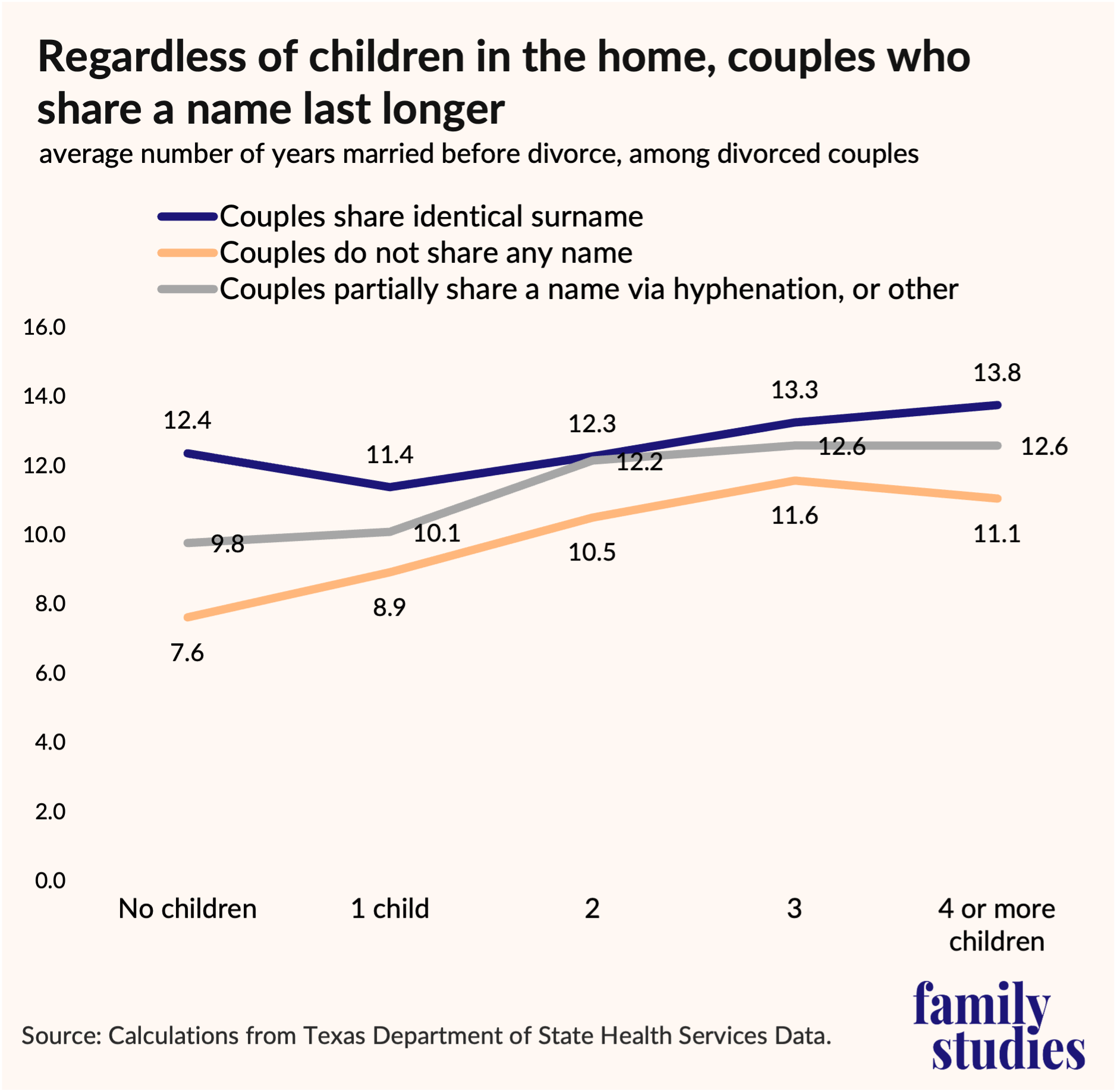
At every family size, couples who share a name stick together longer. Controlling for kids, we can also see that hyphenation falls between the two extremes. This is a strong suggestion that naming practices, like the presence of children, may be a proxy for the extent to which a couple is really committed to one another for the long haul.
But there’s a glaring problem with this analysis: it only looks at couples who got divorced. In some sense, if you’re going to get divorced, it’s not clear doing it after 12 years and two kids is better than after 8 years and no kids.
What about couples who didn’t get divorced at all (at the time of the survey)? This is a much trickier question, since Texas’ marriage index provides bride and groom names before marriage, but it doesn’t tell us anything about their post-marital surname choice, and so we do not have a denominator to use to create an actual divorce rate by surname.
But, we can make a loose approximation using the Pew survey data. Suppose Texas is about like the national average and so has approximately 75-80% of its married couples sharing surnames (we found a value of 77% in the complete data in Pew’s dataset, just a bit below their published estimate of 79%). If divorces of couples with shared names are less than 75-80% of divorces, that would imply that couples with shared surnames have lower divorce rates on average.
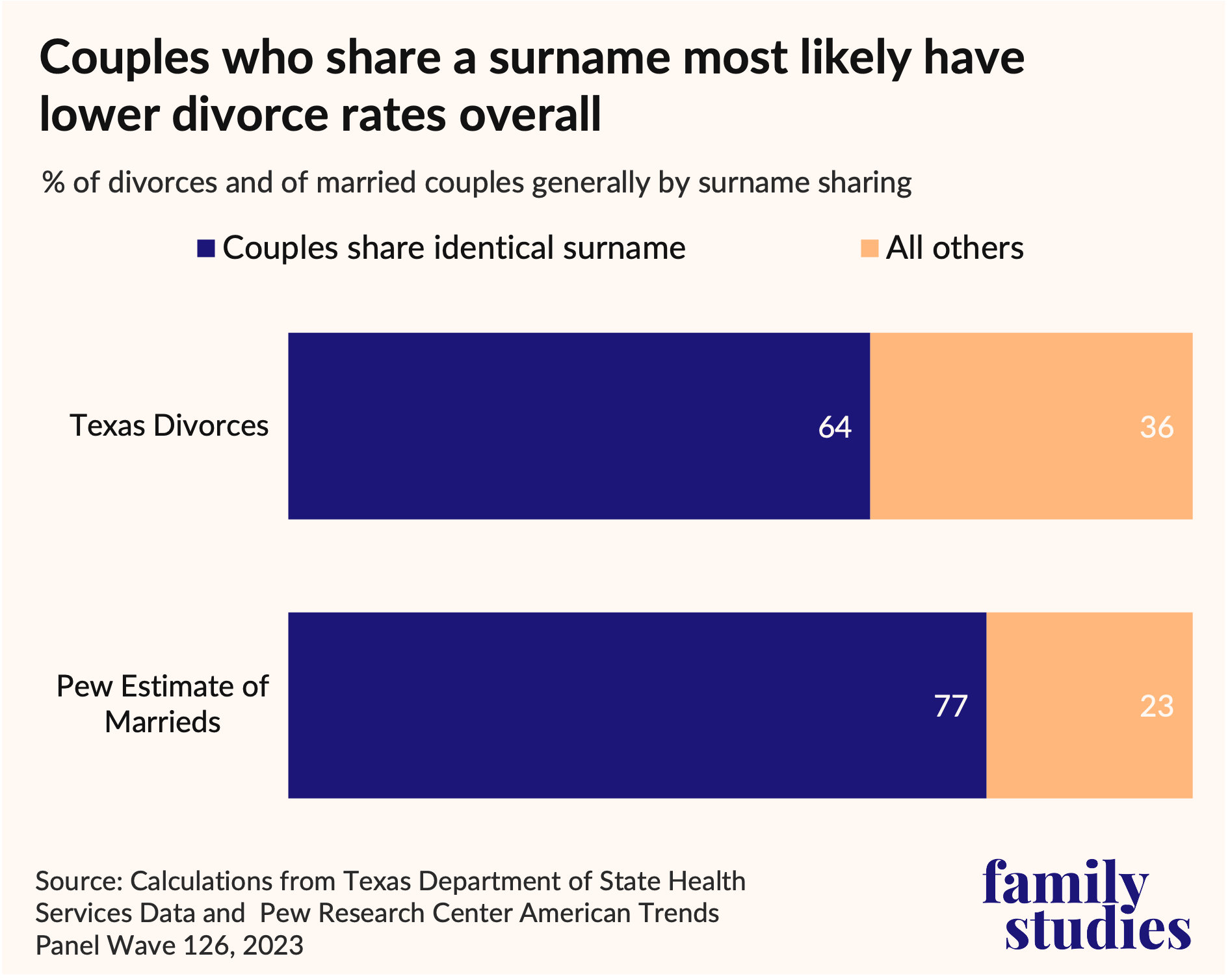
This turns out to be the case. Whereas perhaps 75-80% of Texas couples share a surname, only 64% of Texas divorces have a shared surname. This suggests that couples who don’t share a surname probably have higher divorce rates. Thus, not only do couples who do not share a surname who get divorced do so faster than name-sharing-couples, the overall divorce rate is probably higher for couples who do not share a surname.
Of course, differential age composition of divorcees and married couples could be biasing these results. Just to be sure, we can calculate these same proportions for the age categories in the Pew survey data: 18-29, 30-49, 50-64, and 65+. For simplicity, we convert these proportions into relative rates: dividing a surname-group-by-age category’s divorce share by its married population share.
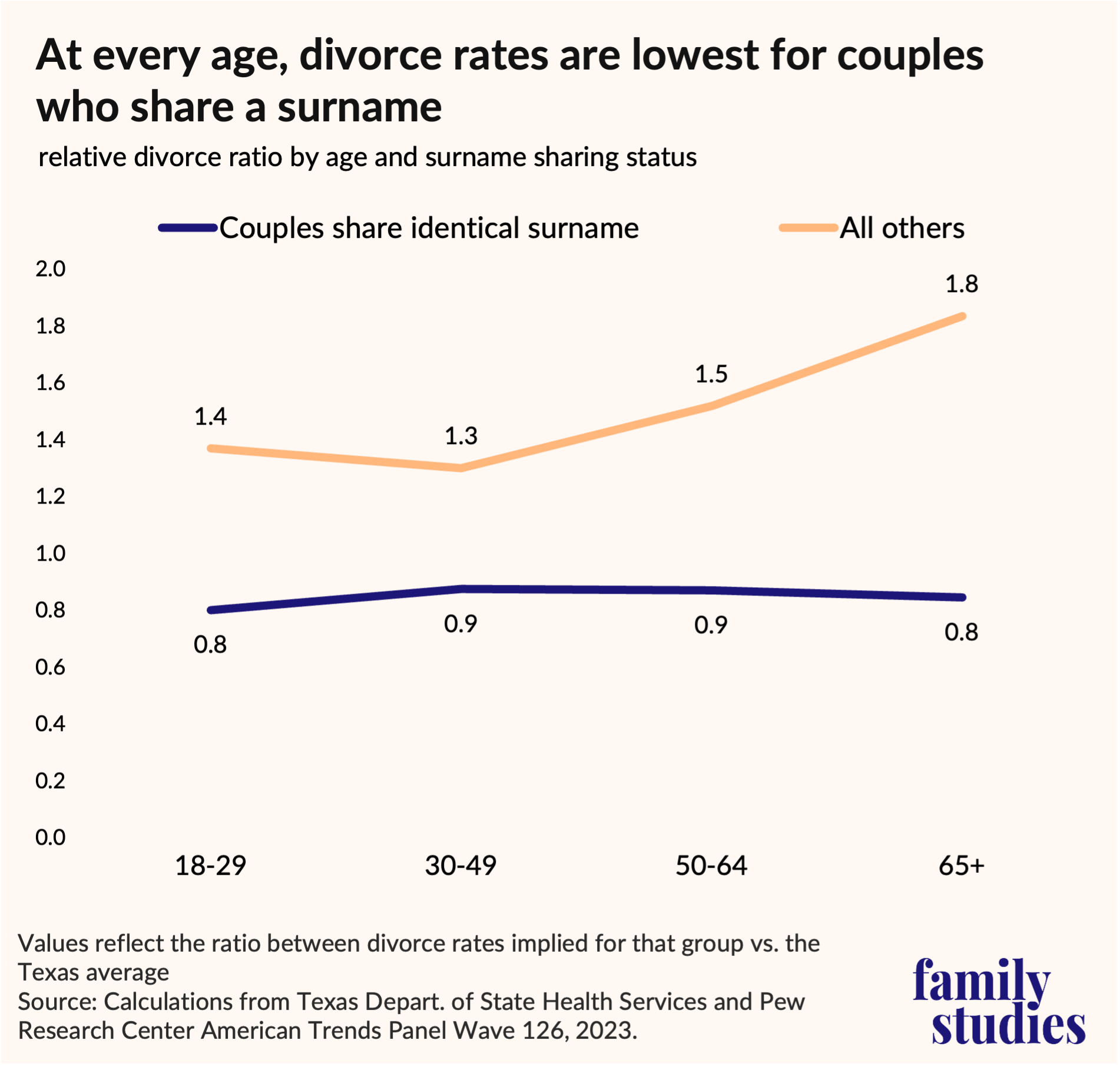
At every age, couples who share a surname appear to have below-average propensity to divorce, while couples who don’t share a surname appear to have above-average propensity to divorce.
Can Sharing a Last Name Save Your Marriage?
When engaged couples debate what to do about last names, they do not usually look at charts and graphs, nor do they necessarily articulate the belief that sharing a surname might make their relationship more solid. And yet, surname sharing turns out to predict enormous differences in divorce probability and timing.
There are at least two reasons to think this correlation, though very strong, may be spurious. At the same time, there are also two reasons to think this correlation may actually have some genuine causal component to it.
On the spurious side, obviously couples who do not share a last name will include some very thoughtful partners who are philosophically opposed to taking the husband’s last name—but it will also include a lot of couples who got married on the spur of the moment and who couldn’t be bothered to get their paperwork in order. Because non-shared names may partly select for hasty, ill-considered weddings to begin with, its association with divorce may be just that—an association, not a causal tie.
Likewise, women who philosophically prefer to keep a maiden name or to hyphenate may simply have different values—we already showed above that this is the case. Liberals may simply not view divorce in the same way conservatives do, and so higher divorce rates could be seen as a positive thing. If women who keep their names are more liberated, maybe it’s good they shed deadbeat men faster, this argument would suggest. More importantly, making a woman with liberal dispositions take her husband’s name hardly seems conducive to marital happiness. Thus, again, the relationship between divorce and unshared names may be spurious.
But there are two very real dynamics that may create a causal link between name sharing and divorce. The first is simply administrative: bureaucratic hurdles shape divorce rates in powerful ways. Changing a legal name is a huge hassle. It may be that the prospect of having to change back to a prior maiden name, to have one more set of papers to file, actually somewhat discourages couples with shared surnames from divorcing. This effect is speculative, but other studies have shown that other kinds of bureaucratic elements of the divorce process may alter divorce rates.
Second, and more substantively, nowadays most couples will at some point discuss their surnames. Because having different last names is very common, shared surnames are unlikely to be taken for granted. This conversation, about the meaning of family and gender roles, may shape how couples enter into marriage. It is possible (if speculative) that a clear conversation where a woman explains to her groom-to-be her hesitancy to take his last name, and he communicates his desire to build a family together without robbing her of her independence, to make “his” name “their” name, may actually strengthen that relationship. Research on marriage also suggests that couples who hold more things in common—from names to money—are more likely to take a “team-first approach to marriage life” that reinforces cooperation, trust, and a sense of a common future. Again, while this causal channel is speculative, it’s perfectly plausible: other research has found that conversation-based premarital counseling may have some modestly positive effects on relationship quality. And indeed, the 2022 State of Our Unions survey found that couples who share a surname really do have slightly higher relationship quality, even controlling for background demographic factors.
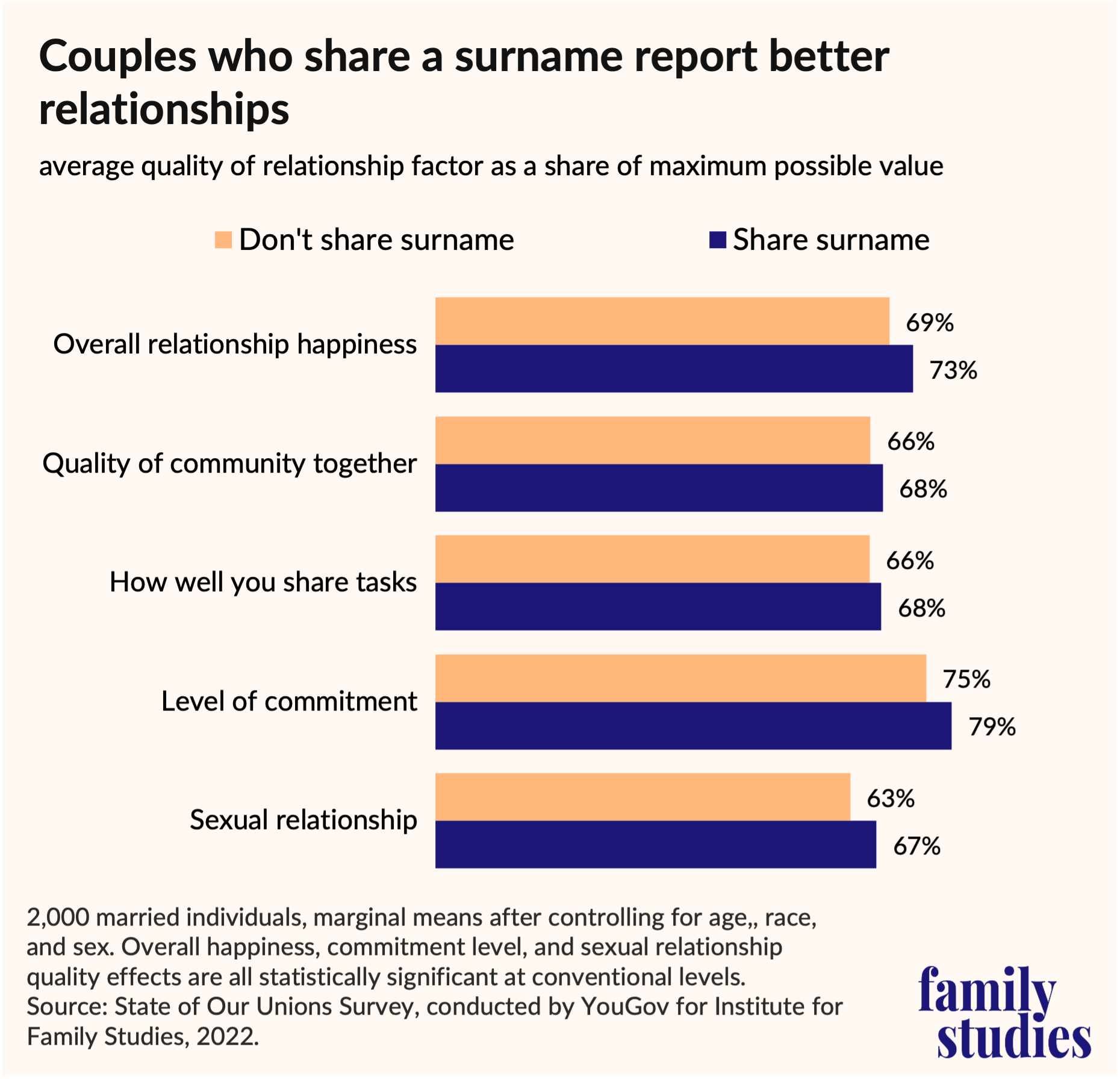
So, can sharing a surname save a marriage? The present evidence does not answer that question definitively—but if changing last names creates a stronger legal commitment mechanism for a couple, and if the conversation around surname choices creates an opportunity to affirm and deepen commitments, then maybe so! On the other hand, simply imposing shared surnames on couples probably will not save many marriages, since some of the divorce difference is certain to be due to non-causal correlations. On the whole, even for couples not totally sold on sharing a surname, it’s certainly worth having this important conversation. For many couples, after all, it sure looks like sharing is caring.
Lyman Stone is a Senior Fellow and Director of the Pronatalism Initiative at the Institute for Family Studies.
*Photo credit: Shutterstock
1. Of course, Hispanics often rely on a double-surname system, where individuals carry two family names — the first (paternal) from the father's first surname, and the second (maternal) from the mother's first surname, which is different from the Anglo convention. For the purposes of our analyses, couples who carry fully separate such names would be listed as “No shared name.” If, by coincidence or choice, they did share one of those names, they would be listed as “hyphenated or other.” However, the prevalence of such compound names is greatly overstated in popular discourse: just 12% of divorced couples where one or both spouse had Spanish-origin names had at least one spouse with a compound surname of some sort, vs. 6% for non-Hispanic whites. For the most part, Hispanics in Texas appear to approximately follow Anglo-typical surname conventions.