Highlights
Editor's Note: The charts have been updated by the author.
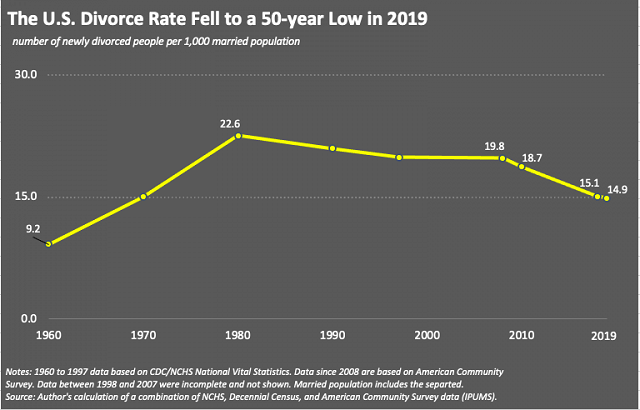
Divorce in America has been falling fast in recent years, and it just hit a record low in 2019. For every 1,000 marriages in the last year, only 14.9 ended in divorce, according to the newly released American Community Survey data from the Census Bureau. This is the lowest rate we have seen in 50 years. It is even slightly lower than 1970, when 15 marriages ended in divorce per 1,000 marriages.
A lower divorce rate means longer marriages. According to the new Census data, the median duration of current marriages in the U.S. has increased almost one year in the recent decade, from 19 years in 2010 to 19.8 years in 2019.
The drop in the divorce rate is likely to continue in 2020, despite the pandemic. When COVID-19 hit America in March, early signs suggested that the pandemic may have expedited divorces because of lockdown-related stress. However, new survey data finds that the pandemic has actually brought some couples closer to each other. According to data from the American Family Survey, a majority of married Americans (58%) say that the pandemic has made them appreciate their spouse more and half agree that their commitment to marriage has deepened. Moreover, initial data from some states suggests that divorce filings have indeed declined. It is likely that divorce may increase a bit after COVID-19 because of the pent-up demands, but the overall decline in divorce appears to be a consistent trend.
This is great news for Americans who are married. It means that their marriages will likely be more stable, and their children will be more likely to grow up with two married parents, which provides them the best chance for success later in life.
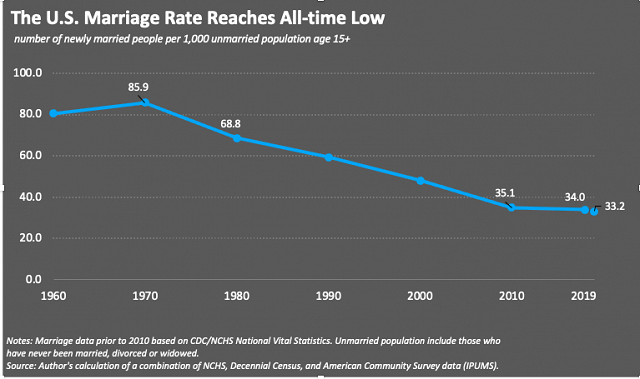
Even so, fewer Americans are married today to reap the many benefits associated with marriage. Another piece of news coming out of the new Census data is that the U.S. marriage rate just hit an all-time low in 2019. For every 1,000 unmarried adults in 2019, only 33 got married. This number was 35 a decade ago in 2010 and 86 in 1970.
Meanwhile, America’s so-called “marriage divide” is only widening. College-educated and economically better off Americans are more likely to marry and stay married, but working-class and poor Americans face more family instability and higher levels of singleness. For Americans in the top third income bracket, 64% are in an intact marriage, meaning they have only married once and are still in their first marriage. In contrast, only 24% of Americans in the lower-third income bracket are in an intact marriage, according to my analysis of the 2018 Census data.
What’s worse, all signs point to a continuing downward trend for new marriages. On top of the already record high share of never-married adults, Americans are postponing their marriage plans because of the pandemic. The initial state-level data suggests that a dramatic decline in marriage certificates filed during the COVID-19 crisis. Given that “can’t afford a wedding” and “not having a stable job” ranked high on the reasons why today’s singles are not married, it is reasonable to predict that fewer singles will tie the knot amidst a pandemic when financial distress is high.
This sobering news about marriage puts a damper on our hope for the future of American families. With the rates of both divorce and marriage dropping in America, we expect to see the marriage divide deepen and poor and working-class Americans increasingly disconnected from the institution of marriage. The impact of this disconnection on our family lives can be destructive, which makes it an issue that policymakers, community leaders, and scholars should continue to pay attention to.
Wendy Wang, Ph.D., is director of research for the Institute for Family Studies. Her work has been featured in The New York Times, The Wall Street Journal, and many other venues.