
Highlights
- We’re witnessing what one scholar has called a “happiness crash” that is hitting young adults hardest—since 2000, reports of unhappiness have more than doubled from 11% to 23% for men and women aged 20 to 35. Post This
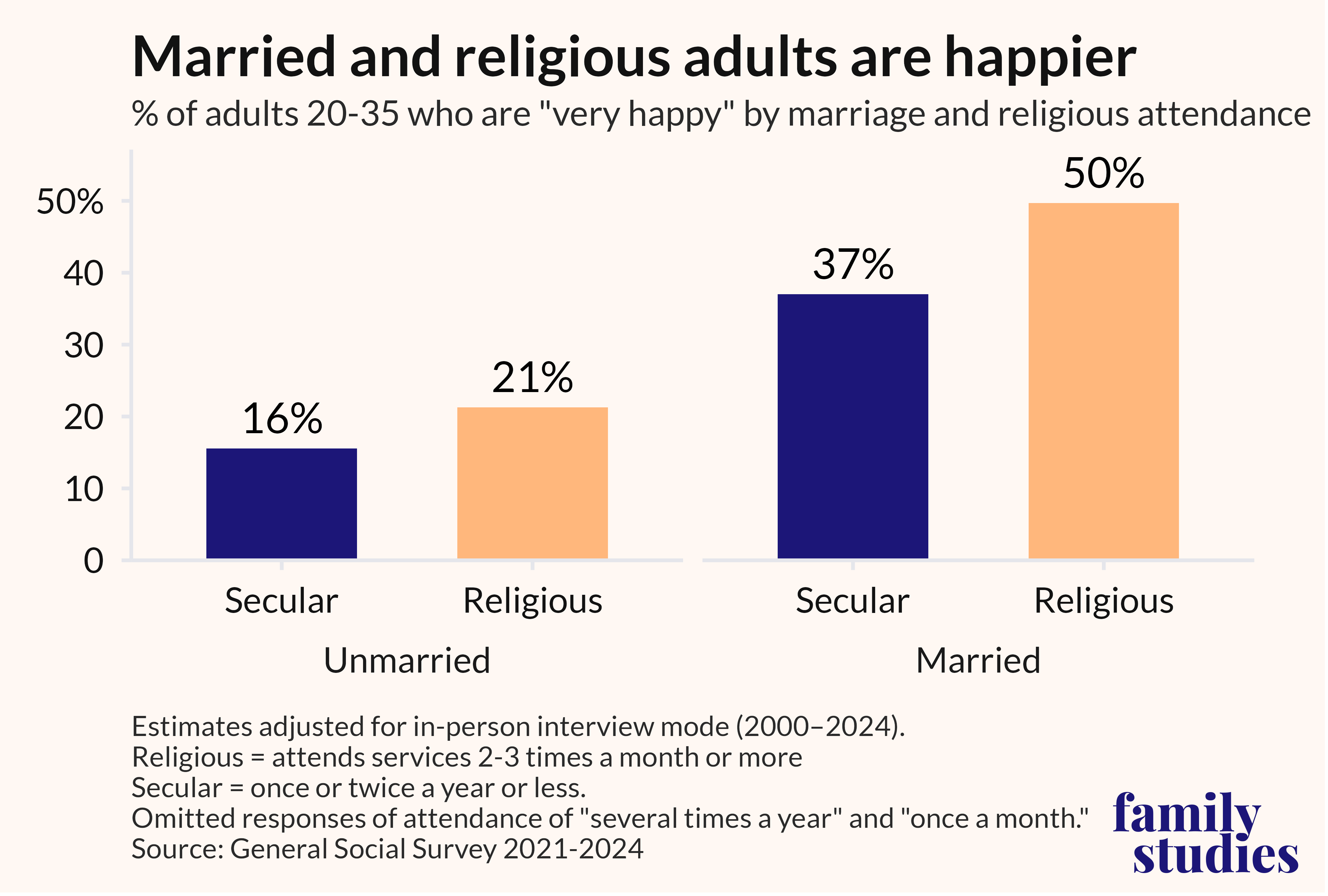
- Married and religious young adults have largely escaped the happiness crash: 50% of married, religious Americans aged 20 to 35 describe themselves as “very happy,” compared with just 16% of their unmarried, secular peers—a threefold difference. Post This
In the 1960s, the psychologist Harry Harlow placed newborn rhesus monkeys in clean, temperature-controlled cages with food, water and everything they seemed to need. They lacked for only one thing in this University of Wisconsin experiment: contact with other monkeys.
The results of being isolated for months were devastating: The monkeys rocked, harmed themselves and stared blankly. When finally introduced to peers, many cowered or lashed out, and at least one stopped eating and died. For these animals, Harlow’s research showed, social contact was not optional. It was a necessity as non-negotiable as food or oxygen.
Forty years later, in his book Loneliness: Human Nature and the Need for Social Connection, University of Chicago psychologist John Cacioppo confirmed the same was true for another species: Homo sapiens. Not only did lonely people suffer from elevated cortisol, impaired immune function and poor sleep, they also were hypervigilant to social threats, more inclined to read others as hostile or rejecting.
In fact, social connection is even a matter of life and death. Brigham Young University psychologist Julianne Holt-Lunstad found that social isolation raised the risk of early death by 29%, loneliness by 26% and living alone by 32%.
Less Socializing, More Screens
Even though the science could not be clearer about social isolation’s devastating toll, we have been running a new experiment, and its unwitting subjects are the young adults who grew up amidst the digital revolution. Smartphones and social media—not to mention gaming, pornography and AI chatbots—have crowded out face-to-face conversation, socializing, and community life among teens and young adults. Teen dating has been halved, and two-thirds of eligible young adults are not dating anyone seriously. Socializing among young men and women is down more than 50%, from 12 hours to 5 hours per week. Instead, they’re spending an average of three hours per day on social media, “interacting” with other avatars in a virtual world.
They (and we) might be tempted to call all this “socializing”—as if posting selfies, scrolling, commenting on strangers’ posts, and gaming on an Xbox could satisfy the deep human need for real relationships with real people that researchers like Harlow, Cacioppo and Holt-Lunstad have documented.
But the poisonous fruits of the digital revolution suggest otherwise. Anxiety, depression and anti-social behavior are way up, especially among young people. An increasing number of them hold catastrophic views of the world and report a lack of agency over their own lives.
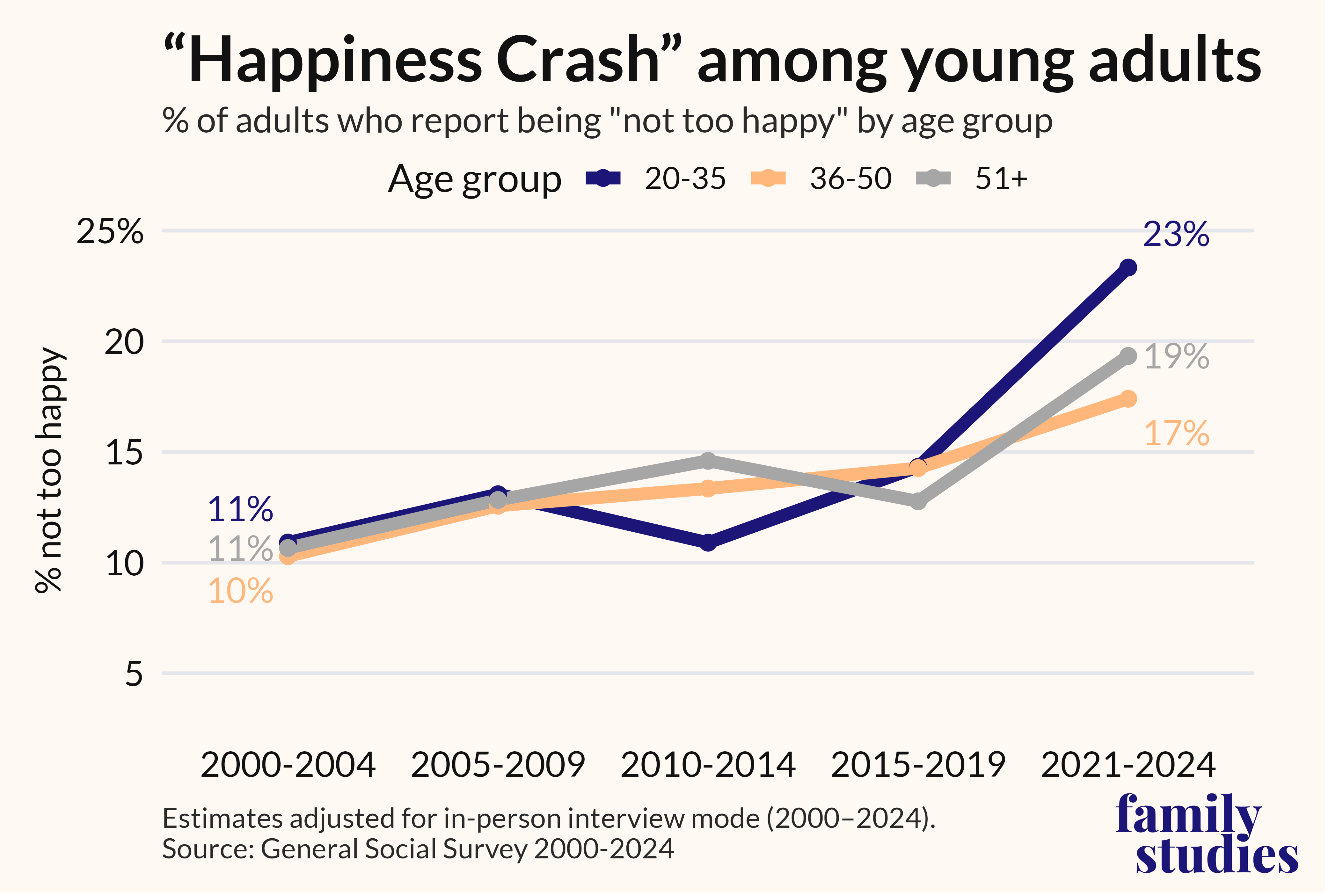
We’re witnessing what one scholar has called a “happiness crash” that is hitting young adults hardest—since 2000, reports of unhappiness have more than doubled from 11% to 23% for men and women aged 20 to 35. Far from thriving in this world of “social” media, millions of young men and women are floundering in what The Atlantic writer Derek Thompson has called our “Anti-Social Century.”
A Devout Difference
But the news is not all bad: Some young men and women are much more likely to escape the happiness crash engendered by the digital revolution.
A new Institute for Family Studies report, The Devout Difference: Religion, Marital Quality, and Sex Among Americans, points to two forms of community that protect people from the isolating currents of modern life: strong marriages and regular religious practice. Both institutions, the report notes, have long been “signal sources of social solidarity,” safeguarding their members’ physical and emotional well-being in part by connecting men and women to real relationships with real people. Faith and family “may be especially valuable now in a society that has grown more technologically distracted, atomistic, and economically unequal—conditions that erode the informal sources of meaning and belonging that allow men and women to thrive.”
The data bear this out: Married and religious young adults have largely escaped the happiness crash that has engulfed their peers. According to the General Social Survey, 50% of married, religious Americans aged 20 to 35 describe themselves as “very happy,” compared with just 16% of their unmarried, secular peers—a threefold difference. Marriage alone matters a great deal (37% of married, secular young adults are very happy), but the combination of faith and family appears most powerful.
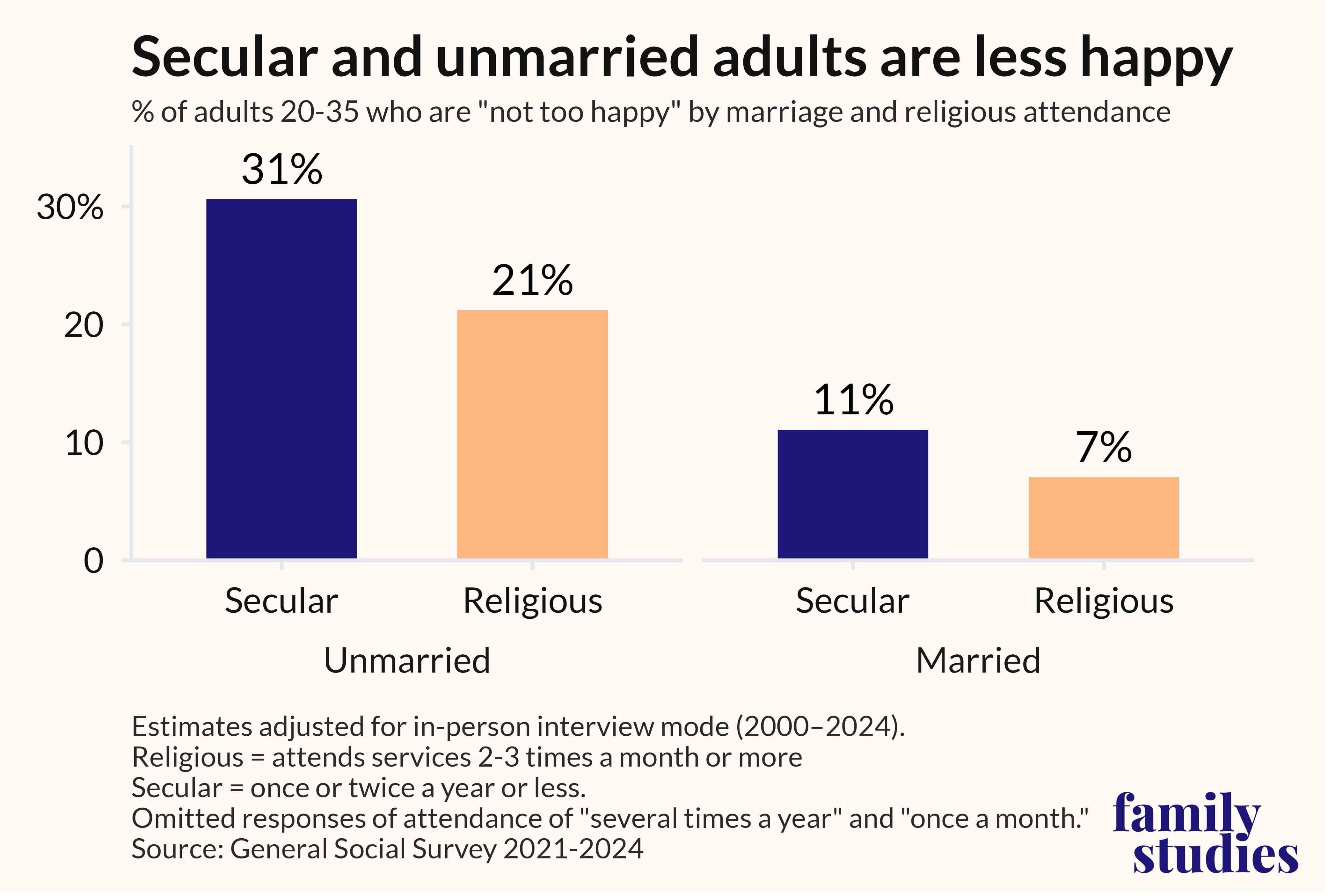
The pattern for unhappiness is the mirror image: 31% of unmarried, secular young adults say they are “not too happy” (the lowest category in the GSS) compared with just 7% of their married, religious peers. These figures don’t prove cause and effect—happier people may be likelier to marry and to go to church—but the lesson is hard to miss. In an age marked by too many screens and too much solitude, faith and family remain two of the strongest bulwarks against loneliness and despair.
The tragedy—and a big reason so many men and women are failing at the pursuit of happiness—is that fewer young adults are finding their way to the altar or the pew. In the 1970s, 58% of Americans aged 20 to 35 were married; today, just 30% are. Over the same period, the share of young adults who never attend religious services has more than doubled, from 17% to 39%. If Harlow’s monkeys taught us that social contact is as essential as food or oxygen, today’s young adults are showing us that the institutions best able to supply it are the very ones they are increasingly disconnected from today.
The cost of this disconnection isn’t only anxiety, depression, and unhappiness. Young people who are isolated and adrift are also more vulnerable to the counterfeit communities that flourish online—radical movements of the left and the right, from socialism to antisemitism, that promise a better tomorrow or a sense of community but often leave their followers only more isolated from and hostile to their fellow citizens.
Three-quarters of a century ago, the longshoreman-philosopher Eric Hoffer wrote about the kinds of people drawn to mass movements—extremist, sometimes violent, often cultlike movements of the sort that now spread quickly online. Those most vulnerable to radicalism, he observed, are not idealists bent on improving the world but people who are lonely and, crucially, who lack a sense of purpose in their own lives. “A mass movement attracts and holds a following,” Hoffer wrote, “not because it can satisfy the desire for self-advancement, but because it can satisfy the passion for self-renunciation.”
People crave something bigger than themselves to live for. Marriage and faith answer that craving twice over: They call us to sacrifice for something beyond ourselves, and they bind us to the people we need to survive and thrive. So let’s hope the signs of religious renewal among Gen Z prove real—a new Harris Poll finds this generation is now more religious than any other—and that family life also takes a turn for the better among today’s young adults.
Because the alternative is not just more isolation, atomization and unhappiness. It is a rising tide of political radicalization, the kind of movement Hoffer warned about—one that turns our crisis of connection into a matter of life and death for the nation.
Brad Wilcox is Melville Foundation Jefferson Scholars Foundation University Professor of Sociology and Director of the National Marriage Project at the University of Virginia and the Future of Freedom Fellow and Director of the Get Married Initiative at the Institute for Family Studies. Maria Baer is a contributing writer at the Institute for Family Studies.
Editor's Note: This article appeared first at Deseret News. It has been reprinted here with permission.


