
Highlights
- By combining two incomes, marriage also moves many of these couples up the housing ladder, turning renters into plausible starter-home buyers. Post This
- The Rings to Roofs data dashboard shows the benefits of a marriage recovery on the housing shortage and the new couples in states and metros throughout the country. Post This
The American Enterprise Institute's Housing Center has spent the past five years proposing solutions for the housing supply shortage in cities and states around the country. In large part, these solutions revolve around ending the ban on starter homes—making it legal to build naturally affordable homes that young and working families can afford to buy and rent. Legalizing starter homes is the single most important action local governments can take to improve housing affordability for young and working families.
However, there's another path to affordability for individual Americans: getting married. In Rings to Roofs, the AEI Housing Center and the Institute for Family Studies examine how increasing marriage rates would make housing more affordable, both for people getting married and for everybody else.
Marriage has three benefits for the housing market. First, increasing marriages would decrease the number of homes required in the housing market, by consolidating two households into one. This acts like a supply-side solution, reducing our national shortage. Second, when two working people get married, their household income rises, meaning they can afford to live in larger and higher-quality homes. Finally, the homes that would be freed up by a marriage recovery are among the most affordable in the country, making marriage both an affordability and supply solution.
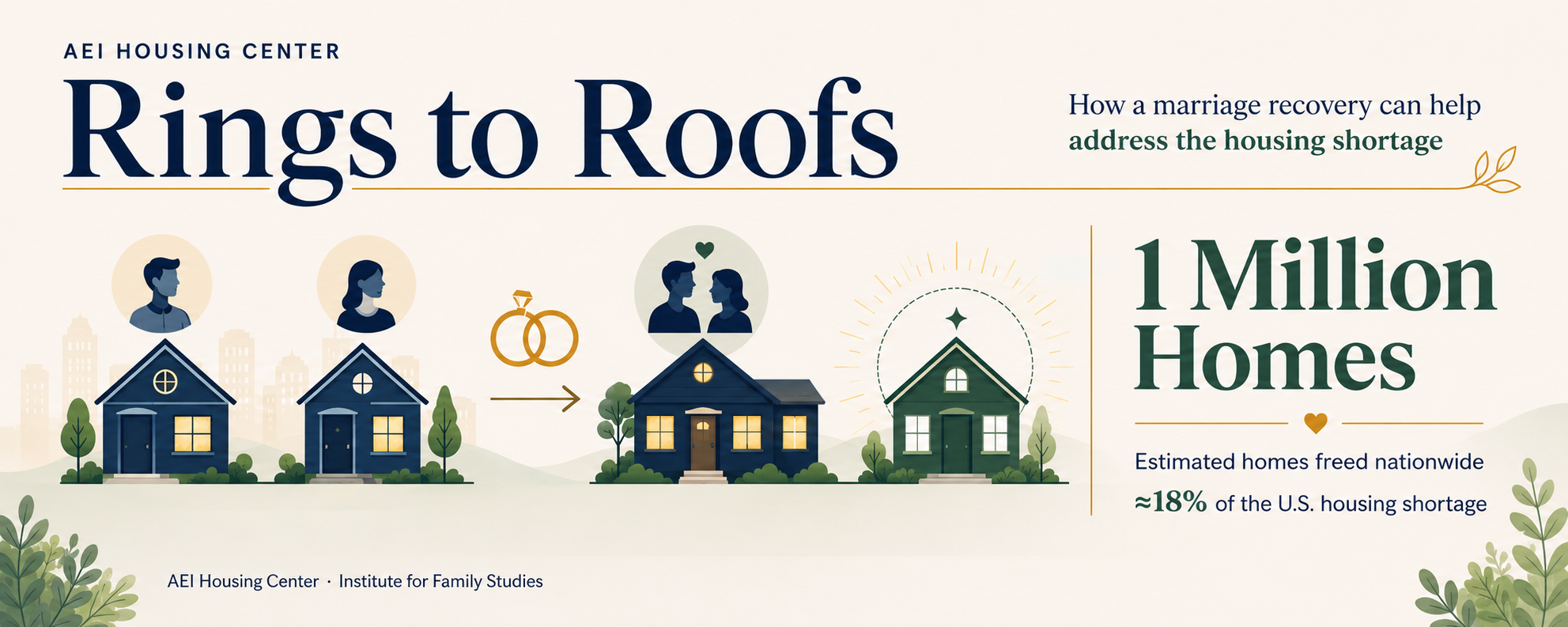
In Rings to Roofs, Part I, we focus on the supply-side benefits of marriage. If marriage recovered to its 2000 level among working-age adults, it would be the equivalent of building one million homes in metros experiencing a housing shortage. Beyond the benefits of getting married itself, a marriage recovery should begin with Americans themselves, and entire markets would reap the rewards. View the dashboard here.
Key Findings
- One million homes would be freed up by returning marriage to its 2000 level among working-age adults, about 18% of the national housing shortage.
- The partnered-share gap opened over 24 years, from 2000 to 2024. Closing it over the same span annualizes to 44,800 homes a year and lifts the refined marriage rate from 31.2 to 33.9 per 1,000 unmarried women (age 15+).
- Returning to 1980 levels of marriage would reduce the shortage by 2 million homes.
- Reaching the 2000 benchmark takes about 4.9 million additional marriages and frees about 1.08 million homes, roughly one home per 4.6 marriages.
- Homes freed up by marriage tend to be smaller, less expensive, and rented: about 82% are rentals at a median rent near $1,070 (the 28th percentile of local rents), and over half sit in multifamily buildings.
- The annual Rings to Roofs estimate equates to roughly 80% of new Low-Income Housing Tax Credit (LIHTC) construction. In subsidy-equivalent terms, Rings to Roofs produces a value of roughly $2,700 per marriage annually (vouchers), or a one-time federal $30,000 cost (LIHTC).
- Marriage differs from other demand-side solutions. It raises a household's buying power while simultaneously reducing the number of households, creating affordability and easing a shortage instead of bidding up prices.
- The Rings to Roofs data dashboard shows the benefits of a marriage recovery on the housing shortage and the new couples in states and metros throughout the country.
Visit the interactive Rings to Roofs dashboard.


