
Highlights
- Today, children have more nutritionally rich diets than their predecessors—but they are lacking in another essential component of child life: the ability to play freely and independently. Post This
- A major driver of this play deficit is that parents no longer feel empowered to decide when and where their children should be allowed to exercise independence. Post This
Around 5:30 p.m. most days, my husband comes home from work, gives me a kiss, hugs our younger kids, and then asks about our older sons' whereabouts. "Don't know," I typically reply. "They’re out in the neighborhood somewhere playing with friends.” My older sons, ages 10 and eight, usually vanish as soon as their friends get home from school. They’re homeschooled, but they know exactly when the local schools let out and are often watching the clock to make sure they’re done with their own schoolwork and are free to play.
A Deficit in Play
Unlike the free-range children in our neighborhood, the average American child is unfortunately experiencing a play deficit. Past generations of children may have struggled with a lack of Vitamin D or iron, resulting in rickets or anemia. Today, children have more nutritionally rich diets than their predecessors—but they are lacking in another essential component of child life: the ability to play freely and independently.
Psychologist Peter Gray, a researcher at Boston University, has identified this lack of play as a critical factor in increasing rates of mental health disorders among children. In 2013, Gray authored an article titled The Play Deficit for Aeon Magazine: “Over the same decades that children’s play has been declining, childhood mental disorders have been increasing.” Over the past 75 years, children have become more and more restricted in their ability to play independently, unsupervised by adults, pursuing self-directed activities. The causes, per Gray, are manifold: school days are longer and take up more of the calendar year; organized sports have overtaken pick-up games; and parents fear letting their children roam without supervision. The end result is not only physical and mental illness, but also an even more fundamental problem: children who do not know how to get along with others. According to Gray, “[P]lay teaches social skills without which life would be miserable.” Gray’s research has been picked up and amplified by Jon Haidt, author of The Anxious Generation. Haidt has identified the shift from a “play-based childhood” to a “phone-based childhood” as a major driver of teen anxiety and depression.
Recent research by The Institute for Family Studies confirms that the play deficit is a very real phenomenon. In a research brief titled Resilient Children, Struggling Parents: Mapping American Parenting, IFS looked at the relationship between technology and family life for Americans. Among other findings, the authors discovered that many American children are not allowed to play outside in their neighborhoods without adult supervision. Even in upper elementary school, many children are only allowed to play unsupervised in their homes or yards—ruling out the kind of casual neighborhood play that my children find so valuable.
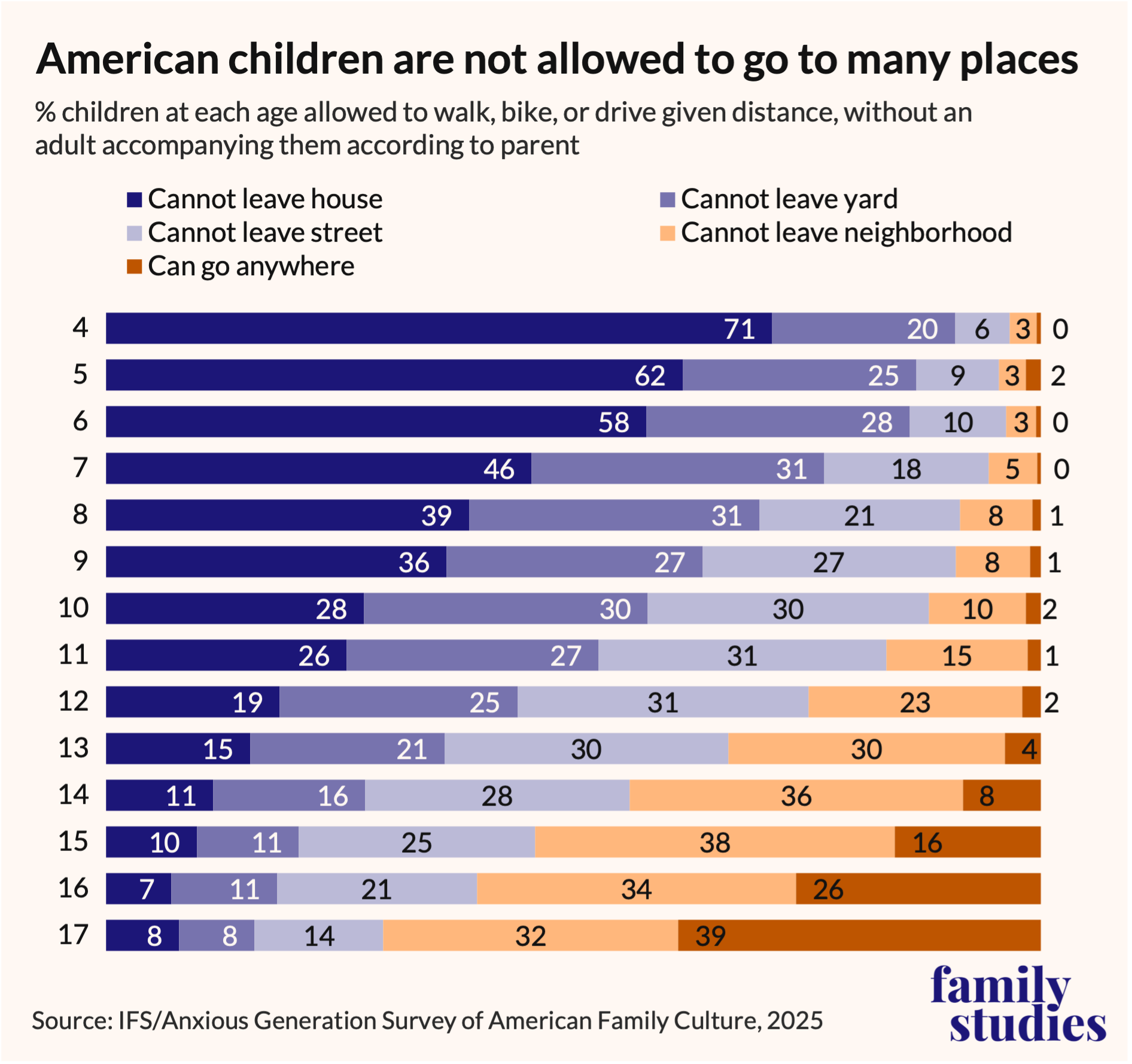
A major driver of this play deficit is that parents no longer feel empowered to decide when and where their children should be allowed to exercise independence. Many states have draconian or blanket rules that prevent children from playing independently or from staying home alone. My home state of Connecticut, for example, discourages parents from leaving their children home alone until they are 11 or 12. In other states, parents have been arrested for letting their children play at a park. The problem with these blanket rules is that by setting a universal floor, they discourage parents from making the kind of individualized, nuanced decisions that are vital for parenting generally and for childhood independence questions, specifically. When is a kid old enough to bike to a neighborhood store to buy a quart of milk? When can a child safely be left at home for 20 minutes while Dad runs to the convenience store to pick up paper towels? These and other questions depend on a multiplicity of factors, including: neighborhood crime rates, how safe it is to walk or bike on local roads/sidewalks, the child’s own maturity levels, etc. In our case, I know the age at which I will feel comfortable letting each child bike around independently will significantly vary, because each of my children is so different.
Empowering Parents
In this hostile regulatory environment for parents, a new bill introduced by Rep. Blake Moore (R-UT) is aimed at giving children greater freedom to play. Among other things, the proposed bill “amends the Child Abuse Prevention and Treatment Act to clarify that a decision by a parent or caretaker to allow a child to participate in reasonable childhood independence activities is not neglect.” It also has measures to encourage states to allow parents to exercise their own reasonable judgment regarding when a child is able to play or explore independently. Rep. Moore’s office told me that the bill is deliberately drafted to empower parents: “By clarifying that reasonable childhood independence is not neglect, we can empower parents to decide how to best raise their children, get kids outside and off screens, and practice personal responsibility.” Indeed, such a result would be better for both parents and Child Protective Services: “If we trust parents, we will protect them against unnecessary and traumatic investigations," Moore's office told me, "and allow Child Protective Services to dedicate more resources to serving children who are in harm's way.”
Bingo. We don’t often think of childhood independence laws as also very good for parents, but they are. The benefits don’t only accrue to children who are able to address their need to play, they also are felt deeply by Mom and Dad. First, of course, happy children usually mean happier parents. In our case, I’m delighted my older sons spend so many of their afternoons outside riding their bikes, cracking silly jokes, and socializing with their peers. It’s so good for them. Second, it offers an opportunity for parents to get things done while their children are developing important skills independently. In my own case, it’s a huge help to me that my older children are out of my hair in the late afternoons while I am dealing with getting dinner on the table and caring for their younger siblings. Indeed, it goes beyond that: my oldest son is now capable of biking to a nearby store to pick up some eggs or to a neighbor to borrow a cup of sugar. Third, I deeply value the little lessons my children learn from other parents in the neighborhood. I might tell a child repeatedly to say “please” and “thank you” when eating at a friend’s house, but often, it’s the mom across the street who brings that kind of lesson home most effectively.
It’s not all perfect, of course. Not too long ago, one of my sons hit a baseball through a neighbor’s window (the neighbor was very gracious about it). Every now and then, one of the kids comes home furious over an argument with a child in the neighborhood that got too heated. Still, the positives outweigh the negatives. Even these problems can be turned into vital lessons in getting along with others, building community, and working towards becoming a good and useful adult. The childhood independence my kids benefit from should be accessible to all kids. We need more bills like the one from Rep. Moore—on both the state and federal level—to help encourage play.


