
Highlights
- The proportion of babies born to mothers who are unmarried at the time of their infant’s birth is one troubling birth characteristic that, in recent years, is not decreasing Post This
- One maternal characteristic that practically guarantees that a woman will have “tied the knot” before giving birth: having a college education or more. Post This
In a recent blog post for IFS, I shared some good news about the changing characteristics of America’s annual crop of newborn babies. I reported that more babies are being born to mothers who are college graduates and fewer to mothers who are high school dropouts. What’s more, these positive trends are occurring among Hispanic and Black infants as well as among White and Asian newborns. But the proportion of babies born to mothers who are unmarried at the time of their infant’s birth is one troubling birth characteristic that, in recent years, is not decreasing.
In fact, a substantial minority of all U.S. births are to unmarried women—1,440,031 in 2025, representing 40% of all births that year. This compares with 40% in 2022 and in 2023; 33% in 2000; and 32% in 1995.1
The Benefits of Married Parents
From the viewpoint of a newborn in modern America, having married parents is a good omen for your overall well-being, including your birth.2 Compared to a baby born to a married mother, a baby born to an unmarried mother is:
- Three times more likely to need Medicaid or other government or charitable assistance to pay for his or her delivery (68% versus 23%).
- Twice as likely to have received late or no prenatal care (11% versus 5%).
- Twice as likely to be born prematurely (under 20 weeks) (1% versus 0.5%).
- 1.6 times more likely to be born at a low birthweight (under 2,500 grams) (11% versus 7%).
- 1.7 times more likely to have been fathered by a man with less than a college education (92% versus 55%).
- 14 times more likely to have been fathered by a man not identified on the birth certificate (29% versus 2%).3
College-educated Women More Likely to Marry Before Giving Birth
Given these advantages of married childbirth, it is not surprising that one maternal characteristic practically guarantees that a woman will have “tied the knot” before giving birth. That attribute is having a college education or more.
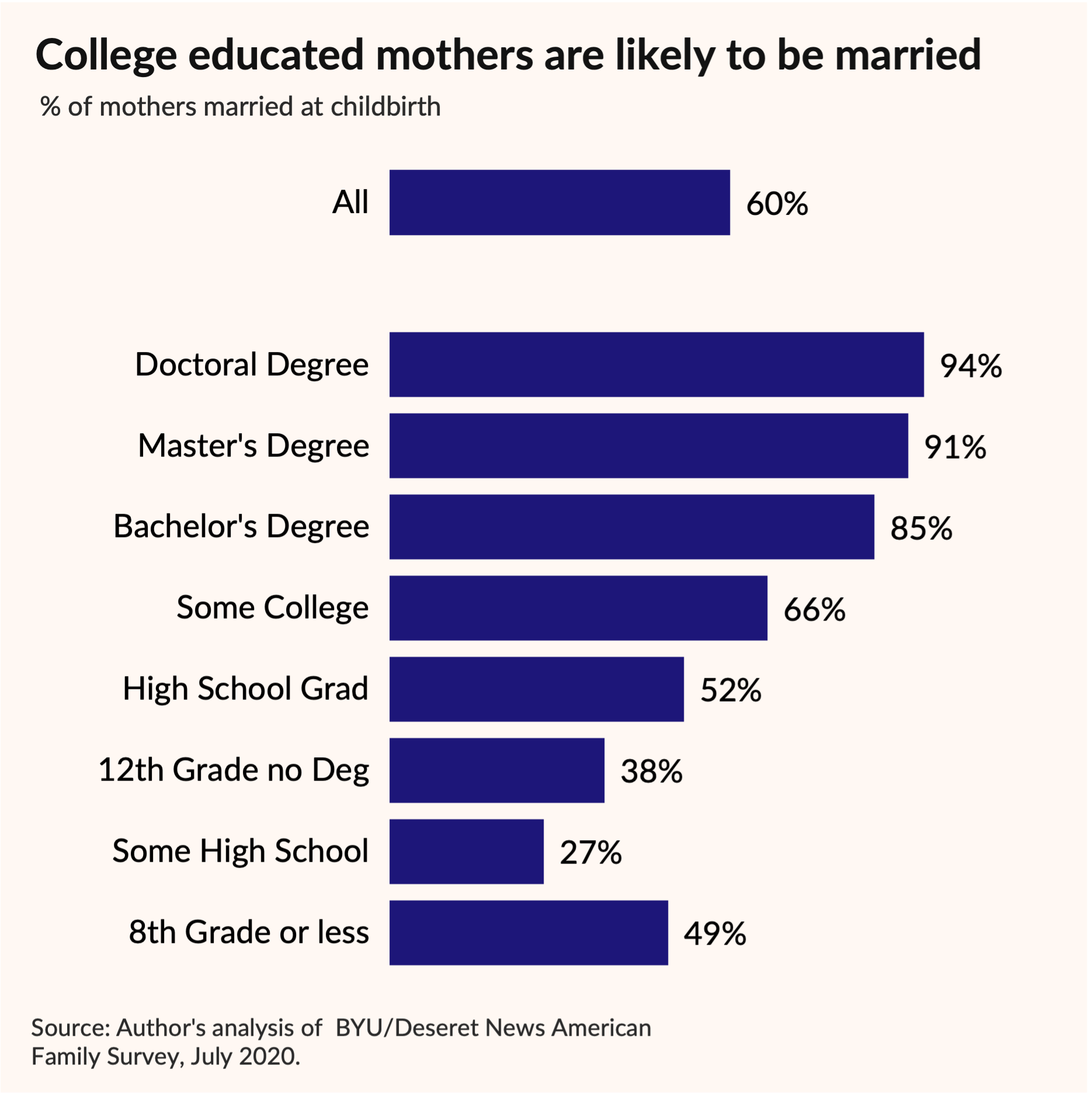
Of babies born in the U.S. in 2023, 94% of those whose mothers had doctoral or professional degrees had mothers who were married, as did 91% percent of those whose mothers had master’s degrees, and 85% of those whose mothers had a bachelor’s degree. Among babies born to women with less education, having an unmarried mother was more common, as may be seen in the figure below.
Racial/Ethnic Differences
Among most racial and ethnic minorities in the U.S., childbirth without marriage is the majority scenario. For example, 70% of Black newborns and 54% of Hispanic newborns had unmarried mothers in 2023.4 The same held true of 53% of multiracial newborns, 54% of Native Hawaiian and Other Pacific Islander infants, and 70% of Native American and Alaskan Native infants . For comparison, 12% of Asian newborns had unmarried mothers, as did 27% of white newborns.
Given the relative size of different U.S. population groups, however, white infants made up the single largest group of babies born to unmarried mothers in terms of racial and ethnic identity. They numbered some 458,000 in 2023 and constituted 36% of the total number of babies born to unmarried mothers in that year.5
From the viewpoint of a newborn in modern America, having married parents is a good omen for your overall well-being, including your birth.
Most College-educated Black and Hispanic Moms Are Married
Yet again, we see that college education is a pro-marriage factor among Black and Hispanic women as well as among White and Asian women. Among Hispanic newborns whose mothers have doctoral degrees, 84% of their mothers are married at childbirth, as are 83% with master’s degrees, and 72% with bachelor’s degrees. Among Black infants whose mothers have doctoral degrees, 84% of their mothers are married at childbirth, as are 70% of those with master’s degrees, and 57% of those with bachelor’s degrees as their highest credential.
Immigrant Mothers Twice as Likely to be Married
Being a mother born outside the U.S. would not seem to be a major pro-marriage factor in terms of raw differences: 64% of babies of immigrant mothers have mothers who are married, compared with 59% of babies of native-born mothers. When adjusted for other factors, however, such as age, education, and race and ethnicity, infants of immigrant mothers are twice as likely to have married mothers as are infants of native-born mothers.6
Time for Policymakers to Act
The risks that children of unmarried mothers face are not just those surrounding their births. Cities and neighborhoods where single-parent families are in the majority have high rates of child poverty and violent crime. Efforts to improve children’s lives by increasing child support and involvement by non-resident fathers have been more successful with divorced than unmarried fathers. It is time for state and national policymakers to recognize that our current welfare arrangements, which pay for prenatal care, delivery and postnatal care are, in effect, subsidizing unmarried childbearing, while allowing the men involved to escape accountability for the children they help bring into the world.
Nicholas Zill is a research psychologist and Senior Fellow of the Institute for Family Studies. He directed the National Survey of Children. He previously served as the first project director of the Head Start Family and Child Experiences Survey, and he is the founder of the organization, Child Trends.
*Photo credit: Shutterstock
1. National Vital Statistics Report 52_10. Table C, p. 10.
2. All statistical comparisons made herein are based on the author’s analysis of public use data files on 2023 U.S. Births obtained from the Centers for Disease Control and Prevention, U.S. Department of Health and Human Services.
3. Adjusted for maternal age, education, race and Hispanic origin, immigration status, and source of payment for delivery, the odds ratios for births to unmarried compared to married mothers are: 1.44 for late or no prenatal care; 2.82 for Medicaid or other welfare payment for delivery; 1.35 for prematurity; 1.23 for low birth weight; 2.72 for father having less than college education, and 14.58 for father unidentified. These are all statistically significant at p < .001).
4. Adjusted for age of mother, source of payment for delivery, mother’s educational attainment, and mother’s immigrant status, and compared to white mothers, the Odds Ratio for being unmarried at childbirth was: Hispanic (2.52); Black (4.65); Asian (0.82); multiracial (2.30); AIAN (2.77), NHOPI (2.46). All of these are significant at p < .001.
5. The second largest group was Hispanic infants (411 thousand, or 32% of all unmarried births). The third largest was Black infants (330 thousand, or 26%).
6. Adjusted for mother’s age at birth, education, and race/ethnicity, the Odds Ratio of being married at childbirth is 2.20 for immigrant mothers compared to native-born mothers. p < .001.


