
Highlights
- In a new AEI/IFS analysis of the National Survey of Children’s Health, family structure is as or more predictive of key outcomes than race, family income, and student sex. Post This
- NAEP should regularly report family structure data to enable policymakers, educators, parents and the general public to better understand factors affecting student outcomes. Post This
The federal government collects a wealth of data to help us understand what drives child outcomes in student learning, health, and economic security. Yet the government often leaves out a critical factor in its public reporting: family structure. In a new report from the American Enterprise Institute (AEI) and the Institute for Family Studies (IFS), we focus on education as one example of this exclusion. The National Assessment of Educational Progress from the US Department of Education disaggregates student performance by factors such as race and ethnicity, sex, and poverty. However, it does not report student scores by family structure on the official Nation’s Report Card—even though it has been systematically collecting these data since 2013. This omission deprives policymakers, educators, professionals, and parents of valuable insights into one of the most powerful predictors of academic success.
Indeed, this AEI/IFS report analyzing the the National Survey of Children’s Health demonstrates that children raised in “intact” families (in which the biological or adoptive parents are together and married) are far more likely to thrive in school and life than are their peers from other households. We find that children in non-intact households—where children are living with stepfamilies, cohabitating parents, single parents, or foster or kin-based families such as in grandparent-led homes—are 13% less likely to receive A’s and B’s than those raised in an intact, married-parent home, 47% more likely to have their parents contacted for problems at school, and more than twice as likely to be depressed. We also find, in this instance, that family structure is a more powerful predictor of school problems, academic performance, and depression than are race and poverty.
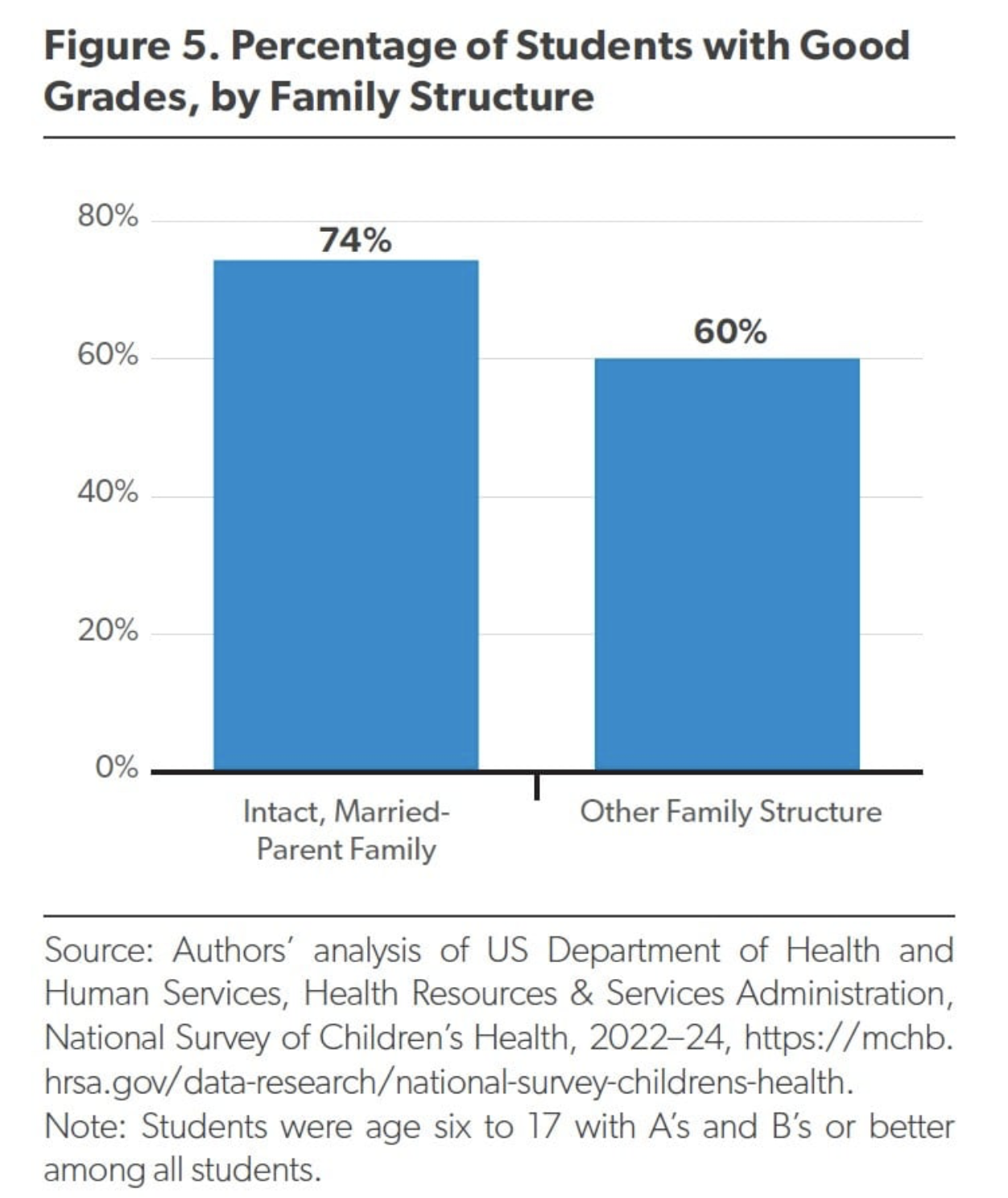
These are important findings because public policies, research, and discussions related to education, human services, and health policy often focus on race and poverty but neglect family composition. Indeed, despite the federal government’s commitment to reporting outcomes by different demographic groups, family structure is often ignored. Though our findings in this analysis are not necessarily general results, they indicate that family structure ought to be studied further to determine the extent to which its predictive strength is a general result.
Family structure is an important factor in student success.
To remedy this, key federal reports from the Department of Education and other federal agencies that monitor child well-being should make family structure a standard and consistent data category used to report child outcomes. They should also make sure standard family-structure categories are included in reports that analyze surveys on child well-being. Doing so would shed light on the impact different family compositions have in shaping student outcomes and children’s well-being. These data insights would empower key stakeholders to move beyond incomplete or misleading narratives about the causes of educational, health, and economic disparities and enable them to better serve children in their care.
By providing the public with a clearer picture of how family structure influences children’s health, student success, and economic security, federal agencies can empower schools, communities, local and state governments, professionals who work with children, and parents to address family structure when they are dealing with issues related to children’s educational success, physical and emotional well-being, and financial security. Better reporting will also help policymakers, educators, and civic leaders educate the public about the family’s role in helping children flourish inside and outside of school. Finally, reporting student outcomes by family structure will help young people understand the impact that different family types have on a range of child outcomes, thus making them more proactive regarding their own future family formation.
Read the full AEI/IFS report here.


