
Executive Summary
Over the past decade, as new research exposed the deleterious effects of digital technologies on children’s health and development, a growing movement of parents has objected to the ways in which social media and screens are transforming childhood. This has inspired a wave of states and school districts to establish stricter restrictions on student cellphone use in schools, with many opting for “bell-to-bell” phone bans. But it’s not just smartphones and social media that parents are rethinking. Naturally, the move to limit digital technology in childhood has also led parents to scrutinize educational technology, or “ed tech,” and, ultimately, rethink screen-based education altogether.
It is during this season, in which parents, teachers, administrators, and education leaders are seeking to restrain ed tech and recover tried-and-true, person-to-person modes of learning and classroom instruction, that artificial intelligence (AI) has arrived in America’s schools. Despite pushback from parents on phones and screens in the classroom, there has been steady pressure by some policymakers to rapidly and completely integrate AI into the curriculum. What parents want for their kids is a critical matter for education, and parents clearly want fewer screens. But what do they want when it comes to AI in the classroom? Do they see AI as providing better learning outcomes or greater risks to their children’s learning and mental health? Do they want AI in the classroom at all? If so, when do they want it, how involved do they want to be in its implementation, and in what manner should it be used?
So far, despite the urgent political imperative to re-center the education of America’s children around AI, parents have not been consulted, and these questions have not been asked. This report corrects these critical omissions.
Major Findings
1. Official actions by administrators and teachers to incorporate AI into schools are already widespread.
Nearly 4 in 10 American students in primary or secondary education attend schools where AI use is either explicitly allowed or even required. By contrast, 15% of American students attend schools where the use of AI in the classroom is officially blocked. The largest portion of American students, 45%, attend schools where no official action has been taken.
2. Most parents of K-12 students either do not want AI in schools, or they want less of it.
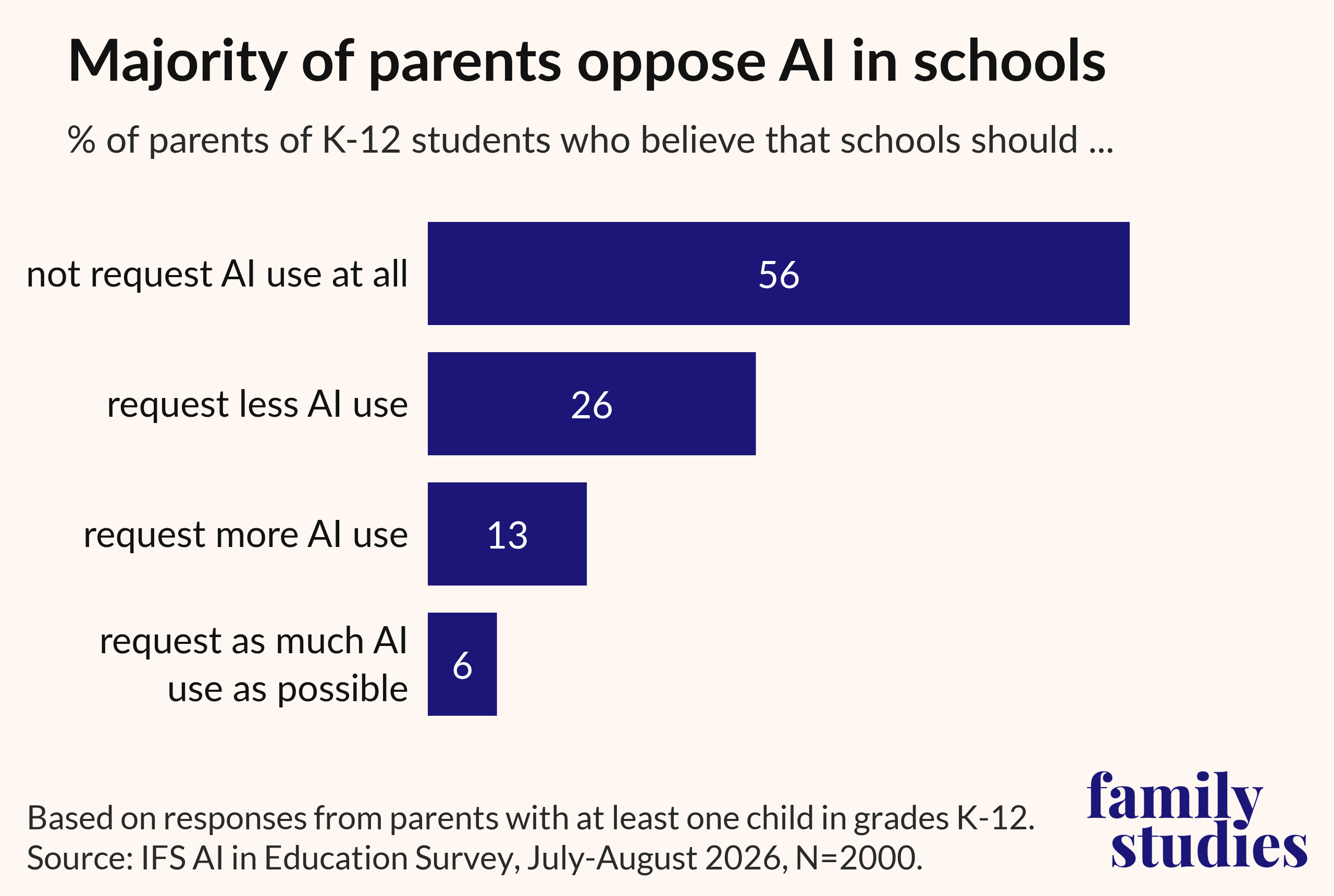
A majority (56%) of parents want AI fully blocked in schools, and another 26% want less AI in schools than is currently required or allowed. Only 13% of parents want more AI use in school, and a mere 6% want as much AI use as possible.
3. Many parents want deep changes to the way digital technology is used in the classroom, including AI.
A new “computer lab,” where AI and ed tech are used in discrete classrooms, is the most popular classroom form among parents: 38% of parents want AI to be used in computer labs only, with the remainder of schooling focused on physical books and handwriting; and an additional 25% of parents want books and handwriting only. The current trajectory—AI grouped with tablets as the basis of education—is very unpopular with most parents. Only 11% of parents want this form of education for their kids.
4. Parents want AI later, not sooner, in K-12 education.
Parents also feel strongly about when AI should be introduced. More than 2 in 3 parents want AI introduced in high school or later, or not at all. Only 3% of parents believe that students should be using AI in kindergarten and only 9% want it introduced in elementary school. The numbers rise in middle school and high school (21% and 25%, respectively), but nearly as many want it introduced in 12th grade or later (20%) or not at all (22%). In sum, parents as a group are generally not eager to have AI introduced in schools at any specific stage, though later years score modestly better.
5. Parents think that AI is more likely to harm students than help them.
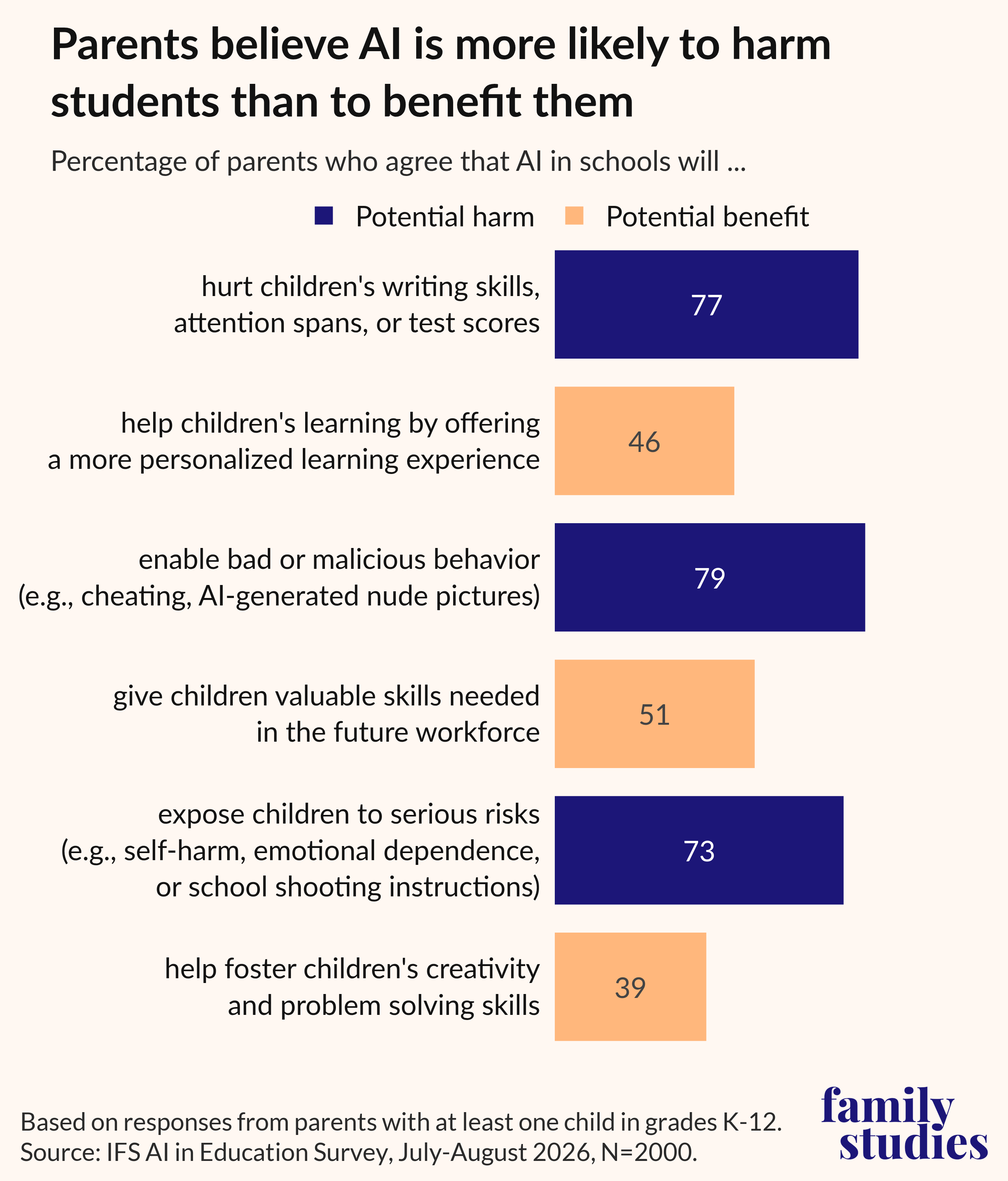
When offered a set of scenarios, a significant majority of parents tell us that AI will introduce more harms into the primary and secondary classroom than benefits. In fact, 77% say that AI will undermine learning, 79% say that AI will enable malicious behavior by students, and 73% say it will expose children to serious risks. As for benefits, only 46% agree that AI will help children learn by personalizing their learning experience, and a mere 39% say it will boost childhood creativity. The most popular positive case for AI in schools is that it will prepare children for the workforce of the future (51%).
6. A large majority of parents support the policy to pause AI in schools.
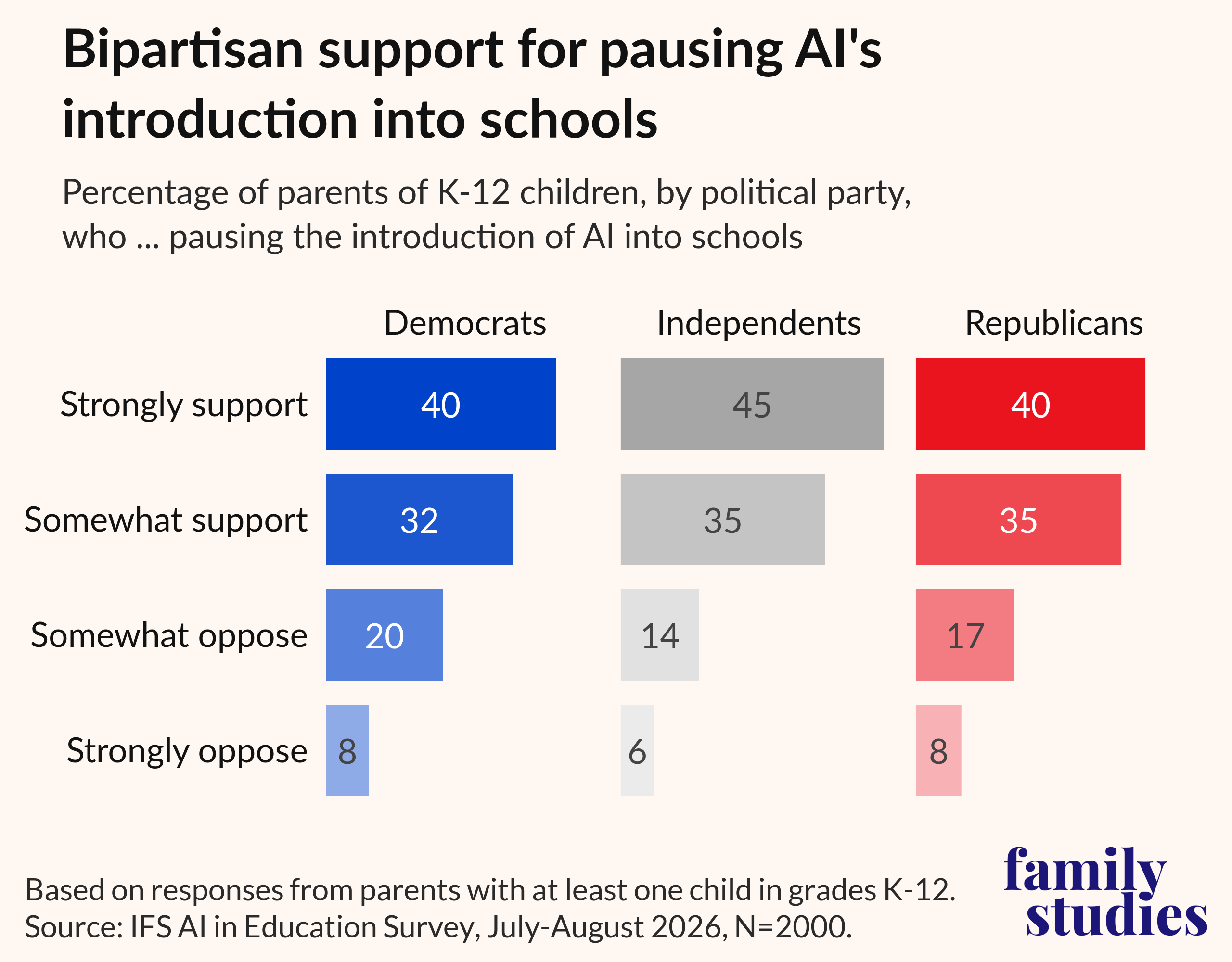
Recently, two of the nation’s largest school districts, New York City and Los Angeles, paused the use of AI in most K-12 classrooms. Given the “deep blue” character of these localities, it may be that pausing AI in schools is a partisan policy. But that’s not what we found. In fact, 75% of Republican parents support the policy to pause AI in schools, as do 72% of Democratic parents.
7. AI in education gives most parents a sense of foreboding about their children’s future.
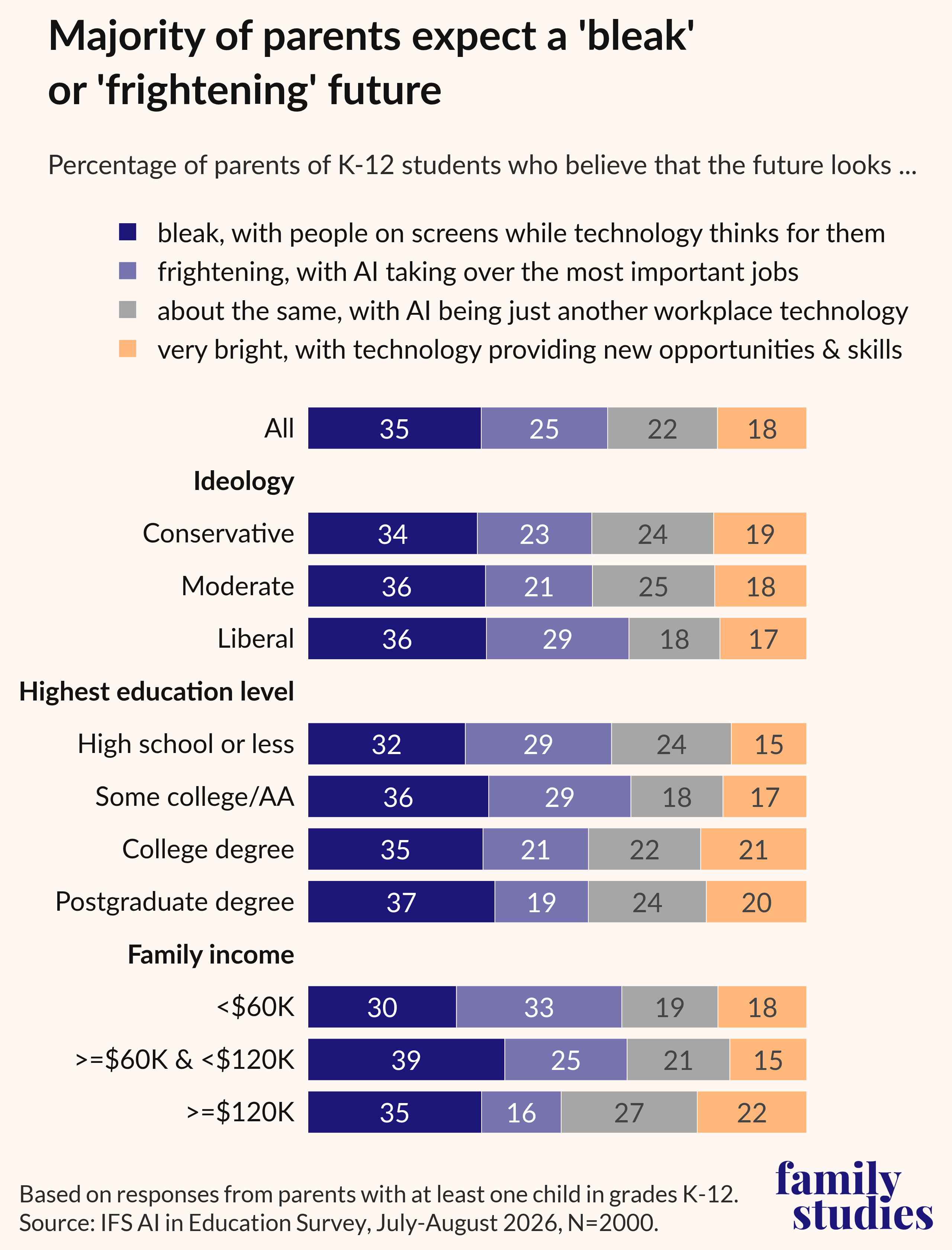
When asked about their outlook on the future, considering the incorporation of AI in the K-12 classroom, a majority of parents are concerned for their kids. Most parents either think the future for their children looks “bleak” (35%) “with technology doing most of the thinking and people being stuck on screens all day,” or “frightening” (25%) “with AI taking over the most important jobs and making the future less human.” In sum, for 6 in 10 parents with school-age children, AI fosters a negative view of their child’s future.
Introduction
In recent years, parents have become increasingly skeptical of school-issued educational technology, or “ed tech,” such as “one-to-one” laptops and tablets, gamified learning applications, and other tools. At the same time, the sheer scope of ed tech has grown in leaps and bounds. According to one industry report, the number of distinct educational technologies accessed by school districts has tripled since 2018 alone. Another recent survey from the National Center for Education Statistics (NCES) found that, for the 2024-2025 school year, about 9 in 10 public schools (88%) had issued one-to-one devices for their students, with the significant majority of high schools (80%) and middle schools (67%) allowing students to take these home on evenings and weekends.
Though they are distributed ostensibly for educational purposes, school-issued devices—the most popular of which is Google’s Chromebook—grant students unsupervised and relatively unrestricted access to the internet, while also making parental controls notoriously complex and hard to set up. This makes it incredibly challenging (if not practically impossible) for educators and parents to ensure that school-issued devices are used only for education. For example, a recent NBC exposé found that students are watching thousands of YouTube videos during school and on school-issued devices, yet only a tiny fraction of them are educational. Chromebooks have also exposed students to age-inappropriate content, including pornography, in large numbers. Even when parents successfully set up controls, children may still be sent an email on their thirteenth birthday—the age at which platforms are no longer legally required to acquire parental consent to collect data on minors—asking if they want to be taken off their parent-managed family accounts. In other words, the new reaction of parents to ed tech is driven not only by technology’s corrosive effects on education (as we shall see presently) but also its effects on children’s formation and well-being more generally.
As the number of one-to-one devices and screen-based learning time has increased in schools in the past decade, academic performance has steadily declined. This year, the Organisation for Economic Co-operation and Development’s (OECD) Program for International Student Assessment (PISA), a global exam that measures students’ performance in reading, math, and science, found that US students are underperforming in reading and math relative to prior US scores. While US reading scores are above average (compared to other countries), its student reading scores saw a significant decrease between 2022 to 2025 and are currently at their lowest since PISA issued its first assessment in 2000. Furthermore, US students’ math scores (which have been in gradual decline) hit their lowest on the most recent PISA assessment, remaining below the international PISA average in math. These findings are also corroborated by the US-based National Assessment of Educational Progress (NAEP). According to the latest NAEP results, math and reading scores began to plateau in 2013 before plummeting during COVID-19. They have yet to rebound.
Despite the drastic decline in youth mental health and academic performance, ed tech advocates are promising that a new wave of technology in the classroom—this time, artificial intelligence (AI) chatbots, tutors, counselors, and other AI-generative systems—will augment student learning and strengthen student well-being. For example, tech investor Joe Leimandt’s Alpha School claims to leverage AI technology to make learning more efficient, minimizing in-class learning to a mere two hours. Other schools are using AI-based systems for student mental health services. As of September 2026, 200 schools in 19 states have contracted with Alongside, an AI-based mental health chatbot. Even the Trump administration has been publicly pushing for AI in education. Last year, First Lady Melania Trump, accompanied by a humanoid robot, promised that every child would have a personalized AI-run robot tutor. And one of the Department of Education’s official supplemental grantmaking priorities directs funds to help integrate AI training and technology in schools across the country for students and teachers alike.
Despite the hype, a growing body of evidence indicates that AI may be causing students more harm than help, leading a growing number of states and school districts, red and blue alike, to set restraints on the new technology. Research from MIT found that those who use AI for essay writing “consistently underperformed at neural, linguistic, and behavioral levels.” AI also has costs for students’ well-being. Since the release of ChatGPT in 2022, several teens have been driven to self-harm or even suicide at the behest of sycophantic AI chatbots. And according to a Forbes expose, one ed tech company offered an AI tutor that could be jailbroken to encourage eating disorders and illegal drug use. Due to these risks to learning and well-being, some school districts, such as those in New York City and Los Angeles, have temporarily paused the use of AI in the classroom until its safety for children can be guaranteed and its effects on learning are better understood. Additionally, some states like Nevada have passed laws protecting person-to-person care for students by prohibiting the replacement of school counselors with AI services.
As federal administrators, state lawmakers, and school districts debate what is best when it comes to AI in schools, the Institute for Family Studies wanted to know what parents think about AI in the classroom. To date, little (if any) of the research on American attitudes toward AI in education has focused on parents. Surveys of parents about AI have tended to focus on what parents think about the technology in the lives of their kids generally. And surveys that have analyzed Americans' attitudes towards AI in education-specific contexts have tended to poll students, teachers, and/or administrators, rather than parents. Our survey fills a critical gap by asking parents themselves what they think about AI in their children’s schools.
Data and Methods
The Institute for Family Studies AI and Education Survey was conducted by YouGov from July 27 to August 13, 2026. The final sample contains 2,000 American parents ages 25 to 70 whose children range from 5 to 18 years old. The sample's margin of error is +/- 2.6%, and its estimated design effect is 1.19.
All of the metrics in this report are weighted to make them more representative of the broader population of US parents. These weights, which are based on respondents' sex, age, race, region, and education level, were calculated by YouGov using data from the 2023 American Community Survey.
The Lay of the Land: Current AI Use in Schools
Only a fraction of schools require AI use in primary or secondary education. But when we include schools that not only require but also officially allow students to use AI, we find that roughly 4 in 10 schools use (or at least tolerate) AI in the classroom, according to the parents surveyed. That percentage is even higher among middle and high schools, where nearly half of students can, or must, use AI.
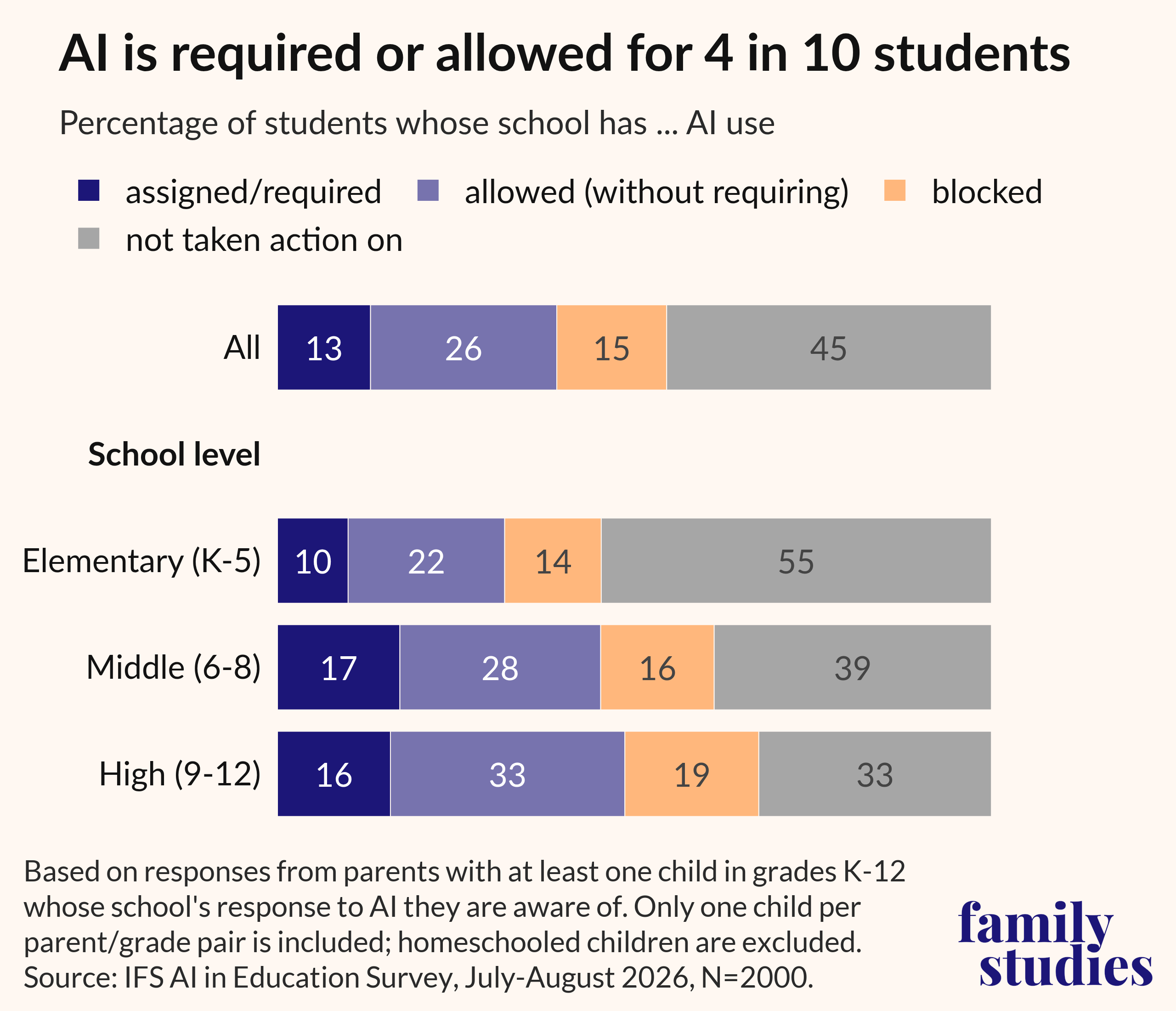
Figure 1. Percentage of students, by school level, whose school has assigned/required, allowed, blocked, or not taken action on AI use
Likewise, the number of parents who report that their child’s school blocks the use of AI is overall small (but not insignificant given the recent rise of AI). Specifically, 14% of elementary schools, 16% of middle schools, and 19% of high schools have blocked the use of AI.
The largest share of schools (45%) have not taken official action to address AI in the classroom. This does not necessarily mean that AI is not being used by students in those schools. Many, undoubtedly, are using it surreptitiously. All we can learn from these findings is that 45% of schools have yet to establish any explicit policy regarding AI in in the classroom. Many of these schools will most likely be establishing guidance in the coming years, if they are not in the process of doing so already.
We also break down our findings by the type of school in which parents have enrolled their children. We group schools into four different categories: religious private schools, secular private schools (non-religious), public charter schools, and public schools.
Secular private schools are much more likely to require or allow AI use (72%) than any other school type. Meanwhile, religious private schools are more likely to block AI use (29%) than secular private schools (9%), as well as non-charter public schools (14%).
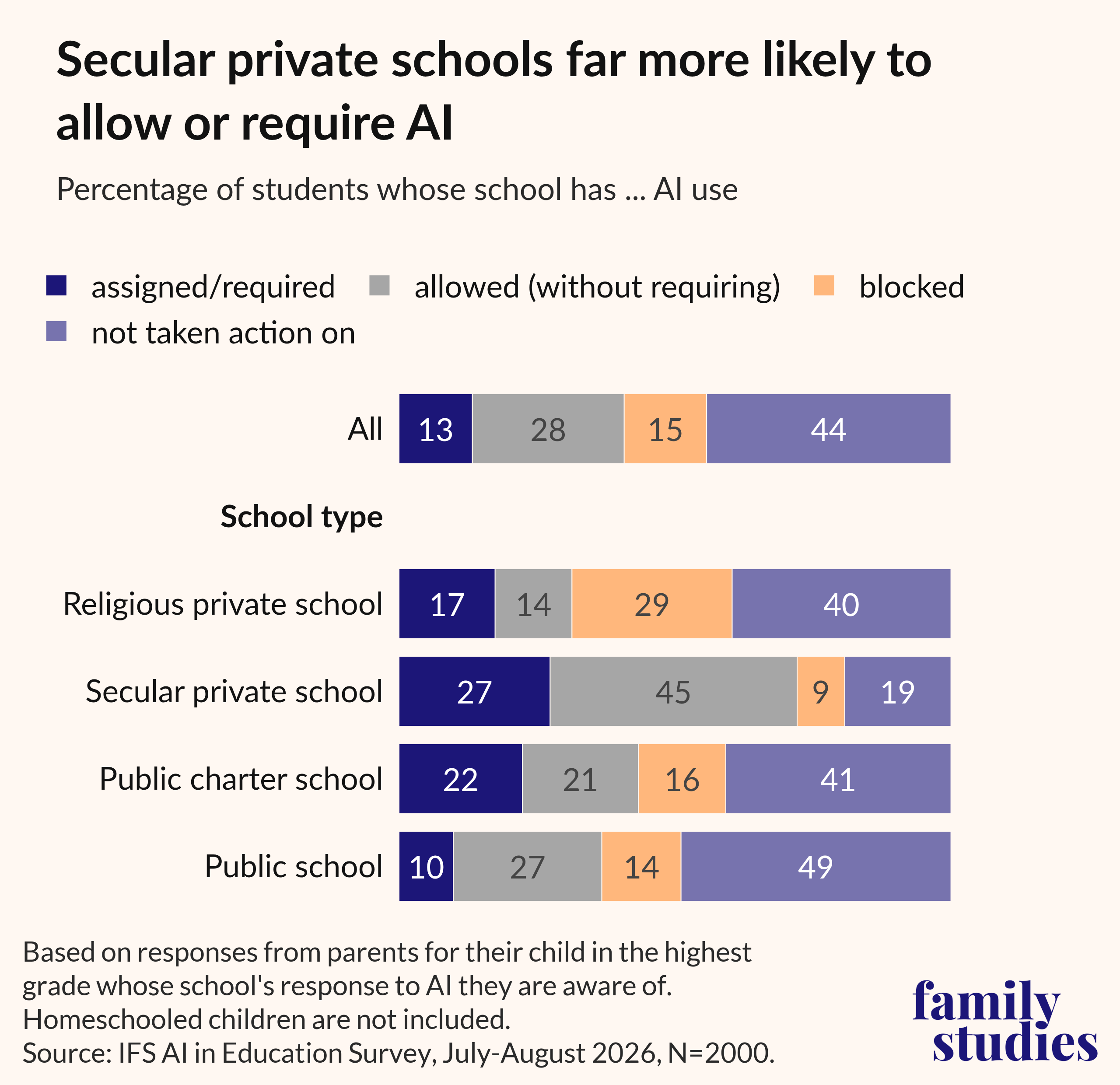
Figure 2. Percentage of students, by school type, whose school has assigned/required, allowed, blocked, or not taken action on AI use
Interestingly, parents with children in public schools report the smallest amount of required AI use (10%). This could be partly explained, as noted above, by public-school parents being the most likely to report that their child’s school has not yet taken action on AI. However, even after excluding schools that haven’t responded to AI, we still find public schools to be less likely to require AI use (19%) than public charter schools (38%) or secular private schools (34%).
Parental Views on AI Usage in Schools
The actions (or inactions) of schools do not necessarily align with the views and hopes of parents who send their children to these schools. Some of the most contentious social and political issues of our time have broken out as visceral disagreements between groups of parents and school administrators. Thus, an administrator might be keen to know parents’ views on AI.
Parents have strong views about how much kids should be using AI in schools. More than 8 in 10 parents agree either that schools should not be asking students to use AI at all (56%), or that they should be asking students to use AI less than they currently are (26%). In contrast, only 13% of parents think that children should be using AI more than they currently are in the classroom, and a very small minority (6%) agree that children should be using the technology as much as possible.
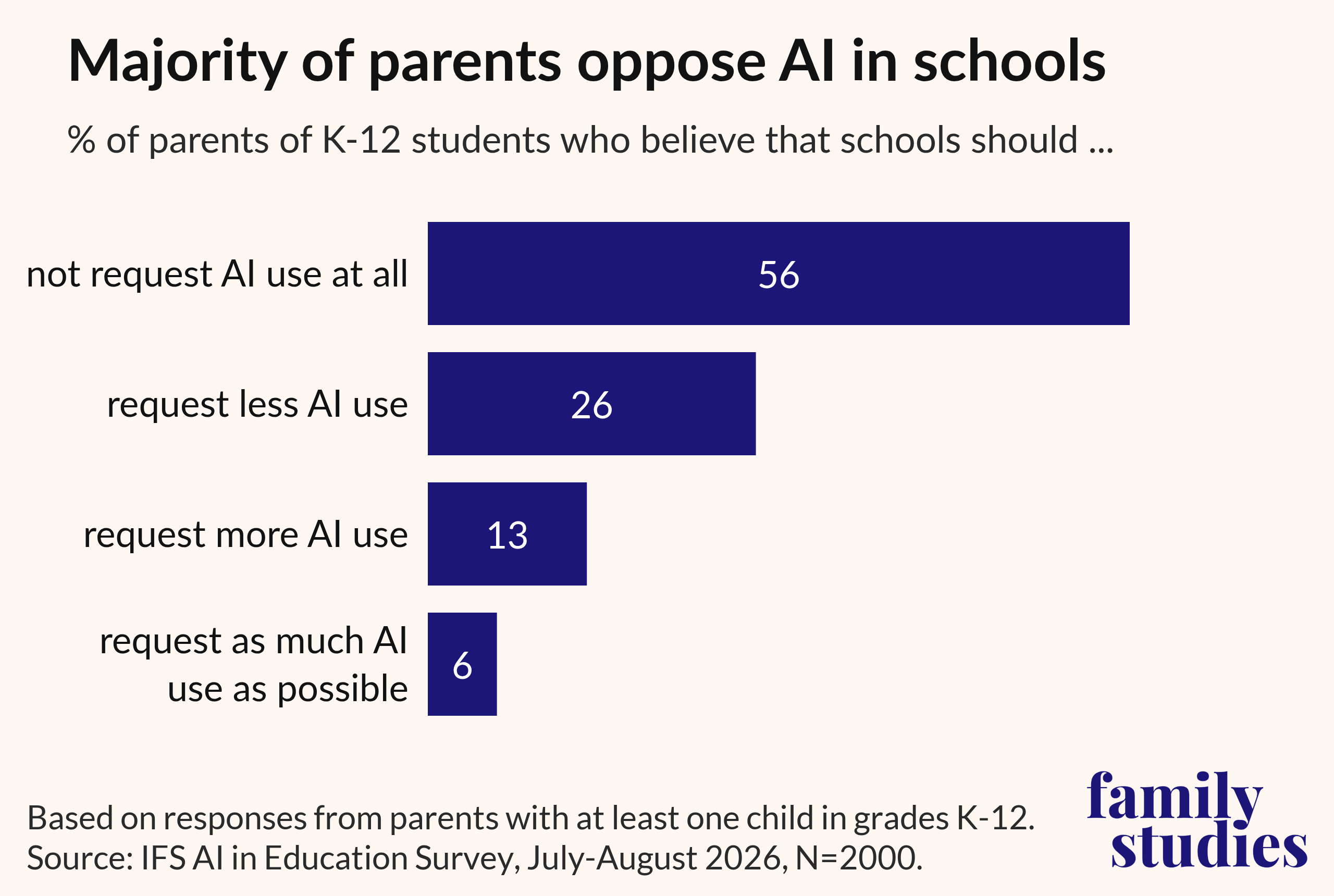
Figure 3. Views of parents on how much AI use schools should request
These ratios held, for the most part, across demographics. Around half of both Republicans (52%) and Democrats (49%) think children should not be using AI in schools at all. And at least 54% of parents with a college education or less are in agreement.
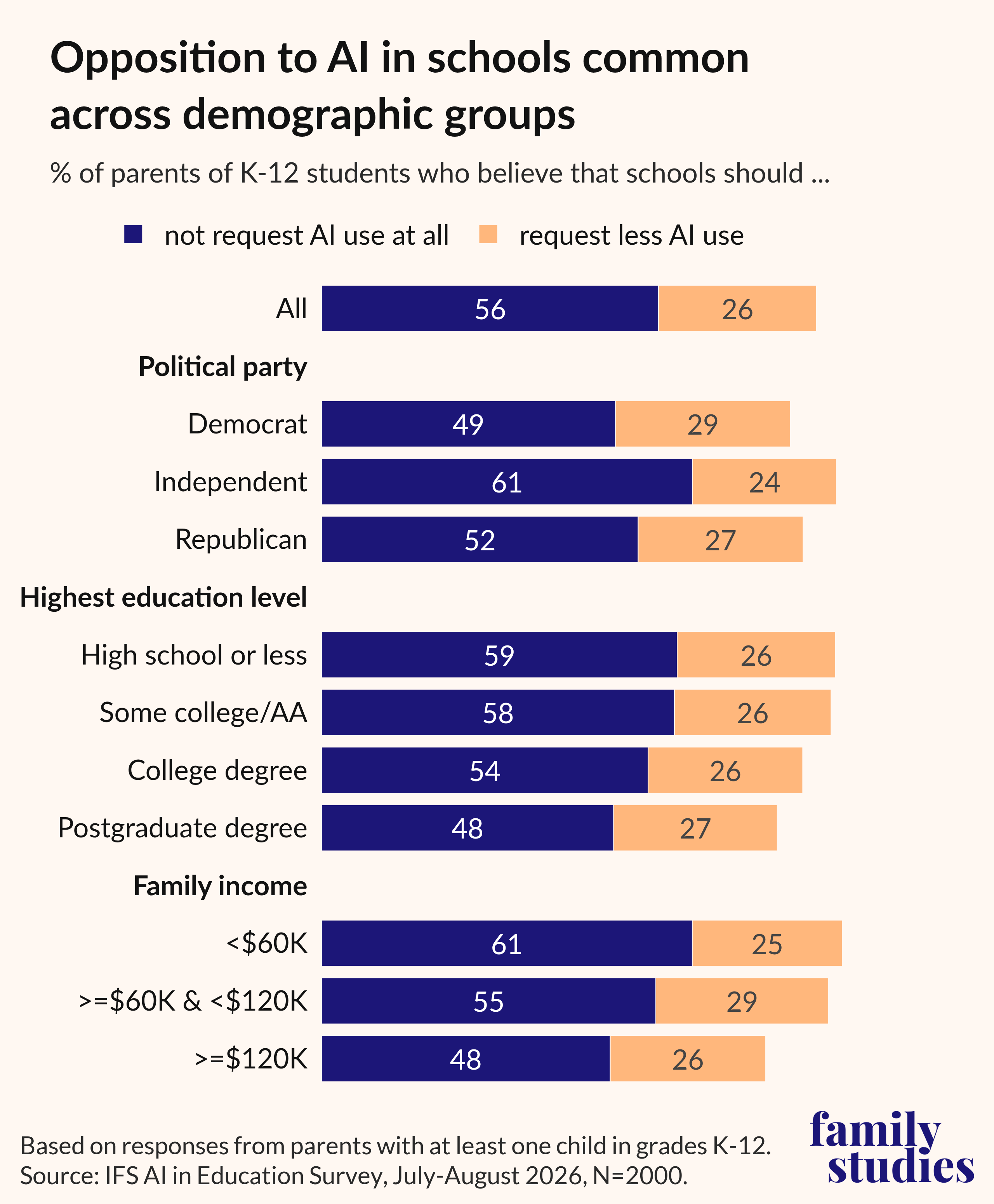
Figure 4. Views of parents, by political party, income, and education level, on how much AI use schools should request
While the highest-educated and the highest-earning parents are slightly less likely than others to think children should not be using AI at all (48% of both), 1 in 4 parents with post-graduate degrees and 1 in 4 parents in the highest income bracket also agree that schools should be asking children to use AI less than they currently are. This means that a strong majority—around 3 out of every 4—of both the highest-educated and the highest-earning parents agree that schools should be asking kids to use AI less than they currently are, or not at all. In sum, there is significant class unanimity on this issue.
Beyond general use, when do parents think it is appropriate to introduce AI in the classroom? Most parents support introducing AI in high school (25%); in 12th grade or later (20%); or not at all (22%). Only 21% think it is appropriate to introduce AI in middle school, and even fewer agree that children should begin using AI in elementary school (9%) or kindergarten (3%).
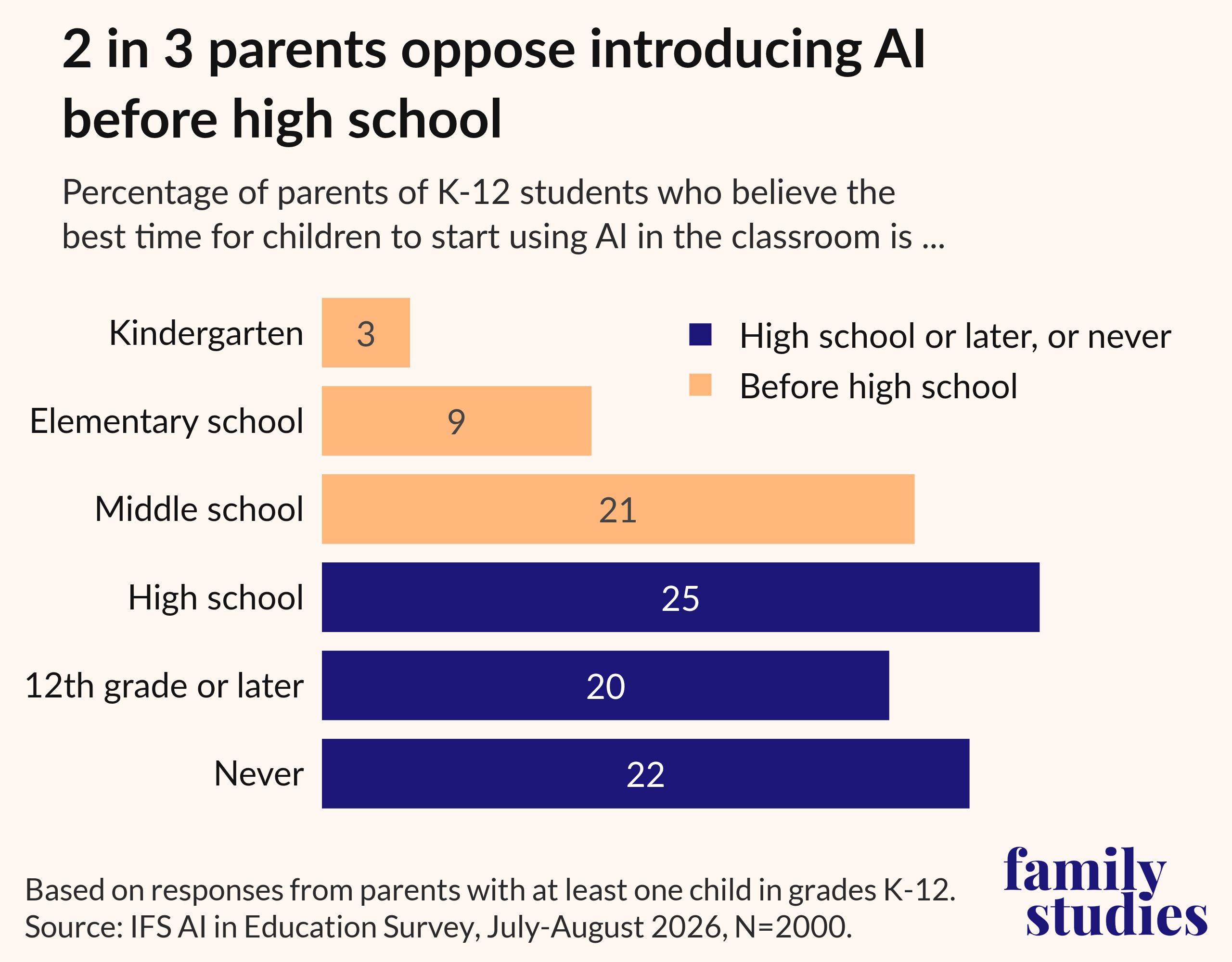
Figure 5. Views of parents on when schools should introduce AI in the classroom
Regarding when to introduce AI in schools, we again find considerable agreement across demographics. Only a small minority of parents (≤15%) of all political persuasions, education levels, or income brackets think it is appropriate to introduce AI early in a child’s education (elementary or kindergarten). In each category, the majority agree that the earliest AI should be introduced, if at all, is in high school or later.
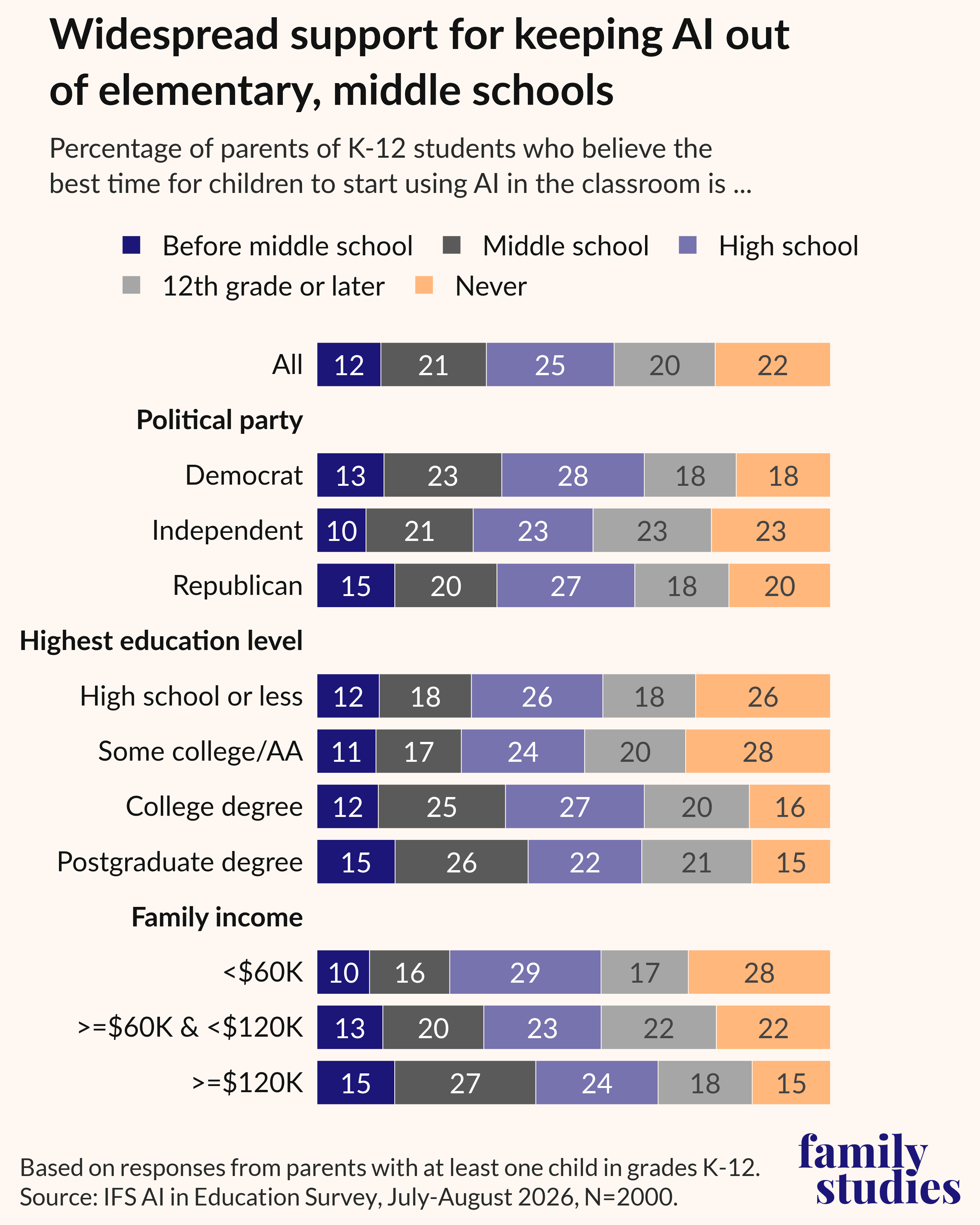
Figure 6. Views of parents on when children should begin using AI in school, by political party, education level, and income
As we describe in the introduction, parents have witnessed the negative effects of ed tech firsthand, and that history informs how they want to see AI introduced, if at all. So, we asked them to describe their ideal classroom, offering four general types, namely: tablet-based education with AI layered on top; tablet-based education that blocks AI’s addition; a wholesale return to printed textbooks and handwritten assignments; and a return to printed texts and handwriting, supplemented by a “computer lab” where students can use AI.
A fraction of parents have a positive view of the AI-and-tablets classroom. Only 11% agree that tablets have been good for learning and that AI will only make it better. The rest have some degree of concern about ed tech and AI in schools. For example, 26% of parents support tablets in education, but are concerned that AI would undermine learning. Another 1 in 4 agree that replacing books and handwriting with tablets and typing has been a “mistake,” and that schools should bring back books and re-emphasize handwriting.
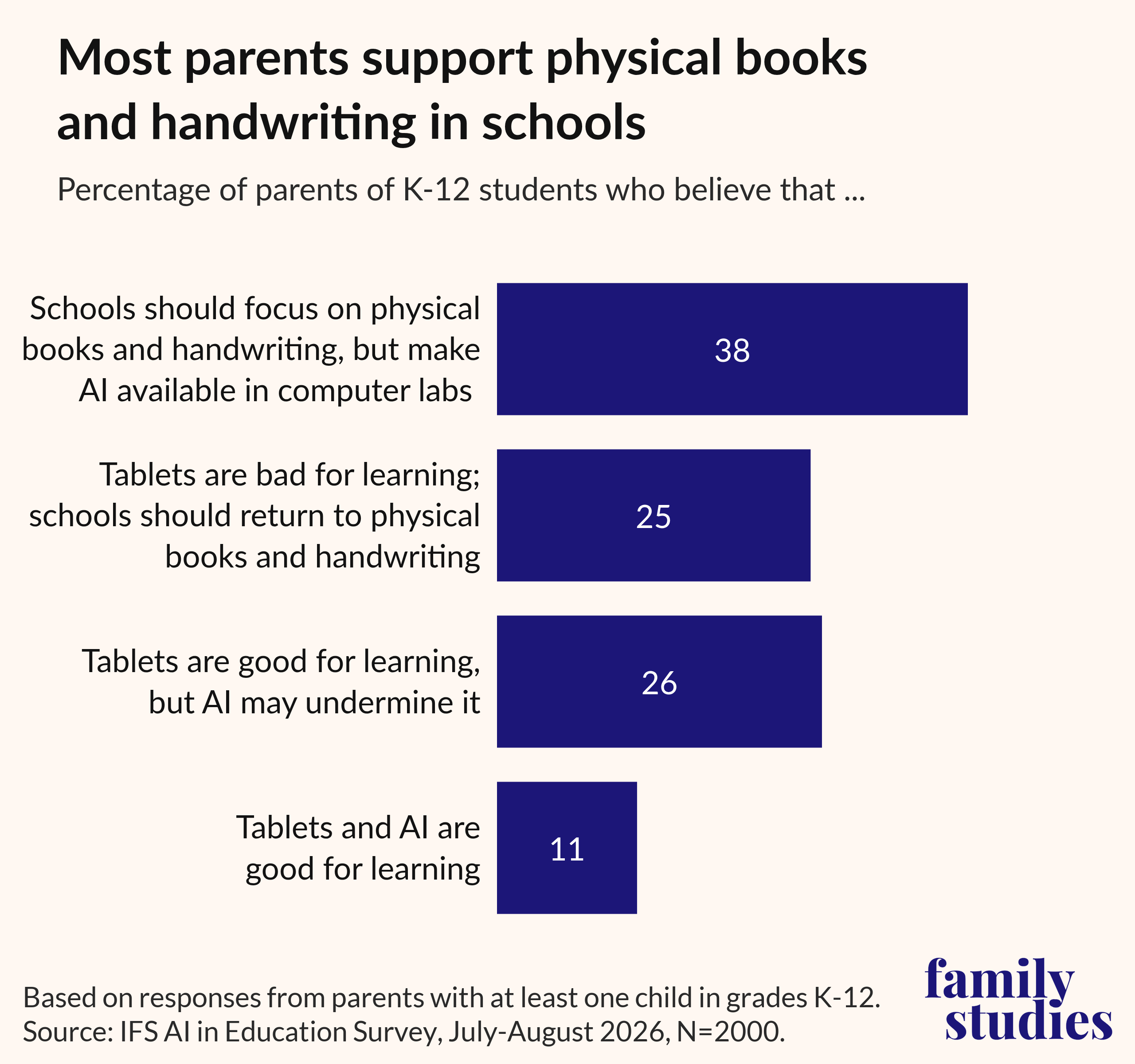
Figure 7. Views of parents on whether technology in schools has been beneficial
However, the largest share of parents, about 2 in 5 (38%), prefer a re-balanced approach, where printed texts and handwriting are the primary media of education, and computers and AI are used in a restricted subject, like classic computer labs. This both/and approach differs somewhat in spirit to the parents who want to see a full return to physical text and handwriting, but together they demonstrate that most parents want a robust place for more tried-and-true media and technology in their child’s education.
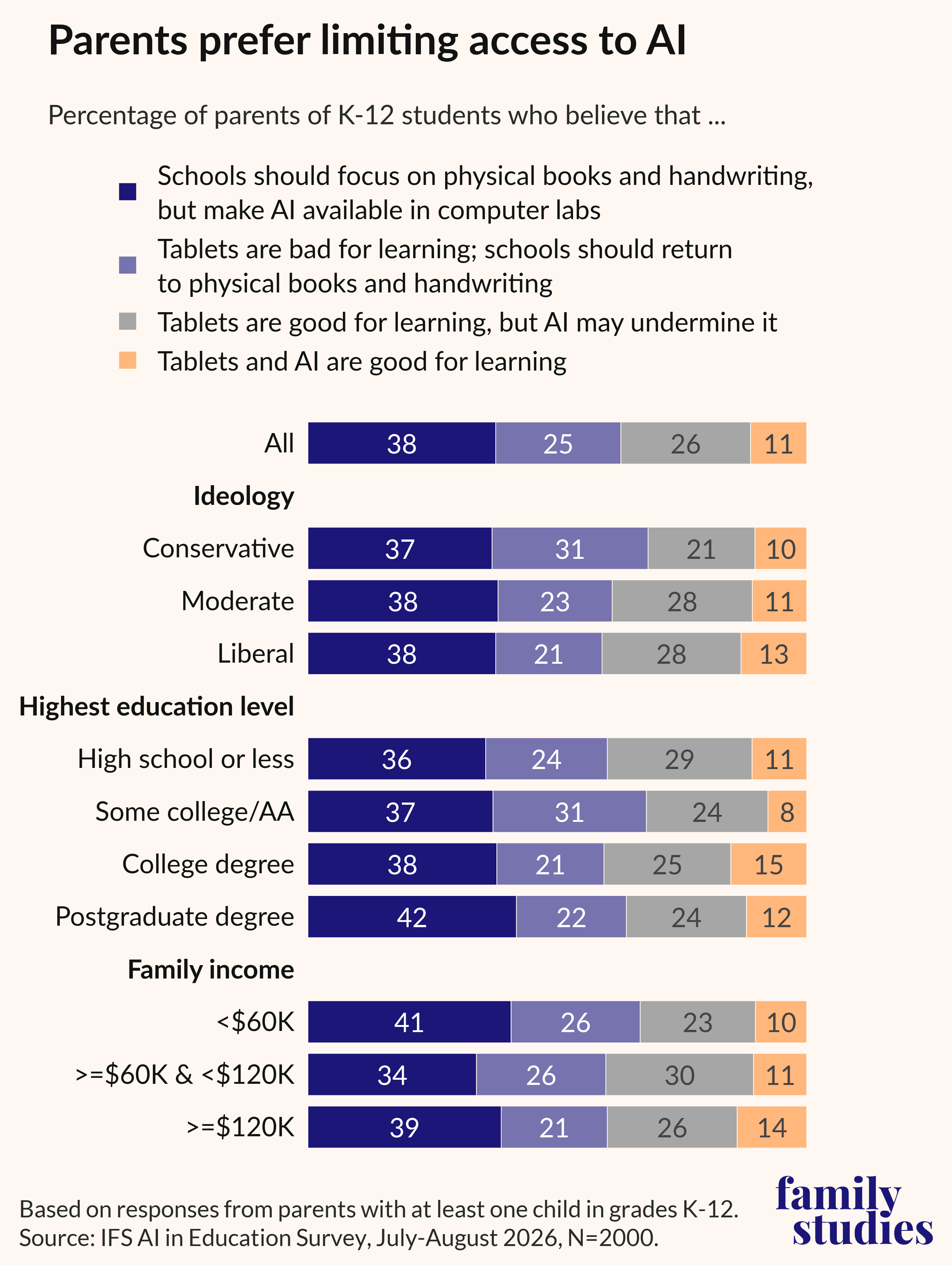
Figure 8. Views of parents, by ideology, education level, and income, on whether technology in schools has been beneficial
Similar proportions hold across every education level, income, and ideology. No more than 15% of parents in any of these categories think tablets and AI are an unqualified net positive; and no less than a third of parents in any of these categories agree that a balance can be struck.
With respect to political ideology, conservatives are more likely (31%) than liberals (21%) or moderates (23%) to support replacing tablets with handwriting and books. However, the both/and approach seems to appeal across the political divide. Nearly identical percentages of conservatives, moderates, and liberals (37-38%) agree that schools should primarily use handwriting and books but still teach AI within the confines of computer labs.
More Harm Than Help: Parents’ Views on AI’s Effects in the Classroom
So far, we have discussed how schools are currently approaching AI and what kind of approach parents prefer. But why might parents have the views they do about AI use and integration in schools? What effects do parents think that AI will have on their children and their education more specifically?
We asked parents about their views on the benefits and drawbacks of AI in schools. For each scenario, parents ranked how much they agree or disagree with a given statement about the technology. We find that parents are much more convinced of AI’s risks to learning and safety than its positive benefits for learning.
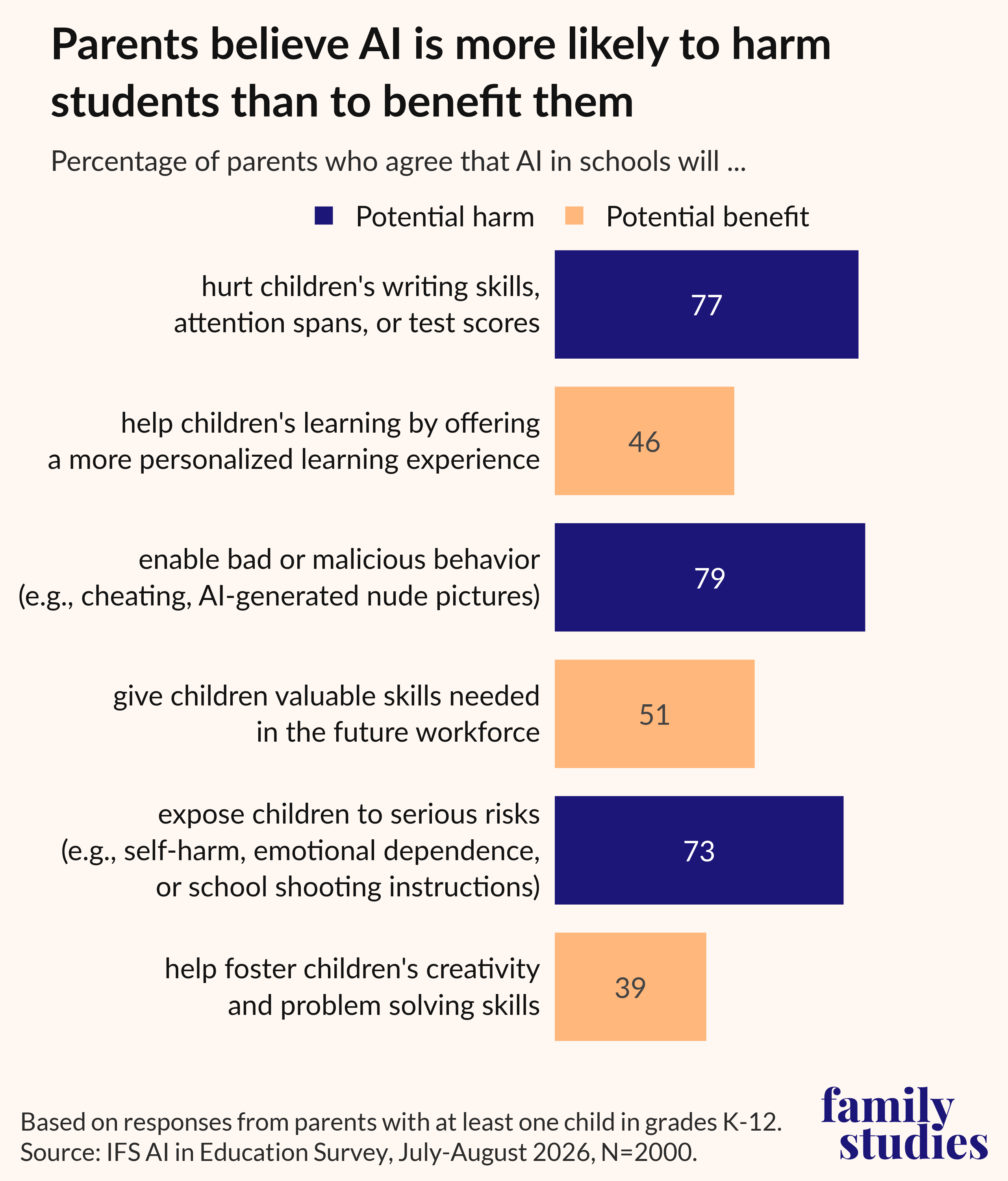
Figure 9. Percentage of parents who expect AI in schools to cause various benefits and harms
Risks
More than 3 in 4 parents (77%) strongly or somewhat agree with the statement that “AI in schools will hurt children’s learning, such as decreasing test scores, writing skills, or attention spans.”
Strong concern that AI will hurt kids’ learning is not limited to parents with children in any one grade level or at any particular kind of school. This concern is high across the board for most parents. Almost 8 in 10 parents of kids whose oldest children are in elementary, middle, and high school agree that AI will harm kids’ learning. And at least 75% of parents of kids in nearly all types of schools are similarly concerned.
Parents who send their children to private secular schools are somewhat of an outlier on this question, but not by very much overall. For example, 62% of parents whose kids attend secular private schools think that AI will harm their kid’s learning. While that is a clear difference of more than 15 percentage points from the nearest group, it is still a solid majority.
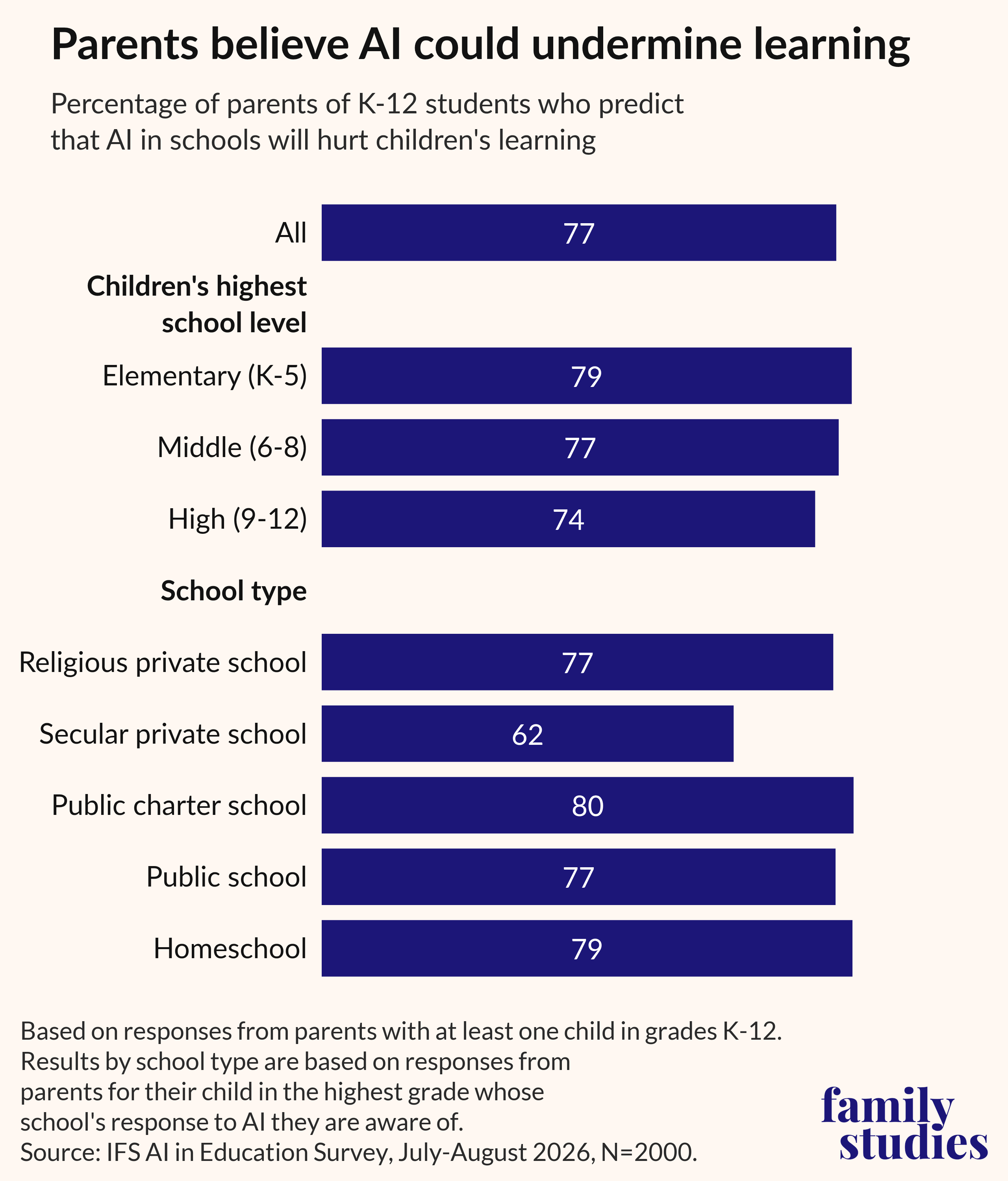
Figure 10. Percentage of parents, by school type and children’s highest school level, who predict that AI in schools will hurt children’s learning
The same is true across income, education level, and political ideology, with at least 73% of college-educated parents agreeing with the statement. For every other group in these demographics, at least 75% or more agree.
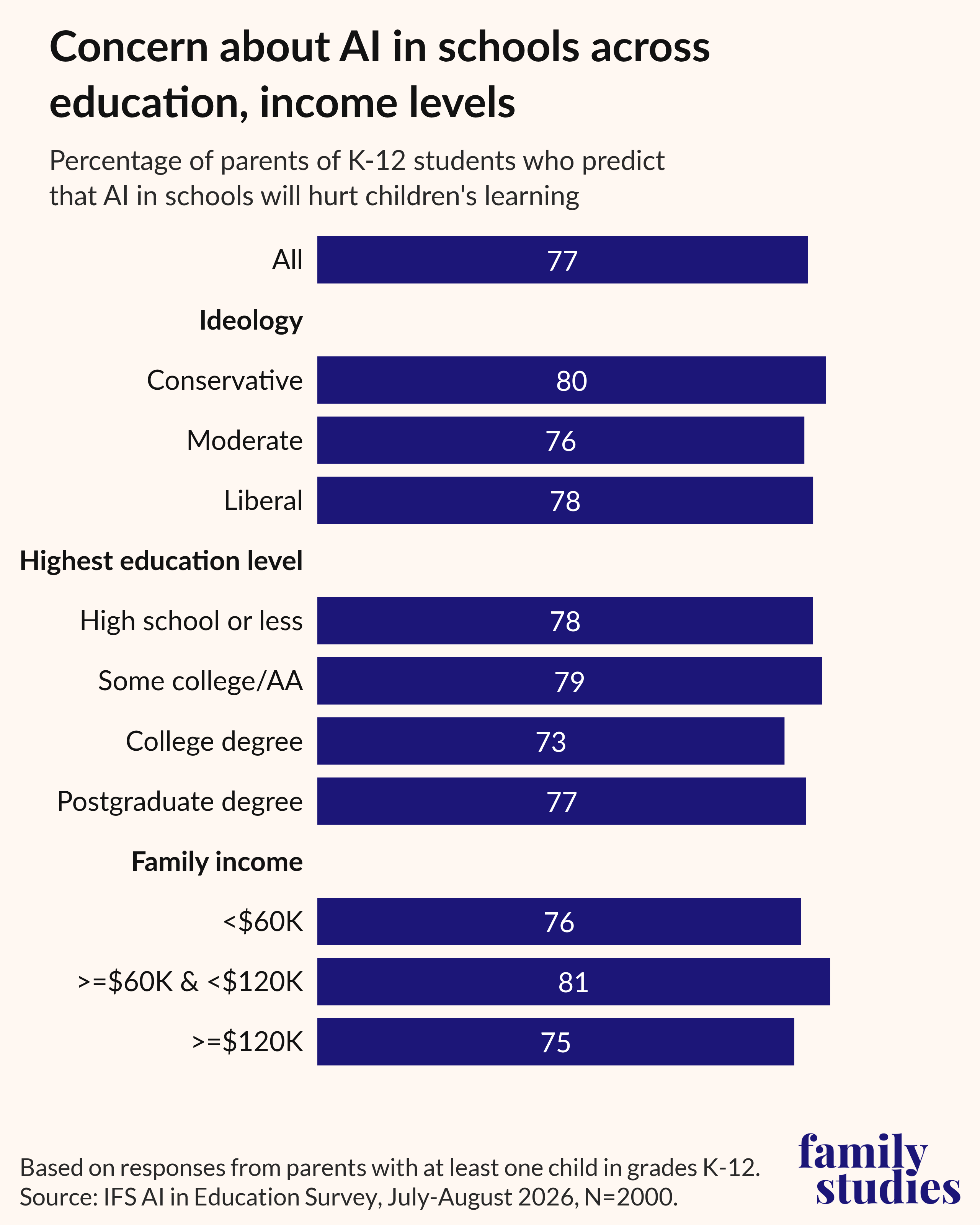
Figure 11. Percentage of parents, by ideology, income, and education level, who predict that AI in schools will hurt children’s learning
Trump administration officials have moved assertively to help advance the incorporation of AI in schools around the country. But do their voters support this maneuver?
In fact, they do not. A strong majority of conservative parents are worried about AI’s effects on learning: 80% of conservative parents agree that AI will undermine children’s learning. This view, it turns out, is bipartisan, with 78% of liberal parents sharing this view.
Beyond negative effects on learning, a majority of parents are also concerned about how AI might enable malicious behavior and expose students to serious risks. We asked parents if they agree or disagree that “AI in schools will enable bad or malicious behavior, such as making it easier to cheat or create AI-generated nudes of peers or staff.” Here again, a strong majority of parents across demographics agree.
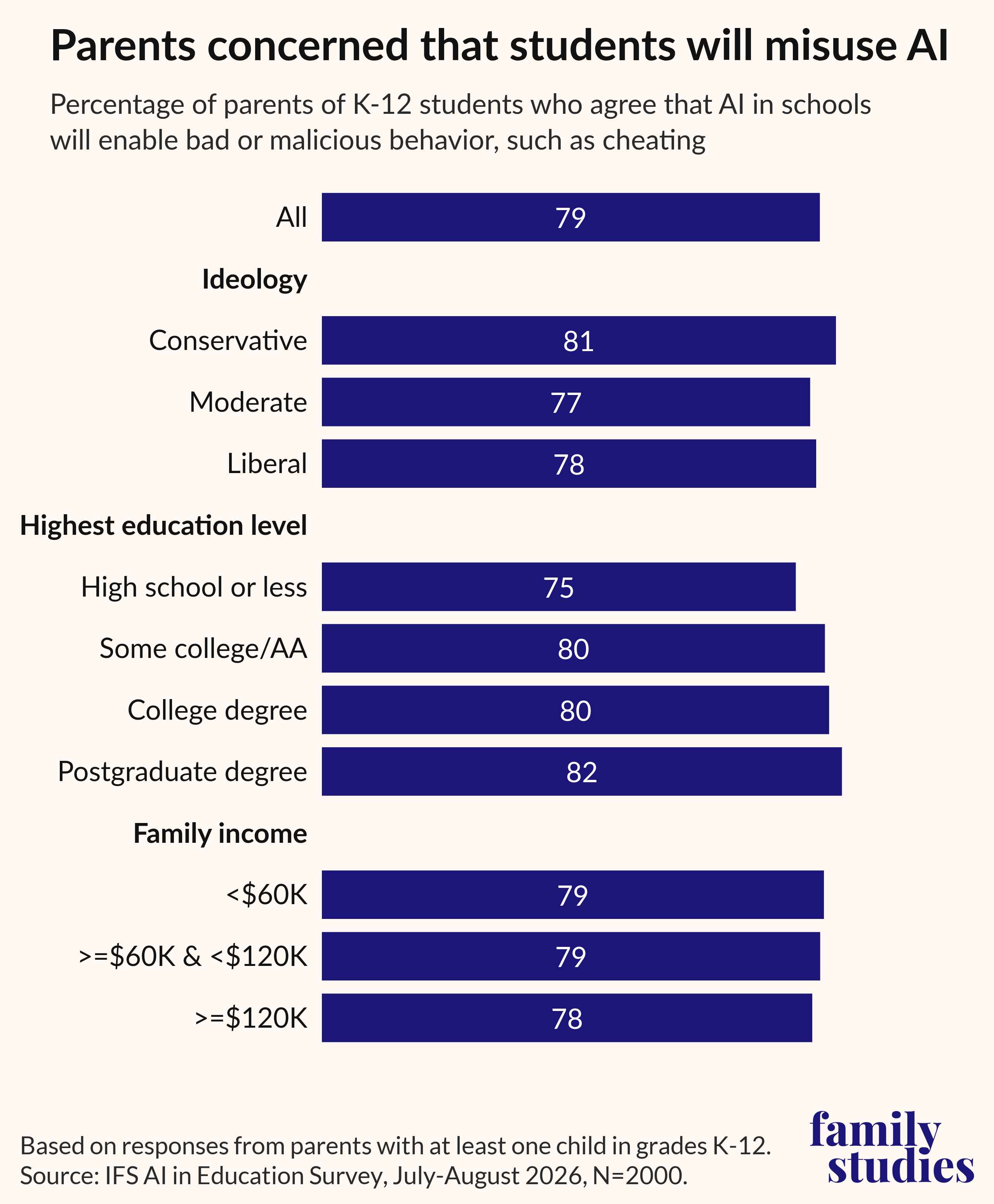
Figure 12. Percentage of parents, by ideology, income, and education level, who predict that AI in schools will enable bad or malicious behavior
Furthermore, 73% of parents are concerned that AI in schools will expose children to serious risks, including chatbots that encourage self-harm, emotional dependence, or even provide instructions for violent actions, like school shootings. A comparable majority held for parents whose oldest children attend each school level: elementary (76%), middle (71%), and high school (71%).
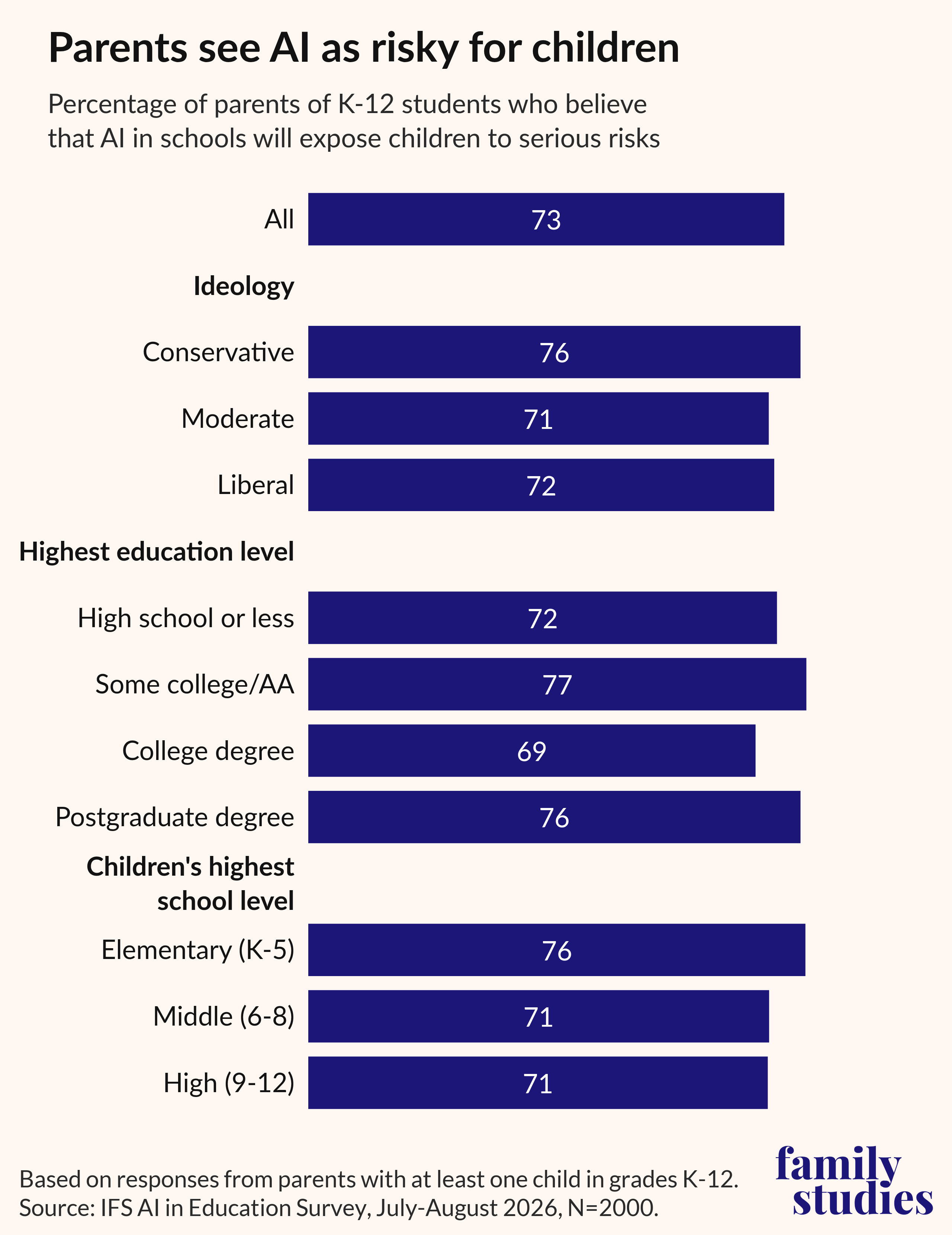
Figure 13. Percentage of parents, by ideology, education level, and children’s highest school level, who predict that AI in schools will hurt children’s learning
Parents of all income and education levels and political leanings are concerned about these risks. Those with household incomes at or above $120,000 are about as likely to see AI as risky (71%) as are those who earn less than $60,000 (72%). Similarly, parents with a postgraduate degree have similar views on this issue to those with fewer years of education. And conservative parents are just as likely to foresee risks from AI as are liberal and moderate parents.
Benefits
AI has increasingly been marketed as a tool that can foster creativity and problem solving. Do parents agree? When we asked if they think AI will do this for students, fewer than 2 in 5 parents (39%) agree. This skepticism regarding AI’s potential to enhance creativity is shared across income groups, political ideologies, and most education levels.
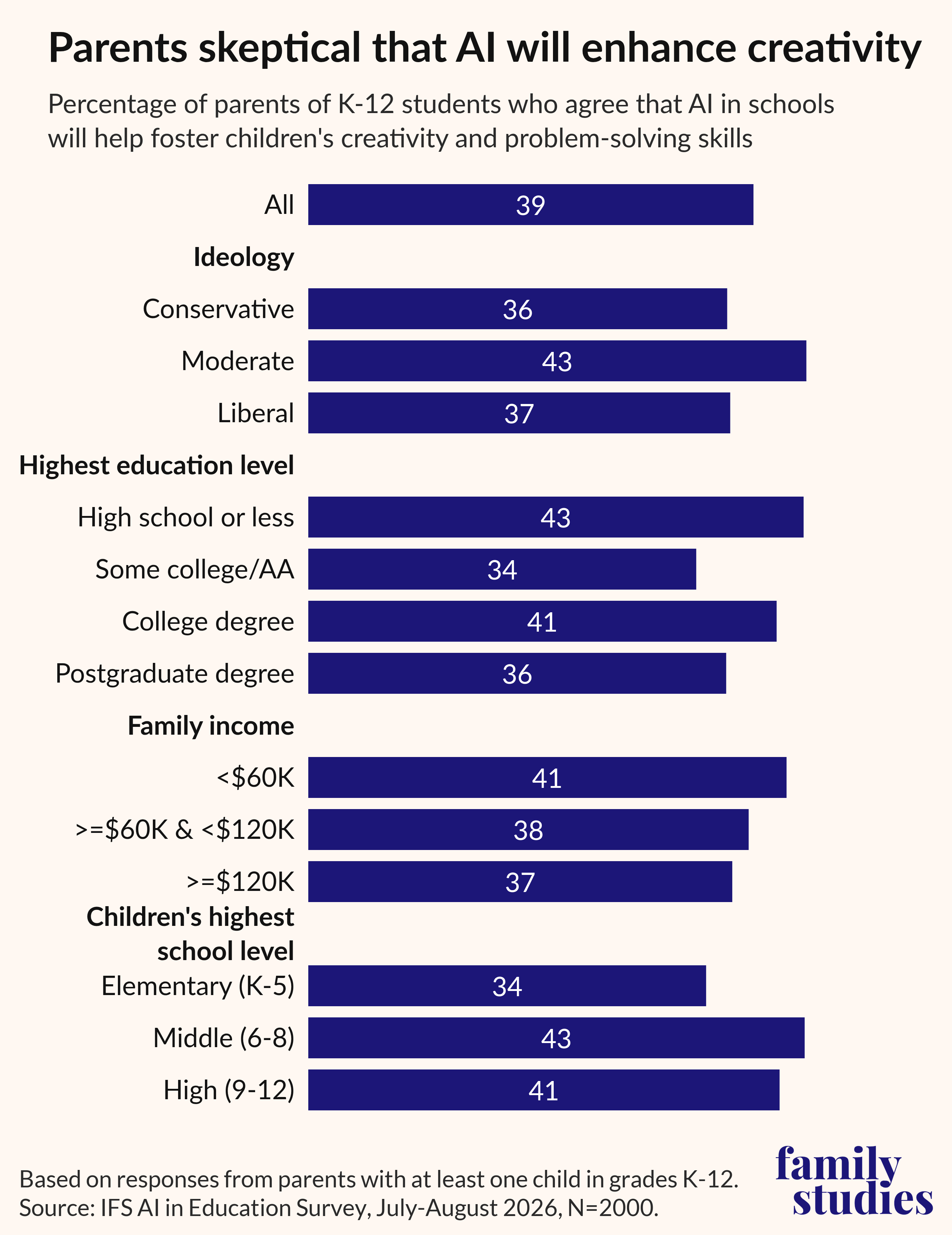
Figure 14. Percentage of parents, by ideology, education level, income, and children’s highest school level, who predict that AI in schools will help foster children’s creativity
Parents whose oldest school-aged children are in elementary school (34%) are less likely than their counterparts—that is, parents whose oldest school-aged kids are in middle (43%) or high school (41%)—to agree that AI fosters creativity and problem solving.
While agreement across most demographic breakdowns hovers between 34% and 43%, parents of kids in secular private schools are an outlier. Nearly 7 in 10 of these parents agree that AI in schools will foster creativity and problem solving.
We also asked parents whether they think AI will equip children with the skills they need to enter the workforce in the future. Here, a very slim majority (51%) of parents agree. For this question, the demographic breakdowns are much more varied. For one, there is a clear split among parents by education level. Those without a bachelor’s degree are less likely than higher-educated parents to think that AI in schools will be beneficial for entering the future workforce.
The difference here might be explained by the kind of work that such parents can expect for their children. Perhaps parents with a bachelor’s or a graduate degree are more likely to anticipate that their children will be employed in some sector of the information economy; whereas parents with some college education or a high school education or less are likely envisioning their children in the service sector or the trades, where AI is currently less than necessary to an employee’s workflow.
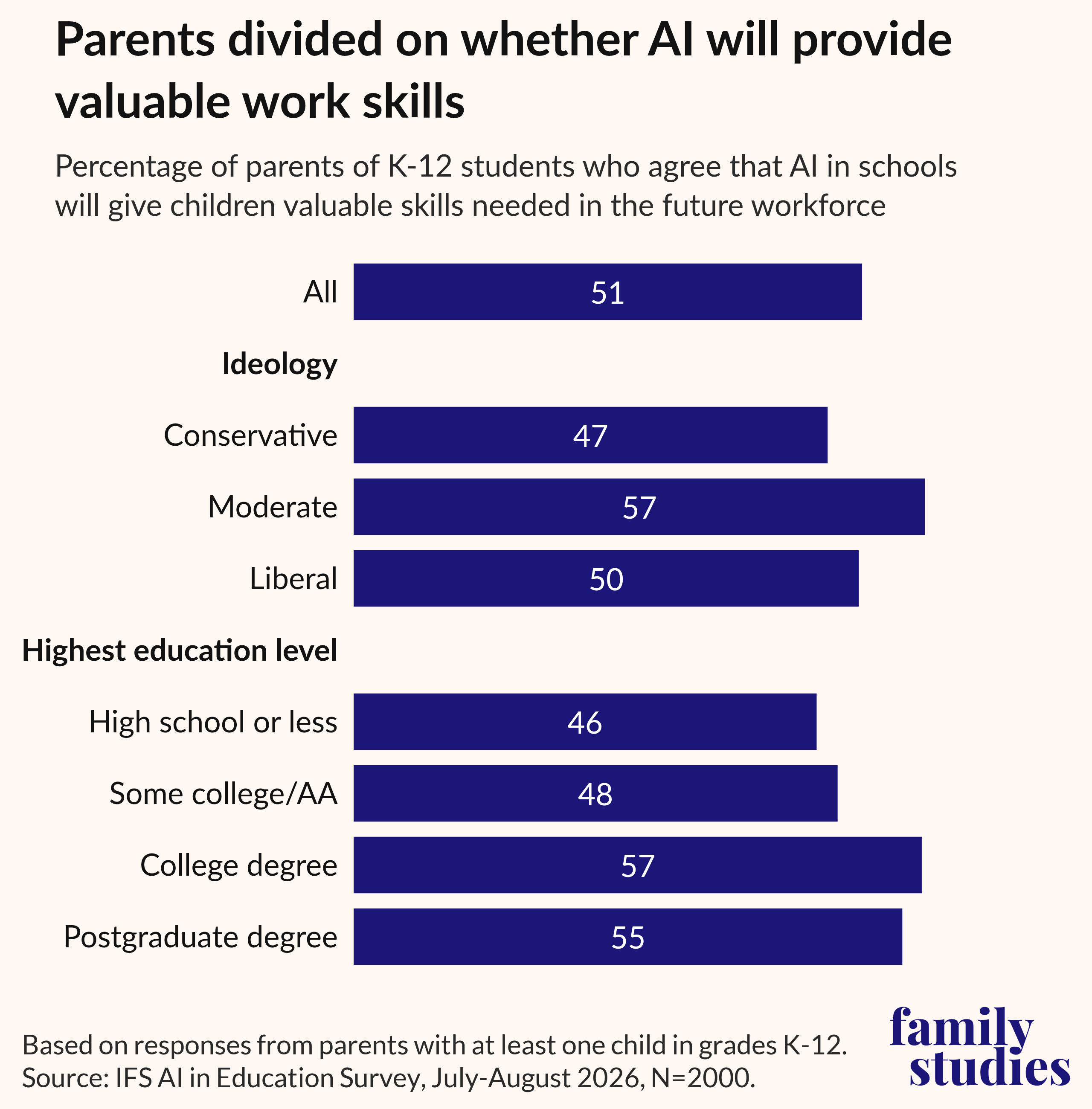
Figure 15. Percentage of parents, by ideology and education level, who predict that AI in schools will give children valuable skills needed in the future workforce
Our final statement on AI’s benefits is about personalized learning experiences. When we asked if AI in schools will provide more personalized learning experiences for students, less than a majority of parents (46%) agree. This, it should be noted, is the case that AI advocates most consistently make for the value of AI in schools. In view of that, it is interesting to note that there is not widespread agreement among parents for this claim.
In sum, our survey finds that the majority of parents are much more in agreement about the technology’s risks than its benefits. To be sure, parents are more evenly split when it comes to AI’s benefits; yet, for 2 of the 3 questions about the benefits of AI in schools, most parents do not agree that AI will provide the claimed benefit.
Furthermore, when we compare parents’ responses to the proposed benefits of AI in schools to their responses to the proposed risks of AI in schools, we find that more parents are more confident about the risks. No more than 12% of parents strongly agree with the proposed advantages of AI in education. In fact, for each of the positive statements about AI, parents are significantly more likely to strongly disagree than strongly agree. When asked, for example, whether AI will foster creativity, parents are far more likely to strongly disagree (27%) than to strongly agree (11%).
In contrast, when asked about various potential harms of AI, parents are far more likely to strongly agree than to strongly disagree that AI will cause these harms. At least 32% strongly agree with each potential risk of AI in schools, whereas no more than 6% strongly disagree.
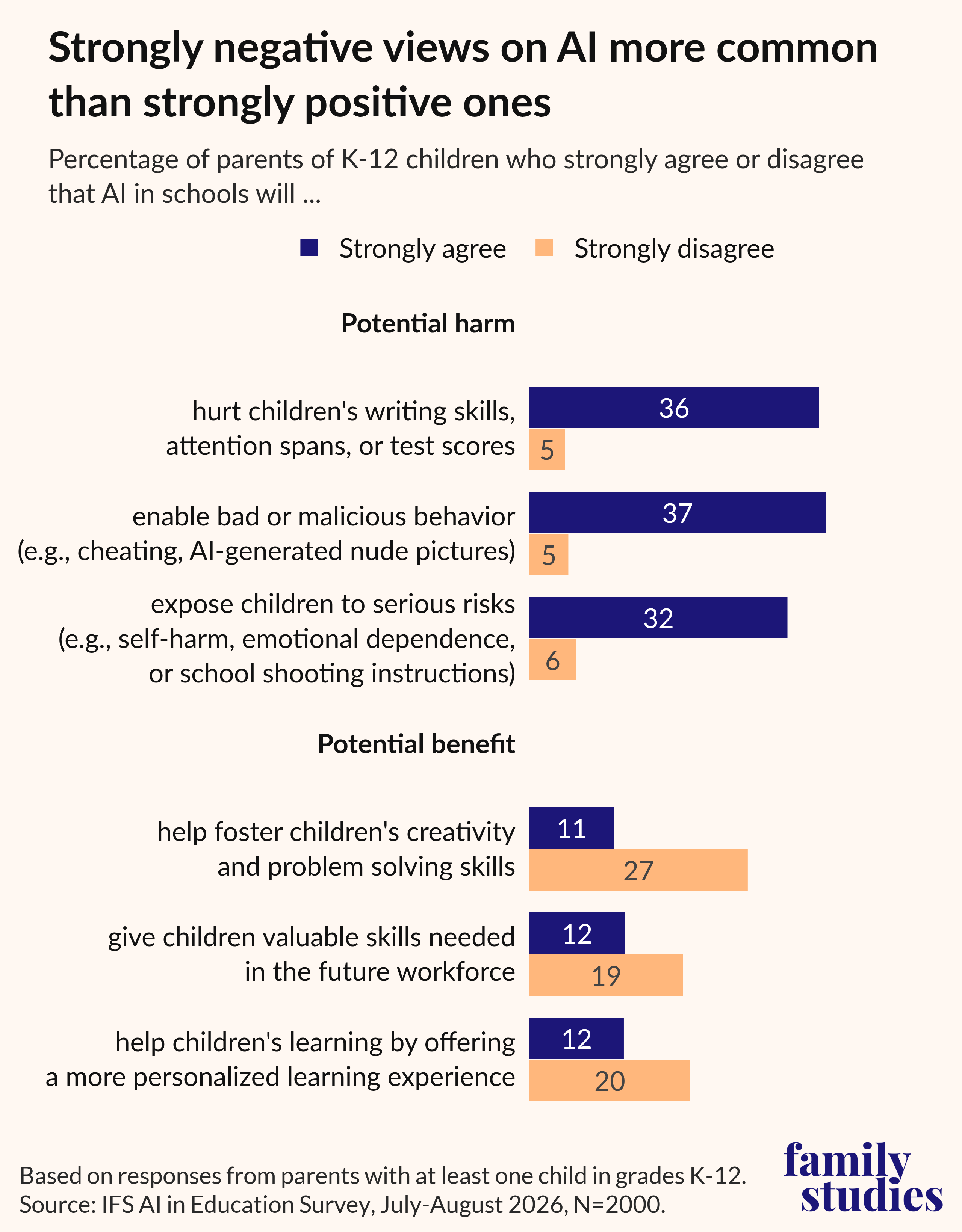
Figure 16. Percentage of parents who strongly agreed or disagreed that AI in schools will cause various benefits or harms
Schools and Parents: How Parents’ Preferences and Views Are Being Heard
Parents clearly have opinions on AI in schools. But what’s less clear is whether their views are actually being heard. Do parents feel like they have the ability to shape how AI is used in the classroom? And do they have the choice to opt out if their school pursues technology policies they disagree with?
Our survey asked parents each of these questions about their child in the highest grade that has engaged with AI in the classroom, since direct experience with AI in the classroom increases with a child’s age.
When asked if the school of their oldest child who has used AI in the classroom (from here forward, “oldest AI-exposed child”) considers their preferences and concerns about introducing new technologies, a total of 70% of parents agree, with 20% strongly agreeing and 50% somewhat agreeing.
Granting that the largest share of this group, 50%, only “somewhat agree,” we should be forthcoming that this finding surprises us. Technology does not often get introduced into the classroom as a result of parental preference; nevertheless, it is quite clear that American parents, in the main, feel they can voice their concerns about ed tech in schools.
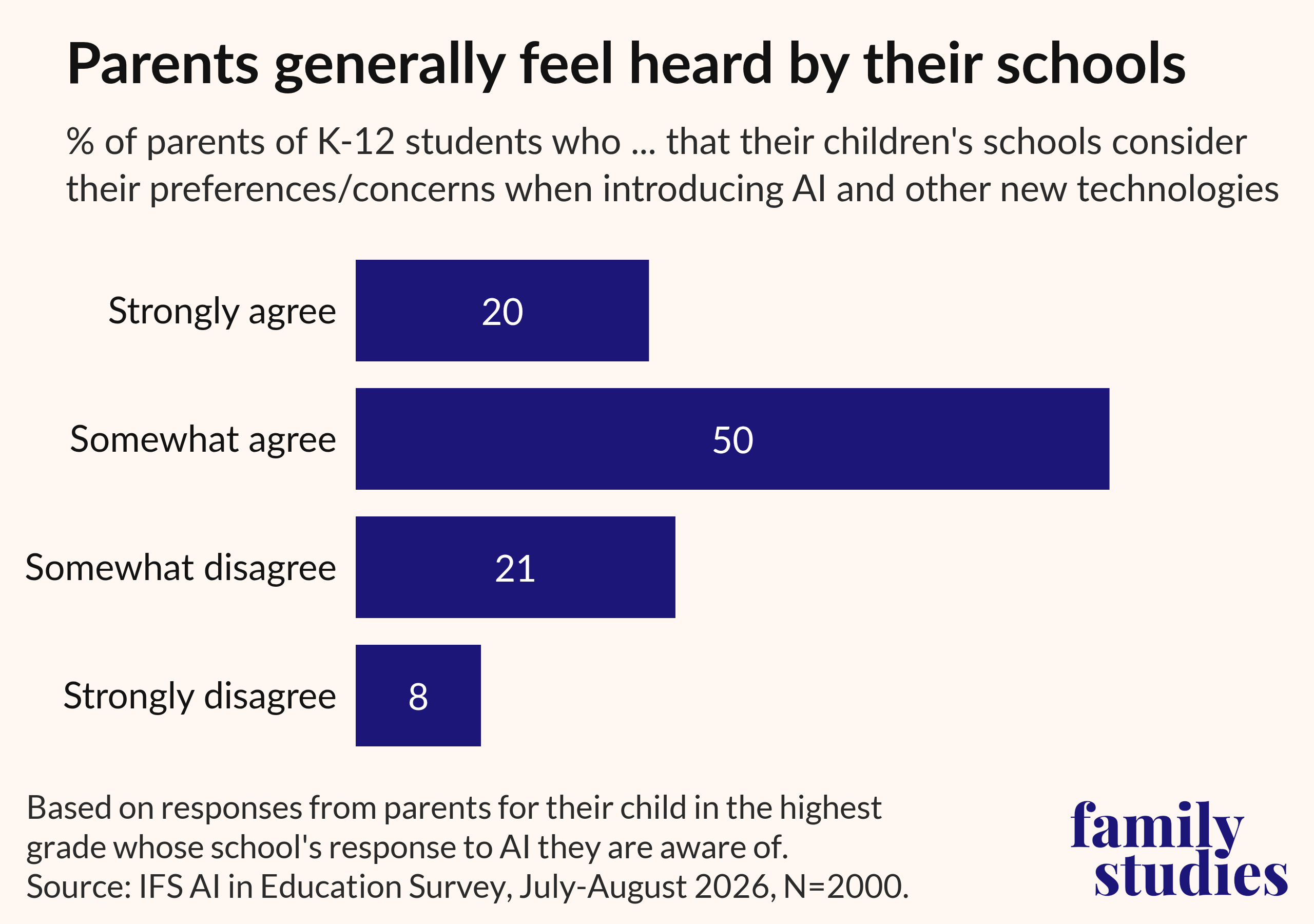
Figure 17. Views of parents on whether their children’s schools consider their preferences or concerns when introducing AI and other new technologies
That said, it is still important to note that some groups of parents feel more heard than others. Parents whose kids are enrolled in secular private schools are around twice as likely as those with kids in public or public charter schools to strongly agree, which suggests a sizeable gap in parental agency between these school types.
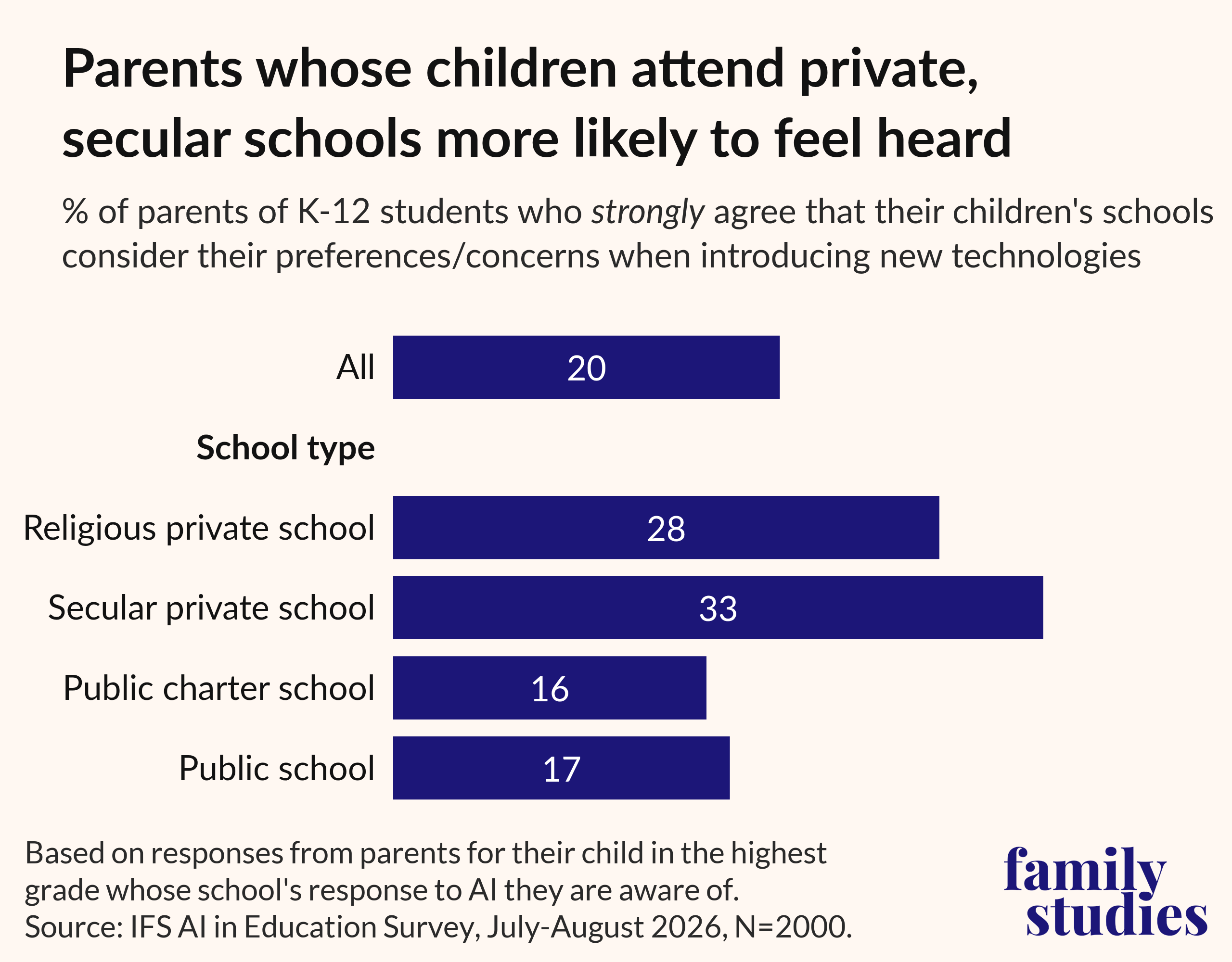
Figure 18. Percentage of parents, by children’s school type, who strongly agree that their children’s schools consider their preferences or concerns when introducing AI and other new technologies
It also appears that parents feeling as if they are being heard about technology in the classroom diminishes as their children get older. Parents of high schoolers are more likely to disagree that they feel heard than parents whose oldest children attend elementary or middle school. By that time, schools appear to be less interested in the concerns and preferences of parents.
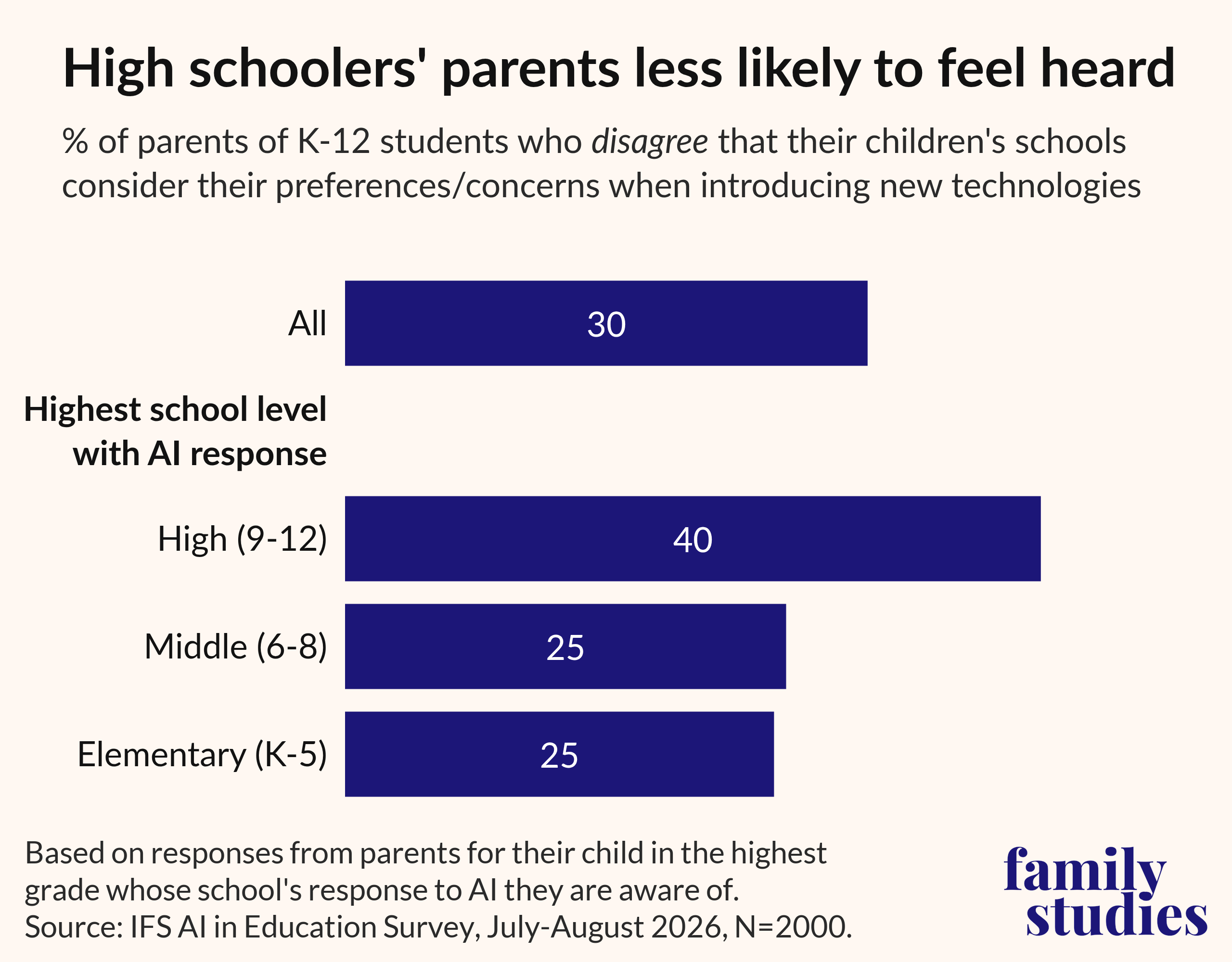
Figure 19. Percentage of parents, by children’s school level, who disagree that their children’s schools consider their preferences or concerns when introducing AI and other new technologies
We then asked parents if they felt they had the ability to shape the use of AI in the classroom of their oldest AI-exposed child. A slim majority (55%) of our respondents agree that, yes, they can shape AI in the classroom of their oldest AI-exposed child.
Once again, differences are much more pronounced when comparing private school parents with public school parents: 84% of parents who send their kids to secular private schools say they have the ability to shape AI use in the classroom of their oldest AI-exposed child, whereas only 49% of parents with kids in public schools say the same. The gap in parental agency is even more pronounced over the power to influence how technology is used in schools than over the power to be heard.
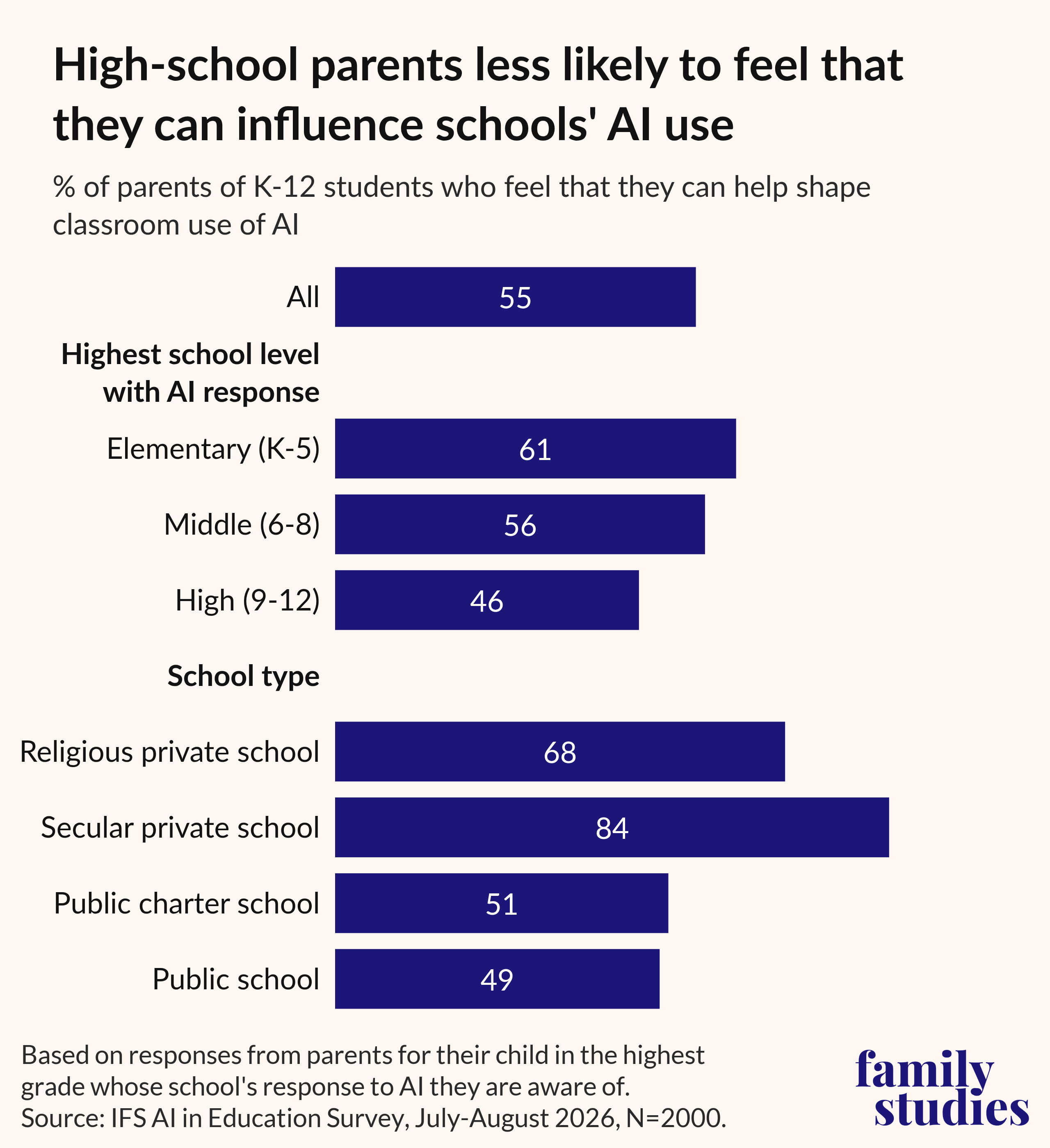
Figure 20. Percentage of parents, by children’s school level and school type, who feel that they can help shape classroom AI use
With this question, we also find similar patterns of stratification by grade level. Parents are less likely to feel that they can shape AI in the classroom if their child is in high school (46%) versus elementary school (61%) or middle school (56%).
Our survey also asked parents if the school of their oldest AI-exposed child has given them the choice to opt out of using AI in the classroom. As shown earlier in the report, a relatively small portion of schools have officially assigned or required AI in schools, which makes the overall portion of the population that could opt out still smaller. Indeed, according to our data, only 6% of such students have been required to use AI without the ability to opt out. Another 6% of students have been assigned AI together with an opt-out option. (For another 2% of students, not included in these calculations, parents are not sure whether an opt-out had been provided.)
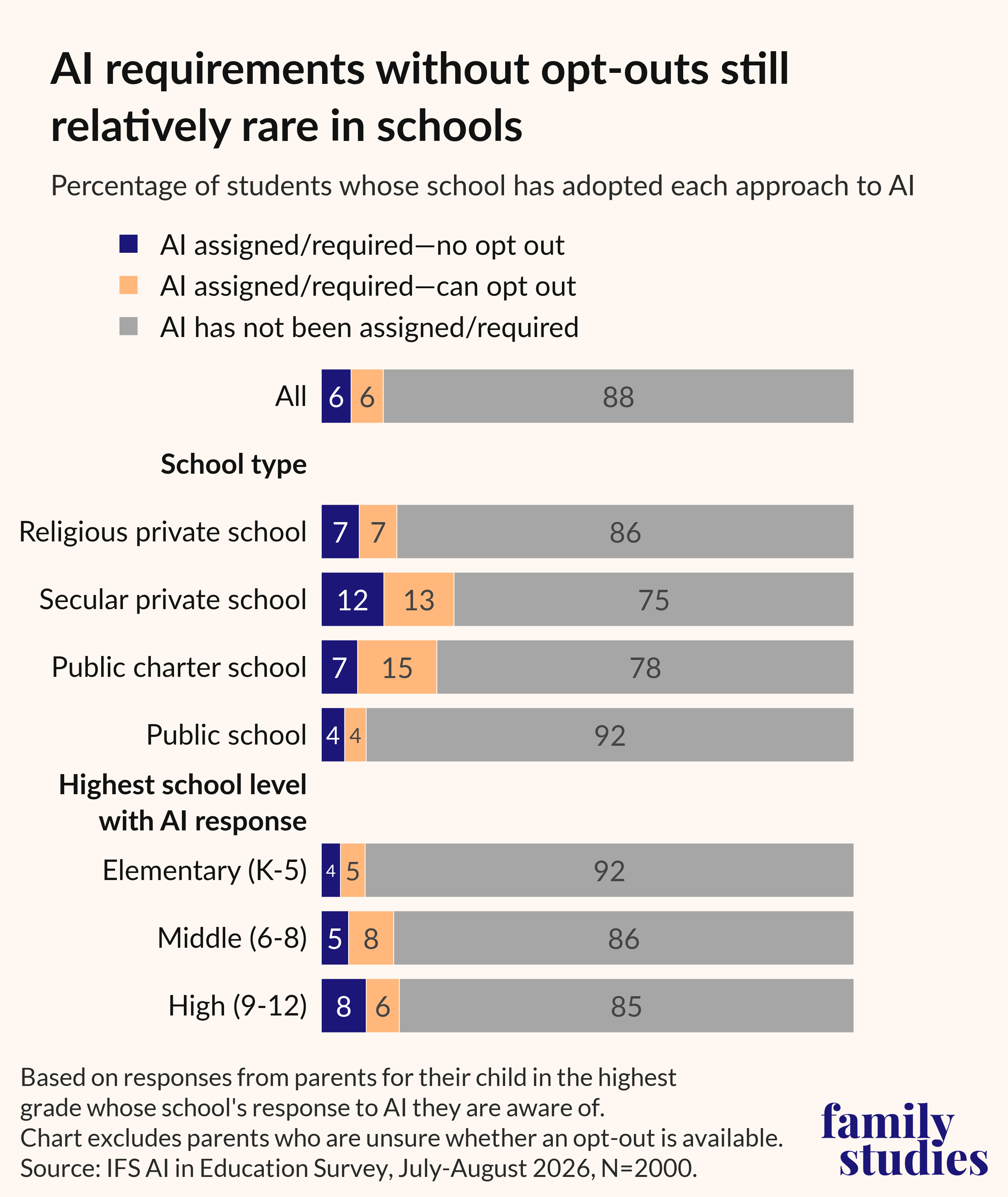
Figure 21. Percentage of students, by school type and level, whose schools have adopted various approaches to AI
But it is also worth stating that, when we narrow our analysis to schools that require AI use, around half of students are permitted to opt out, whereas the other half are not. We should note that the population in our survey that could answer this question is small, so we should read these findings with caution. Be that as it may, if these patterns hold, we could be seeing the beginning of a long-term trend in which some families have the freedom to opt out and others do not.
Will the small percentage of students who cannot opt out of using AI increase in the future? Very likely, yes. On the one hand, our survey was conducted right before the start of the 2026-2027 school year, so it’s possible that more students are under an AI mandate already. In the case of other technologies used in schools, especially those that are central to students’ learning and coursework (such as Chromebooks), most districts don’t allow families to opt out of tech use. If that tendency extends to AI use in schools, we may see fewer opt-outs in schools requiring or allowing AI use moving forward. On the other hand, recent restrictions on AI use in certain municipalities suggest that these numbers, at least for public schools, may be constrained, at least for the time being. As a growing body of research finds that educational technology has not been as effective for learning as promised, parents, educators, and lawmakers are becoming skeptical of technologies in the classroom and are taking steps to restrict tech use. If that trend continues, AI use may end up being even more restricted and opt-outs more common.
Sidebar: Who are Secular Private School Parents?
Since secular private school parents have occasionally held different preferences than other parents around AI in schools, it is worth taking a brief look at the demographics of this group. We find that parents who send their kids to secular private schools are more likely to have an average annual income of $120,000 or more (49%) and to have a bachelor’s degree or higher (62%) than any other group except parents of religious private-school children.
They are also more likely to call themselves “liberal” than are religious-school parents or homeschoolers. It is also the case that a significant majority of this group (63%) voted for Kamala Harris in the 2024 presidential election, but those numbers are little different from parents who send their kids to public charter schools and traditional public schools.
We expected to find that this group would be even more secular than public school parents, but that turned out to not be the case. But, by comparison, they are substantially more secular than parents who send their children to religious private schools. By all appearances, this group of parents appears to be most easily characterized as “elite liberals.” They seem to have the highest sense of agency in school settings among all the parents we surveyed, and while they also tend to be very concerned about AI in education (and AI in general), they are also most likely to highlight its potential benefits to career and learning. It is very likely that the sense of these parents that they can shape AI’s use in the classroom contributes to some of these differences in the results.
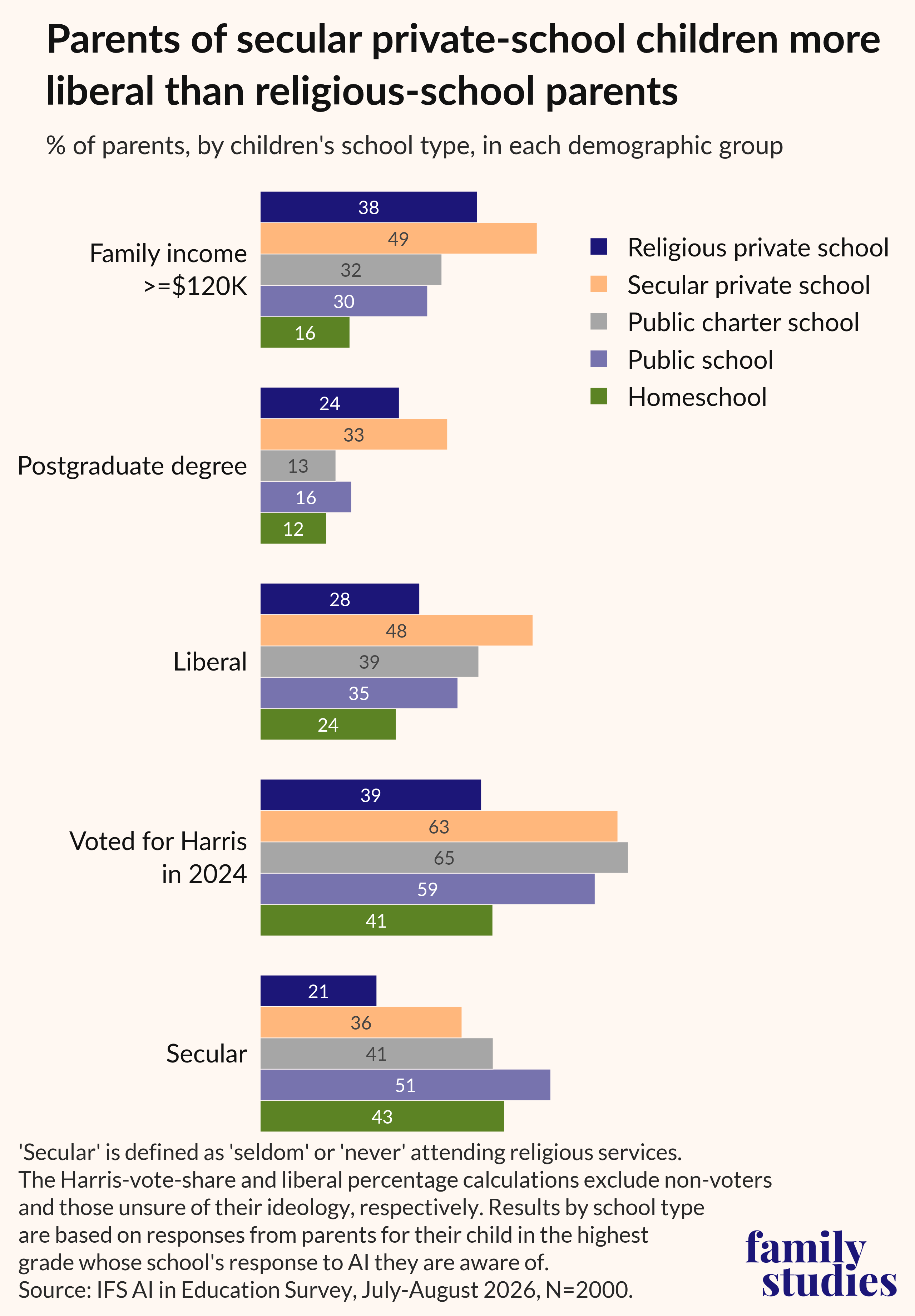
Figure 22. Percentage of parents, by children’s school type, in various demographic groups
Parents and Policy: The Push to Pause AI
In the near term, AI is not showing promising effects on student learning. While student homework scores have gone up with AI use, it has also resulted in sharp declines in exam performance and memory recall. In the wake of these findings, a number of school districts are choosing to pause AI use in schools in the near term until AI’s long-term effects on student learning are better understood. For example, this fall, both the Los Angeles and New York City school districts enacted policies that prohibit student use of AI, including AI tutors and companions, in the classroom. Other school districts have enacted similar policies.
Earlier this fall, we released initial findings from our survey regarding parents’ support for schools putting a pause on AI. As reported in our brief, 3 in 4 parents, including at least 72% of parents of every political persuasion, support this policy. Wide support for this policy not only holds across political views; it also holds across education level and income.
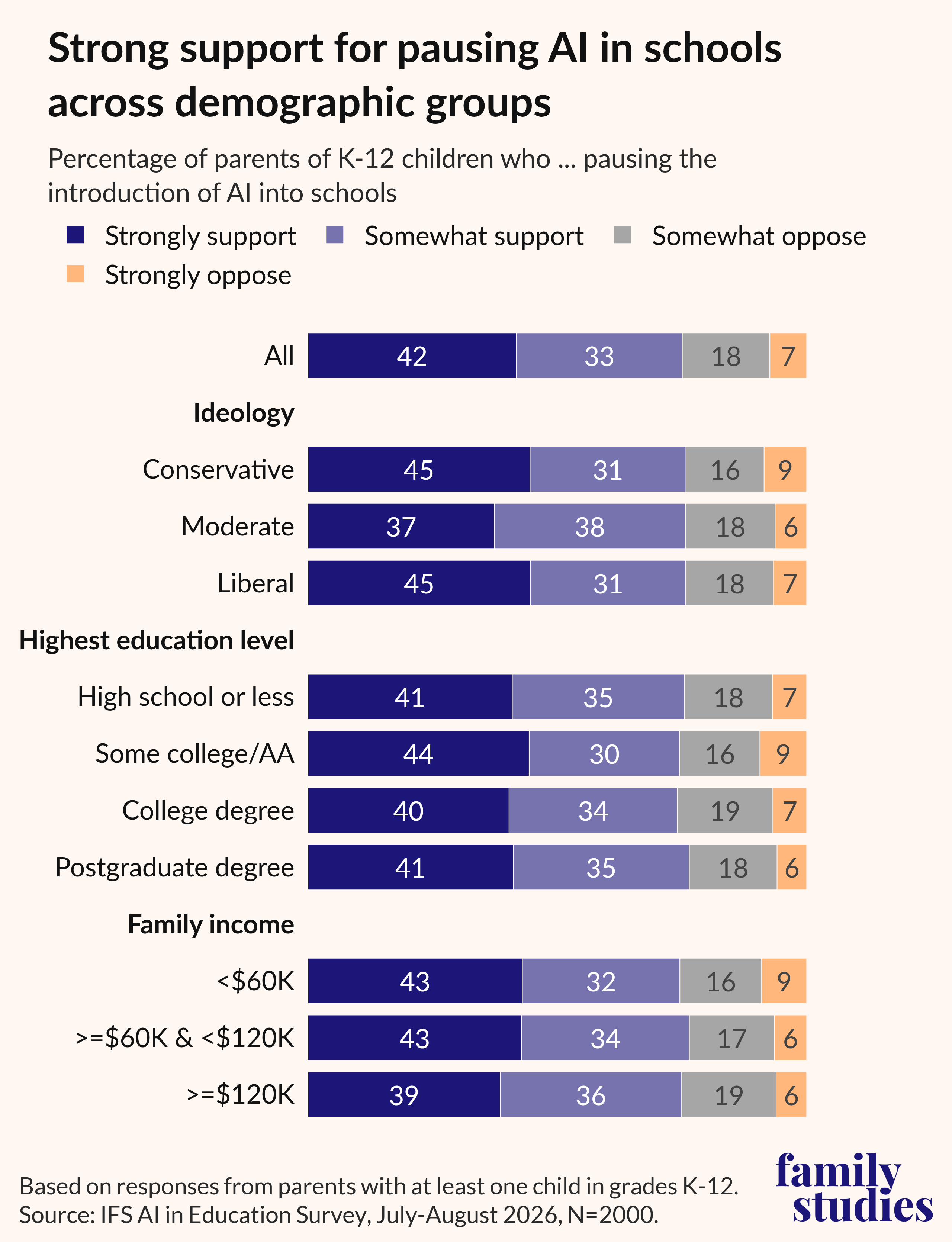
Figure 23. Percentage of parents, by ideology, education level, and income, who support or oppose pausing the introduction of AI into schools
While AI moratoria may not be long-term policy solutions, they buy school policymakers and parents critical time to determine how and where best to integrate AI education and technology to achieve desirable learning outcomes. But, in the context of this larger report, it is worth pausing on what this implies about how parents feel about AI in schools. We have seen in several areas already that parents tend to prefer patience, later implementation, and the relegation of AI to specific classroom settings, rather than as the basis for education as a whole. In many respects, the widespread parental support for an AI pause demonstrates how seriously parents take this issue. They are willing to support vigorous political action to address their concerns around AI in schools.
This could be a blue versus red parent issue, given that some of the major localities that have, so far, enacted this policy are known for their progressive politics, such as New York City and Los Angeles. But is that the case? No, in fact, we see similarly high levels of support among parents who are Republicans and Democrats. Even a significant majority of secular private school parents (63%), who have been an occasional outlier in our findings, support this policy.
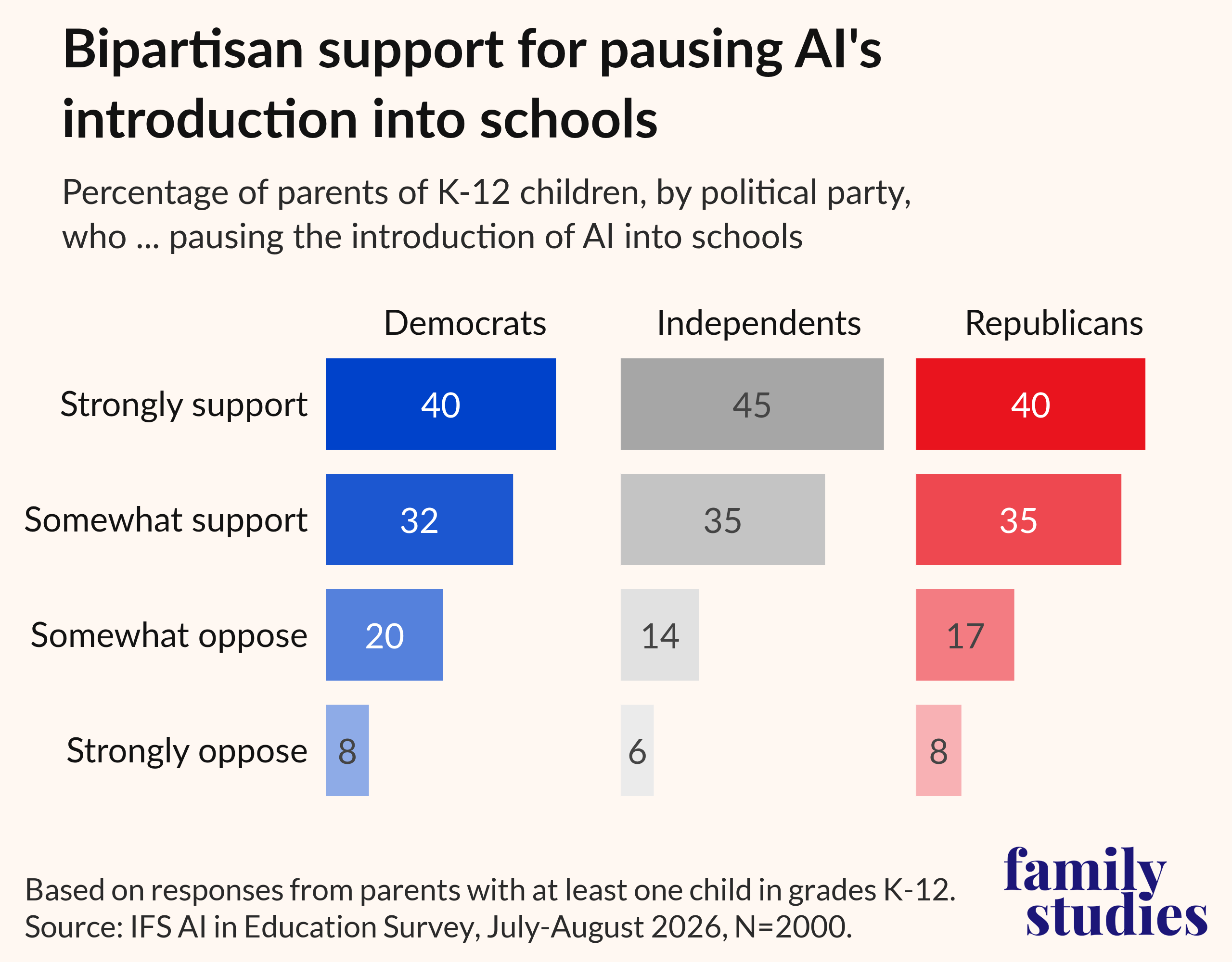
Figure 24. Percentage of parents, by political party, who support or oppose pausing the introduction of AI into schools
Looking Ahead: Parents’ Outlook on The Future
Technologies, including (and perhaps especially) those used in education, shape a person’s sense of their time and the future it portends. Nuclear weapons, for instance, awakened a general sense of foreboding about the future, whereas the automobile, for all its cultural disruptiveness, awakened a general feeling of progressive excitement. The internet, too, inspired utopic visions of a “global village” and the extension of democracy to the ends of the earth. AI is no different. Whether positively or negatively, AI is shaping parents’ expectations for their own life and livelihoods, as well as for their children’s. How institutions, including schools, handle and incorporate new technologies will inevitably shape their children’s own sense of the future.
To that end, our survey asked parents what they think AI in schools means for their children' s future. We find that the majority of parents either think the future for their children looks “bleak” (35%), “with technology doing most of the thinking and people being stuck on screens all day,” or “frightening” (25%), “with AI taking over the most important jobs and making the future less human.” Only 18% of parents think the future AI evokes in the classroom is “very bright,” and the remainder (22%) are simply unimpressed, with the future being “about the same,” where AI becomes just another technology like cell phones or computers for their kids to use in the workplace.
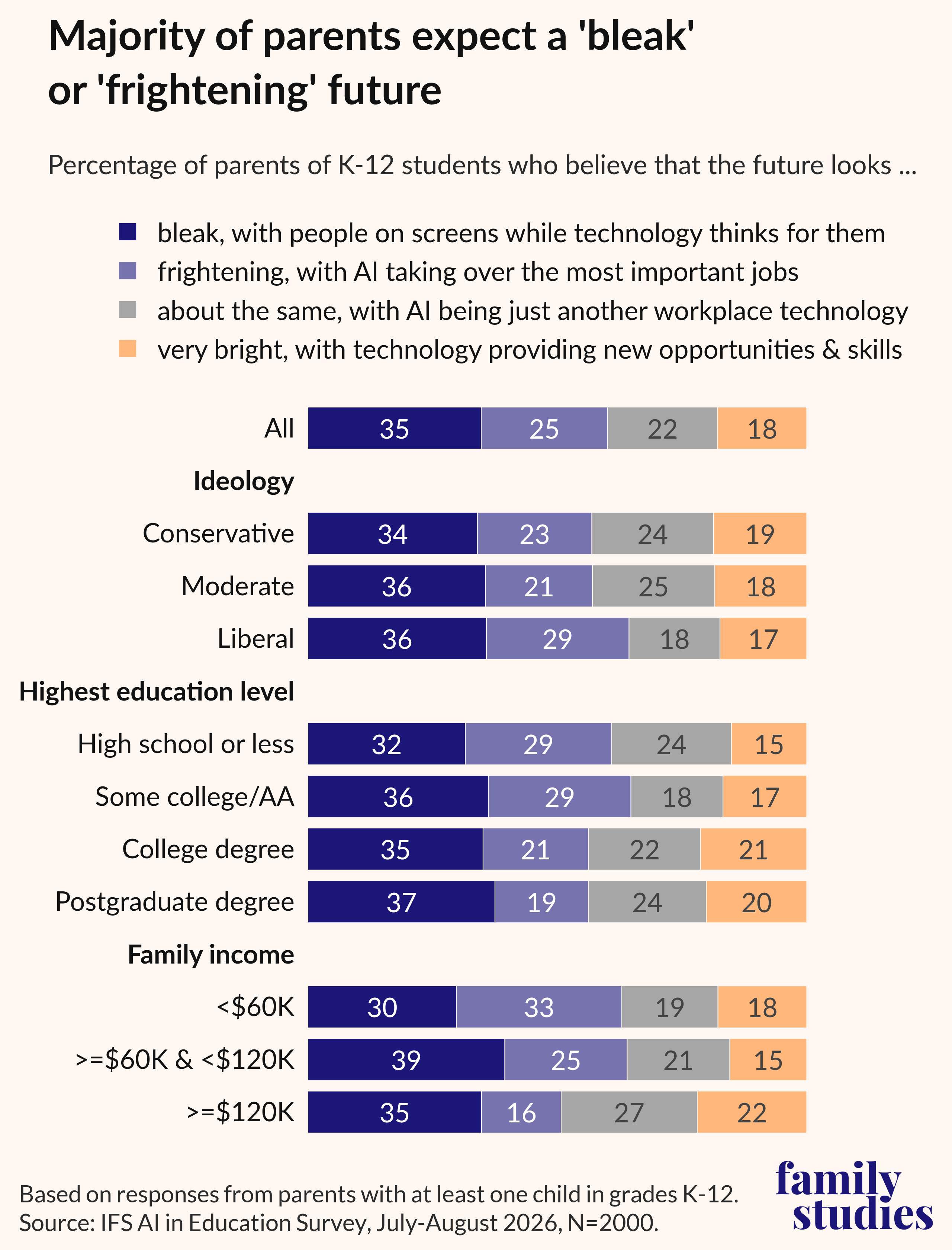
Figure 25. Views of parents, by ideology, education level, or income, on the future
For the most part, these proportions held for parents of every political ideology, though a greater proportion of liberals see the future as “frightening” (29%) than do conservatives and moderates. But similar percentages of liberals, moderates, and conservatives consider the future to be bleak (34-36%).
Likewise, while those earning between $60,000 and $120,000 are more likely to consider the future bleak (39%) than those who earn less, the majority of parents at every income level see the future as either bleak or frightening.
And again, though a greater percentage of those with a college degree see the future as ‘very bright’ (21%) than those without a college degree, a much higher percentage of college-educated respondents (56%) describe the future as ‘bleak’ or ‘frightening.’ A similar pattern holds true for those with postgraduate degrees.
Though these concerns of parents are more abstract than the others we discussed above, it is worth reflecting on what this may portend. To the degree AI in schools evokes a grim view of the future among parents, it seems inevitable that AI in schools will foster negative feelings about education per se, as well as the teachers, administrators, and political leaders who are advancing its use. Parental discontent with the education system, as we have seen repeatedly over the last several decades, can lead to intense political struggle, which will almost certainly have repercussions for America’s education system, as well as our nation’s future. Policymakers would be wise to pay attention to this unfolding situation.
Recommendations
As our survey has shown, most parents are concerned about AI’s integration in schools. For all their concern, however, parents must depend on the help of school administrators, school boards, and state and federal policymakers to resist the current pressures to make AI the center of K-12 education. To this end, we offer the following recommendations based on our findings.
1. Strengthen Parental Agency in Public Schools
It is no secret that private schools have become more responsive to parental concerns than public schools over the last several decades. But that is an unacceptable status quo. At their best, American public schools are a democratic project that offers every American, no matter their social status, a world-class education. To achieve this, however, public school parents must have a voice in the implementation of ed tech, especially AI, on the front end.
Strengthening parents’ ability to inform the vision for media technology in schools will increase trust, guard against ed tech overreach, and help establish a unified vision for AI in schools on a local level. One way that states can do this is by explicitly requiring state and local boards of education to have time for public comment on AI-related and ed tech policies. Utah’s Balance Act is one example of this. Parental consent should also be strengthened and restored by ensuring direct parental consent instead of allowing schools to have broad rights to consent on their behalf. Likewise, as the Department of Education seeks to return authority to states and local communities when it comes to education, it should work to ensure that its policies strengthen parental agency and align with parental opinion on AI rather than undermine, whether directly or indirectly, parents’ wishes for their kid’s education.
2. Schools Should Establish a New Computer Lab
Given that most parents want a balanced approach to learning, where physical media remain primary and computers and AI are more restricted, schools should make efforts to return computer learning to a “computer lab” based model. The amount of digital and online content schools depend on for instruction, as well as the one-to-one device on which that content is accessed, make substantive changes to ed tech a significant challenge for any school district. However, one plausible solution would be computer labs for elementary classrooms with rotating days and times, and shared computer carts for middle and high school classrooms, which require more frequent use. In a controlled environment with structured lessons, measures for online safety would be more effective as a result of greater oversight by teachers; additionally, student logins would continue to provide online accountability. By limiting digital device usage to allotted times in public, supervised spaces, the “computer lab” model would easily entail more intentional and educational use of the technology, and curb effects of cognitive offloading or passive engagement with gamified content.
3. Limit AI Use Before High School and Provide Opt-Outs
As our findings show, the majority of parents are concerned about AI’s risks and think it should be integrated in high school or later. As more states and school districts develop policies for AI usage, they should work to exclude or minimize AI use and exposure in elementary and middle school classrooms. Examples of this approach include policies enacted by school districts, such as those in Los Angeles and New York City, that ban the use of student-facing AI in elementary and middle school classrooms and heavily restrict its use in high schools. Another example would be state laws such as Utah’s Balance Act, which restricts the use of ed tech generally in lower grades. The Balance Act also establishes state-wide AI standards for schools, such as prohibiting the use of generative AI and unsafe AI tools and requiring parents be notified about AI used for instruction.
4. Where Integrated, AI Should Be Proven to Help Achieve Learning Outcomes
Parents are concerned about AI’s potential to undermine their children’s learning. Where schools do integrate AI technology in the classroom, especially in high school, they should ensure that the AI apps and tools are both safe and effective. That is, they should take an outcomes-based approach as opposed to an engagement-based approach. One way that policymakers can help schools is by ensuring that state or federal funding for ed tech is used only for technologies that are tested and verified by third parties for safety and for efficacy in achieving learning outcomes. This could be done through policies such as Utah’s Software Accountability for Education (SAFE) Act, enacted this year, which requires vendors to have their products independently verified for academic effectiveness and prohibits them from having addictive design features or employing AI that analyze students’ emotions. Another way lawmakers could address this is through subsidies for educational technology. For example, as the Federal Communications Commission reviews E-Rate funding for connectivity technology in schools, it should amend the program’s requirements to narrow the scope of covered services; require ed tech vendors to demonstrate positive learning outcomes of their services; and implement a government regulated fee-schedule for vendors.
5. Schools Should Reprioritize Physical Books and Handwriting
It is becoming clear that some media are better at fostering learning outcomes among kids than others. In fact, the argument for ed tech was basically this: new digital technology meets children at their level and so will be even more effective at helping kids learn than printed texts. Furthermore, it was argued, the workforce of the future will no longer require handwriting but will be largely interfaced via screens, so handwriting is a skill children can part ways with. What was not grasped at the time is that the cognitive and pedagogical benefits of physical texts and handwriting are much stronger than the new, digital alternatives. So, it turned out that, yes, some media are better at enabling learning than others—but, in an ironic twist of history, American institutions poured all their cultural, political, and financial capital into the wrong ones.
We need to change course. One way to do this would be by pursuing policies, such as Tennessee’s HB 2393 (enacted in 2026), that require elementary schools to develop policies for digital device usage that minimize unnecessary screen time. Such policies might prioritize both teacher-led instruction and non-electronic materials or even block access to social media on school-run internet networks. Beyond this, state and federal governments could reprioritize printed media by increasing subsidies for printed texts while reducing their subsidies for ed tech and considering a “device buyback program” in which schools could exchange their Chromebooks and other devices for printed texts and non-electronic materials.
Conclusion
Despite the rapid expansion of technology in the classroom, the prestige of ed tech has taken a major hit over the last five years. The same seems to be the case with AI. As AI integration accelerates in the classroom, the discontent of parents seems to be accelerating with it. This is an unsustainable dynamic. There is no coherent and productive way forward that does not include heeding the concerns of parents. We have made several important policy recommendations, but perhaps the most important one is this: Listen to parents. As the primary stewards of the minds and hearts of their children, parents need to be heard by school officials and lawmakers, especially when they are raising concerns and telling us something is wrong.
As noted in the introduction, AI in the classroom is a deeply political matter. Leaders in Washington and Silicon Valley have made it a national imperative to have children use AI as early and often as possible. Indeed, they foresee a future in which children are learning from humanoid AIs themselves. But parents don’t want this. Indeed, we see the opposite: the place of AI in the classroom tends to evoke a sense of foreboding and fear for their children’s future. Inevitably, the push by political leaders to maximize children’s use and exposure to AI is on a fast-track collision course with the very constituency—namely, parents—that they have claimed to champion.
Parents’ opposition to AI, however, should not be confused with broader anti-tech sentiments. As we have seen, most parents do not want to abolish any and all tech in the classroom. Rather, they want media—print, digital, or otherwise—that work and tools that are proven to foster real learning and academic success. Where they do want computers and AI in schools, they often want them used as a subject of learning, reserved for a specific time and place in the school day, rather than as the basis of learning itself. In other words, parents want moderation. It is the techno-political leaders committed to “accelerationism” who are advocating for the extreme when it comes to AI in the classroom. Listening to parents, not elites in Washington or Silicon Valley, is the better and more reasonable path.
The mounting opposition to ed tech and AI ultimately seems to be driving a return to more fundamental questions about the purpose of education itself. If education is no more than a matter of technical training and information gathering to make American children skilled in the latest commercial and technological systems, then making AI and ed tech the basis of schooling might make sense. But if education is really a matter of intellectual and moral formation, aimed at fostering a skilled and innovative citizenry and cultivating virtue and knowledge, then it requires much more than tapping screens and learning to prompt the latest machine intelligent systems. The fallout around ed tech and the growing push back on AI in schools seem to signal that national education is at an inflection point. The question before us now is whether we will repeat the same mistakes of the past decade or chart a different course.
Editor's Note: For references and author information, please download the full report below.


